The short version: let the pan cool, wash it with warm water, mild dish soap and a soft sponge, and dry it right away. Almost every other problem, from rainbow tinting to cloudy spots to dull finish, is fixed with a nonabrasive cleanser or white vinegar. Copper needs a different routine, based on a mild acid and a gentle polish. I pulled the steps below from the care guides of cookware makers and from published kitchen references, and I name each source at the point where I use it. I have not used these methods on any pan myself, so every claim here traces back to a maker or a cited publication.
TL;DR
- Cool the pan completely before washing. Washing a hot pan in cold water risks warping, according to the makers I cite below.
- Everyday cleaning is warm water, mild soap, a soft sponge and a dry cloth. A 15-minute hot-water soak loosens stuck-on food.
- Rainbow tints respond to white vinegar. Cloudy hard-water film responds to a 1:1 vinegar and water solution.
- Polish stainless in the direction of the grain, and keep steel wool, oven cleaner and bleach away from it.
- Copper is polished with lemon and salt or a flour, salt and vinegar paste. Tin-lined copper must never be scoured.
Why the way you clean matters for stainless steel
Stainless steel is forgiving, but its finish is not unlimited. The surface is a thin, brushed or polished layer that shows scratches, film and heat marks. Cleaning it well is mostly about avoiding two mistakes: thermal shock (sudden temperature change) and abrasion.
If you are still choosing a pan, the way the metal is layered affects how it behaves on the stove, and I explain that in my guide to stainless steel cladding: ply, core and metal release. Care, though, is nearly the same across brands, which is why the makers’ instructions line up so closely.
Everyday cleaning after cooking
This is the routine that prevents most of the problems later in this article.
- Let the pan cool completely. All-Clad’s care guide says to let stainless pans cool completely and never submerge a hot pan in cold water. Mauviel gives the same warning in its own guidance, noting that cold water poured into a hot pan may cause warping. KitchenAid also tells owners to let the pan cool before rinsing.
- Wash with warm water and mild dish soap. Use a soft sponge. According to All-Clad, that is all a daily wash needs.
- Soak if food is stuck. All-Clad advises filling the pan with hot water and soaking for about 15 minutes, then washing as usual.
- Dry right away. All-Clad recommends drying thoroughly with a clean cloth to prevent water spots.
That last step is the one home cooks skip most often. Air-drying on a rack is what leaves the mineral spots that later look like a permanent stain. If you already have white marks, my article on white spots on a stainless pan, deposits or pitting explains how to tell a harmless deposit from real surface damage.
A quick note on food that keeps sticking
If the pan needs scrubbing every time, the problem is often technique, not cleaning. Heat control and pan preheating decide whether food releases. My guide to why a stainless steel pan sticks and the water test covers the causes, and it is worth reading before you reach for harsher cleaners.
Removing rainbow tints and cloudy film
These two marks are the most common reason people search for a way to restore stainless steel, and neither means the pan is damaged.
Blue or rainbow discoloration
Heat tint shows up as blue, purple or gold swirls. According to All-Clad’s use and care guide, wiping the surface with white vinegar removes blue or rainbow discoloration. Mauviel’s stainless care guide treats heat stains and rainbow discoloration as normal and not a performance problem, and recommends its dedicated stainless cleaner if you want a like-new shine.
So you have two sensible options: leave the tint alone, since it does not affect cooking, or wipe it off with vinegar and a soft cloth.
Cloudy hard-water spots
A dull, cloudy film or chalky ring usually comes from minerals in tap water. All-Clad says to remove cloudy hard-water spots by boiling a solution of equal parts white vinegar and water in the pan. Let it cool, wash with soap and water, and dry.
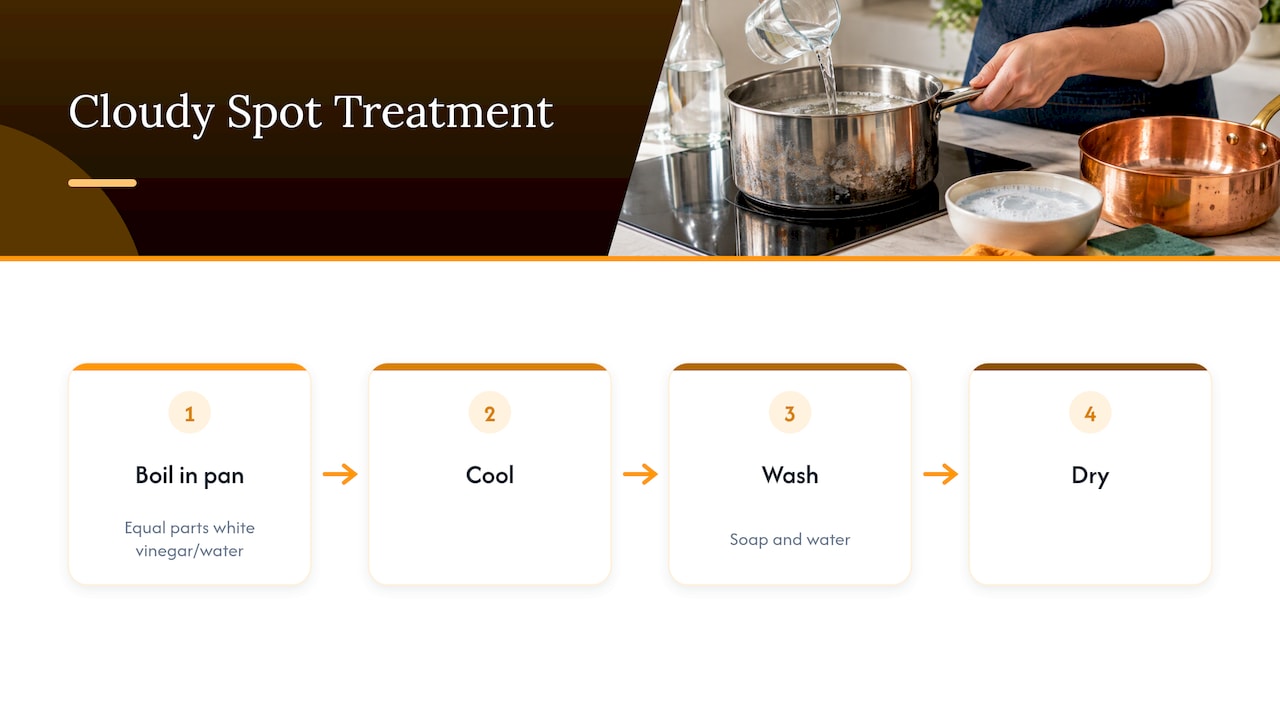
If the marks come back in the same places, or the spots feel like small pits instead of a film, read my piece on white spots on stainless steel before scrubbing harder.
Polishing stainless steel cookware
Polishing is different from cleaning. You are restoring uniform shine, not removing food.
- Use a nonabrasive cleanser made for stainless. Calphalon’s use and care page says to restore shine with Bar Keepers Friend or another polish made for stainless steel, applied with a nonabrasive sponge or soft-bristle brush.
- Work with the grain. Bar Keepers Friend’s do’s and don’ts for stainless steel says cleaning, wiping or polishing in the direction of the grain reduces the chance of dulling or scratching and helps lift grime from the grooves. On a brushed pan, the grain is the faint parallel lines you can see in the metal.
- Finish with a clean microfiber or soft cloth. The same source says to polish and dry with one, and that drying all surfaces is part of keeping the pan looking clean.
A paste works well when a spot needs more than a wipe. All-Clad describes mixing a nonabrasive, non-chlorine cleanser (its own cookware cleaner, Bar Keepers Friend or Bon Ami) with water, rubbing in circular motions with a soft cloth or sponge, then rinsing warm and drying.
What to keep away from stainless steel
All-Clad’s care guide lists oven cleaners, steel wool, steel scouring pads, harsh detergents, and detergents containing bleach or peroxide as products that can damage the pan. CNN Underscored makes the same point in its guide to cleaning stainless steel cookware: it advises a nonabrasive, non-chlorine cleanser over hard abrasives like steel wool, accepting that gentler products work a little slower in exchange for a finish that lasts longer.
The tool question comes up often, so here is the short list.
| Use | Avoid |
|---|---|
| Soft sponge or cloth | Steel wool and steel scouring pads |
| Mild dish soap | Bleach or peroxide detergents |
| Nonabrasive, non-chlorine cleanser | Oven cleaner |
| White vinegar for tints and film | Harsh detergents |
| Microfiber cloth for drying | Air-drying with water still on the surface |
Utensils also leave marks. If you wonder whether a metal spoon or whisk will scar the interior, I cover that in can you use metal utensils on stainless steel pans.
Polishing and restoring copper cookware
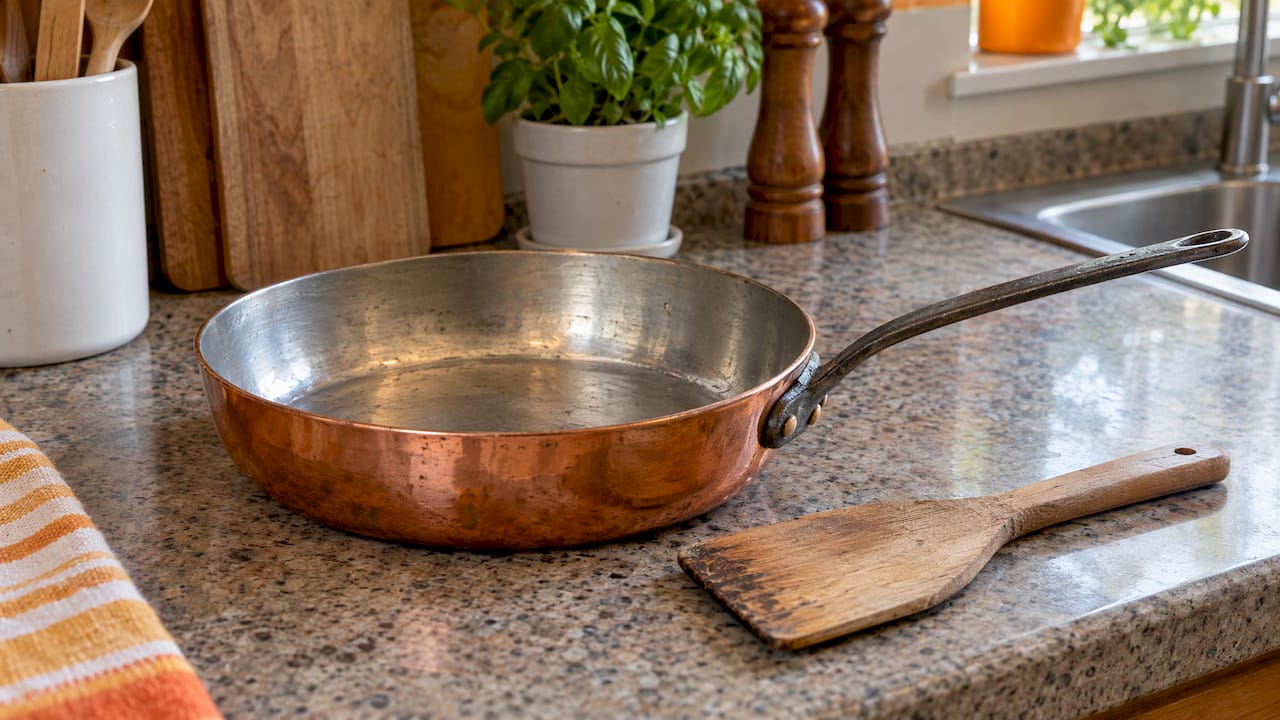
Copper is a different material and wants a different routine. It darkens over time, and that is normal. Epicurious’s guide to copper cookware describes the darkening as a desirable patina and says to avoid gray-green verdigris, which can eventually blacken and rust. It also notes that brand-new factory pieces and recently retinned antiques get a complete acid dip, and that you can refresh shine at home with an acid plus polish or a natural remedy.
Check the lining first
Many copper pans are lined with tin or stainless steel. Duparquet’s copper care guide warns against scouring a tin lining with scouring pads or steel wool. For cooked-on food it suggests filling the pan with water and dish soap, simmering 15 minutes, and using a bamboo or wooden scraper if needed. Know your lining before you pick a method.
Two home polishes
Lemon and salt. The Kitchn’s cookware cleaning tips recommend salt and a halved lemon for tarnished copper, or a less coarse paste made by mixing lemon into salt. Epicurious describes the same lemon juice and salt method, followed by washing with soap and warm water and drying completely.
Salt, vinegar and flour paste. Duparquet gives a food-based polish for use after each wash:
- Dissolve 1 tablespoon of salt in 1/2 cup of white vinegar.
- Add enough flour to make a thin paste.
- Apply with a moist paper towel for about 30 seconds.
- Wash and dry thoroughly to prevent water spots.
The second recipe is gentler than coarse salt, which is why I would reach for it first on a pan you care about. Either way, the final dry is not optional: Duparquet and The Kitchn both end with it.
Cast iron and enameled pans need their own methods
These instructions are for stainless steel and copper. Enameled cast iron has a glass-like coating with its own rules, covered in my guide to cleaning enameled cast iron and removing stains. Bare cast iron is a seasoning question, and I address rust in how to fix rusty cast iron.
A simple care schedule
- After every use: cool, wash with mild soap and a soft sponge, dry with a clean cloth.
- When you see tinting or film: vinegar wipe or the 1:1 vinegar and water boil, then wash and dry.
- When the finish looks dull: nonabrasive cleanser, with the grain, finished with microfiber.
- For copper, after each wash if you like the bright look: the salt, vinegar and flour paste, or lemon and salt, then wash and dry.
My view on cookware care
Most cleaning advice online is a list of hacks. What I find more useful is that the makers of stainless and copper cookware, who have every reason to want the pan to last, agree on a few simple rules: cool the pan, use soft tools, avoid bleach and steel wool, and dry it.
That agreement is the reason I read care guides before I read reviews. When I compare pans, I look at specifications, owner reviews and what the maker says about care, because a pan that needs fussy upkeep costs more over its life than its price tag suggests. I do not own or use the pans I write about, so I rely on those documents and on what owners report, and I attribute each claim to its source.
If a pan keeps getting stained, sticking or spotting, the care routine is usually the first place to look, and the second is the pan itself. A well-chosen stainless set cleans up with nothing more than soap, a soft sponge and a towel.
Glenn
Choosing your next pan with care in mind
If your current set is worn beyond polishing, or you are buying for the first time or as a gift, I compare cookware on specifications, pricing, owner reviews and the complaints owners report, so you can see how a pan holds up before you buy. Start with the Kitchenware Compare homepage for current reviews, or read my cookware essentials for a new home if you are equipping a kitchen from scratch.

If you are weighing coatings, my comparison of ceramic vs nonstick cookware sets out how each one behaves in daily use. Because the site earns through affiliate links, I explain how in the affiliate disclosure.
FAQ
Can you use steel wool on stainless steel?
No. All-Clad lists steel wool and steel scouring pads among the things that can damage a stainless pan, and CNN Underscored also steers readers to nonabrasive, non-chlorine cleansers. A soft sponge with a nonabrasive cleanser does the job without scratching the finish.
How do you fix blue or rainbow marks on stainless steel?
Wipe the surface with white vinegar, as All-Clad advises, then wash and dry. Mauviel considers these tints normal and harmless to cooking, so you can also leave them if the pan cooks well.
How do you remove cloudy hard-water spots?
Bring a 1:1 mixture of white vinegar and water to a boil in the pan, according to All-Clad. Let it cool, wash with soap and water, and dry with a clean cloth. Drying promptly after each wash helps keep the spots from returning.
How do you polish copper pans at home?
Rub a halved lemon dipped in salt over the tarnish, as The Kitchn suggests, then wash with soap and warm water and dry completely. Duparquet’s alternative is a thin paste of salt, white vinegar and flour, applied for about 30 seconds. On a tin-lined pan, never scour the lining.
What should you not cook in stainless steel?
I have not found a maker source in the care guides above that sets a list of foods to avoid, so I would rather not invent one. Check the use and care page for your specific brand, which is where limits on heat or cooking methods are stated.
Sources
- How to Clean Stainless Steel Cookware, All-Clad
- All-Clad Use and Care Guide
- How to clean stainless steel cookware the right way, CNN Underscored
- Do’s and Don’ts for Cleaning Stainless Steel, Bar Keepers Friend
- Cookware Use & Care, Calphalon
- How to Clean Stainless Steel Cookware, Mauviel
- How to care for copper cookware, Duparquet
- 5 Smart Tips for Cleaning Your Favorite Cookware, The Kitchn
- A Guide to Copper Cookware, Epicurious
Recommended
- How to Clean a Burnt Stainless Steel Pan (What Makers Say)
- Best Non-Stick Copper Cookware 2026: 4 Sets Reviewed
- White Spots on a Stainless Pan? Deposits or Pitting
- Can You Use Metal Utensils on Stainless Steel Pans?

I'm Glenn, and I started Kitchenware Compare to cut through conflicting product reviews and help readers pick kitchen gear with confidence. I don't own or test the products I write about — these guides are built from verified-purchase reviews, manufacturer specifications, and independent testing where it exists, with the reasoning shown, not just a rating.
Leave a Reply