The right cookware size comes from two numbers: how many people you cook for on a normal night, and the largest batch you cook on purpose. For one or two people, a 10-inch skillet, a 2-quart saucepan, a 3 to 4-quart sauté pan or Dutch oven and an 8-quart stockpot cover almost everything. A family of four moves up to a 12-inch skillet, a 3-quart saucepan and a 5.5 to 7-quart Dutch oven. The rest of this guide shows how to check those numbers against your own habits before you buy.
A note on scope: I do not cover rice cookers on this site. I write about cookware, air fryers and espresso equipment, so this guide gives the same sizing logic for pots and pans. I have not tested or owned any product mentioned here. Where I name a size, it is a rule of thumb based on how pot volume and pan diameter work, not a lab result.
TL;DR
- Size for the meal you cook most often, not the biggest dinner of the year. Oversized pans heat unevenly on a small burner and waste space.
- A 10-inch skillet suits one to two people. A 12-inch skillet suits three or more, or anyone who browns a full pound of meat at once.
- Dutch ovens: 3 to 4 quarts for one or two people, 5.5 to 7 quarts for most families, larger only for batch cooking or big roasts.
- Pots are measured in quarts, pans in inches across the top. The two systems do not convert, so check both on the product page.
- Buy a set only if its piece sizes match the list below. Otherwise, buy the three or four pieces you will use daily.
How cookware size is measured
Cookware uses two different measurements, and mixing them up is the most common first-time mistake.
Pots, saucepans, stockpots and Dutch ovens are sold by capacity in quarts. One quart is four cups of liquid. That number is the brim-full capacity, which you will never use in practice. For simmering soups, sauces or braises, I treat usable volume as roughly three quarters of the stated number, so a 4-quart pot comfortably holds about 3 quarts of soup. That headroom keeps boiling liquid from climbing over the rim.
Skillets, fry pans and sauté pans are sold by diameter in inches. The catch is that makers measure the diameter across the top rim, not the flat cooking surface. A 12-inch skillet with sloped sides may have a base of only 9 or 10 inches. For searing, the base is what matters, because that is where the food touches metal. Product pages that list “cooking surface” separately give the more useful figure.
Two more details change how a size behaves:
- Depth. A sauté pan has tall straight sides and holds more liquid than a skillet of the same diameter. A skillet has flared sides that help moisture evaporate and make flipping easier.
- Handle length and weight. A 12-inch pan filled with food is heavy. If you have limited wrist strength or small hands, a lighter 10-inch pan you will use daily beats a larger pan that stays in the cupboard.
A size table by household
This table is my starting point for most readers. Adjust up if you meal prep, entertain often or cook a lot of one-pot dishes. Adjust down if you cook small portions or have a small stove.
| Piece | 1 person | 2 people | 3 to 4 people | 5 or more people |
|---|---|---|---|---|
| Skillet | 8 inch | 10 inch | 12 inch | 12 inch plus a second pan |
| Saucepan | 1 quart | 2 quarts | 3 quarts | 3 to 4 quarts |
| Sauté pan | 2 to 3 quarts | 3 quarts | 4 to 5 quarts | 5 to 6 quarts |
| Dutch oven | 2 to 3 quarts | 3 to 4 quarts | 5.5 to 7 quarts | 7 to 9 quarts |
| Stockpot | 6 quarts | 8 quarts | 8 to 12 quarts | 12 quarts or more |
These ranges overlap on purpose. Most households sit between two columns, and the larger size is usually the safer choice for pots because you can always cook less in a big pot, while a pot that is too small cannot be stretched.
Skillets: 8, 10 or 12 inches
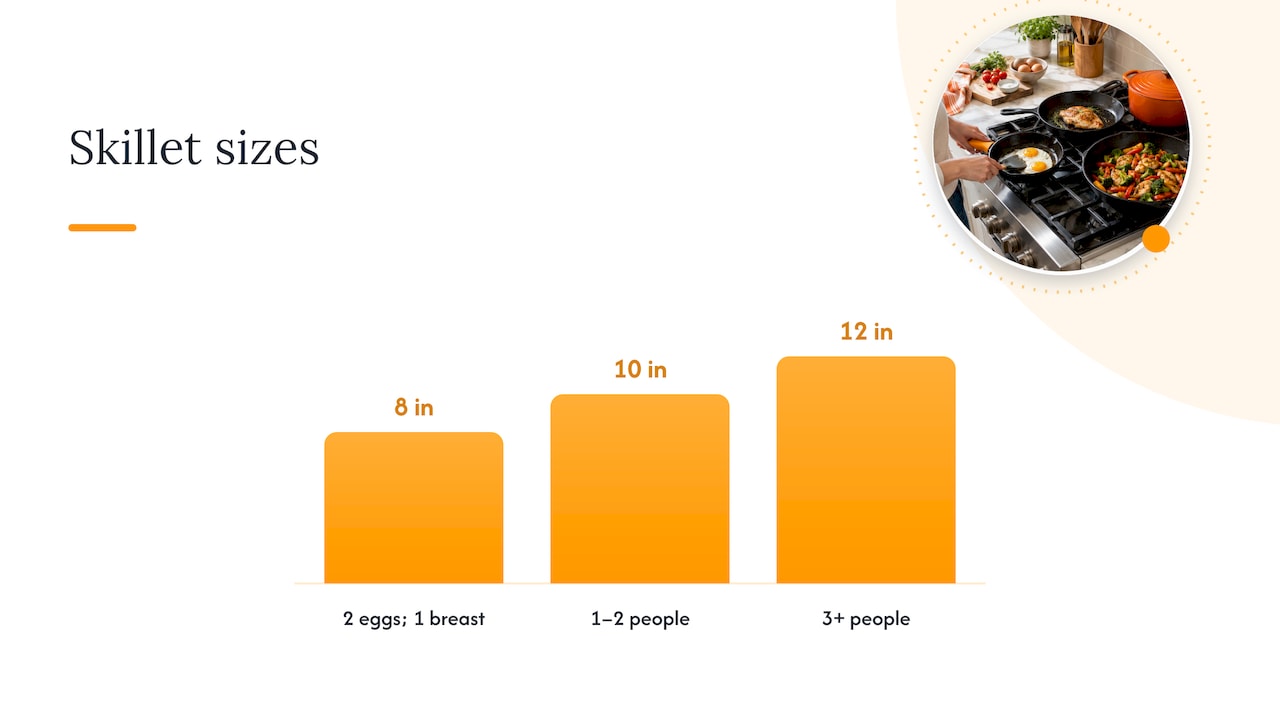
The skillet is the pan you will use most, so it deserves the most careful sizing. If you want side-by-side detail, my frying pan size comparison goes through 8, 10 and 12-inch pans one by one. Here is the short version.
8 inch. Good for a two-egg omelet, toasting nuts, a single chicken breast or a grilled cheese. It is the wrong size for dinner for two. Crowding is the problem: when food is packed tightly, it steams instead of browning.
10 inch. The best single skillet for one or two people. It fits two chicken thighs, a pair of pork chops or enough vegetables for a side without crowding. It also fits comfortably on a standard burner, so heat spreads evenly across the base.
12 inch. The right size for three or more people, for a full pound of ground meat or for a one-pan dinner with sides. It is also the size that lets you cook four chicken thighs at once. On a small burner, the outer ring of a 12-inch pan can run cooler than the center, which is why heavy, thick-based pans suit this size better than thin ones.
A worked example
Say you cook chicken thighs for two people and want them brown and crisp. A typical bone-in thigh is roughly 4 to 5 inches across when laid flat. Two thighs need about 10 inches of base with a little gap between them. A 10-inch pan, with a base closer to 8 inches, is tight. A 12-inch pan, with a base around 9 to 10 inches, fits two thighs with room to spare. So for the same two-person household, the answer depends on the dishes you cook, not only the headcount. If searing is a regular habit, go up one size.
Saucepans: 1, 2 or 3 quarts
A saucepan handles sauces, grains cooked on the stove, oatmeal, small amounts of pasta, soft-boiled eggs and reheated soup.
- 1 quart is enough for a single serving of oatmeal or a cup of sauce. It is too small for anything else, and most cooks outgrow it quickly.
- 2 quarts is the workhorse for one or two people. It holds a pot of stovetop grains for two, plus a side of boiled vegetables.
- 3 quarts suits families of three or four. It is also the better choice if you boil potatoes or heat a full can of soup plus add-ins.
If you are buying a set, the saucepan is where manufacturers often trim. A set may include a 1.5-quart and a 3-quart pan, which skips the 2-quart size most small households would reach for. Look at the actual capacities before assuming a set covers you.
Dutch ovens: the size most buyers get wrong
A Dutch oven is the piece where size mistakes cost the most, because it is heavy, expensive and rarely replaced. I cover the topic in full in my Dutch oven size guide, but the decision comes down to a few points.
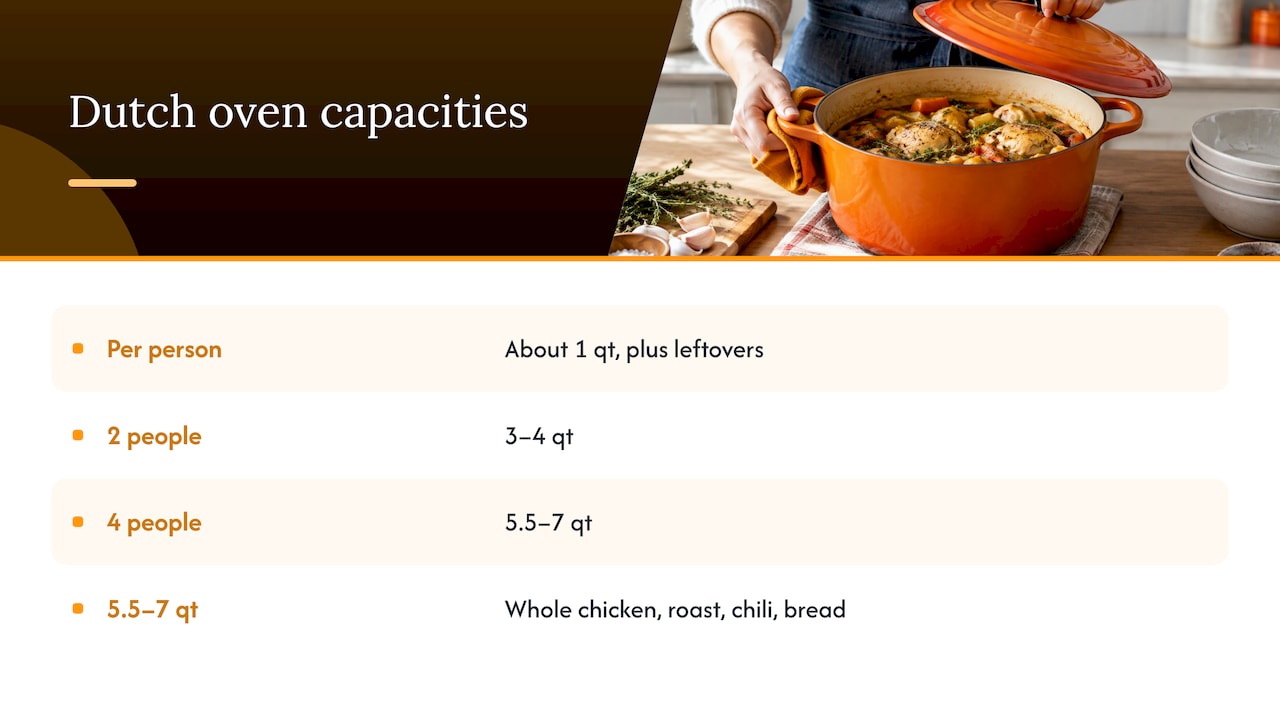
Capacity. A working rule I use is about one quart per person for braises and stews, with extra for leftovers. That gives a 3 to 4-quart pot for two people and a 5.5 to 7-quart pot for four. The 5.5 to 7-quart range is the most flexible: it handles a whole chicken, a 3 to 4-pound pot roast, a double batch of chili and a loaf of bread.
Weight. Enameled cast iron is dense. A 7-quart pot can be hard to lift when it is full of stew, and awkward to move from stove to oven. If you will carry it often, choose the smallest size that meets your needs.
Shape. Round pots suit stovetop burners and bread boules. Oval pots suit long cuts like a brisket or a whole fish but sit unevenly on a single burner. My oval versus round Dutch oven comparison goes through the trade-off.
Storage. Measure the cupboard shelf before you buy. A 7-quart pot with its lid is taller than many people expect, and a pot you cannot store conveniently ends up on the stove permanently.
Quick sizing by dish
- A 2 to 3-quart pot suits side dishes, a small batch of beans or a single-serving braise.
- A 3 to 4-quart pot suits stews for two, with one portion left over.
- A 5.5 to 7-quart pot suits a whole chicken, pot roast, soup for a crowd or no-knead bread.
- A 7 to 9-quart pot suits large batches, big cuts and holiday cooking.
Stockpots and pasta pots
A stockpot is a tall, narrow pot for liquids: stock, large pasta batches, corn on the cob, a seafood boil. The sizing logic differs from a Dutch oven because you rarely need to brown food in it.
An 8-quart stockpot is the best default for most homes. It boils a pound of pasta with room to spare and makes a batch of stock. A 12-quart pot is worth owning only if you regularly cook for six or more or freeze large batches of soup. For a one-person kitchen, a 6-quart pot is plenty and heats faster, which saves time and energy.
A wide, shallow pot of the same quart size boils water more slowly than a tall one with a narrow base, because heat has to travel through more liquid at once. If you cook a lot of pasta, check that the base diameter is close to your largest burner.
Sauté pans and braisers
If you cook mostly one-pan dinners, a sauté pan can replace both a skillet and a saucepan. Its straight sides hold sauce without splashing and its flat base gives full contact for searing. A 3-quart sauté pan fits two people. A 5-quart pan fits a family of four, though at that size, a lid and a helper handle on the opposite side of the long handle make it much easier to lift.
If you already own a Dutch oven in the 3 to 4-quart range, a sauté pan can be skipped. The two overlap heavily for braises and stews.
Sets or single pieces?
A set looks like value, but the size mix matters more than the piece count. Many sets pad the count by counting lids and utensils as pieces. A set listed as 12 pieces may contain only five or six pots and pans.
Use this checklist when you compare sets:
- Count pans and pots only. Subtract lids, spatulas and any steamer inserts to see what you actually receive.
- Check the skillet. A set with one 8-inch and one 10-inch skillet is a good fit for one or two people. A family needs a 12-inch.
- Check the saucepans. You want a 2-quart and a 3-quart, or a 3-quart alone. A set with only a 1-quart saucepan will leave a gap.
- Check for a stockpot. An 8-quart pot is the one most sets include that you will use.
- Look at total weight. Heavier sets usually mean thicker bases, which can help with even heat, but they also mean more to lift.
If you want to see how a large budget set breaks down, my review of an 18-piece non-stick set lists the piece sizes and what owners say about them. For a starting list of what a new kitchen needs, my kitchen essentials checklist covers the basics.
Four sizing mistakes I see in owner reviews
Owner reviews are the best evidence I have on what size problems show up after purchase. These four come up repeatedly.
- Buying the biggest pan “just in case.” Owners of 12-inch pans on small burners often report uneven browning. The pan edge stays cool, so food in the outer ring steams.
- Buying too small a Dutch oven. People who buy a 3-quart pot for a family find that a whole chicken or a pot roast does not fit, and the lid will not close.
- Ignoring the cooking surface. A pan sold as 12 inches that has a 9-inch base is closer to a 10-inch pan for searing.
- Forgetting storage and weight. A heavy 9-quart pot that is hard to lift ends up unused.
How to decide in five steps
- Write down your five most common meals. Skillet dinners, pasta, soups, braises, one-pot meals.
- Note the number of servings you cook, including planned leftovers.
- Check your burners. Measure the largest burner. A pan base much wider than the burner will cook unevenly.
- Measure your storage. Height, width, and shelf weight limit.
- Pick the smallest size that fits your biggest regular meal. Not the biggest one you cook twice a year.
I am not a lab and I do not own or test any of the products on this site. What I do is read the manufacturer specifications, line them up against what owners report after months of use and flag where the two disagree. For sizing, that matters because the stated number and the real number often differ.
My view is that cookware sizing is a spec problem more than a taste problem. The things that go wrong, a lid that will not close, a pan that crowds, a pot too heavy to lift, show up in the numbers if you know where to look: usable volume against stated volume, cooking surface against rim diameter, weight when empty. That is why I put those figures side by side in my comparisons instead of leaving them to the product page headline.
If you buy through links on the site, I may earn a commission at no extra cost to you. My affiliate disclosure explains how that works, and how I review kitchen equipment explains what I base recommendations on.
Glenn
Where to find sized-up comparisons
Once you know the sizes you need, the fastest way to compare real products is to filter by those sizes. My cookware reviews and buying guides list specifications, pricing and owner-reported complaints side by side, so you can see which 10-inch skillet or 5.5-quart Dutch oven holds up best for the money.
If you are still choosing between materials, my ceramic versus nonstick comparison covers that next step. Deals on cookware and other equipment come and go through the year, and the guide to when to buy kitchen equipment explains the usual pattern.
FAQ
What size skillet do I need for two people?
A 10-inch skillet fits most two-person meals, such as two chicken thighs, two pork chops or a stir-fry. If you sear often or like space between pieces, a 12-inch pan gives more room. Check the cooking surface listed on the product page, since rim diameter overstates the flat base.
What size Dutch oven is best for a family of four?
A 5.5 to 7-quart Dutch oven is the most flexible choice. It holds a whole chicken, a pot roast or a double batch of chili, with room to stir. Pick the lower end if lifting weight matters to you, and the upper end if you cook large batches or have leftovers planned.
Is a bigger pot always better?
No. A pot that is much larger than the food you cook spreads thin layers of liquid, heats unevenly on a small burner and takes more storage and lifting. Choose the smallest size that fits your biggest regular meal, then cook larger holiday meals in batches.
Do quarts and inches convert?
No. Quarts measure a pot’s volume and inches measure a pan’s width. A 12-inch skillet and a 12-quart stockpot are unrelated sizes. Read both numbers when you compare products, and look for the cooking surface and depth if they are listed.
Does a cookware set save money compared with single pieces?
Only when the set contains the sizes you will use. Count the pots and pans, not the lids and utensils, and compare their capacities against the size table above. If a set skips your most-used size, buying three or four single pieces can cost less in the long run.
Recommended
- Dutch Oven Size Guide: Which Size Should You Buy?
- Dutch Oven vs Stockpot: Which Should You Buy?
- Frying Pan Sizes: 8, 10 and 12 Inches Compared
- Oval vs Round Dutch Oven: Which Should You Buy?

I'm Glenn, and I started Kitchenware Compare to cut through conflicting product reviews and help readers pick kitchen gear with confidence. I don't own or test the products I write about — these guides are built from verified-purchase reviews, manufacturer specifications, and independent testing where it exists, with the reasoning shown, not just a rating.
Leave a Reply