It depends where the chip is, and the makers disagree. Le Creuset Canada says an outside chip is still safe to use. On the cooking surface, Le Creuset’s US care page says to stop using the pot immediately, while America’s Test Kitchen says it is fine to cook with once the loose enamel is cleaned off.
Below, for a chipped enamel Dutch oven or skillet: each maker’s advice side by side, which warranties cover a chip (of those I read, only Lodge’s says so in writing), what to avoid before you claim, and how to prevent the next one.
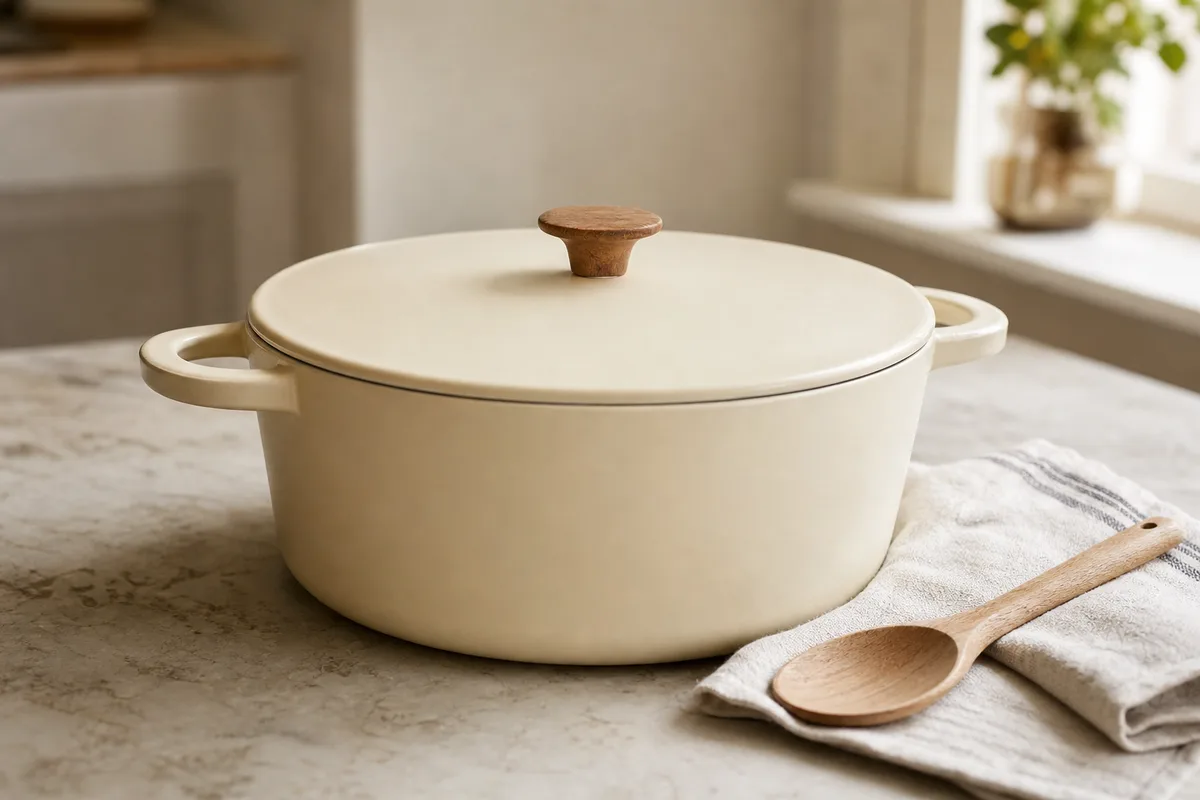
What Makers and Test Kitchens Say About Cooking in a Chipped Pot
Each row comes from the named maker’s page or publication. Le Creuset’s US and Canadian pages give different advice, so each gets a row.
| Source | Chip on the cooking surface | Chip on the outside |
|---|---|---|
| Le Creuset, US care and use page | Never use the pot once the interior enamel has chipped; stop using it immediately. | Not addressed in the care text I read. |
| Le Creuset Canada, FAQ page | Submit a warranty claim so the piece can be evaluated. The answer does not tell you to stop cooking in it. | Still safe to use. Coat the chipped spot with oil to keep moisture out. |
| Tramontina, enameled cast iron use and care insert | Bumping pieces together when stacking will scratch or chip the exterior and interior, though it won’t affect the cookware’s performance. That is about cooking, not safety. | Same line. |
| Chantal, enameled cast iron cleaning guide | Chips or rough areas exposing the iron are real damage: stop cooking with the piece until you understand whether it is still safe. | Same advice. |
| America’s Test Kitchen, metal utensils article | Clean the pot well so no loose enamel can chip off, then it is fine to cook with. | Not addressed separately. |
| Better Homes & Gardens Test Kitchen, chipped Dutch oven article | Depth decides. If the chip is on the cooking surface and exposes metal, it is probably no longer wise to cook in it as usual. | No need to worry about exterior or lid chips: think of them as patina. |
Lodge, Staub, Cuisinart and Made In say nothing about whether to keep cooking in a chipped pot on the pages I read; they handle chips through warranty terms and care rules.
My reading: an outside or lid chip is a moisture problem, not a food one. On the cooking surface I would stop, as the Le Creuset US page and Chantal say, until the maker answers a warranty claim.
What the Risk of Cooking on an Interior Chip Actually Is
The risk the sources name most often is physical. Food scientist Lauren Grant-Vose told Better Homes & Gardens the main risk is enamel continuing to chip off during cooking, especially when you scrape the chipped area.
Le Creuset’s US care page says chips could cause personal injury if ingested. Beyond that, the health effect of swallowing small enamel fragments is not established: none of the maker, FDA or university pages I read quantifies it.
Expect the chip to grow. Reviewed’s writer, describing a chip in her own Le Creuset, says the chipped area is likely to grow if you keep cooking with it.
Chip, Crazing, Rim Rust or Factory Mark?
- Crazing, a web of fine cracks: Le Creuset’s US care page lists crazing, cracks and chipping as damage from heating too fast or on high.
- Factory marks such as bubbling, small holes and spots are hand-made variations according to Le Creuset’s Hong Kong guarantee FAQ, which says they fall outside the guarantee but will not affect performance.
- A dark rim that looks like bare iron is not a chip. Tramontina’s insert says the cast iron is exposed on its pot and lid rims and suggests rubbing them with oil, while the Cast Iron Collector reference says such rims carry a clear glaze. Lodge puts rim rust down to damp storage or a rim not dried well after washing; how to fix rusty cast iron covers removing it.
- A crack through the iron itself is a different problem, covered in what to do with a cracked cast iron skillet.
What to Do When You Find a Chip
- Stop cooking on an interior chip until the maker answers.
- Photograph it first. Lodge’s returns page asks for a photo of the damaged area and one of the Lodge logo, the item number from the base, where and when you bought it, and how you usually preheat.
- Find your receipt. Staub’s warranty booklet says proof of purchase is required to process a claim.
- Do not try a repair first. Zwilling’s US warranty page says damage from repair attempts may void the warranty, and the Staub booklet names Zwilling as its warranty contact.
- Oil an outside chip to keep moisture off the exposed iron, as Le Creuset Canada advises.
Which Warranties Cover a Chipped Enamel Dutch Oven
| Maker and page | Does it cover a chip? | What is excluded |
|---|---|---|
| Lodge, Made Right warranty page | Yes, if the enameled cast iron chips, cracks or is otherwise damaged during cooking in normal household use, or arrives damaged. | Drops, accidents, overheating. Heating it empty on the stovetop, metal utensils and stacking without protectors void it. Original purchaser or gift recipient only. |
| Le Creuset, US warranty page | Normal household use only, and only if you follow the care instructions. | Abuse, neglect, abnormal wear or tear, overheating, or use not in line with the instructions. |
| Le Creuset Canada, warranty and care pages | Interior chips go to a claim for evaluation; drop or knock damage is excluded. | Misuse. Only the original purchaser or a gift recipient can claim, and you pay return costs. |
| Staub, Lifetime Limited Warranty booklet (USA, Canada, UK purchases) | Functional, manufacturing and material defects, with Staub deciding at its own discretion. | Damage from impact or accident, improper handling or improper storage. B-goods are excluded, and cover is for first-time purchases with proof of purchase. |
| Cuisinart, Chef’s Classic enameled cast iron booklet (Canada) | Defects only, for the original purchaser’s lifetime. | Accident, misuse, overheating, and surface damage that does not impair the functional utility of the cookware. |
| Tramontina, enameled cast iron use and care insert | Defects, for the lifetime of the original purchaser. | Accidents, abuse, overheating. Metal utensils or high heat may void the warranty. |
| Made In, warranty page | Pieces that arrived damaged, or defects that impact use and longevity. | Wear, metal utensils, heat above 580°F, the dishwasher, thermal shock and accidental damage. |
Lodge is the one maker here that says in writing it replaces enamel that chips during cooking, and Lodge may ask for photos or for the pot back at its own expense; Lodge vs Le Creuset Dutch ovens compares the two on everything else.
Zwilling’s Canadian and UK cookware FAQs give Staub a 30-year warranty, while the Staub booklet says Lifetime Limited and Zwilling’s UK warranty page lists Staub under its lifetime warranty. Check the terms for your country.
Can Chipped Enamel Be Repaired?
No maker page I read explains how chipped enamel is fixed. Le Creuset Canada, Staub, Cuisinart and Tramontina say they will repair or replace a piece their warranty covers, without saying whether a chip qualifies or what a repair involves. Zwilling’s US warranty page says it does not provide repair services and points customers to independent repair professionals, while warning that damage from repair attempts may void the warranty. Food scientist Bryan Quoc Le told HuffPost the enamel is applied once at production and there is no way to rehabilitate it.
Against that, Better Homes & Gardens quotes Juli Hale saying a small interior chip that doesn’t expose metal can often be repaired with food-safe epoxy. No cookware maker I read approves an epoxy patch, and a heat rating is not a food-contact rating: J-B Weld Original, for example, is rated to 550°F once cured, but the product page I read makes no food-contact statement.
Repair blogs also push touch-up paint and patch kits; I would not cook on any patch. Hunker suggests asking a re-enameling professional for a quote, and says the service can cost close to a new pot.
How to Prevent the Next Chip
- Heat gradually on low to medium. Le Creuset’s US care page warns against high heat for preheating; Lodge says not to heat enamel empty on the stovetop.
- Never add cold water to a hot pot. Staub’s booklet says the thermal shock may cause cracking or loss of enamel when the pot is next heated.
- Don’t knock utensils on the rim. Le Creuset Canada allows metal tools with care but not knocked on the rim; Tramontina says knocking utensils on rims may permanently damage the enamel.
- Store with protectors. Le Creuset’s US blog suggests keeping the plastic lid spacers that come with the pot, and Cuisinart says to avoid stacking to prevent chipping.
- Don’t drop or drag it. Le Creuset Canada says both may permanently damage the enamel, and Zwilling’s Canadian FAQ says Staub enamel may chip if the pot collides with objects or falls.
Safe pads and cleaners are covered in how to clean enameled cast iron.
Where the Advice Genuinely Conflicts
Tasting Table says cooking in a chipped enamel Dutch oven is not recommended by any major manufacturer or industry expert. That is too strong: Le Creuset Canada calls an outside chip still safe to use, and America’s Test Kitchen says an interior chip is fine once cleaned. The sharpest split is over interior chips; on outside chips, only Chantal, whose advice covers any chip, says to stop. Sources split on metal utensils too: America’s Test Kitchen allows them used gently, while Lodge says they void its warranty.
What to Do With a Pot You Won’t Cook In
Better Homes & Gardens says a chipped pot lined with parchment still works for baking bread, and suggests using it as a planter or asking a local scrap metal facility whether it takes enameled cast iron. To replace it, see the best cast iron Dutch oven guide, or bare vs enameled cast iron Dutch ovens if bare iron, with no enamel to chip, appeals.
How This Page Was Put Together
This page is based on makers’ care pages, warranty terms and booklets, plus articles from test kitchens and journalists, not on testing: I do not own any of these pots.
What I could not establish: what swallowing small enamel fragments does to health, whether exposed iron at a chip releases enough metal to matter, whether a chip changes any lead or cadmium exposure (the FDA pages I read set limits for ceramic foodware, not enamel on cast iron), how often makers approve chip claims, and which brand’s enamel resists chipping best, since no independent test I read names the models that chipped.
The Verdict
Le Creuset Canada and the Better Homes & Gardens Test Kitchen both say an outside chip is no reason to stop cooking: oil it and carry on. If your chipped enamel Dutch oven or skillet has the chip inside, I would stop, photograph it and claim before trying any repair, because of the warranties I read, only Lodge’s says it covers chips from cooking. For everything else in the kitchen, start at the cookware hub.
Frequently Asked Questions
Is a chipped enamel Dutch oven safe to use?
Le Creuset Canada and Better Homes & Gardens say an outside chip is no reason to stop. On the cooking surface, Le Creuset’s US care page says stop using the pot, Chantal says stop until you know it is safe, and America’s Test Kitchen says it is fine once cleaned.
Will Le Creuset replace a chipped Dutch oven?
Only if the company judges the chip a defect. Its US warranty excludes abuse, neglect, overheating and use against the instructions, and its Canadian care page says drop or knock damage is excluded. Le Creuset Canada’s FAQ says to submit an interior chip for evaluation, so ask.
Does Lodge’s warranty cover chipped enamel?
Yes, within limits. Lodge’s Made Right warranty says it replaces enameled cast iron that chips or cracks during cooking in normal household use. It excludes drops and overheating, and metal utensils, heating it empty on the stovetop or unprotected stacking void it.
Can you fix chipped enamel with epoxy?
Better Homes & Gardens quotes its Test Kitchen saying a small interior chip that doesn’t expose metal can often be patched with food-safe epoxy, but no cookware maker I read approves an epoxy repair. Zwilling warns repair attempts may void its warranty. I would not cook on a patch.
Is a chip on the outside of the pot a problem?
Not for cooking, according to Le Creuset Canada, which says an outside chip is still safe to use and should be coated with oil to keep moisture out. The exposed iron can rust if left wet, so dry the pot thoroughly after every wash.
Should you buy a chipped Dutch oven secondhand?
Only as a planter or a bread pot, unless the chip is outside. Lodge, Cuisinart, Tramontina and Le Creuset Canada limit their warranties to the original purchaser (Lodge and Le Creuset Canada also accept a gift recipient), so a secondhand chipped pot from them has no claim.

I'm Glenn, and I started Kitchenware Compare to cut through conflicting product reviews and help readers pick kitchen gear with confidence. I don't own or test the products I write about — these guides are built from verified-purchase reviews, manufacturer specifications, and independent testing where it exists, with the reasoning shown, not just a rating.
Leave a Reply