I may earn a commission if you buy through links on this site, at no extra cost to you. See the affiliate disclosure.
For most home bakers, a stand mixer rated between roughly 275 and 500 watts is the right range, and the number on the box matters less than you would expect. Wattage on a stand mixer is a measure of electrical draw, not a promise of kneading strength. Bowl size, gearing, stability and the dough you make decide how a mixer performs. I will show you how to read the number, what the major ratings mean, and how to pick the right size for what you bake.
TL;DR
- Home stand mixers commonly carry ratings from about 275 watts (compact tilt-head models) to 500 watts (large bowl-lift models).
- According to KitchenAid, its wattage is measured under UL standards to inform consumers about home electrical circuit loading, not to describe power output under heavy loads.
- A higher number often tracks a bigger bowl and a heavier simulated load, so compare wattage only between mixers of similar design and capacity.
- Match the mixer to your batch size and dough: cookies and cake batter suit a tilt-head, frequent bread dough and double batches suit a bowl-lift.
What stand mixer wattage actually tells you
Watts describe how much electrical power the motor draws. They do not directly describe how much torque reaches the beater, which is what you feel when a stiff bagel dough starts to push back. Torque depends on the motor, the gear train and how the whole machine holds together under load.
KitchenAid is the clearest on this point. In its 7-quart bowl-lift FAQ, the company states that its wattage is measured per UL standards to inform consumers about home electrical circuit loading, and is not intended to describe power output or performance under heavy loads. Its Artisan Plus vs. bowl-lift buying guide goes the same way: wattage helps you understand electrical requirements, but it should not be treated as a stand-alone measure of mixing performance. Capacity, stability, speed control and the type of mixture all matter.
That changes how you shop. Treat wattage as one line on a spec sheet, useful for comparing like with like, and never as a ranking of strength across brands.
What the common KitchenAid ratings look like
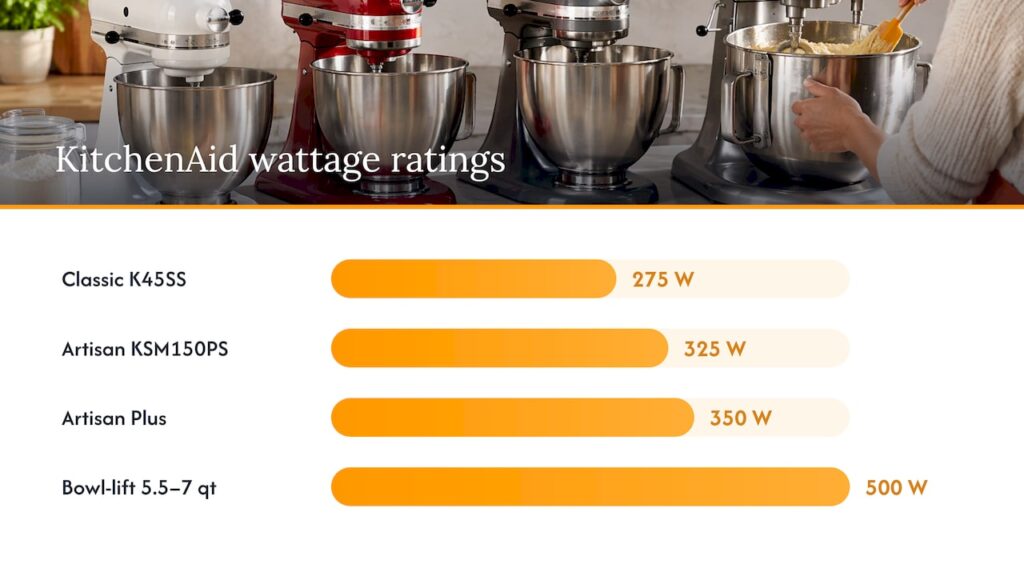
Because KitchenAid publishes its ratings clearly, its lineup is a useful reference for the numbers you will meet in the US. These figures come from the manufacturer’s own pages.
| Model | Bowl | Wattage rating | Source |
|---|---|---|---|
| Classic K45SS | 4.5 qt | 275 W | KitchenAid Classic vs Artisan (Oct 2025) |
| Artisan KSM150PS | 5 qt | 325 W | KitchenAid Classic vs Artisan (Oct 2025) |
| Artisan Plus | 5 qt class | 350 W | KitchenAid buying guide |
| Bowl-lift, 5.5 qt and 7 qt | 5.5 to 7 qt | 500 W | KitchenAid buying guide |
You may see slightly different figures for the same Classic mixer on retail listings, so read the model number and the manufacturer’s spec page before you compare.
The pattern is clear: wattage climbs with bowl size. The Artisan at 325 watts sits above the Classic at 275 watts, and per KitchenAid, the Artisan’s extra power helps with thick, heavy doughs. The 7-quart KSM70SN is rated at 500 watts, and KitchenAid states it can knead up to 8.75 lbs of bread dough or mix 13 dozen cookies in a batch.
If you are weighing the two most popular tilt-head models, my KitchenAid Classic vs Artisan comparison goes through the bowl, the price gap and the owner feedback side by side.
Why a bigger number does not always mean a stronger motor
KitchenAid credits the Artisan’s extra 50 watts with helping on thick, heavy doughs, yet the same company describes its ratings as circuit-loading figures, not a measure of output under heavy loads.
The practical lesson: when two mixers from different makers show 300 and 400 watts, you cannot conclude the second kneads better. Two things can differ that the rating hides:
- Drive type. A direct-drive motor sends power straight to the gearbox. A belt-driven design routes it through a belt, so the same electrical draw can produce different torque at the beater.
- Gear design. Metal gears and a well-supported gearbox hold up under stiff dough. A plastic or lightly built drivetrain can struggle even with a generous wattage figure.
That is why the same wattage can feel very different in two machines. It is also why owner reviews of long-term durability carry more weight than the headline number. If you own a KitchenAid and see symptoms, my page on common KitchenAid stand mixer problems covers oil leaks, wobble and shut-offs.
Rated watts versus watts used while mixing
A common second question is how many watts a mixer uses when you actually run it. The two figures are related but not the same.
- Rated wattage is the label figure, which KitchenAid says is measured under Underwriters Laboratories (UL) standards using representative loads.
- Actual draw depends on speed and load. A mixer whisking cream on a low setting draws far less than the same mixer working a stiff dough on a high setting.
A simple calculation helps. Household current in the US is 120 volts, and watts equal volts times amps. A 325-watt rating works out to a little under 3 amps at full rated load. That is a modest draw, and a mixer shares a kitchen circuit with whatever else is plugged in. If you want to understand how appliance ratings relate to circuit capacity more broadly, this electric oven wattage guide explains the same logic for a much larger appliance.
For a stand mixer, the running cost is small, so electricity should not drive your decision. Performance and durability should.
How many watts for the things you bake
Use these as working ranges, not hard rules. They draw on the manufacturer ratings above and the way those machines are positioned for different jobs.
Cookies, cake batter and whipped cream
These are light loads. A tilt-head in the 275 to 350 watt range handles them comfortably, and KitchenAid states the 4.5-quart Classic mixes up to 8 dozen cookies per batch and the 5-quart Artisan up to 9 dozen, at 28 g of dough each. Volume matters here more than watts: if you routinely make triple batches for a bake sale, a larger bowl solves the problem before more power does.
Occasional bread, pizza dough and brioche
A single loaf of bread dough every so often is workable on a 325 to 350 watt tilt-head, as long as you keep batches modest and the dough is not very stiff. Run at low speed, and stop if the head starts to rock or the motor sounds strained. Enriched, sticky doughs like brioche are the ones that put the most strain on a smaller motor.
Weekly bread, bagels and double batches
This is where a bowl-lift design earns its place. The 500-watt, 5.5 to 7 quart bowl-lift models are built around a bigger bowl and a stiffer frame, and the 7-quart KSM70SN is rated by KitchenAid for 8.75 lbs of bread dough. For a closer look at which machines suit dough, see my best stand mixer for bread dough roundup.

What to check besides wattage
If the number is only part of the picture, here is the rest, in the order I would weigh it.
- Bowl capacity and your typical batch. Fill the bowl to the point where the beater still reaches the bottom. A mixer that is too small for your batch struggles regardless of power.
- Head design. Tilt-head models are easier to add ingredients to and fit under most cabinets. Bowl-lift models brace the bowl more firmly, which suits stiff dough.
- Stability. Look in owner reviews for mentions of walking across the counter or wobbling at higher speeds. This tells you more about a mixer’s real strength than the wattage.
- Speed control. Per KitchenAid’s buying guide, speed control is one of the factors that matter alongside wattage. A true low speed keeps dough from tearing the machine.
- Attachments and bowl material. Check what ships in the box: flat beater, dough hook and whisk, and whether the bowl is stainless steel or glass.
- Price against use. A mixer you use weekly justifies more than one that comes out twice a year. My data study on whether expensive kitchen appliances are worth it looks at that trade-off.
If you are choosing between brands
Comparing wattage across makers is the weakest way to choose. I would rather compare capacity, drive type and owner-reported durability. My side-by-side pages cover Hamilton Beach 63326 vs KitchenAid Artisan, Bosch Universal Plus vs KitchenAid Artisan and Cuisinart SM-50 vs KitchenAid Artisan, each with specifications and what owners report.
Quick buying guide by reader
- First-time buyer, mostly cookies and cakes: a 4.5 or 5-quart tilt-head in the 275 to 350 watt range covers it.
- Budget-conscious baker: compare capacity and owner reviews first. The Hamilton Beach 63326 review lays out the value and the limits as owners describe them.
- Serious bread baker or professional cook: look at 500-watt bowl-lift models with a 5.5 to 7 quart bowl.
- Gift shopper: a 5-quart tilt-head is a safe size for most households, and it suits the widest range of recipes.
The practical advice: decide on batch size and dough first, narrow to two or three models, and then use wattage only to confirm you are comparing machines of the same class.
Where to compare mixers next
If you are ready to narrow the field, my stand mixers buying guide collects reviews and head-to-head comparisons in one place, and the baking equipment hub shows how mixers fit with the rest of a baking setup.

FAQ
How many watts should a stand mixer have?
For typical home baking, ratings between about 275 and 500 watts cover the common models. Tilt-head mixers in the 275 to 350 watt range suit cookies, cakes and occasional bread, while 500-watt bowl-lift models suit frequent, heavy dough. Capacity and build matter as much as the figure.
What wattage are KitchenAid mixers?
Per KitchenAid’s own pages, the Classic K45SS is rated at 275 watts, the Artisan KSM150PS at 325 watts, and the Artisan Plus at 350 watts. Its 5.5 and 7-quart bowl-lift models are rated at 500 watts. Retail listings sometimes show different figures for the Classic, so check the model number.
Does a higher wattage mean a stand mixer is more powerful?
Not necessarily. KitchenAid states that its ratings are measured under UL standards to describe electrical circuit loading, not power output or performance under heavy loads. Use wattage to compare machines of a similar type and size, and look at capacity, stability and speed control for real performance.
How many watts does a stand mixer use while running?
The label rating is measured under UL standards using representative loads. In normal use the draw varies with speed and with how stiff the mixture is, so a mixer on a low setting with light batter uses much less. At 120 volts, a 325-watt rating equals a little under 3 amps.
Which KitchenAid has the strongest motor?
Among the models in KitchenAid’s own guides, the 5.5 and 7-quart bowl-lift mixers carry the highest rating at 500 watts. The 7-quart KSM70SN is listed by KitchenAid for kneading up to 8.75 lbs of bread dough. That makes the bowl-lift line the one built for the heaviest loads.
Sources
- KitchenAid Classic vs Artisan stand mixer
- KitchenAid Artisan Plus vs. bowl-lift stand mixers
- KitchenAid 7 quart bowl-lift stand mixer FAQ
- Electric pizza oven wattage guide
Recommended
- Stand Mixers: Buying Guide, Reviews & Comparisons
- Best Stand Mixer: Reviews + Buying Guide
- KitchenAid Classic vs Artisan: Worth the Upgrade?
- Best Stand Mixer for Bread Dough: 4 Picks Compared

I'm Glenn, and I started Kitchenware Compare to cut through conflicting product reviews and help readers pick kitchen gear with confidence. I don't own or test the products I write about — these guides are built from verified-purchase reviews, manufacturer specifications, and independent testing where it exists, with the reasoning shown, not just a rating.
Leave a Reply