Tamp firmly, in the neighborhood of 20 to 30 pounds, and spend your attention on keeping the tamper level and pressing the same way every time. Past the point where the grounds stop compressing, extra force buys you very little and costs your wrist. I wrote this for home cooks who just bought a machine and want a number they can trust, plus the reasoning behind it, so you can stop second-guessing a step that is simpler than the internet makes it sound. I have not used any of the gear mentioned here myself. Everything below comes from published specs, owner reports and the named sources I cite.
TL;DR
- A practical range is 20 to 30 pounds (roughly 9 to 14 kg). Florida International University’s Coffee Academy teaches 20 to 25 pounds with a hand tamper.
- A controlled comparison of 5, 10, 15 and 20 kg tamps found no significant difference in extraction, so do not chase a precise figure.
- Level matters more than force. Keep the tamper flat, your wrist straight and the pressure identical shot to shot.
- You do not need a scale at the counter. If you want a reference, press once on a bathroom scale to learn what 20 to 30 pounds feels like, then go by feel.
What the published numbers actually say
Ask ten baristas how hard to tamp and you get a spread of answers, but the spread is narrower than it looks. Here is what named, independent sources report.
| Source | What it reports |
|---|---|
| Florida International University Coffee Academy | Level the grounds, hold the elbow at 90 degrees, apply 20 to 25 lb of even pressure with a hand tamper |
| Specialty Coffee Association, 2018 report on a 2017 Barista Guild of America survey | Most respondents used 20 to 30 lb; 22% answered “other,” including not measuring or tamping until the puck felt evenly dense |
| Chowhound, September 2025 | Quotes former barista Matt Woodburn-Simmonds suggesting about 20 lb as a general pressure, with consistency mattering more than the exact amount |
The Specialty Coffee Association, a trade body for the coffee industry, says the survey had 275 respondents, just over three-quarters of them based in the United States. That is a small, professional sample, so read it as a picture of habits rather than a rule. Still, it shows two things clearly. The common working range is 20 to 30 pounds, and a meaningful minority of working baristas do not measure pressure at all. They tamp until the puck feels evenly dense.
For a home cook, that is permission. You are not failing if you have never weighed your tamp.
Why the exact number matters less than you think
The strongest evidence that pounds are not the point comes from a controlled comparison. According to Socratic Coffee’s study, published in July 2015, the author pulled 10 shots at each of four tamping pressures: 5, 10, 15 and 20 kg, which is about 12, 22, 32 and 42 pounds. The study reported no significant difference in TDS (total dissolved solids, the measure of how much coffee ended up in the cup) or in extraction yield, with a p-value of 0.40. The only significant predictor of TDS was the weight of the brewed shot.
That is one author’s setup with one machine and one coffee, so it does not settle every case. But it points the same way as the professional habits above: once the bed of grounds is compressed, pushing harder does not change much. That is why a range, not a single figure, is the honest answer.
What does the range protect you from?
- Too light: the grounds are not fully compacted, and air pockets can remain in the puck.
- Too heavy: you gain nothing in the cup and add strain to your wrist and forearm over hundreds of shots.
- Inconsistent: if you press 15 pounds one morning and 45 the next, you introduce a variable you did not need.
And where does the dial belong instead? On grind size and dose. If your shots run faster or slower than you want, espresso grind size is the lever to adjust, not your arm.
Level beats heavy
Florida International University’s Coffee Academy names the level first, then the pressure: level the grounds, set the elbow at 90 degrees, then press with even force. The order is deliberate. A tamp that is perfectly firm but tilted leaves one side of the puck denser than the other, and water takes the easier route through the looser side. That uneven flow is what baristas mean by channeling.
Three habits keep the tamp level:
- Distribute before you tamp. Tamping compresses the surface of the bed, but it cannot fix clumps or uneven grounds underneath. Level the dose with a finger sweep or a tap on the counter first.
- Keep the wrist straight. Chowhound’s piece recommends a sturdy tamper that fits the basket, a straight wrist and firm, even pressure. A bent wrist tilts the tamper without you noticing.
- Look at the rim. After tamping, the edge of the puck should sit flat against the basket wall with no gap and no slope.
Holding the tamper like a doorknob, with the handle in your palm and your elbow above it, makes straight-down pressure the natural direction. Pressing from the side of a bent arm tilts the base.
A repeatable tamping routine
Follow these steps in order. Each includes where people commonly go wrong.
- Dose the basket. Grind directly into the portafilter basket, or transfer the grounds in. Mistake: dosing a different amount each time. Even a small swing changes how high the bed sits, and with it how much you have to press.
- Level the grounds. Tap the side of the portafilter gently, or sweep a finger across the top. Mistake: tamping a mound. A tamper pressed onto a peak will tilt toward one side.
- Set the portafilter on a stable, flat surface. A folded towel under the basket protects the counter and your wrist. Mistake: holding the portafilter in the air, which lets it rock.
- Place the tamper level. Check that the base sits flat on the grounds and the edge touches the basket evenly all the way around.
- Press straight down. Use a smooth, steady push, roughly in the 20 to 30 pound range, until the puck feels solid and stops compressing. Mistake: a jab or a rock. A quick hit and a gradual press can give different densities even at the same peak force.
- Lift off without twisting hard. A gentle polish is fine. Mistake: dragging the tamper sideways, which can break up the surface you just set.
- Wipe loose grounds off the rim, then lock in and start the shot.
If this routine feels fussy, give it a week. After a few dozen shots, steps 2 to 5 take seconds.
Learning what 20 to 30 pounds feels like
You do not need a scale in your kitchen at every shot. But if you want a one-time reference, set a bathroom scale on the counter, press your tamper onto it the way you would onto a puck, and note how hard 20, 25 and 30 pounds feel. Then put the scale away. A few presses is enough to calibrate your arm, and that mental picture is all you need.
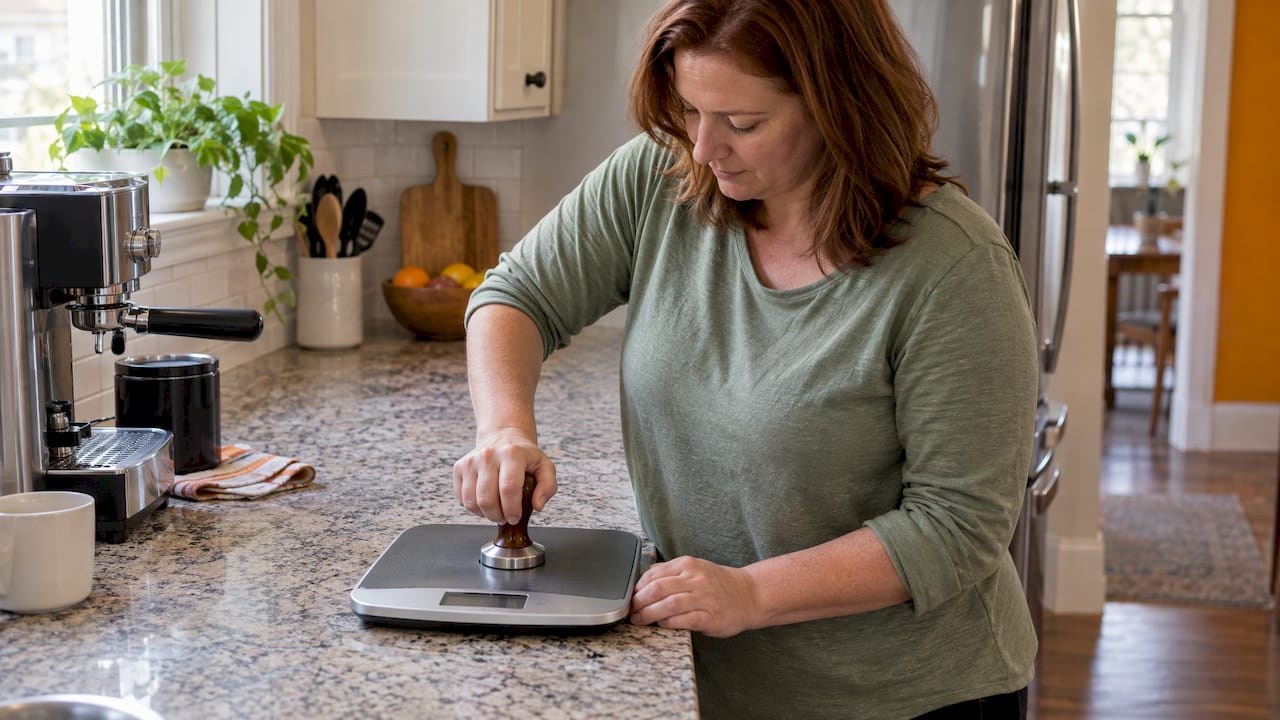
The Barista Guild survey figures show why this is a reasonable stopping point: plenty of professionals rely on feel rather than a gauge. What you are building is repeatability. When you can press roughly the same way ten times in a row, you have what the number was meant to give you.
Florida International University’s Coffee Academy also notes that an automatic tamper can be set to a chosen force, giving repeatability between tamping actions. That is a fit for a busy cafe pulling hundreds of shots a day. At home, a hand tamper and a steady routine are enough.
Choosing a tamper that makes good form easier
The tamper itself affects how easy it is to stay level, and a few specs are worth checking on a product page or in owner reviews:
- Base size. The base should match the basket’s inner diameter closely, so no grounds are left at the edge. Chowhound’s guidance is a tamper that fits the basket.
- Flat base. A flat face makes level easy to see. Check that the listing says flat, not curved.
- Handle shape. Look for a handle that sits comfortably in your palm, since you will push through it every time.
- Build. Sturdy, solid construction means no flex when you press.
Tamping only works if the grounds are right to begin with, so the grinder deserves the same scrutiny. A grinder that produces uneven particles undermines even the best tamp. My best espresso grinder for home use guide lines up specs, pricing and owner-reported complaints side by side. If you want the wider picture of machines and accessories, the coffee equipment reviews and guides collect it in one place.
Common questions about hard versus light tamping
One of the most persistent worries among new baristas is pressing too hard. In practice, a sturdy tamp rarely hurts the puck. The real cost of excess force is on you, as wrist and forearm strain, and there is no extraction benefit to repay it. The opposite worry, tamping too lightly, is the more realistic one: if the puck is not fully compressed, you get inconsistent density. So aim for the firm end of the range, stop when the grounds stop giving, and keep the movement the same every time.
How I approach tamping advice
I read a lot of tamping guidance, and the first thing I notice is how often a single number gets presented as the answer. The published evidence I can point to says something less tidy: the professional range is about 20 to 30 pounds, a controlled comparison found no significant extraction difference across a wide spread of pressures, and the people who teach this stress level and repeatable technique.
That shapes how I write about coffee gear. I do not own or use the products I cover, and I do not claim to. What I do is lay out specifications, pricing and what owners report, strengths and complaints together, so that you can compare a tamper, a grinder or a machine on the same footing and decide without marketing language doing the deciding.
For tamping, that means my advice is plain: pick a tamper that fits your basket, learn the feel of a firm press once, and put the rest of your attention on grind size and dose.
Glenn
Where to go from here
If you are still choosing equipment, the side-by-side reviews on Kitchenware Compare cover specifications, pricing, owner review data and current deals for espresso and coffee gear, cookware and air fryers, in one place. Start with the grinder comparison above, since grind quality is what makes a good tamp pay off.

If you are also upgrading the rest of the kitchen, the cookware reviews and buying guides follow the same format: specs, owner feedback and prices next to each other.
FAQ
How much pressure should I use to tamp espresso?
A working range is 20 to 30 pounds. Florida International University’s Coffee Academy teaches 20 to 25 pounds of even pressure with a hand tamper, and the Specialty Coffee Association’s report on a Barista Guild survey found most respondents using 20 to 30 pounds. Press firmly until the grounds stop compressing, and repeat the same motion each time.
Does tamping harder make better espresso?
The evidence says little changes once the puck is compressed. In Socratic Coffee’s 2015 comparison across 5 to 20 kg, the author found no significant difference in extraction yield. Extra force mostly adds wrist strain, so if a shot is running off, adjust grind size or dose instead.
Do I need a scale to measure my tamp?
No. Many working baristas tamp by feel, as the Barista Guild survey’s “other” answers show. If you want a reference, press a tamper onto a bathroom scale a few times to learn what 20 to 30 pounds feels like, then rely on that memory.
What matters more: pressure or a level tamp?
Level. A tilted tamp leaves uneven density, and water flows through the weaker side. Distribute the grounds first, keep your wrist straight, hold the elbow near 90 degrees as Florida International University’s Coffee Academy describes, and press straight down.
Sources
- Espresso Tamper, Coffee Academy, Florida International University
- Defining the Ever-Changing Espresso, 25 Magazine, Specialty Coffee Association
- How Much Pressure Should You Really Use When Tamping Espresso, Chowhound
- The Impact of Tamping Pressure on Espresso Extraction, Socratic Coffee
Recommended
- Espresso Machine Not Building Pressure? Fix It in Order
- Espresso Grind Size: How Fine to Grind and How to Adjust
- Espresso Shot Troubleshooting: Fast, Slow, Sour or Bitter

I'm Glenn, and I started Kitchenware Compare to cut through conflicting product reviews and help readers pick kitchen gear with confidence. I don't own or test the products I write about — these guides are built from verified-purchase reviews, manufacturer specifications, and independent testing where it exists, with the reasoning shown, not just a rating.
Leave a Reply