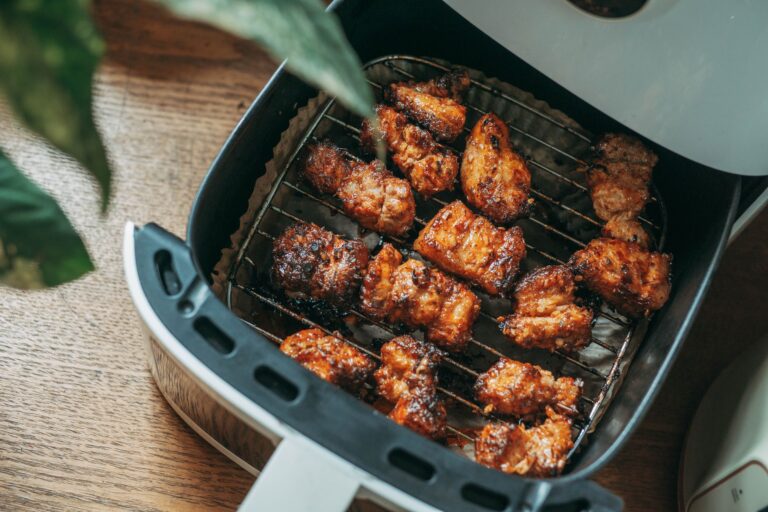
An air fryer is a small countertop convection oven: a fan pushes hot air around the food, so it browns and crisps faster than in a regular oven with little or no oil. Give the food room, shake it halfway, and check the temperature with a thermometer. This guide covers how it works, the tips with the sources behind them, safe temperatures, what to cook and six beginner recipes.
I earn a commission if you buy through the Amazon links on the buying guides linked below, at no extra cost to you.
If you haven’t bought one yet, my best cheap air fryer guide covers the budget picks, and the best air fryer for a family of four is worth a look for larger households.
How an Air Fryer Works
The USDA’s Food Safety and Inspection Service (FSIS) describes air fryers as essentially countertop convection ovens that cook food faster and use less energy than a full-size oven. Hot air is released from a heating element and circulated quickly, which crisps the food. FSIS puts typical cooking at 5 to 25 minutes at 350 to 400°F (FSIS: Air Fryers and Food Safety).
The fan is the difference from a regular oven. Moving air strips moisture from the surface, so the outside browns and crisps before the inside overcooks. It is the same browning reaction as in a deep fryer, with far less oil. For capacity and multi-rack baking, see air fryer vs convection oven.
The crispness is close to deep frying but not identical. In a French-fry study that measured crispness, the deep-fried fries were crispier than the air-fried ones at the same level of water loss (Gouyo et al., Food Research International, 2020).
Tips That Make a Difference
Preheat if your manual says to
Makers differ, so check your own manual. Ninja’s AF080 manual says to let the unit preheat for 3 minutes before adding ingredients, and that preheating gives the best cooking and crisping results (Ninja AF080 manual). Starting with a hot basket means the food begins crisping on contact.
Don’t overfill the basket
FSIS says air fryers don’t have a lot of room inside, and that overcrowding prevents enough air circulation to cook food properly. It recommends batches for a large amount of food and warns that overfilling can cause uneven cooking and undercooking. COSORI’s Lite 2.1-quart manual says the same: an overfilled basket cooks unevenly, so do not pack the food in (COSORI manual).
A single layer with small gaps is the working rule. For more than two people, cook in batches and keep the first batch warm in a low oven.
Shake or flip halfway through
COSORI’s manual says small foods that are stacked, such as fries or nuggets, usually need shaking, that food may not crisp without it, and that you should shake or flip once halfway. Flip larger pieces like thighs, fish fillets and burgers at the same point, because the side against the basket cooks faster.
Pat food dry before it goes in
Wet surfaces steam before they brown. Patting food with a paper towel before seasoning helps it crisp, which matters most for chicken straight from the fridge, fish and watery vegetables like zucchini.
Use a little oil, applied evenly
Fatty foods like sausages and chicken thighs often need none. Leaner foods, such as vegetables, chicken breast and fish, brown and release better with a light mist. COSORI’s manual calls oil sprays a good way to apply small amounts evenly, and Ninja’s says to use an oil spritzer to coat ingredients for even browning.
Whether aerosol cans harm a nonstick basket depends on the maker. I found no warning about them in the Ninja AF080 or COSORI Lite manuals, so read yours. A refillable pump mister with plain oil avoids the question.
Adjust oven recipes as a starting point
A common rule of thumb is to drop an oven recipe’s temperature by about 25°F and begin checking early. Treat it as a starting point: FSIS notes that each air fryer has varying cooking times because of its size and power, while the safe internal temperature is always the same.
Use a thermometer
Air fryers cook fast, and the gap between done and overdone chicken breast is narrow. FSIS says to check every air-fried food with a food thermometer; the minimums are in the table below. My best Bluetooth meat thermometer guide covers models that work for quick checks on smaller cuts.
Cook starchy foods to golden, not brown
Potatoes and other starchy foods form acrylamide as they brown, and the darker they get the more there is. The FDA advises cooking cut potato products to a golden yellow rather than a brown color, soaking raw slices in water for 15 to 30 minutes first, and keeping raw potatoes out of the fridge (FDA acrylamide guidance). The air fryer doesn’t change any of that.
Safe Internal Temperatures
These are FSIS’s minimum internal temperatures, measured with a food thermometer. Cooking time varies by model; the temperature does not (FSIS safe minimum internal temperature chart).
| Food | Minimum internal temperature |
|---|---|
| Poultry, including ground poultry | 165°F (73.9°C) |
| Ground beef, pork, veal and lamb | 160°F (71.1°C) |
| Steaks, chops and roasts of beef, pork, veal and lamb | 145°F (62.8°C), then rest for at least 3 minutes |
| Fish and shellfish | 145°F (62.8°C) |
| Leftovers and casseroles | 165°F (73.9°C) |
FSIS also says not to cook raw, stuffed, breaded chicken breast products in the air fryer, and to follow the maker’s instructions on any packaged food. Refrigerate leftovers within 2 hours.
What You Can Cook in an Air Fryer
Almost anything you would cook in an oven or a frying pan, plus reheating that a microwave handles badly. FSIS lists chicken nuggets, meatballs, pork chops and wings, and says air fryers can bake, roast and reheat without the food going soggy.
Chicken
Wings, thighs, drumsticks and a spatchcocked whole chicken all come out with crisp skin, which is hard to get in a standard oven without a fan setting. Bone-in, skin-on pieces work best. Chicken breast dries out quicker than in a pan, so pull it at 165°F.
Fish and seafood
Most fillets take roughly 8 to 12 minutes, so start checking early; fish is done at 145°F. Salmon, cod, haddock and shrimp all work. Oil the basket or use a parchment liner so the fish doesn’t stick or leave smells.
Fries and potatoes
Cut potatoes into even strips, soak them in cold water for 15 to 30 minutes, pat very dry, toss with a teaspoon of oil and salt, then air fry at 400°F for 20 to 25 minutes, shaking every 8 minutes. Stop at golden; the FDA’s advice above is why.
Vegetables
Broccoli, cauliflower, Brussels sprouts, asparagus, zucchini, peppers and mushrooms roast in about half the time of a full-size oven. Cut them to similar sizes, toss with a little oil and seasoning, and shake halfway.
Frozen foods
Fries, nuggets, fish sticks, spring rolls and onion rings generally go straight in from the freezer; follow the package times, as FSIS advises. The exception is raw stuffed breaded chicken, which FSIS says not to air fry.
Reheating leftovers
The air fryer beats a microwave for anything that should stay crisp: pizza regains its crust, roast potatoes crisp up and fried chicken comes back close to its original texture. Three to five minutes at 350°F is enough for most things; leftovers should reach 165°F.
Baked goods
Muffins, cookies, individual cakes and garlic bread all work in small batches. Cover the tops with foil if they brown before the center sets, keeping the foil clear of the basket holes (can you put foil in an air fryer?).
Is an Air Fryer Worth It?
The fat saving is real; the acrylamide advantage is not. Studies of the food itself generally find less fat after air frying. In one bean-chip study the air-fried chips had much lower fat content than the deep-fried ones, though they were also harder and had a higher level of HMF, a compound formed by heat (Göncü, Food Science & Nutrition, 2025).
Acrylamide is where the usual claim fails. In a 2024 study of potato sticks, the air-fried potatoes had the highest acrylamide of the three methods (12.19 µg/kg, against 8.94 deep-fried and 7.43 oven-fried), though the differences were not statistically significant (Navruz-Varlı and Mortaş, Frontiers in Nutrition). A 2025 study found air-fried potatoes without enzyme pretreatment had the highest acrylamide of the deep, microwave and air methods tested, at 963.83 µg/kg (Esposito et al., Journal of Food Science).
Another 2025 study found acrylamide concentrated at the dry edges of air-fried potato strips, at least five times the level in the core (Li et al., Food Chemistry). That matches the FDA advice: stop at golden. For the longer health discussion see are air fryers healthy?, and for the cooking comparison see air fryer vs deep fryer.
The practical case rests on speed and clean-up. It heats faster than a full-size oven, makes less mess than a frying pan, and is easy to wipe down. For one or two people it is often the appliance that gets used most.
Air Fryer Recipes for Beginners
These six recipes need no equipment beyond the air fryer. Times vary by model, so check the temperature as well as the clock.
Crispy chicken wings
Temp: 400°F (200°C) | Time: 25–28 minutes
Pat 2 lb (about 1 kg) of wings completely dry; most people skip this step and it matters. Toss with 1 tsp baking powder (aluminum-free), 1 tsp garlic powder, 1 tsp smoked paprika, salt and pepper. No oil needed.
Air fry for 25 to 28 minutes, flipping halfway, until the wings reach 165°F. The baking powder raises the pH of the skin, which helps it brown and crackle.
Air fryer fries
Temp: 400°F (200°C) | Time: 22–25 minutes
Cut 2 large russet potatoes into even ½-inch strips. Soak in cold water for 15 to 30 minutes, drain and pat very dry. Toss with 1 tsp neutral oil, salt and pepper.
Air fry for 22 to 25 minutes, shaking every 8 minutes, until golden and crisp. If your air fryer has a preheat function, use it here.
Garlic and herb salmon
Temp: 400°F (200°C) | Time: 10–12 minutes
Place fillets skin-side down in the basket; salmon has enough fat that the basket needs no oil. Mix 1 tbsp softened butter with 1 minced garlic clove, a pinch of dried thyme or dill, lemon zest, salt and pepper, and spread it over the top.
Air fry for 10 to 12 minutes until the thickest part reaches 145°F and flakes. The butter bastes the fish as it melts.
Roasted broccoli
Temp: 400°F (200°C) | Time: 10–12 minutes
Cut a head of broccoli into similar-sized florets. Toss with 1 tsp olive oil, a pinch of garlic powder, chili flakes, salt and pepper. Air fry for 10 to 12 minutes, shaking halfway, until the edges are lightly charred and the stems are tender. Finish with a squeeze of lemon.
Breaded chicken strips
Temp: 400°F (200°C) | Time: 12–14 minutes
Slice 2 chicken breasts into finger-width strips. Set up three bowls: seasoned flour, beaten egg with a splash of milk, and panko mixed with a pinch of paprika and garlic powder. Coat each strip in flour, shake off the excess, dip in egg, then press into the panko.
Spray lightly with oil and air fry for 12 to 14 minutes, flipping halfway, until golden and 165°F inside. Panko matters here; regular breadcrumbs don’t crisp as well.
Sausages
Temp: 360°F (180°C) | Time: 15 minutes
Place sausages in a single layer; they can touch but shouldn’t be piled. Air fry for about 15 minutes, turning once, until fresh pork or beef sausages reach 160°F and poultry sausages 165°F. No oil needed.
They brown evenly on all sides without the constant turning a frying pan needs. Thin chipolatas take 10 to 12 minutes and thick bratwurst 18 to 20, but go by the thermometer.
How This Guide Was Put Together
Handling and temperatures come from the USDA FSIS pages linked above, the starchy-food advice from the FDA, and the fat, acrylamide and crispness findings from the five studies linked in the sections where they appear. The preheat, shaking, overfilling and oil-spray points come from the Ninja AF080 and COSORI Lite manuals. The recipes are standard techniques sized for a typical basket, not lab-tested figures.
One thing I could not establish is a trustworthy percentage for how much less fat an air fryer leaves in food. I could not find an independent study behind the commonly quoted 70 to 80 percent figure, so this guide doesn’t use it.
Frequently Asked Questions
Can you put foil in an air fryer?
Yes, with conditions. Foil is safe as long as it doesn’t cover the basket perforations, which would block airflow, and you should avoid it with acidic foods like tomatoes or citrus, which can react with aluminum. My foil guide has the full rules.
How does an air fryer compare to a deep fryer?
Close but not identical. Air frying leaves less oil in the food, but in one study deep-fried fries were crispier at the same water loss. For everyday fries, chicken and vegetables the result is good and clean-up is easier. See the full comparison.
What size air fryer do I need?
A 2 to 3 quart basket suits one or two people, 4 to 5 quarts suits three or four, and 6 quarts or a dual basket suits larger families. Overfilling is the main problem, so size for your usual batch. See Ninja AF101 vs COSORI Pro II.
Are air fryers actually healthy?
They leave less fat in food than deep frying, which helps if you eat fried food often. They do not reliably cut acrylamide, and oven roasting with little oil can be just as light. Treat one as a low-oil cooking method, not a health shortcut. See the full breakdown.
What should you not put in an air fryer?
Avoid wet batters, which drip through the basket; piles of loose cheese, which melt before they brown; and leafy greens, which blow around and burn. FSIS also says not to air fry raw, stuffed, breaded chicken breast products. Follow the package instructions for those instead.
What internal temperature should air fryer food reach?
Poultry, including ground poultry, needs 165°F. Ground beef, pork and lamb need 160°F. Fish and whole cuts of beef, pork, veal and lamb need 145°F, with a 3-minute rest for the whole cuts. Measure with a food thermometer, because cooking times vary by model.
Looking for specific model recommendations? My air fryers page covers every style from compact basket models to full countertop ovens, with reviews and buying guides for every budget.

I'm Glenn, and I started Kitchenware Compare to cut through conflicting product reviews and help readers pick kitchen gear with confidence. I don't own or test the products I write about — these guides are built from verified-purchase reviews, manufacturer specifications, and independent testing where it exists, with the reasoning shown, not just a rating.
Leave a Reply