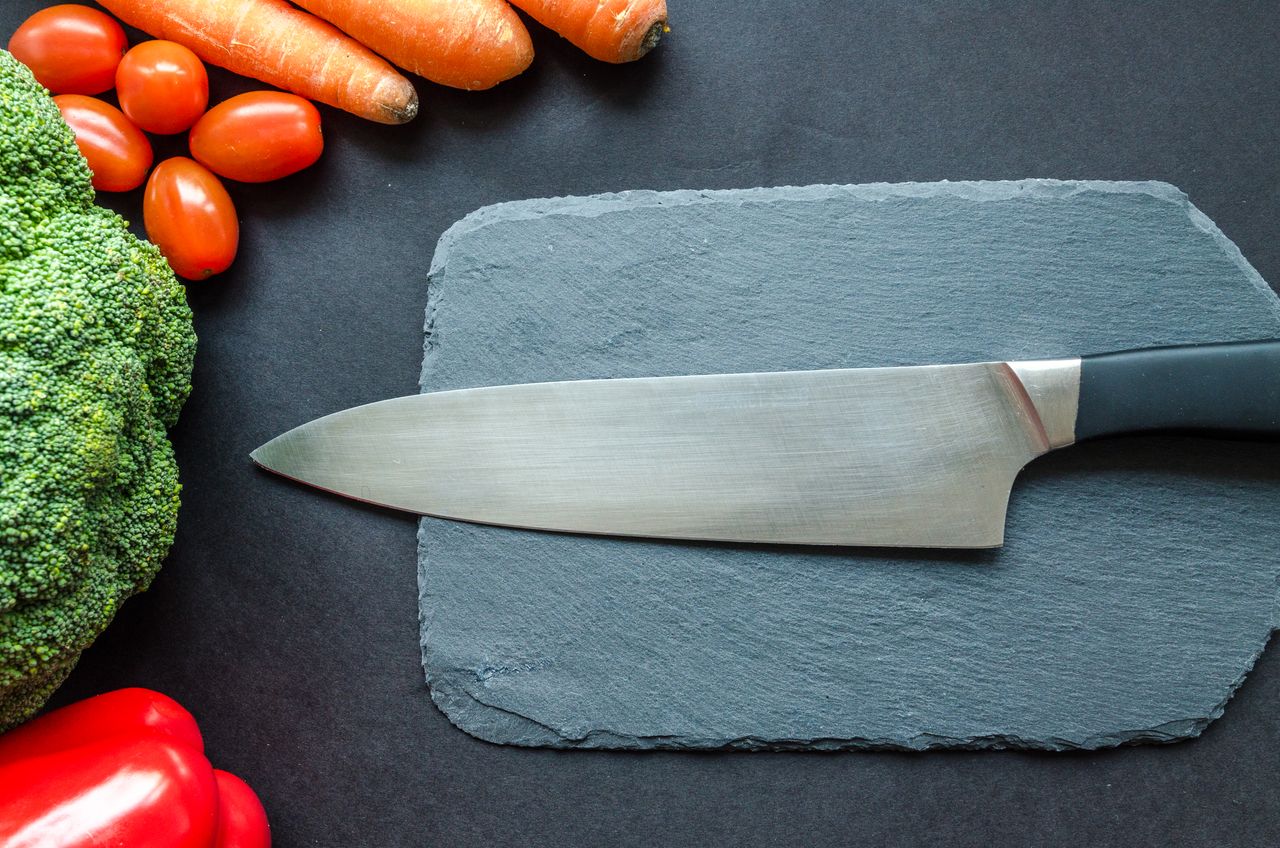
A chef’s knife is measured along the blade only: from the tip to the heel, where the cutting edge stops and the handle begins. The handle is never counted. Neither is the bolster, the thick collar of steel between blade and handle on many Western knives — it is not cutting edge, so it does not go into the number.
The short answer
Tip to heel, in a straight line, blade only. The catch is that the number on the box is a category label rather than a measurement. Two knives both sold as “8-inch” can differ by nearly half an inch, because most makers design in round metric sizes and then round again for the American label.
Where the measurement starts and where it stops
The tip is easy. The heel is the end people get wrong: it is the rear corner of the cutting edge, the point where the sharpened edge meets the bolster or the handle. It is not the back of the handle, and it is not the front of the bolster.
The measurement is taken in a straight line, not traced along the curve of the edge. A chef’s knife has a curved belly for rocking, so following the curve with a tape measure gives a longer figure than the one on the box. Lay the knife flat and measure the straight distance.
One consequence is worth knowing before you buy. Two knives with the same blade length can give you very different amounts of usable edge, because a knife with a full bolster that runs down to the edge sacrifices the last portion of the heel to steel you cannot sharpen. That is a real difference in what the knife can do, and it is invisible in the size on the label.
Why an 8-inch knife is rarely exactly eight inches
Manufacturers publish their own blade lengths, and they do not agree with each other. Three knives that are all sold as 8-inch chef’s knives:
| Knife | Sold as | Blade length | Where that figure comes from |
|---|---|---|---|
| Wüsthof Classic | 8 inch | 20 cm / 7.87 in | Wüsthof lists the product as “Classic Chef’s Knife 20 cm | 8 inch” |
| Victorinox Fibrox Pro | 8 inch | 20 cm / 7.87 in | Part number 5.2063.20 — the suffix is the blade length in centimetres |
| Misen Chef’s Knife | 8 inch | 21 cm / 8.26 in | Misen’s own specification page |
That is a spread of nearly four tenths of an inch between knives with identical labels. Nobody is being dishonest. The German makers design in round metric sizes — 16, 20, 23, 26 cm — and 20 cm converts to 7.87 inches, which gets marketed as 8. Misen designed to a round 210 mm instead, which converts to 8.26 and also gets marketed as 8.
The practical upshot: if the exact length matters to you, read the millimetre or centimetre figure in the specifications rather than the inch figure on the front of the box. The metric number is almost always the one the knife was actually built to.
Reading the length straight off a Victorinox part number
Victorinox encodes it, which makes their catalogue unusually easy to decode. The last group of digits in the part number is the blade length in centimetres: 5.2063.20 is a 20 cm blade sold as 8 inch, and 5.2003.15 is a 15 cm blade sold as 6 inch. If a listing gives you a Victorinox part number but a vague size, the number settles it.
How to measure a knife you already own
It takes a ruler and about fifteen seconds.
Lay the knife flat on a board with the edge facing you. Put the ruler alongside the blade, not on top of it, so the curve does not lift it away from the steel. Line the zero mark up with the very tip.
Read off the figure at the heel — the rear corner of the sharpened edge, where it meets the bolster or handle. Record it in millimetres if you can. Kitchen knife sizes cluster tightly, and millimetres separate a 200 mm blade from a 210 mm one where inches round both to eight.
Millimetres, centimetres or inches
Which unit you meet depends on where the knife was designed. Japanese makers work in millimetres and the common chef’s knife sizes are 180, 210 and 240 mm. German and Swiss makers work in centimetres, usually 16, 20 and 23. American listings convert whichever of those the maker used into inches, and round.
The anchors worth remembering: 180 mm is about 7 inches, 200 mm is just under 8, 210 mm is about 8.3, and 240 mm is about 9.5. A Japanese gyuto sold as an 8-inch knife is usually a 210 mm blade, which is genuinely longer than a European 20 cm blade wearing the same label.
Blade height is a separate measurement
Blade height — the distance from the edge up to the spine at the tallest point, near the heel — is measured separately and is not implied by the length. Misen publishes 49 mm for its chef’s knife; most Western chef’s knives sit somewhere between 45 and 55 mm.
It matters more than people expect. Height is what gives you knuckle clearance over the board, and it is what lets you scoop chopped food off the board on the flat of the blade. A long but shallow knife will rap your knuckles on the board in a way a shorter, taller one will not, which is why blade height is worth checking if you have found an 8-inch knife uncomfortable and assumed the length was the problem.
What size to actually buy
Two things decide this, and your own height is not one of them: what you cut most, and how big your board is.
An 8-inch blade is the default for a reason — long enough to get through a cabbage or a chicken, short enough to stay controllable for everyday chopping. A 6-inch is worth considering if your board is small, if your hands are small, or if most of your prep is herbs and shallots rather than squash. A 10-inch earns its place when you are cutting large produce or working in volume, and it needs a board with the room to swing it.
The constraint people miss is the board. A blade wants a board longer than it is, and an 8-inch knife on a small board leaves you no room to work; the cutting board guide covers sizing. For the knives themselves, the chef’s knife guide compares the options at each size, and length is not what separates a good knife from a bad one — edge retention and how the knife feels in a pinch grip matter far more. A dull 8-inch knife is worse than a sharp 6-inch, which is what the knife sharpener guide is for.
Common mistakes
Measuring the whole knife is the usual one. Overall length includes the handle and runs three to five inches longer than the blade, so a knife measured that way looks like a size it is not. Misen’s 8-inch model, for instance, is 13.5 inches overall against an 8.26-inch blade.
Tracing the curve is the second. Following the belly of the blade with a flexible tape adds length that no manufacturer counts.
Assuming two 8-inch knives are interchangeable is the third, and the table above is the reason. If you are replacing a knife you liked, match the metric figure rather than the inch label.
The last is confusing height with length — a knife described as “taller” is talking about the distance from edge to spine, not about how much cutting edge you get.
How This Guide Was Put Together
The blade lengths above come from the manufacturers’ own published figures: Wüsthof’s product listing for the Classic 20 cm chef’s knife, Misen’s specification panel, and Victorinox’s own part numbering. Nothing here was measured in a kitchen.
Two things could not be established. There is no industry standard that requires blade length to be measured from any particular point, so “tip to heel” is the near-universal convention rather than a rule anyone enforces — which is part of why published figures vary. And no maker publishes a manufacturing tolerance for blade length, so how closely an individual knife matches its stated figure is not something that can be checked against a specification.
Frequently asked questions
Is a chef’s knife measured with the handle included?
No. Only the blade is measured, from the tip back to the heel where the cutting edge ends. Including the handle gives overall length, which runs three to five inches longer and is not what the size on the box refers to.
Where exactly is the heel of a chef’s knife?
The heel is the rear corner of the sharpened edge, where it meets the bolster or the handle. It is the widest part of the blade and the end of the usable cutting edge, which is why the measurement stops there rather than at the handle.
Why is my 8-inch knife not exactly 8 inches?
Because the inch figure is a rounded label. Most European makers build to 20 cm, which is 7.87 inches, and market it as 8. Others build to 210 mm, which is 8.26 inches, and also market it as 8. Read the metric figure instead.
What is the mm measurement on a chef’s knife?
It is the blade length in millimetres, and it is the figure the knife was designed to. Common sizes are 180, 200, 210 and 240 mm. Japanese makers label in millimetres as standard; European makers usually give centimetres.
Does blade height affect what size knife I need?
Yes, independently of length. Height is the edge-to-spine distance, typically 45 to 55 mm, and it sets your knuckle clearance over the board. If an 8-inch knife felt awkward, a taller blade of the same length may fix it.
Measured properly, the number is simple: tip to heel, blade only, in a straight line. It is the label on the box that is approximate.

I'm Glenn, and I started Kitchenware Compare to cut through conflicting product reviews and help readers pick kitchen gear with confidence. I don't own or test the products I write about — these guides are built from verified-purchase reviews, manufacturer specifications, and independent testing where it exists, with the reasoning shown, not just a rating.
Leave a Reply