Disclosure: I earn a small commission if you buy through links on this page, at no extra cost to you.
Photo by Boris Ivas from Pexels
For most cooks, the Lavatools Javelin PRO instant-read is the probe thermometer to buy first: it was $43.99 on Amazon with 4.7 stars across 18,403 ratings and a 14% critical share, and America’s Test Kitchen and TechGearLab both rated the related Javelin PRO Duo highly. For a leave-in probe, the TempPro TP16 at $16.14 is the cheap wired choice, while the wireless options have weaker records.
“Probe thermometer” covers instant-reads that you insert briefly and leave-in probes that stay in the meat, wired or wireless. Every price, rating and seller below was read from Amazon.com on 7 October 2026.
Quick Comparison
| Product | Best For | Price | Rating | Buy |
|---|---|---|---|---|
| Lavatools Javelin PRO Instant-Read | Best Overall | $43.99 | 4.7★ (18,403) | Check Price |
| TempPro TP16 Wired Leave-In Probe | Best Budget Leave-In | $16.14 | 4.5★ (50,704) | Check Price |
| MEATER Plus Wireless Probe | Best Cable-Free | $79.99 | 4.3★ (48,552) | Check Price |
| TempPro TempSync 4-Probe Bluetooth | Best Multi-Probe | $49.99 | 4.5★ (10,333) | Check Price |
The Types of Probe Thermometer
| Type | How it is used | Best for |
|---|---|---|
| Instant-read | Inserted briefly for a reading, then removed | Steaks, burgers, chicken pieces and a quick final check |
| Wired leave-in | A probe on a cable stays in the meat, tethered to a display | Oven roasts and simple, cheap monitoring |
| Wireless leave-in | A cable-free probe transmits to a phone | Grilling and smoking without a cable through the lid |
| Multi-probe with receiver | Several cabled probes feed a receiver that talks to a phone | Several cuts or cooking zones at once |
What the Independent Tests Found
America’s Test Kitchen (June 2025) named the Lavatools Javelin PRO Duo its midprice instant-read pick, calling it fast and accurate with a rotating display, a long probe and automatic wake-up, though slightly slower than premium models. TechGearLab (November 2024) gave the Javelin PRO Duo a Top Pick at 81 out of 100, measuring ±0.9°F and a read in just under four seconds. It scored the ThermoPro TP16 56 out of 100, with ±1.8°F accuracy and no backlight, and the MEATER Plus 50, with ±1.0°F accuracy but about 38 seconds to settle and connectivity problems.
America’s Test Kitchen (July 2025) took the opposite view of the TP16, naming it the Best Buy leave-in thermometer and one of the most accurate it tested, while noting it lacks a low-temperature alarm. America’s Test Kitchen (March 2026) found the MEATER Plus accurate but limited in range, because its Bluetooth transmitter must stay near the probe and the phone. It tested a different ThermoPro model, the TP960, and found temperatures up to 2 degrees off, so neither tester covered the TP25 TempSync.
1. Lavatools Javelin PRO Instant-Read — Best Overall

4.7 stars | 18,403 ratings | $43.99 | sold by Lavatools
This is the pick for most cooks because it is the only one here with a strong result in both independent tests. America’s Test Kitchen named the Javelin PRO Duo its midprice pick and TechGearLab gave it a Top Pick at 81 out of 100. The listing is titled Javelin PRO Classic, which I took to be the same line, though I could not confirm it is the identical unit, and it claims 2-to-3-second reads, IP65 water resistance and NSF certification at 4.6 ounces.
Of 1,484 written reviews, 213 are critical (14%). In a sample of 16 critical reviews, at least three titles question accuracy or reliability, such as “Great variance in accuracy”, and two say it stopped working or broke.
Pros:
- Highly rated by both independent testers in its Duo form
- A 14% critical share across 1,484 written reviews
- IP65 and NSF listed, with a 2-to-3-second read claimed
Cons:
- An instant-read only, not for leaving in the meat
- The tested Duo and the Classic listing may not be identical
- Accuracy and reliability complaints appear in the critical sample
- $43.99 is more than the wired probe
2. TempPro TP16 Wired Leave-In Probe — Best Budget Leave-In

4.5 stars | 50,704 ratings | $16.14 | sold by TempPro Inc
This is the cheap leave-in probe, and the two testers disagree about it. America’s Test Kitchen named it the Best Buy leave-in thermometer in July 2025, while TechGearLab scored it only 56 out of 100 with ±1.8°F accuracy and no backlight. I matched both reviews to this listing by its TP-16 part number, which the seller now brands TempPro, and the listing itself states the ±1.8°F figure.
The listing gives a 40-inch cable, a probe and wire rated to 716°F and a timer up to 99 hours 59 minutes. Of more than 13,000 written reviews, 3,080 are critical, under 24%. In a sample of 19 critical reviews, five titles say it did not last, from seven months to three years, two mention the battery, and one says the probe plug is very hard to pull out.
Pros:
- America’s Test Kitchen’s Best Buy leave-in thermometer
- $16.14, the lowest price here
- A 40-inch cable and a probe rated to 716°F, per the listing
Cons:
- ±1.8°F accuracy, and TechGearLab scored it 56 out of 100
- No backlight, per TechGearLab
- Early failures appear in the critical sample
- Wired, so the cable has to run through the oven door or grill lid
3. MEATER Plus Wireless Probe — Best Cable-Free
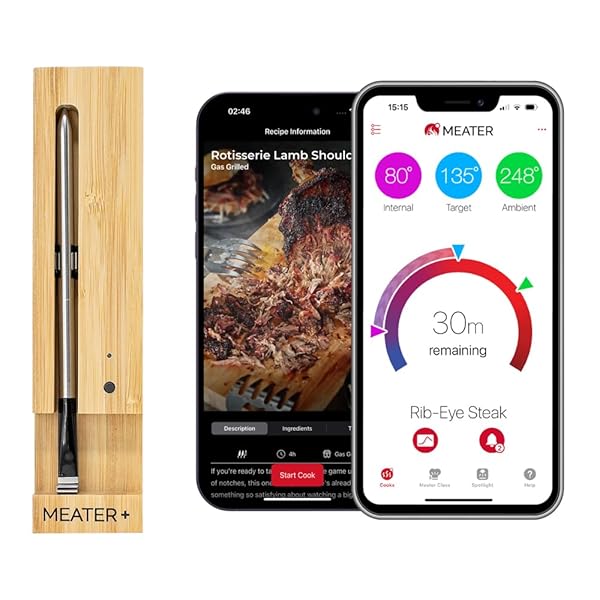
4.3 stars | 48,552 ratings | $79.99 | sold by the MEATER store
This is the cable-free option, but its record is mixed. The listing gives a fully wire-free probe with dual sensors for meat and ambient temperature and a stated Bluetooth range of 165 feet. America’s Test Kitchen found accurate temperatures but a limited range, and TechGearLab scored it 50 out of 100, with ±1.0°F accuracy but about 38 seconds to settle and connectivity problems.
Of 13,505 written reviews, 4,477 are critical (33%). In a sample of 19 critical reviews, at least four titles describe weak or dropped connections, three describe it breaking or failing to charge after about two years, and one says it is not worth the price. My MEATER Plus review and MEATER vs ThermoPro comparison cover it in more detail.
Pros:
- No cable through the oven door or grill lid
- Dual sensors for meat and ambient temperature, per the listing
- America’s Test Kitchen found its readings accurate
Cons:
- A 33% critical share and 4.3 stars, the weakest record of the four
- Connection problems and limited range in both independent tests and the critical sample
- TechGearLab scored it 50 out of 100 for slow readings
- A single probe, and the highest price here
4. TempPro TempSync 4-Probe Bluetooth — Best Multi-Probe

4.5 stars | 10,333 ratings | $49.99 | sold by TempPro Inc
This is the pick for monitoring several cuts at once, though its record is weaker than its price suggests. The listing gives four color-coded probes cabled to a rechargeable receiver, Bluetooth 5.0 with a stated 650-foot range, an app with presets for nine meat types, up to four timers and a ±0.5°F accuracy claim. Neither independent tester reviewed this TP-25, and America’s Test Kitchen’s test of the related TP960 found readings up to 2 degrees off.
Of 1,519 written reviews, 494 are critical (33%). In a sample of 15 critical reviews, two titles say the real range is far below the stated figure, two criticize the app, one says it did not last a year, and one says it cannot be recalibrated. My TempPro TempSync review covers it in detail.
Pros:
- Four probes at once, with a receiver and an app
- $49.99, $30 less than the MEATER Plus
- Stated 650-foot range and ±0.5°F accuracy, per the listing
Cons:
- A 33% critical share across 1,519 written reviews
- Range complaints in the critical sample
- The probes are cabled to the receiver
- No independent test of this model
How to Choose a Probe Thermometer
Instant-read or leave-in
An instant-read checks a steak, burger or chicken piece in seconds at the end of the cook, while a leave-in probe watches a roast or smoked cut for hours. Instant-reads are made for brief checks, so use a leave-in probe for a long cook. Most kitchens end up with one of each, and the Javelin plus the TP16 cost about $60 together.
Accuracy: claims versus tests
The Javelin listing claims about ±0.5°F, but TechGearLab measured ±0.9°F on the Duo, and the TP16 listing and TechGearLab both give ±1.8°F. For meat that is usually close enough, but you can check any thermometer in ice water, and my guide to calibrating a meat thermometer shows how. Whether wireless probes hold their accuracy is covered in are wireless meat thermometers accurate.
Wireless range and apps
Stated Bluetooth range is measured in the open, and owners of the TempSync report far shorter real range, while ATK found the MEATER’s range limited. See Bluetooth vs Wi-Fi meat thermometers if you want to monitor from further away.
How many probes you need
One probe covers one cut. If you smoke or grill several items together, a multi-probe unit like the TempSync saves effort, but its record is thinner. For smoker and barbecue use, see best meat thermometer for smoking and best BBQ thermometers.
Frequently Asked Questions
What is the difference between a leave-in probe and an instant-read thermometer?
A leave-in probe stays in the meat for the whole cook and reports continuously, while an instant-read is inserted briefly for a quick check and removed. Use a leave-in for roasts and smoked cuts, and an instant-read for steaks, burgers and a final check. My meat temperature guide lists the temperatures to aim for.
Can you leave a probe thermometer in the oven?
Only a leave-in probe made for it. The TP16 listing says its probe and wire are rated to 716°F, and the MEATER Plus is sold for grill and oven use. Instant-reads like the Javelin are made for brief checks, so do not leave one in a hot oven.
How accurate are probe thermometers?
TechGearLab measured ±0.9°F for the Javelin PRO Duo, ±1.0°F for the MEATER Plus and ±1.8°F for the TP16, and America’s Test Kitchen found the TP960 up to 2 degrees off. I could not find a test of the TempSync. Check yours in ice water, as my calibration guide explains.
Do I need a wired or wireless probe thermometer?
Wired is the cheapest and, in the TP16’s case, America’s Test Kitchen’s Best Buy, but the cable has to run through the oven door or grill lid. Wireless removes the cable, yet both wireless picks here have a 33% critical share, so weigh convenience against reliability. My best wireless meat thermometers and best Bluetooth meat thermometer guides compare more of them.
What is the best probe thermometer for a smoker?
For long cooks you need a leave-in probe, either the MEATER Plus for a single cable-free probe or the TempSync for several cuts. Both have mixed records, so read best meat thermometer for smoking and best thermometer for brisket before you choose.
How long do probe thermometers last?
I found no independent source that measures lifespan. In the critical reviews I sampled, owners report the TP16 failing after seven months to three years, the MEATER Plus after about two years and the TempSync within a year, so keep the return window in mind.
How These Picks Were Chosen
This is a research-based guide, not a hands-on test: I have not cooked with these thermometers. Each pick rests on its Amazon listing, read on 7 October 2026, plus its rating, its count of written critical and positive reviews, and a sample of 15 to 19 critical reviews, with the themes counted as mentions.
Independent testing comes from America’s Test Kitchen, America’s Test Kitchen, America’s Test Kitchen and TechGearLab, and the guide says where a tested model differs from the listing. I could not establish whether any of these units meets its stated accuracy in the long run, or how long any of them lasts, because no test I found covers either for these exact listings.
The Verdict
For most cooks, start with the Lavatools Javelin PRO: strong in both independent tests in its Duo form and a 14% critical share. Add the TempPro TP16 at $16.14 if you want a cheap leave-in probe, knowing the testers disagree about it. The wireless picks suit specific needs but have 33% critical shares.
For more, see the meat thermometers hub.

I'm Glenn, and I started Kitchenware Compare to cut through conflicting product reviews and help readers pick kitchen gear with confidence. I don't own or test the products I write about — these guides are built from verified-purchase reviews, manufacturer specifications, and independent testing where it exists, with the reasoning shown, not just a rating.
Leave a Reply