This post contains affiliate links. If you buy through my links, I may earn a commission at no extra cost to you.
A griddle wins for breakfast spreads, batch cooking, and smash burgers, while a grill wins for steaks, chops, and anything that benefits from smoke and char. Either way, doneness should come from a thermometer, not guesswork: USDA FSIS guidance sets safe internal temperatures at 145°F for whole cuts, 160°F for ground meats, and 165°F for poultry.
TL;DR:
- A griddle cooks food evenly through conduction, making it ideal for breakfast foods, delicate items, and batch cooking without flare-ups.
- Grills produce smoke and char flavor via flare-ups and radiant heat, making them better for steaks, chops, vegetables, and meats that benefit from a smoky crust.
- Proper heat management, including two-zone setups and frequent flipping, is essential for even cooking and flare-up control on both surfaces.
- Maintenance involves seasoning and cleaning routines specific to each surface, with a griddle requiring oiling and scraping, while a grill benefits from regular grates brushing and trap emptying.
- Choice depends on primary cooking style, space, and whether indoor or outdoor use; many home setups benefit from a combined unit or insert to cover both cooking needs.
How a griddle and a grill actually cook food differently
The core difference comes down to what the food is touching. A griddle is a flat, smooth plate that sits directly on the heat source, so it cooks almost entirely through conduction: even, direct metal-to-food contact across the whole surface. A grill suspends food above the heat source on a grate, which means it draws on three heat modes at once: conduction where the grate bars touch the food, convection from hot air moving around it, and radiation from the flame or coals themselves.
That mix is exactly why grills produce smoke and occasional flare-ups. Fat and juices drip through the grate onto the heat source below, vaporize, and rise back up through the food, which is where char and that distinctive grilled flavor come from. A griddle has nowhere for drippings to go but the pan itself, so it never generates that effect, for better or worse depending on what you’re making.
Grills also have a reputation for cooking unevenly, and engineering testing backs that up. A Cal Poly study on grill temperature distribution found that flame tamers and airflow patterns strongly influence how heat spreads across the grate, creating hot and cold zones that vary by design. Increasing airflow through the flame tamers in that testing produced a more uniform front-to-back temperature, which tells you the burner and heat-spreader hardware underneath a grill matters as much as the grate on top.
Fuel type shapes the outcome further:
- Gas grills heat up fast and hold a steady temperature, but produce less smoke flavor than charcoal or wood.
- Charcoal grills run hotter at the surface and add a smokier taste, at the cost of longer setup and less precise temperature control.
- Wood-fired setups add the strongest smoke character but require the most attention to manage heat swings.
- Electric griddles and grills offer the most consistent, controllable heat indoors or on a patio, with no live flame to manage.
None of these fuel differences change the basic mechanics. A griddle stays conduction-dominant no matter what heats the plate, and a grill keeps its mixed heat profile whether it burns propane, charcoal, or wood. What changes is flavor intensity and how much babysitting the cook has to do.
What to cook on a griddle versus a grill
Matching the food to the surface is where most of the real decision-making happens, and it usually comes down to whether a dish wants even, direct heat or wants smoke and char.
- Pancakes, eggs, and bacon do best on a griddle because the flat surface lets a whole breakfast run side by side without flare-ups or grease drips.
- Smash burgers need the hard, flat contact a griddle provides, since the crust forms from pressing thin patties directly against hot metal.
- Quesadillas and stir-fries benefit from a griddle’s wide, even cooking zone, which keeps ingredients moving without losing heat the way a small pan would.
- Steaks and chops are better suited to a grill, where high, direct heat from the grate and the radiant heat of open flame build a deep crust and pick up smoke.
- Bone-in chicken cooks well on a grill using indirect heat, letting the meat finish through without burning the skin over direct flame.
- Whole fish picks up smoke character on a grill that a flat plate simply cannot replicate.
- Grilled vegetables and fruits, like corn, peppers, or peaches, get char marks and smoky sweetness on a grill that griddles can’t produce.
Some setups blur the line on purpose. A plancha or fitted griddle insert placed over grill burners lets a cook sear delicate items like shrimp or scallops without losing them through the grates, while still sitting on the same appliance used for steaks. According to a practical comparison from The Takeout, griddles tend to win on batch breakfast cooking and delicate foods, while grills hold the advantage for smoke and char, which lines up with how most home cooks actually use each surface week to week. A good compromise for indirect finishing, whether on a grill or off it, is to sear hard on one zone and move the food to a cooler zone or a covered area to finish through.
Getting the heat management right on either surface
Technique matters as much as the appliance. On a grill, two-zone cooking means banking coals or lighting burners on one side only, so one half runs hot for searing and the other stays cooler for slower cooking or holding food warm. A griddle can mimic this by running burners at different levels across separate zones, since most multi-burner griddles let you set the left side higher than the right.
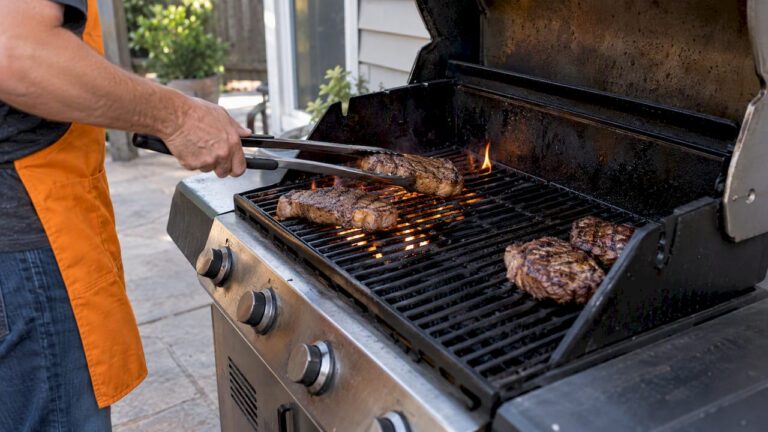
Searing behaves differently on each surface. A grate sears in stripes, concentrating heat where the metal touches and leaving gaps in between, which is part of why grilled food develops those classic char marks. A griddle sears the entire surface of the food at once, building a more uniform crust but never reproducing the char stripes or the smoke that comes with open flame.
Flipping strategy is worth rethinking too. A mathematical analysis of burger flipping by Jean-Luc Thiffeault, building on earlier testing from The Food Lab, found that flipping more often can shorten total cooking time and even out heat exposure compared with the old rule of flipping only once. That applies on a griddle or a grill: frequent flips can help thin cuts cook faster and more evenly, even if it feels counterintuitive next to the usual “leave it alone” advice.
- Keep a spray bottle of water nearby on a grill to knock down sudden flare-ups from dripping fat.
- Trim excess fat before grilling fatty cuts to cut down on smoke and flare-ups.
- Wipe a griddle surface between batches to prevent smoking from built-up residue.
- Keep a lid nearby for both surfaces to control airflow and smother small flare-ups fast.
Pro Tip: Move food to a cooler zone the moment you see flare-ups building, rather than trying to cook through them.
Weighing the trade-offs side by side
Each surface earns its keep in different ways, and the limitations are just as telling as the strengths.
Griddle advantages:
- Even heat across the whole plate makes it forgiving for beginners and efficient for batch cooking.
- Delicate foods like eggs, fish, or thin vegetables hold together better on a flat surface than over open grates.
- Cleanup is often faster since there is one flat surface to scrape rather than grates to disassemble.
Griddle drawbacks:
- No smoke flavor and no char marks, since there is no open flame or dripping fat involved.
- Large griddles take up real counter or patio space and usually need a dedicated grease trap.
Grill advantages:
- Smoke and char flavor come standard, especially with charcoal or wood fuel.
- Indirect cooking zones make it possible to slow-roast a whole chicken or ribs without burning the outside.
Grill drawbacks:
- Hot and cold zones, as shown in Cal Poly’s testing on flame tamers and airflow, mean food near the edges often cooks slower than food in the center.
- Flare-ups and grease drips require more active attention, and grates take longer to scrub clean.
For a lot of home cooks, the real answer is not choosing one appliance forever. A combined grill-and-griddle unit, or a grill with a fitted plancha insert, covers both breakfast and steak night without needing two separate setups. That combination makes the most sense for anyone who already grills often but keeps wishing they had a flat surface for eggs or smash burgers without buying a second appliance outright.
Keeping a griddle or grill clean and rust-free
Upkeep looks different on each surface, and skipping it shows up fast in performance.
A griddle needs a seasoning layer built up over the first few uses, then maintained with light oiling after each cook. Scraping the surface with a metal spatula while it’s still warm removes stuck-on food before it hardens, and a thin coat of oil after cleaning keeps rust from forming during storage. A full walkthrough of how to clean a flat top grill, including when a quick wipe-down is enough versus when a deep clean is overdue, covers both routines in more detail.
A grill needs its grates brushed after every use while they’re still warm, since grease hardens fast once it cools. Ash and grease trays need regular emptying to avoid flare-ups from old drippings, and flavorizer bars or heat spreaders should get replaced once they rust through, since that’s often what causes uneven heat over time.
- Scrape a griddle while it’s still warm, then wipe with a thin layer of oil before storing.
- Brush grill grates immediately after cooking, before grease has a chance to cool and harden.
- Empty grease traps and ash catchers regularly to reduce flare-up risk.
- Wash hands, utensils, and cutting boards separately for raw meat to avoid cross-contamination during outdoor cooking, a habit USDA highlights for summer cookouts.
- Keep perishable food out of the danger zone: no more than 2 hours at room temperature, or 1 hour above 90°F, per USDA FSIS guidance.
How to choose between a griddle and a grill
The right pick depends less on brand reputation and more on what’s actually on the weekly menu.
- Identify your primary foods. Someone making pancakes, smash burgers, and stir-fries weekly leans griddle; someone grilling steaks and ribs leans grill.
- Count how many people you’re feeding regularly. Large families or frequent hosts benefit from a wide griddle surface that cooks several servings at once.
- Check your storage and footprint. Griddles tend to be wide and flat, while grills, especially kettle or barrel styles, take up vertical space instead.
- Decide on indoor versus outdoor use. Electric griddles work indoors on a counter, while most grills need outdoor ventilation regardless of fuel type.
- Look at plate or grate material and thickness. Thicker steel plates hold heat more evenly and resist warping better than thin stamped metal.
- Check the heat range. Higher BTU burners matter more for searing steaks on a grill than for most griddle cooking, which runs at moderate, steady heat.
- Look for a removable grease tray. This single feature affects how much cleanup time a griddle demands after every single use.
- Consider accessory compatibility. Some grills accept a fitted plancha or griddle insert, which covers both cooking styles without a second purchase. Readers planning a permanent setup might also look at how a combined unit fits into a larger layout, as covered in this guide to building an outdoor kitchen.
Budget and space usually settle the rest. A small two-burner griddle costs less and takes up less room than a full-size grill, but a cook who wants both smoke and flat-surface control long-term is often better served saving up for a combined unit rather than buying two separate appliances over time.
Maintenance shortcuts that prevent most owner complaints
Most griddle complaints trace back to seasoning, not the appliance itself. A step-by-step process for seasoning a Blackstone griddle covers the initial high-heat seasoning cycle that polymerizes oil into a protective layer, plus the lighter maintenance oiling needed after each use.
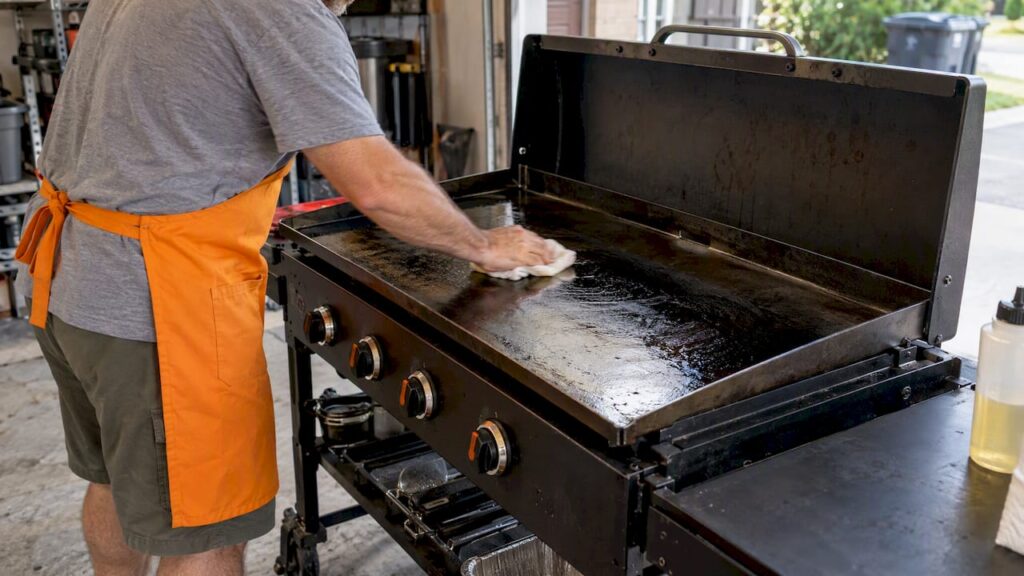
Sticking is the most common issue reported by griddle owners, and it’s almost always a seasoning or temperature problem rather than a defect. A breakdown of why a Blackstone griddle sticks walks through the usual causes, from insufficient oil to cooking on a surface that hasn’t fully preheated.
A simple after-first-season checklist: re-season any bare spots, check burners for even flame, and inspect for rust before the next long stretch of use.
Pro Tip: If a griddle still sticks after reseasoning, check that the whole surface is reaching temperature evenly before blaming the pan itself.
Two quick scenarios that show how the choice plays out
Family breakfast for six on a Saturday morning calls for a griddle: pancakes, eggs, and bacon can all cook at once on one wide surface without juggling pans. Backyard steak night calls for a grill: the char and smoke a grate delivers just isn’t something a flat plate can produce, no matter how hot it gets.
In both cases, a thermometer settles doneness, since USDA FSIS notes that browning alone is not a reliable doneness test.
— Glenn
Where to go next once you’ve picked a surface
Choosing between a griddle and a grill is only half the decision. Picking the right model within that category is where side-by-side comparisons covering plate thickness, BTU output, owner-reported faults, and current deals across dozens of tested specs can help.

- Start at the main comparisons page to browse griddle and grill roundups by budget and size.
- Building a full outdoor cooking setup from scratch, check the kitchen essentials guide for what else belongs on the list.
Either starting point points toward a model that actually fits the way you cook, not just the one with the biggest price tag on the shelf.
Sources
- Barbeque Grill Temperature Distribution Design Improvement
- Grilling and food safety — FSIS USDA
- The mathematics of burger flipping — J.-L. Thiffeault
- What’s the difference between a griddle and a grill? — The Takeout
FAQ
Is it better to cook on a grill or griddle?
Neither surface is universally better: a griddle suits breakfast foods, batch cooking, and smash burgers, while a grill suits steaks, chops, and anything that benefits from smoke and char. The right choice depends on what’s typically on the menu rather than one appliance outperforming the other across the board.
What are the downsides of a flat top grill?
A flat top griddle cannot produce smoke flavor or char marks, since there’s no open flame or dripping fat involved in how it cooks. It also needs regular reseasoning and oiling to prevent sticking and rust, which adds an upkeep step grates don’t require in the same way.
Can a griddle be used as a grill?
A griddle cannot replicate a grill’s char marks or smoke flavor, since it cooks through direct contact with a flat plate rather than suspending food over open flame. Some cooks bridge the gap with a plancha insert on a grill, which allows flat-surface cooking without giving up the grill’s grates entirely.
What can’t you cook on a griddle?
Foods that depend on open-flame char or heavy smoke infusion, like a classic grilled steak with grate marks or smoked ribs, don’t translate well to a flat griddle surface. A griddle can still cook those foods through, just without the charred exterior or smoky flavor a grill produces.
Recommended
- How to Season a Blackstone Griddle (Step by Step)
- Why Is My Blackstone Griddle Sticking? (Causes & Fixes)
- How to Clean a Flat Top Grill (Quick Clean vs Deep Clean)
- Why Is My Blackstone Griddle Rusting? (And How to Fix It)

I'm Glenn, and I started Kitchenware Compare to cut through conflicting product reviews and help readers pick kitchen gear with confidence. I don't own or test the products I write about — these guides are built from verified-purchase reviews, manufacturer specifications, and independent testing where it exists, with the reasoning shown, not just a rating.
Leave a Reply