I earn a commission if you buy through the Amazon links below, at no extra cost to you.

The Typhur Sync Gold is the top pick in my brisket thermometer guide and the most expensive thermometer on this site at $145.34. It is the only one here that publishes the number that actually matters: ±0.5℉ accuracy with a half-second response, backed by NIST-traceable calibration.
That is the headline argument. The more interesting one turned out to be the radio. This is not a WiFi thermometer in the way most people mean it, and the difference explains both why owners rate its signal so highly and the one situation in which it reliably fails.
Quick Verdict
| Score | Price | Rating | Buy |
| 8.5/10 | $145.34 | 4.5★ (562) | Check Price on Amazon |
What Comes in the Box
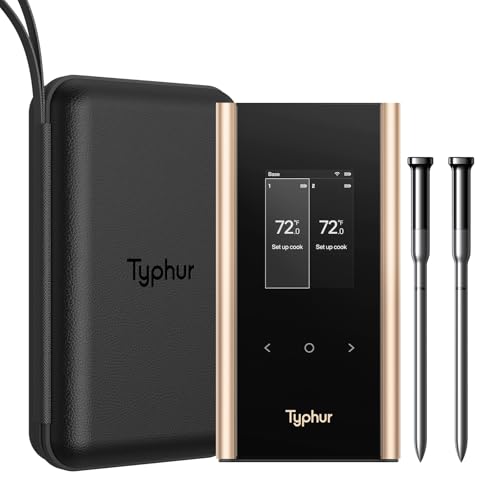
Two probes, the smart base, a hard carrying case and a charging cable. The case matters more than it sounds. Probes are the part that gets bent, lost in a drawer or thrown out with the foil, and a moulded case is the difference between owning two working probes in a year and owning one.
Two probes is also the ceiling. There is no four-probe version of this model, so if you want to track three cuts and the chamber at once, this is the wrong tool regardless of how good it is.
Specifications
| Model | Typhur Sync Gold (dual probe) |
| Probes | Two, each with 5 internal sensors plus 1 ambient tip sensor |
| Stated accuracy | ±0.5℉, 0.5-second response, triple-calibrated |
| Probe → base link | Sub-1 GHz radio, up to 3,000 ft unobstructed |
| Base → phone link | WiFi, via the Typhur app |
| Standalone use | Yes — the base displays readings and sets targets with no phone |
| Heat rating | Up to 932℉ |
| Water rating | IPX8; Typhur states the probes are dishwasher safe |
| Materials | Stainless steel and ceramic |
| In the box | Base, 2 probes, hard carrying case, charging cable |
| Certification | CE, FCC, NIST, RoHS |
Why a Stated Accuracy Figure Is Worth Paying For

Almost no wireless meat thermometer publishes an accuracy tolerance. TempPro does not. Weber does not. They publish range, probe count and battery life, because those are easy to market and impossible to dispute.
Typhur states ±0.5℉ and backs it with NIST certification. That matters more than it sounds: NIST is traceable calibration, which is a different class of claim from the NSF mark on cheaper thermometers. NSF says the probe is safe to put in food; NIST says the reading has been checked against a standard.
Whether you need it is a fair question. For a steak, no — two degrees either way is invisible. For a brisket held at 203℉ through a twelve-hour cook, or for anyone cooking to a food-safety threshold rather than to taste, a known tolerance is worth real money. I go into how far to trust these readings in are wireless meat thermometers accurate.
One caveat before the marketing carries you away: among the Amazon reviews, one owner reports noticeable variance between the two probes when placed inches apart in the same cut. A stated tolerance is a manufacturing claim, not a guarantee about your particular unit.
Who It’s For
- Long cooks where a couple of degrees compounds — brisket, pork shoulder, overnight smokes
- Anyone who wants a stated, certified accuracy figure rather than a marketing range
- Cooks with a ceramic kamado or a thick metal smoker, where Bluetooth thermometers routinely drop out
- Anyone who wants readings without reaching for a phone — the base displays them on its own
- Cooks who want to leave the property entirely while something is on the smoker
Who Should Look Elsewhere
- Anyone tracking more than two things at once — two probes is the hard limit here
- Anyone who wraps in foil mid-cook and needs the signal to survive it — see the range section below
- Cooks working with thin cuts — fish, cutlets, thin chicken — where the probe cannot be buried deep enough
- Buyers who want a large body of owner feedback; 562 ratings is the thinnest sample of the three thermometers here
- Anyone on a budget — this is three and a half times the price of the four-probe TempPro
Performance
Six sensors per probe, and what they are for
Each probe carries five internal sensors along its length plus one ambient sensor at the tip. The internal sensors read the meat at different depths, which is how the app can report the coolest point rather than whatever the tip happens to be touching.
The ambient sensor is the one that earns its keep on a smoker. Chamber temperature and meat temperature from the same probe means you are not spending a second probe just to watch the pit, which partly offsets having only two to begin with.
Partly, not entirely. Several owners point out that the ambient tip sits exposed above the meat, and in a hot smoker that exposed section runs close to its own limit. The workarounds owners describe — a silicone sleeve, or burying the tip in a potato — are not supplied in the box.
It is not really a WiFi thermometer, and that matters

This is worth being precise about, because the category is loose with the word. The probes do not connect to your home network. They reach the base over a Sub-1 GHz radio, and the base is what connects to WiFi and pushes readings to the app.
The first consequence is the good part. Sub-1 GHz generally penetrates dense material further than the 2.4 GHz that Bluetooth thermometers use, which is why this model gets recommended for ceramic kamados and thick steel smokers where a MEATER or an iGrill loses the plot. Owners say exactly that, unprompted and repeatedly.
The second is that the WiFi half is what lets you leave the house, and it depends on your home network. A router reboot mid-cook takes your remote monitoring with it, though the base keeps reading and logging regardless. The general trade-off is in Bluetooth vs WiFi meat thermometers.
Range, and the one thing that reliably breaks it

Typhur claims up to 3,000 ft unobstructed. Treat that as the usual line-of-sight number, but the weight of owner feedback here is unusually consistent: people who had given up on Bluetooth units say this one holds a connection from a smoker at the far side of the house.
Then there is the exception, and it is a real one. More than one owner reports losing both probes at the moment they wrapped the meat in foil to push through the stall. Foil is a metal skin around the transmitter, and no radio gets a free pass through it.
That deserves stating plainly rather than burying, because wrapping is standard practice on exactly the long brisket cooks this thermometer is sold for. It is physics rather than a defect, and it applies to every wireless probe on the market. But if your method involves foil, know it before spending $145.34 on range.
The base is a real control unit, not a charger

The standalone base shows live readings and lets you set target temperatures without a phone, which is genuinely uncommon at any price. Most rivals are phone-only, and a phone-only thermometer is one dead battery away from being a paperweight.
Owner opinion on the software splits harder than on anything else. Some call the app among the best cooking apps they have used; others say it is a thermometer and a timer with a software package bolted on, and complain specifically about weak audible alerting. If app polish is part of what you are buying, that split is worth weighing.
Design and Build

A gold-finished base with two probes and a hard carrying case. Probes are rated to 932℉ and IPX8, in stainless and ceramic, and Typhur states they are dishwasher safe — which the Weber iGrill 3, for comparison, explicitly is not.
Finish is the thing owners mention first and most consistently: it reads as expensive, and at $145.34 it ought to. Whether that matters to you is a separate question from whether the sensor package does.
What Owners Report
I have not cooked with this thermometer. What I can do is read what several hundred people who own one say about it, and the themes that recur are more useful than any single verdict. Here is what comes up repeatedly on both sides, as of 7 September 2026.
What recurs in the positive reviews
- Signal, overwhelmingly. Owners who had abandoned MEATER and other Bluetooth units describe this one holding a connection through ceramic kamados, cast-iron Dutch ovens and across a house. It is the single most repeated point.
- Build and finish. Described as solid and well made, with the case singled out.
- Customer support. Several owners whose first unit failed report a fast, no-argument replacement. That matters when weighing the reliability complaints below.
- Accuracy in practice. Owners replacing the wired probes bundled with their smoker consistently say the readings are closer to what they expect.
What recurs in the critical reviews
- Foil kills the signal. Reported independently by owners wrapping brisket and chuck roast, and by one using a lidded Dutch oven.
- Probe hardware failures. Separate reports of a probe physically detaching after a few uses, and of probes losing pairing with the base and never recovering — including on a replacement unit.
- Ambient measurement is fiddly in a smoker. The exposed section needs a cover or a clip that Typhur does not supply.
- Wrong tool for thin food. Fish, thin chicken and small cuts do not let you bury the probe past its heat limit.
- Battery mismatch between probes. At least one owner reports one probe draining in about four hours while the other stays near full.
- Charging fragility. One owner describes a unit going into overcharge protection and not recovering after being charged from a USB-C power bank.
Read together, the pattern is a product whose radio and finish are genuinely strong and whose probe hardware is the weak link, sold by a company that replaces failures quickly. That is a different proposition from “it is accurate”, and it is not something a specification sheet will ever tell you.
Value
$145.34 buys two probes. The TempPro TempSync 650ft buys four for $39.99. On probe count alone this looks indefensible, and if probe count is your constraint it is.
What the money actually buys is a stated and certified accuracy figure, a Sub-1 GHz radio that gets through material 2.4 GHz does not, six sensors per probe rather than one, a base that works without a phone, and a 932℉/IPX8 build. None of those appear on the cheaper machines at any price. It is a specialist purchase, not a better version of the same thing.
Durability
On 7 September 2026, across 539 ratings, the distribution ran 82% five-star, 7% four, 4% three, 1% two and 6% one-star. That 82% five-star share was the highest of any thermometer in my guide then; the average has since slipped to 4.5, level with the TempSync and iGrill 3.
The sample is the problem. 562 ratings against the TempPro’s 10,333 is an eighteen-fold difference, and a thin sample cannot show the failure that arrives in year two. The 6% one-star tail is also the highest of the three, and reading those reviews it is mostly probe hardware rather than electronics — consistent with the themes above, but on too small a sample to call a pattern.
Alternatives to Consider
- TempPro TempSync 650ft — $39.99. Four probes, 650ft Bluetooth and 10,333 ratings. The better buy for most people, and the one to get if probe count matters more than precision.
- Weber iGrill 3 — $40.00. Bluetooth, two probes, a 250-hour battery, and built to dock into Genesis II and Spirit II grills. Now priced like the TempSync but with a 38% critical share, so it is most useful if you own one.
- See the full ranking in my wireless meat thermometer guide.
Verdict
The Typhur Sync Gold is the thermometer to buy if you care about being right rather than being covered. A stated ±0.5℉ with NIST behind it, six sensors per probe, a Sub-1 GHz radio that gets out of a ceramic kamado, and a build rated to 932℉ is a genuinely different product from the $40 four-probe alternative.
It is also three and a half times the price for half the probes, resting on about an eighteenth of the evidence, and owner reports put the probe hardware ahead of the electronics as the thing most likely to fail. If you smoke seriously, cook on something Bluetooth cannot escape, and do not wrap in foil, it earns the money. If you want to watch four things at once on a Sunday, buy the TempPro and keep the hundred and five dollars.
How This Review Was Put Together
Plainly: this is research-based, not a hands-on test. I have not owned or used this thermometer, and nothing here should be read as a report from my own kitchen.
What it rests on: the published specification — probe count and sensor layout, stated accuracy and response time, the radio architecture, heat and water ratings, and certification marks — read against the other thermometers in my brisket thermometer guide; the shape of the rating distribution across 562 Amazon ratings rather than the 4.5 average it produces; and the text of the positive and critical reviews, read for themes that recur across independent owners.
Why owner reviews are treated as evidence here: one reviewer cooking on one unit for a fortnight cannot show a probe detaching after five uses, or a signal dropping the moment foil goes on. Several hundred owners over months can. A theme is only reported above where more than one unconnected owner raised it.
What I could not establish: whether the ±0.5℉ figure holds on a given unit, since one owner reports probe-to-probe variance; long-term reliability, which 562 ratings cannot yet show; whether the 6% one-star share reflects early production or a persistent fault; and real WiFi behaviour on a weak home network, which no manufacturer publishes.
Price, stock and rating counts were read from Amazon’s US marketplace on 7 October 2026 and will move. The star-share breakdown and review themes above are from 7 September.
Frequently Asked Questions
Is the Typhur Sync Gold WiFi or Bluetooth?
Neither, exactly. The probes reach the base over a Sub-1 GHz radio, and the base connects to your home WiFi to reach the app. That two-hop design is why it holds a signal through a ceramic kamado where Bluetooth thermometers drop out, and it is also why the remote monitoring depends on your router.
Does the signal work if I wrap the meat in foil?
Often not. Several owners report losing both probes at the moment they wrapped to push through the stall, and one reports the same inside a lidded Dutch oven. Foil is a metal skin around the transmitter. This applies to every wireless probe, not just this one, but it matters here because wrapping is standard on the long cooks this thermometer is sold for.
How accurate is the Typhur Sync Gold?
Typhur states plus or minus 0.5 degrees Fahrenheit with a half-second response, and the unit carries NIST certification. It is the only thermometer in my guide that publishes an accuracy tolerance at all. One owner does report noticeable variance between the two probes placed inches apart, so treat the figure as a manufacturing claim rather than a guarantee about your unit.
How far does it actually reach?
Typhur claims up to 3,000 feet unobstructed. That is a line-of-sight number, but owner feedback on range is unusually consistent and positive: people who had given up on Bluetooth units report holding a connection from a smoker at the far side of a house.
How many probes does it come with?
Two, and two is the limit on this model. Each carries five internal sensors plus an ambient sensor at the tip, so a single probe reads both the meat and the chamber. The $39.99 TempPro ships four probes if raw count is what you need.
Can the probes go in the dishwasher?
Typhur states they are dishwasher safe, and rates them IPX8 in stainless steel and ceramic. The Weber iGrill 3, by contrast, explicitly must not be submerged.
Can I use it for fish or thin chicken?
It is a poor fit. Owners report that the probe has to be buried past a certain depth to keep its upper section below its heat limit, and thin cuts do not allow that. This is a tool for roasts, briskets, pork shoulders and whole birds.
Is it worth three and a half times the price of the TempPro?
Only for the precision and the radio. You are paying for a stated and certified accuracy figure, a Sub-1 GHz link that gets through dense material, six sensors per probe, a standalone base and a 932-degree IPX8 build. On probe count and on weight of buyer evidence the cheaper TempPro wins comfortably.

I'm Glenn, and I started Kitchenware Compare to cut through conflicting product reviews and help readers pick kitchen gear with confidence. I don't own or test the products I write about — these guides are built from verified-purchase reviews, manufacturer specifications, and independent testing where it exists, with the reasoning shown, not just a rating.
Leave a Reply