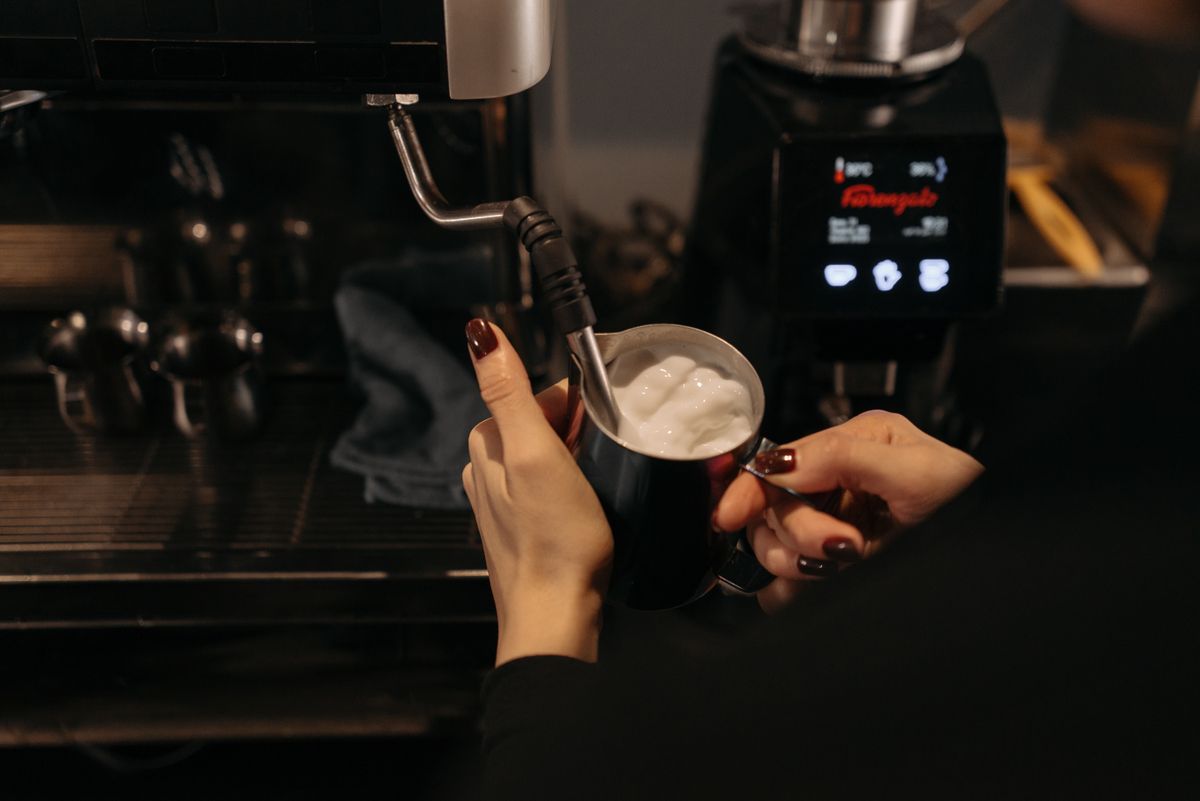
A steam wand that stops frothing is almost always one of two completely different faults, and the fix for one does nothing for the other. Before changing anything, work out which you have — it takes about ten seconds.
Point the wand into an empty jug and open the steam valve. Either dry steam hisses out under pressure, or it does not.
Which problem do you have?
Little or no steam comes out. A weak wisp, a dribble of water, or nothing at all. This is a machine fault — a blocked tip, a machine not up to temperature, or a valve problem. No amount of technique will fix it.
Plenty of steam, but the milk will not foam. The wand hisses properly, the milk gets hot, and you still end up with flat, bubbly or separated milk instead of glossy microfoam. This is technique, milk or equipment shape — and the wand is working fine.
Most guides mix these together and give you a list covering both. Establish which one you have first and you can ignore half of what follows.
If little or no steam comes out
The tip is blocked with dried milk
This is the most common mechanical cause by a distance. Milk that dries inside the tip holes sets hard, and it takes very little of it to choke a 1mm hole. The wand will often still produce a thin, angry hiss rather than nothing at all, which is why people mistake it for a pressure problem.
The fix: soak the tip. Most tips unscrew — take it off and leave it in hot water, or in a dedicated milk-line cleaner, for fifteen minutes or so, then clear each hole with a pin or the wire that came with the machine. If the tip does not unscrew, stand a jug of cleaner under the wand with the tip submerged and leave it.
The habit that prevents it: purge the wand for a second immediately after steaming, before you wipe it. Wiping alone leaves milk inside the holes, which is where the problem starts.
The machine is not at steam temperature
Steam needs a much hotter boiler than brewing does. On a single-boiler machine you have to wait after switching to steam mode — often thirty to sixty seconds after the light changes, because the light frequently indicates the thermostat has switched rather than that the boiler has caught up. Open the wand too early and you get water spitting out rather than steam.
If you get a splutter of water followed by weak steam, this is usually what is happening. Wait longer, and purge the condensed water out of the wand before you put it in the milk.
There is water in the wand and no more
Every wand holds condensed water between uses, which is why purging first is standard. If purging produces water and then nothing, the machine is not making steam at all — check the water tank is seated properly, because a tank that is not fully home will let a machine brew but starve the steam circuit on some designs.
Scale, on an older machine
Scale narrows the steam path over months and shows up as a gradual weakening rather than a sudden stop. If the machine has never been descaled and the decline has been slow, descale before assuming anything has failed.
If there is plenty of steam but no foam
The wand is fine. Something about the milk, the jug or the technique is stopping air being drawn in.
The tip is too deep in the milk
Foam is made in the first few seconds by drawing air in at the surface. If the tip starts submerged, you heat the milk without ever aerating it — hot flat milk, every time.
Start with the tip just under the surface, so it makes a steady tearing or paper-ripping sound. That noise is air being incorporated. Once the jug has grown by roughly a third, sink the tip deeper to stop aerating and just spin the milk to fold the foam in.
There is no whirlpool
Angle the tip off-centre so the milk rotates. The spin is what breaks large bubbles into microfoam. Straight down the middle gives you a jug of stiff, bubbly foam sitting on hot milk — which is what most people mean when they say it is not frothing properly.
The jug is the wrong size or shape
A jug filled much beyond a third has no room to expand, and a jug too large for the volume leaves the tip unable to reach a workable depth. As a rule, fill to just below the base of the spout, and match jug size to the drink rather than using one jug for everything.
What it should sound and look like
Diagnosing bad foam is much easier if you know what correct looks like, because the failure shows up in the first five seconds rather than at the end.
- Seconds 0–1: a splutter as the last condensed water clears. This is why you purge first.
- Seconds 1–5: a steady tearing or paper-ripping sound, repeating in short bursts. This is the only part of the process where foam is created. Silence here means the tip is too deep; a violent screeching or bubbling means it is too shallow and you are blowing large bubbles into the milk instead of fine ones.
- Once the volume has grown by about a third: sink the tip deeper. The tearing should stop and turn into a low rumble as the milk spins.
- The rest: no new sound, just rotation, until the jug becomes too hot to hold comfortably against your palm — roughly 60 °C. Past that the proteins stop holding air and the foam collapses even if you did everything else right.
Finished milk should look like wet paint and pour as one thing. Visible bubbles, or a layer of foam that separates from the milk beneath while it sits, means aeration happened too late or too aggressively — not that the machine failed.
The milk itself
Start cold, straight from the fridge — cold milk gives you a longer window before it gets too hot to texture. Whole milk foams most easily because fat stabilises the foam; skimmed makes stiffer, drier foam that collapses faster. Milk that has been steamed once and cooled will not foam again properly, so start with fresh milk every time.
Plant milks vary enormously, and the ones that work are usually labelled “barista” for exactly this reason — they contain added stabilisers. A standard oat or almond milk failing to foam is not a machine fault.
If your machine has a panarello, the rules are different
Many entry-level machines do not have a bare steam wand at all. They have a panarello — a plastic or metal sleeve around the wand with an air hole in the side. It works by drawing air in through that hole automatically, and it is designed to make foam without any skill on the user’s part.
Three things follow from that, and they reverse the advice above:
- The tip needs to be deeper, not shallower. A panarello aerates through its side hole, not at the surface, so keeping it near the top does nothing useful.
- The air hole blocks. It is small, it sits where milk splashes, and a blocked one is the single most common reason a panarello machine stops foaming. Take the sleeve off and clear the hole.
- You cannot make proper microfoam with it. A panarello produces stiff, bubbly foam suitable for a cappuccino, not the glossy texture latte art needs. If that is what you are chasing, the limit is the hardware rather than your technique — the semi-automatic guide covers which machines have proper wands.
If you are not sure which you have: a bare wand is a plain metal tube with a screw-on tip; a panarello has a wider sleeve with a visible hole in the side, and often a rubber grip.
The order worth working through
- Purge the wand into an empty jug. Steam or no steam? Everything branches here.
- No steam: soak and clear the tip, then check you waited long enough for steam temperature.
- Still no steam: reseat the water tank, then descale if it has been a while.
- Steam but no foam: start with the tip just under the surface until you hear tearing, then submerge and spin.
- Still no foam: check jug fill level, then switch to cold whole milk as a control.
- Panarello machine: clear the side air hole and go deeper rather than shallower.
When it is the machine rather than you
If the tip is clear, the machine has had time to reach steam temperature, and you still get water or a weak hiss, the fault is internal — a steam valve, a thermoblock, or a thermostat. On a machine with a metal boiler that is worth a repair quote. On an entry-level thermoblock machine the diagnosis often costs more than the machine did.
It is also worth being honest about what a given machine can do. Milk texturing is one of the clearest differences between price tiers: a small thermoblock recovers slowly and runs out of steam part-way through a jug, and no technique fixes that. If you have concluded the hardware is the limit, the machines worth buying under $500 and the options under $200 both note steam performance, and the Breville Bambino Plus review covers automatic milk texturing, which removes the technique question entirely.
How This Guide Was Put Together
Plainly: this is a research-based guide, not a hands-on test. I have not stripped down these machines, and nothing here should be read as a report from my own kitchen.
What it rests on: the physics of milk foam, which is well documented — air is entrained at the surface in the first seconds and fat and protein stabilise the resulting bubbles, which is why fat content and starting temperature matter and why re-steamed milk does not work; manufacturer troubleshooting documentation, including De’Longhi’s own steam wand FAQ; and the pattern of what owners report, where blocked tips and blocked panarello air holes recur far more often than any internal fault.
What I could not establish: how much of the reported failure rate is technique versus hardware. Nobody measures that, and the two are almost impossible to separate from owner reports because a person whose machine cannot hold steam pressure and a person steaming badly describe the same outcome. The ordering above puts the cheap, reversible checks first for that reason rather than because they are statistically more likely.
Frequently Asked Questions
Why did my steam wand stop frothing suddenly?
A sudden stop is almost always a blocked tip. Dried milk sets inside the holes and it takes very little to choke them. Unscrew the tip if you can, soak it in hot water or milk-line cleaner for fifteen minutes, and clear each hole with a pin. Purging for a second straight after every use prevents it recurring.
How do I unclog a steam wand?
Soak rather than scrape. Remove the tip if it unscrews and leave it in hot water or a dedicated cleaner, then clear the holes with the pin supplied with the machine. If the tip is fixed, stand a jug of cleaner under the wand with the tip submerged. Do not push anything hard through the holes — enlarging or deforming one changes the steam pattern permanently.
Why is my milk hot but not foamy?
The tip is almost certainly too deep. Foam is created by drawing air in at the surface during the first few seconds. If the tip starts submerged you heat the milk without aerating it. Start just under the surface until you hear a tearing sound, then sink the tip to fold the foam in.
Does the type of milk matter?
Yes. Whole milk foams most readily because fat stabilises the bubbles; skimmed produces stiffer foam that collapses faster. Milk that has already been steamed once will not foam properly again. Most standard plant milks foam poorly unless they are the barista versions, which contain added stabilisers.
Why does my machine make steam for a few seconds and then stop?
Usually the boiler cannot keep up. Small thermoblock machines make steam in short bursts and need time to recover, which is a hardware limit rather than a fault. If it used to manage a full jug and no longer does, descale first.
My machine has a plastic sleeve around the wand and stopped foaming. What is different?
That is a panarello, and it aerates through a small hole in the side of the sleeve rather than at the milk surface. A blocked air hole is the usual cause. Remove the sleeve, clear the hole, and keep the tip deeper in the milk than you would with a bare wand.
More espresso troubleshooting
If the shot itself is the problem rather than the milk, see what to check when an espresso machine is not building pressure, or the guide to an espresso machine leaking water.

I'm Glenn, and I started Kitchenware Compare to cut through conflicting product reviews and help readers pick kitchen gear with confidence. I don't own or test the products I write about — these guides are built from verified-purchase reviews, manufacturer specifications, and independent testing where it exists, with the reasoning shown, not just a rating.
Leave a Reply