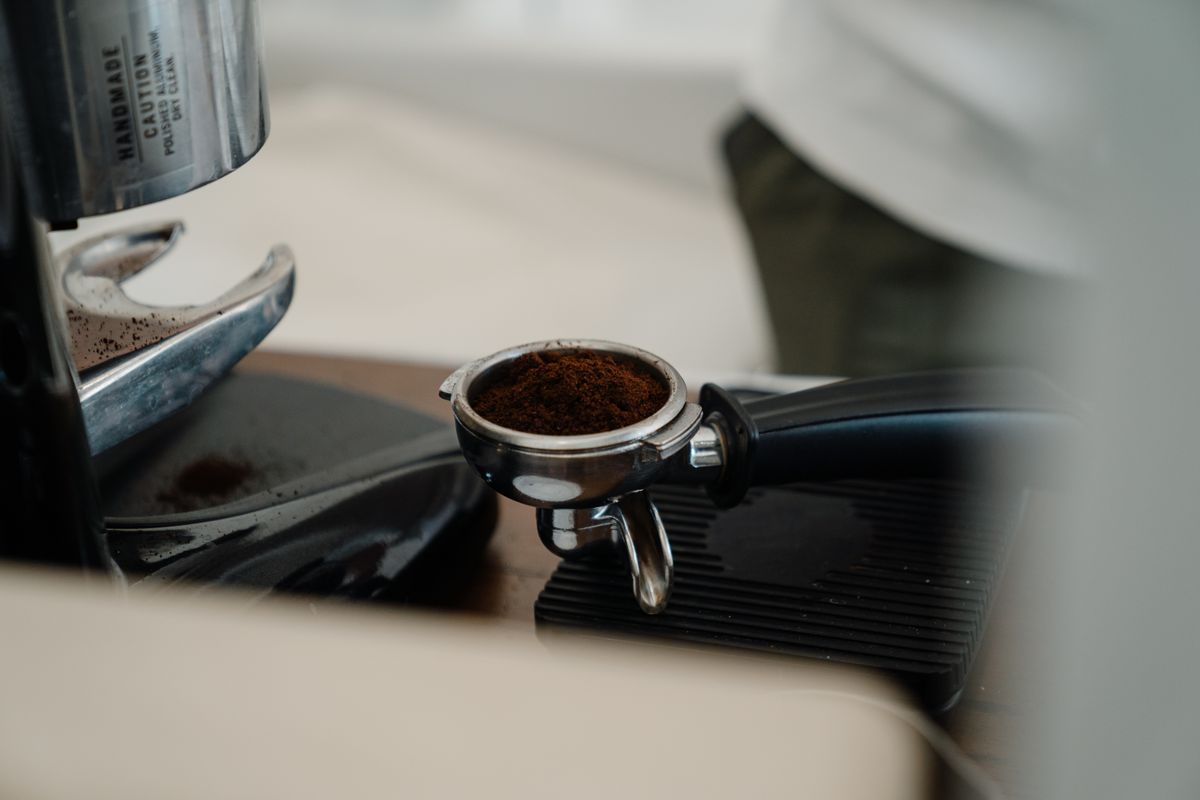
An espresso machine that will not build pressure is usually not broken. In most home kitchens the cause is the coffee or the basket rather than the pump, and the two can be told apart in about thirty seconds without opening anything.
This guide works through the causes in the order worth checking them, with a way to tell which one applies to you at each step.
What “not building pressure” actually looks like
Two different faults get described the same way, and separating them saves a great deal of time.
The gauge never reaches the middle band, and the shot gushes out. A double runs in eight or ten seconds and comes out pale and thin. The machine is producing flow but nothing is resisting it. This is the common case and it is almost always the coffee or the basket.
The gauge sits low and almost nothing comes out. The pump is audible but the flow is a dribble or a few drops. That points at a blockage or at the pump itself, and it is much less common.
The first thing to establish is which of those you have, because everything below branches from it.
Start here: is it the coffee or the machine?
Take the portafilter out, empty it, lock it back into the group head with nothing in it, and run the pump for a few seconds.
Water should pour out fast and freely, and the gauge should stay low. That is correct — there is nothing for the pump to push against. If instead you get a weak dribble with an empty basket, the restriction is in the machine, not in your coffee, and you can skip to the machine section below.
If water runs freely on an empty basket but your shots still gush, the machine is fine and the problem is what you are putting in it.
The cause almost nobody mentions: which basket you are using
This is the single most common reason a home machine stops building pressure, and none of the pages currently ranking for this problem mentions it.
Most entry-level machines ship with a pressurised basket — sometimes called a dual-wall or crema-enhancing basket. It has a single tiny hole in a second layer underneath, and that hole creates back-pressure artificially. It will build pressure and produce foam almost regardless of your grind, which is exactly why manufacturers fit them.
A non-pressurised basket, the kind serious users switch to, is a simple mesh of holes. It creates no artificial resistance at all. The pressure has to come entirely from a correctly ground, correctly dosed puck.
If you recently bought a bottomless portafilter or a “proper” basket and your pressure vanished overnight, nothing has failed. You have removed the thing that was doing the work, and your grinder now has to do it instead. If the grinder is not delivering a consistent fine grind, see what to check when a coffee grinder is not grinding properly. That usually means grinding substantially finer than you were before — often several steps.
Two ways to tell what you have: look underneath the basket for a single small hole in a second wall (pressurised) versus a field of holes right through (non-pressurised), or run a shot and watch. A pressurised basket squirts a thin jet from one point; a non-pressurised one wets the whole underside.
If the coffee is the problem
The grind is too coarse
This is the first thing to change and the one most likely to fix it. Espresso needs a grind close to caster sugar or finer — noticeably finer than filter. If your double is running in under twenty seconds, go finer and try again, one or two steps at a time. Change one variable per shot, otherwise you will not know what fixed it.
Pre-ground supermarket espresso is a common dead end here. Much of it is ground for pressurised baskets or for moka pots and simply cannot be made fine enough by any adjustment on the machine. If you are working from pre-ground coffee and cannot get resistance, that is very likely the whole answer, and it is the case for a decent grinder rather than a new machine.
There is not enough coffee in the basket
A double basket generally wants somewhere around 18 grams, and a single around 9. Under-dosing leaves headroom above the puck, water finds the gap, and pressure never develops. If you are dosing by eye, weigh it once to see where you actually are — people are routinely several grams under what they assume.
The puck is not level or not tamped
Tamping is about flatness more than force. A puck tamped at an angle gives water a preferential path down one side, and once water finds that path it takes it. Distribute the grounds evenly before tamping, then press straight down.
The beans are stale
Stale coffee produces less crema and a slightly different flow, but it will not by itself stop a machine building pressure. Treat it as something that makes a shot disappointing rather than as the cause of a pressure fault.
If the machine is the problem
Work through these only if water would not run freely through an empty basket.
A blocked shower screen or basket
The shower screen sits in the group head and spreads water across the puck. Old grounds and coffee oil build up behind it and restrict flow. Most screens unscrew with a single central bolt; the basket holes can block in the same way, particularly if the basket goes through a dishwasher and picks up mineral deposits.
A basket that has genuinely blocked will usually show it — hold it up to a light and the holes should be evenly bright. Soaking in an espresso machine cleaner solution and a soft brush clears most of it.
Scale
In hard-water areas scale narrows the boiler outlet and the internal lines over months. The usual signs are a gradual decline rather than a sudden fault, and often a longer warm-up. Descale to the interval in your machine’s manual, which is the one number genuinely worth taking from the manufacturer here because it is specific to the boiler design.
The over-pressure valve
The OPV bleeds off pressure above a set point, usually around nine bar. If it is set low or has failed open, the machine dumps pressure that should be reaching the puck. This is a real cause but a less likely one, and on most machines adjusting it means opening the case. It is worth suspecting mainly if the machine has always been weak rather than having changed recently.
The pump
Genuine pump failure is the least common cause on this list and the one people reach for first. A failing vibratory pump usually announces itself: a change in the noise it makes, or a machine that works when cold and fades as it runs. If water still flows freely through an empty group head, the pump is moving water and is probably not your problem.
The order worth checking in
Most guides list causes without saying which to try first. This is the sequence that resolves the largest number of cases in the least time:
- Establish which symptom you have — gushing shot, or almost no flow at all.
- Run water through an empty basket. Free flow means the machine is fine and the coffee is the issue. A dribble means the opposite.
- Check which basket you are using. Pressurised or not. If you changed it recently, this is very likely the answer.
- Grind finer, one or two steps. Change nothing else and pull another shot.
- Weigh your dose. Around 18g in a double.
- Check the tamp is level.
- Clean the shower screen and basket.
- Descale, if it has been a while and your water is hard.
- Only then consider the OPV or the pump.
Steps two to five resolve the majority of cases at home and cost nothing.
When to stop and get it serviced
If an empty basket still will not pass water freely after cleaning and descaling, the restriction is internal and further home diagnosis has poor odds. The same applies to a machine that trips a breaker, leaks from the base, or makes a grinding noise from the pump.
The economics matter at the lower end. A service call frequently costs more than an entry-level machine, so on a machine under about $200 a fault that survives cleaning and descaling is often the end of it. On a Gaggia, a Breville or anything with a metal boiler, repair usually makes sense — those are built to be opened, and parts are available. If yours is at the point where replacement is the honest answer, the espresso machines worth buying under $500 and the cheaper options under $200 are both covered separately, and the semi-automatic guide explains what you actually control on each.
How This Guide Was Put Together
Plainly: this is a research-based guide, not a hands-on test. I have not stripped down these machines, and nothing here should be read as a report from my own kitchen.
What it rests on: the mechanics of espresso extraction, which are well documented and not in dispute — resistance comes from the puck, and a pressurised basket manufactures that resistance artificially; manufacturer troubleshooting documentation, including KitchenAid’s own pressure guidance, which is useful on grind and dose and silent on basket type; and the pattern of what owners report across verified-purchase reviews and enthusiast forums, where the basket-swap case recurs constantly and is rarely written up.
What I could not establish: how often each cause actually occurs. Nobody publishes failure statistics for home espresso machines, so the ordering above reflects how cheap and quick each check is and how often it comes up in owner reports — not a measured frequency. If your machine changed behaviour suddenly rather than gradually, weight whatever you changed most recently above everything on this list.
Frequently Asked Questions
Why did my espresso machine stop building pressure after I changed the basket?
Because the old basket was doing the work. A pressurised or dual-wall basket creates back-pressure through a single small hole, largely independent of your grind. A non-pressurised basket has none of that, so the resistance must come from a finer, well-distributed puck. Grind noticeably finer and the pressure returns.
What should the pressure gauge read during a shot?
Most home machines mark a target band, typically around nine bar. Sitting below it with a fast, pale shot points at grind, dose or basket. Sitting below it with almost no flow points at a blockage. The gauge on many machines measures pump pressure rather than pressure at the puck, so treat it as an indicator rather than a measurement.
Can a bad grinder cause low pressure?
Yes, and it is one of the most common causes. A blade grinder, or a burr grinder without fine enough steps at the espresso end, cannot produce a grind fine and even enough to build resistance in a non-pressurised basket. Pre-ground espresso often cannot either.
How do I know whether it is the pump?
Lock in an empty portafilter and run the pump. If water flows out freely, the pump is moving water and is unlikely to be the fault. Pump problems usually come with a change in noise, or a machine that weakens as it heats.
Will descaling fix low pressure?
It can, if scale is restricting flow — but that produces a gradual decline over months rather than a sudden change. If your machine was fine last week, descaling is unlikely to be the answer, though it is worth doing anyway.
Is it worth repairing an espresso machine that will not build pressure?
It depends what you paid. Below roughly $200, a fault that survives cleaning and descaling often costs more to diagnose than the machine is worth. Machines with metal boilers and available parts — Gaggia, Breville and similar — are generally worth repairing.
More espresso reading
If the milk rather than the shot is the problem, see what to check when a steam wand will not froth milk. If the problem is water rather than pressure, there is a separate guide to an espresso machine leaking water. For the grinder side of this problem, see the espresso grinder guide.

Glenn is the founder of Kitchenware Compare and has spent years researching, testing, and reviewing kitchen appliances, cookware, and gadgets. A lifelong home cook raised in a family that treated every meal as an occasion, Glenn started this site to cut through the noise of conflicting product reviews and give readers honest, practical guidance. When he is not testing the latest air fryer or digging into the specs of a new espresso machine, he can usually be found experimenting with new recipes or hunting for the perfect cast iron skillet at a flea market.
Leave a Reply