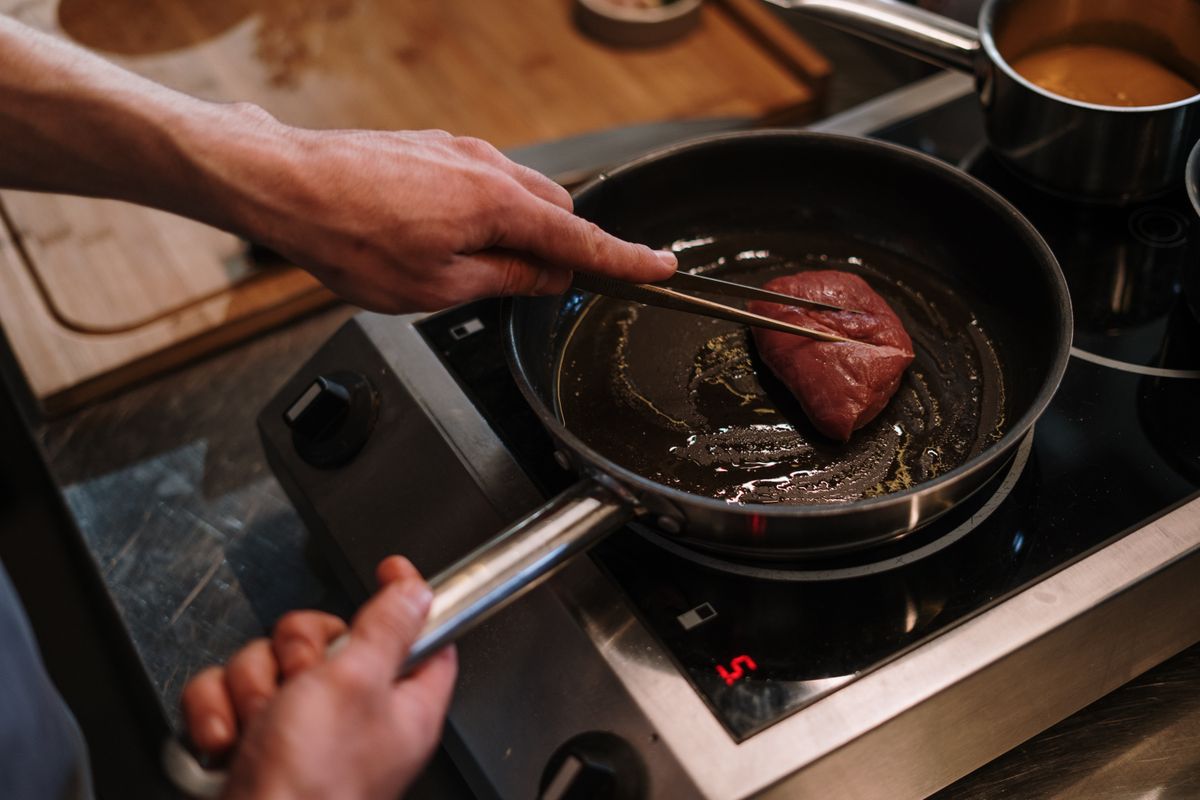
A pan that rocks, spins or lets oil run to one side has warped. Most advice jumps straight to whether you can hammer it flat. The more useful question comes first, and the answer depends entirely on what you cook on.
Does it actually matter? That depends on your hob
The same warp is a non-event on one cooker and a real problem on another, which is why people get such contradictory advice.
Gas: it matters least. A flame wraps around the base and heats it whether or not the pan is perfectly flat. A pan that rocks is annoying to stir in, and oil will pool on one side, but the heating itself is largely unaffected. A mild warp on a gas hob is something you can live with more or less indefinitely.
Electric radiant and ceramic or glass tops: it matters most. These heat by direct contact. Where the base lifts away from the surface, there is an air gap, and air is an excellent insulator.
The result is slow heating, obvious hot and cold zones, and often a pan that spins when you stir. This is the setup where a warped pan genuinely stops working.
Induction: it matters, differently. Induction couples a magnetic field into the base, and that coupling weakens as the base lifts away. A moderately warped pan heats less efficiently and unevenly, and a badly warped one may buzz, rattle or fail to be detected at all. A domed base also lets the pan rotate on a smooth glass surface.
So before deciding what to do about it, decide whether it is actually costing you anything.
Which way has it gone?
Two different shapes get called warping, and they behave differently.
Convex, or domed. The centre of the base bulges downward. The pan rocks or spins on a flat surface, and oil runs away from the middle towards the rim. This is the more common form on thin pans.
Concave, or dished. The centre is pulled upward, so the pan sits flat on its rim but the middle does not touch. Oil pools in a ring rather than spreading, and on a glass top the middle heats poorly. This is more common on disc-base pans where the bonded disc has moved relative to the body.
How to check: put the pan on a genuinely flat surface such as a worktop or a glass chopping board and press one edge, then the opposite one. Rocking means convex. If it sits still, lay a ruler or any straight edge across the inside of the base and look for daylight under the middle — that is concave. A teaspoon of oil and a level surface tells you the same thing faster: watch which way it runs.
Can it be flattened again?
Usually not, and this is where most of the advice on the subject is more optimistic than it should be.
Warping is not the pan being bent out of position. It is plastic deformation: the metal was heated unevenly, one region expanded more than the region around it, and the stress exceeded the point at which the metal could spring back. The base is now a slightly different shape than it was made. Reversing that means deforming it again, in exactly the right places, by exactly the right amount.
Non-stick and coated pans: no
Do not attempt it. Any force sufficient to move the metal will craze, crack or delaminate the coating, and you will convert a slightly annoying pan into one that sheds its surface. That failure is covered in the guide to coatings that flake off, and it is not worth causing deliberately.
Thin stainless and clad pans: almost certainly not
The popular method — upside down on a hard surface, a block of wood over the bulge, a few taps with a mallet — occasionally works on a genuinely thick base. On thin or multi-ply construction it usually moves the problem rather than removing it, creating a new high spot next to the old one, and it can separate a bonded disc from the pan body. Clad pans in particular are layers of different metals joined under heat and pressure; hammering them is not a repair operation.
Cast iron and thick carbon steel: sometimes, carefully
Thick single-metal pans are the realistic candidates, because there is enough material to move without buckling and no coating or bonded layer to ruin. Even then it wants a proper flat anvil surface, a dead-blow or rubber mallet, work from the outside of the bulge inward, and frequent checking with a straight edge. Cast iron is brittle and can crack rather than bend, which ends the pan immediately.
The honest summary: if the pan is cheap, replace it. If it is expensive, it probably has a warranty worth using before anyone reaches for a mallet.
What about the warranty?
Worth checking first, and more often successful than people expect. Several cookware manufacturers treat warping within the warranty period as a manufacturing defect rather than misuse, particularly on pans sold as suitable for induction or flat tops. It is one email, and it costs nothing to ask.
Why it happened
Thermal shock, which is nearly always the cause
Taking a hot pan off the heat and running it under a cold tap, or setting it on a wet surface, or adding cold liquid to a very hot empty pan. The surface in contact with the cold contracts fast while the rest of the metal is still expanded, and the stress between them does the damage in a fraction of a second.
This single habit accounts for most warped pans. Let a pan cool before it meets water, and soak it afterwards if something is stuck.
Preheating empty, especially on high
An empty pan has nothing to absorb the heat, so the base races upward in temperature while the sides lag. Food or liquid in the pan buffers this. Thin pans are much more vulnerable, and non-stick should never be preheated empty at high heat for the separate reason that the coating degrades.
A burner much smaller than the pan
A small gas ring or a small radiant element under a large pan creates a hot disc in the middle and a comparatively cool rim. That difference is exactly the condition that warps a base, and it is a slow, cumulative version of thermal shock. Match pan size to burner size where you can — the gas stove cookware guide covers why burner-to-base matching matters more than most people assume.
The pan was thin to begin with
Warping resistance comes almost entirely from base thickness and construction. A thin single-ply pan will warp eventually under normal use; a thick disc base or fully clad base distributes heat well enough that the stress never concentrates. This is the one factor you buy rather than manage.
Choosing one that will not do it again
If you are replacing the pan, the specification that matters is not the brand or the coating — it is the base.
- Thickness first. A heavy base resists warping and heats evenly. Pick the pan up: weight in the base is the single best proxy available in a shop.
- Fully clad or a thick bonded disc, rather than a thin sheet with a disc spot-welded on. Delamination of a cheap disc shows up as the concave form described above.
- Flatness matters more on flat tops. If you cook on glass, ceramic or induction, this is the specification to prioritise, because it is the setup where a warp actually costs you performance. The frying pan guide for electric and flat top stoves is built around exactly that requirement, and the cookware set guide notes base construction across full sets.
- Cast iron does not warp in normal use because it is thick, though it can crack under genuine thermal shock. If flatness on a glass top is the priority, it is worth considering — see the cast iron skillet picks.
The order worth working through
- Work out whether it matters. Gas: mostly cosmetic. Glass, ceramic or induction: it is costing you real performance.
- Check which way it has gone — rock it, or lay a straight edge across the base.
- Check the warranty before doing anything else.
- Coated pan? Do not attempt to flatten it. Replace it.
- Thick cast iron or carbon steel? Flattening is possible but risky, and cast iron can crack.
- Whatever happens next: stop putting hot pans under cold water. That is what did it.
How This Guide Was Put Together
Plainly: this is a research-based guide, not a hands-on test. I have not warped pans deliberately to compare outcomes, and nothing here is a report from my own kitchen.
What it rests on: the mechanics of thermal expansion and plastic deformation, which explain both why sudden cooling warps a base and why the deformation is not simply reversible; the difference in how gas, radiant and induction hobs deliver heat, which is why the same warp has such different consequences on different cookers; and manufacturer care instructions, which are consistent in warning against cold water on hot pans and against preheating empty.
Also not established: a base thickness in millimetres above which warping stops being a risk. Manufacturers rarely publish base thickness, the figure interacts with construction and hob type, and any number would be invented.
Frequently Asked Questions
Why does my pan not sit flat?
The base has warped, almost always from thermal shock — a hot pan meeting cold water, or being preheated empty, or a burner much smaller than the base. The metal expanded unevenly and deformed past the point where it could spring back, so the base is now a slightly different shape than when it was made.
Is it safe to use a warped pan?
Yes, provided the pan is otherwise sound and the coating, if it has one, is intact. Warping is a performance and stability problem rather than a safety one. The genuine risk is a pan that rocks badly enough to tip on a hob, which is a reason to stop using it for anything heavy or liquid.
How do I make a warped pan flat again?
In most cases you cannot. Coated pans should never be hammered, because the force required will wreck the coating. Thin or clad pans usually end up worse, with a new high spot beside the old one.
Thick cast iron or carbon steel can sometimes be worked flat on a hard surface with a rubber mallet, but cast iron can crack instead of bending. Check the warranty first.
Does a warped pan matter on a gas hob?
Much less than on other cookers. A flame heats the base whether or not it is perfectly flat, so the main annoyances are oil running to one side and the pan rocking while you stir. On glass, ceramic or induction, where heat depends on contact or magnetic coupling, the same warp causes slow and uneven heating.
Why does my pan spin on an induction hob?
The base is domed, so it touches the glass at one point in the middle and pivots on it. Beyond being irritating, it means the base is not sitting flush, which reduces how efficiently the hob couples into the pan and can cause buzzing or a failure to detect the pan at all.
What causes a pan to warp in the first place?
Rapid, uneven temperature change. Running a hot pan under a cold tap is the most common cause by a wide margin. Preheating an empty pan on high, and using a burner much smaller than the pan base, do the same thing more gradually. Thin bases warp far more readily than thick ones.
Do expensive pans warp?
Less often, but not never. Resistance comes from base thickness and construction rather than price as such, so a heavy fully clad pan resists warping while a thin one from the same brand may not. No pan is immune to a hot base meeting cold water.
More cookware guides
For other marks and damage on bare steel, see white spots on a stainless steel pan. If the pan is coated and food has started sticking, there is a guide to a non-stick pan that will not release food.

I'm Glenn, and I started Kitchenware Compare to cut through conflicting product reviews and help readers pick kitchen gear with confidence. I don't own or test the products I write about — these guides are built from verified-purchase reviews, manufacturer specifications, and independent testing where it exists, with the reasoning shown, not just a rating.
Leave a Reply