I earn a commission if you buy through the Amazon links below, at no extra cost to you.
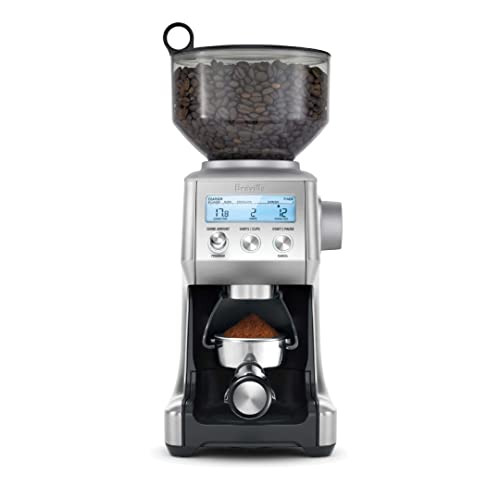
The Breville Smart Grinder Pro is the mid-range pick in my espresso grinder guide, and at $199.95 it is the machine most people land on when they accept that the grinder matters more than the machine. This review covers what its 60 settings actually give you, why timed dosing is the real limitation, and the unusual shape of its rating distribution.
Quick Verdict
| Score | Price | Rating | Buy |
|---|---|---|---|
| 8.0/10 | $199.95 | 4.5★ (6,990) | Check Price |
Specifications
| Spec | Breville BCG820BSS |
|---|---|
| Burr type | Conical burr, stainless steel |
| Grind settings | 60, stepped |
| Dosing | By time, programmable in 0.2 second increments |
| Motor | 165 watts, 110-120 volts |
| Hopper capacity | 18 oz |
| Grinds into | Portafilter, the supplied container, a gold tone basket or a paper filter |
| Portafilter cradles | 50-54 mm and 58 mm, both included |
| Display | LCD showing grind setting, grind time and shot or cup count |
| Weight | 6.4 lbs |
| Warranty | 2 year limited |
Who It’s For
- Anyone pairing a grinder with an entry or mid-range espresso machine, where the grinder is the component actually limiting the shot
- Households brewing more than one way — the 60-step range covers espresso through French press from the same machine
- Anyone who wants to grind straight into the portafilter, since both common basket sizes are catered for in the box
- People who value a repeatable button press over a ritual, which is what programmable timed dosing buys
Who Should Look Elsewhere
- Anyone chasing the finest espresso adjustment. Sixty steps is a lot for a domestic grinder and still not stepless, and at the espresso end the gaps between steps are where dialling in gets frustrating
- Anyone who wants dose by weight. This grinder measures time, not grams, and those are not the same thing
- Single-method brewers on a budget. If you only make French press, a far cheaper grinder covers coarse grinding perfectly well
- Anyone unwilling to run a machine with a known failure tail — see the rating distribution below
Performance
Sixty settings, and where they run out
The adjustment range is genuinely wide: coarse enough for French press at one end, fine enough for espresso at the other, from a single machine. For most households that breadth is the reason to buy it rather than a cheaper single-purpose grinder.
The catch is that the settings are stepped rather than continuous. Across the coarse two-thirds of the range that makes no practical difference, because filter and press brewing tolerate a wide grind window. At the espresso end it does, because espresso is dialled in changes small enough to fall between steps, and the usual workaround is adjusting dose or tamp instead of grind.
Timed dosing is the real limitation
Dosing is by time, programmable in 0.2 second increments, with the count shown on the LCD. It is repeatable and it is convenient, and it is not the same as dosing by weight.
The reason matters: a given number of seconds delivers a different mass of coffee as beans age, as the roast changes, and as the burrs wear. Anyone weighing shots will find the timer drifting against the scale over weeks, which is not a defect so much as the boundary of what timed grinders can do. If your shots are running inconsistently, the guide to an espresso machine not building pressure works through grind, dose and tamp in the order worth checking.
Grinding into the portafilter
Both a 50-54 mm and a 58 mm cradle come in the box, which covers the great majority of domestic machines including the 58 mm commercial-size baskets on machines like the Gaggia Classic Pro. Grinding straight into the basket avoids a transfer step, and a transfer step is where dose gets lost.
Design and Build
Brushed stainless steel over a 6.4 lb body, with an 18 oz hopper that is generous for a domestic grinder. The LCD is the practical part of the design rather than a flourish: seeing grind setting, time and count at once is what makes a change reproducible the next morning.
The 165 watt motor is modest on paper. For a conical burr grinder working in short domestic bursts that is adequate rather than marginal, but it is not a machine built for grinding continuously, and treating it as one is the fastest route to trouble.
Cleaning and Maintenance
A cleaning brush is supplied and the upper burr lifts out for access. The job that actually matters is doing it regularly rather than thoroughly, because coffee oils build up and go stale in the chute and the grinds container.
Stale residue is also the usual explanation when a grinder seems to slow or clog rather than fail. The guide to a grinder that hums but does not grind covers the difference between a jam, an oil-caked burr and a genuinely dead motor.
Value
At $199.95 this sits above the entry-level burr grinders and well below the stepless espresso-focused machines that start around double. What the money buys is range plus repeatability, and for someone brewing espresso on a machine in the $300 to $600 bracket that is a sensible match rather than an overspend.
The judgement in my espresso grinder guide holds here: a capable grinder in front of a modest machine beats an expensive machine fed by a poor one. This is the grinder that makes that trade concrete at a mid-range budget.
Durability
The rating distribution is unusual and worth reading rather than averaging. Across 6,990 ratings it runs 80% five-star, 8% four, 3% three, 2% two and 7% one-star. A one-star share more than three times the two-star share is a failure tail, not gradual dissatisfaction: most owners are very happy and a minority have something go properly wrong.
That shape argues for two things. Register and keep the two-year limited warranty paperwork, and exercise the machine properly in the first weeks rather than discovering a fault after the return window has closed.
Alternatives to Consider
- The full grinder guide — where the cheaper and the stepless options sit, and what each price step actually changes
- Espresso machines under $500 — the bracket this grinder is best matched to
- The coffee section — French press, moka pot and the rest, if espresso is not settled yet
Verdict
The Smart Grinder Pro is the sensible middle of the domestic grinder market, and it earns that position on range and repeatability rather than on any single specification. For a household brewing espresso and something else from the same beans, it is the machine that stops the grinder being the weakest part of the setup.
Its limits are honest ones: stepped adjustment that thins out at the espresso end, and dosing by time rather than weight. Neither matters much for filter and press brewing. Both matter if espresso is the whole point and you are already weighing shots, in which case the money is better spent further up the range.
How This Review Was Put Together
Plainly: this is research-based, not a hands-on test. I have not owned or used this grinder, and nothing here should be read as a report from my own kitchen.
What it rests on: the published specification — burr type, the stepped 60-setting range, timed dosing in 0.2 second increments, motor wattage, hopper size, the two included portafilter cradles and the warranty term — plus the rating distribution across 6,990 Amazon ratings, which is a stronger signal than the 4.5 average it produces.
What I could not establish: grind consistency, which is the specification that would actually separate this grinder from its rivals and which no manufacturer publishes in comparable form. Nothing here claims a particle-size measurement. Price and stock were read from Amazon’s US marketplace on 6 September 2026 and will move.
Frequently Asked Questions
Is the Breville Smart Grinder Pro good enough for espresso?
Yes for most domestic setups, with one caveat. The fine end of its range reaches espresso comfortably, but the adjustment is stepped rather than stepless, so dialling in sometimes means adjusting dose or tamp rather than grind. On an entry or mid-range machine that is rarely the limiting factor.
Does it grind directly into a portafilter?
Yes. Cradles for both 50-54 mm and 58 mm portafilters are included in the box, which covers most domestic machines including those using the 58 mm commercial basket size. Grinding straight into the basket avoids a transfer step where dose is easily lost.
Does it dose by weight or by time?
By time, programmable in 0.2 second increments. That is repeatable but not the same as weighing: the same number of seconds delivers a different mass as beans age and as burrs wear, so anyone weighing shots should expect to retune the timer periodically.
What does the rating distribution say about reliability?
That opinion is polarised rather than lukewarm. Across 6,990 ratings, 80% are five-star and 7% are one-star, against only 2% two-star. That shape points to a minority experiencing outright failure rather than to widespread mild disappointment, which is a reason to keep the two-year warranty details to hand.
If $200 is more than this job is worth to you, the OXO Brew Conical Burr review covers the half-price alternative and exactly what you give up.

Glenn is the founder of Kitchenware Compare and has spent years researching, testing, and reviewing kitchen appliances, cookware, and gadgets. A lifelong home cook raised in a family that treated every meal as an occasion, Glenn started this site to cut through the noise of conflicting product reviews and give readers honest, practical guidance. When he is not testing the latest air fryer or digging into the specs of a new espresso machine, he can usually be found experimenting with new recipes or hunting for the perfect cast iron skillet at a flea market.
Leave a Reply