I earn a commission if you buy through the Amazon links below, at no extra cost to you.
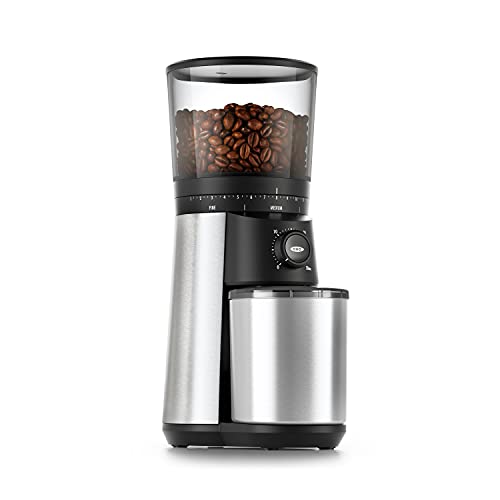
The OXO Brew Conical Burr is the budget electric pick in my espresso grinder guide, and at $109.95 it is where most people upgrading from a blade grinder should start. This review covers what its grind adjustment actually is underneath the marketing number, where that runs out for espresso, and what 23,330 ratings say about reliability.
Quick Verdict
| Score | Price | Rating | Buy |
|---|---|---|---|
| 7.5/10 | $109.95 | 4.3★ (23,330) | Check Price |
Specifications
| Spec | OXO Brew Conical Burr |
|---|---|
| Burrs | 40 mm stainless steel conical |
| Grind adjustment | 15 primary settings, with micro-adjustments between them (marketed as 43) |
| Dosing | One-touch timer that remembers the last setting |
| Hopper capacity | 12 oz, removable, UV-blocking tint |
| Weight | 4.5 lbs |
| Brew methods named by OXO | Drip, French press and cold brew in the listing title; espresso in the feature list |
Who It’s For
- Anyone moving off a blade grinder, which is the single biggest jump in cup quality available for a hundred dollars
- Drip, pour-over, French press and cold brew drinkers, which is the range OXO leads with
- Households where one person sets a grind and everyone else just presses the button
- Anyone who wants a burr grinder proven at scale rather than a boutique one
Who Should Look Elsewhere
- Anyone whose main brew is espresso and who is already weighing shots. The fine end is where 15 primary steps runs thin
- Anyone wanting dose by weight rather than by time
- Anyone grinding for a crowd continuously — this is a domestic grinder working in short bursts
Performance
What “43 settings” actually means
This is the number worth understanding before buying. OXO’s listing headlines 43 grind settings, and its own feature text is more precise: 15 grind settings, plus micro-adjustments between them. Those are not the same claim.
In practice you set one of 15 primary positions and then fine-tune within it. For drip, press and cold brew that is more resolution than the brew method can even use. For espresso it is the crux of the machine, because espresso is dialled in changes small enough to land between primary steps.
Where it runs out for espresso
The guide’s caveat holds up and this is the mechanical reason for it: at the fine end, adjacent settings make a surprisingly large difference to the shot, and the sweet spot can sit between two of them. The usual workaround is adjusting dose or tamp rather than grind.
That is a real limitation and not a disqualifying one at this price. A stepped burr grinder still beats any blade grinder by a wide margin, and if shots are running fast or gushing the guide to an espresso machine not building pressure covers grind, dose and tamp in the order worth checking.
The timer, and what it is good at
Dosing is a one-touch timer that remembers the last setting, so the second morning is a single button press. Like every timed grinder it measures seconds rather than grams, which means the dose drifts as beans age and as the burrs wear, and anyone weighing shots should expect to retune it periodically.
For filter brewing that drift is invisible. It only becomes a nuisance at the espresso end, where a gram either way changes the shot.
Design and Build
A 12 oz removable hopper with a UV-blocking tint, which is a genuinely thoughtful detail for beans left on a sunny counter, and 40 mm stainless conical burrs doing the actual work. At 4.5 lbs it is light enough to move and stable enough not to walk on the counter.
One inconsistency worth flagging rather than glossing: Amazon’s product attributes list the material as stainless steel, while the grinder is commonly described as having a plastic-bodied build with a tinted plastic hopper. Anyone for whom that matters should check the current listing rather than take either description on trust.
Cleaning and Maintenance
The upper burr lifts out and the grounds container removes for brushing. As with every burr grinder, the job that matters is frequency rather than thoroughness, because coffee oils go stale in the chute and taint the next brew before they ever cause a mechanical problem.
If the motor runs and nothing comes out, the cause is usually a jam or caked burrs rather than a failure — the guide to a grinder that hums but does not grind separates the three cases.
Value
At $109.95 this is the most-rated burr grinder in its price bracket by a wide margin, and the upgrade from a blade grinder is the largest single improvement most people can make to their coffee for the money. Nothing at this price grinds more evenly in a way you would notice through a paper filter.
The comparison worth making is upward rather than sideways. The Breville Smart Grinder Pro at roughly double the price buys a wider stepped range and portafilter cradles, which matters if espresso is the point. If it is not, the extra ninety dollars buys very little.
Durability
The distribution across 23,330 ratings runs 72% five-star, 10% four, 4% three, 4% two and 10% one-star. That one-star share is the highest of any grinder in the guide, and on a sample this size it represents a substantial absolute number of unhappy owners rather than statistical noise.
Read alongside the 72% five-star share, the shape says the same thing as the average does not: most people are very happy, and a real minority have a hard failure. On a $110 grinder that is a risk many will accept knowingly, which is different from being surprised by it.
Alternatives to Consider
- Breville Smart Grinder Pro — roughly double the price, wider stepped range, and portafilter cradles for grinding straight into the basket
- The full grinder guide — including the manual option, which grinds finer for less money if you will accept 45 seconds of cranking
- French press guide — the brew method this grinder suits best, and the cheapest good coffee there is
Verdict
The OXO Brew Conical Burr is the right first burr grinder and an honest budget entry, provided you buy it for what OXO leads with rather than for what a feature bullet claims. For drip, pour-over, French press and cold brew it is more grinder than those methods can use.
For espresso it is a compromise you should make knowingly: 15 primary steps with micro-adjustment is not the same as a dedicated espresso grinder, and the sweet spot can fall between settings. At $110 that is a fair trade. At $200 the Breville buys the range that removes the problem.
How This Review Was Put Together
Plainly: this is research-based, not a hands-on test. I have not owned or used this grinder, and nothing here should be read as a report from my own kitchen.
What it rests on: OXO’s published specification — burr size and type, the 15-settings-plus-micro-adjustment mechanism behind the headline number, hopper capacity, weight and the one-touch timer — plus the rating distribution across 23,330 Amazon ratings rather than the 4.3 average it produces.
What I could not establish: grind consistency, which is the specification that would genuinely separate burr grinders and which no manufacturer publishes comparably. Nothing here claims a particle-size measurement. The body-material discrepancy noted above is also unresolved. Price and stock were read from Amazon’s US marketplace on 6 September 2026 and will move.
Frequently Asked Questions
Does the OXO Brew Conical Burr have 15 settings or 43?
Both figures describe the same mechanism. There are 15 primary grind settings, with micro-adjustments between them that OXO totals as 43. For drip and press brewing the distinction does not matter; for espresso it does, because the useful resolution at the fine end is closer to the smaller number.
Is it good enough for espresso?
It will make espresso and it will beat any blade grinder doing it, but it is not a dedicated espresso grinder. At the fine end adjacent settings change the shot noticeably and the ideal point can sit between two of them, so dialling in takes patience and sometimes means adjusting dose instead.
How much coffee does the hopper hold?
12 ounces, in a removable hopper with a UV-blocking tint that shields beans from light on a sunny counter. That is roughly a week of daily brewing for most households, and beans are still better stored sealed and ground fresh.
Is the OXO or the Breville the better buy?
It depends entirely on whether espresso is the point. For filter, press and cold brew the OXO does everything needed at half the price. For espresso, the Breville’s wider stepped range and its portafilter cradles are what the extra money actually buys.

Glenn is the founder of Kitchenware Compare and has spent years researching, testing, and reviewing kitchen appliances, cookware, and gadgets. A lifelong home cook raised in a family that treated every meal as an occasion, Glenn started this site to cut through the noise of conflicting product reviews and give readers honest, practical guidance. When he is not testing the latest air fryer or digging into the specs of a new espresso machine, he can usually be found experimenting with new recipes or hunting for the perfect cast iron skillet at a flea market.
Leave a Reply