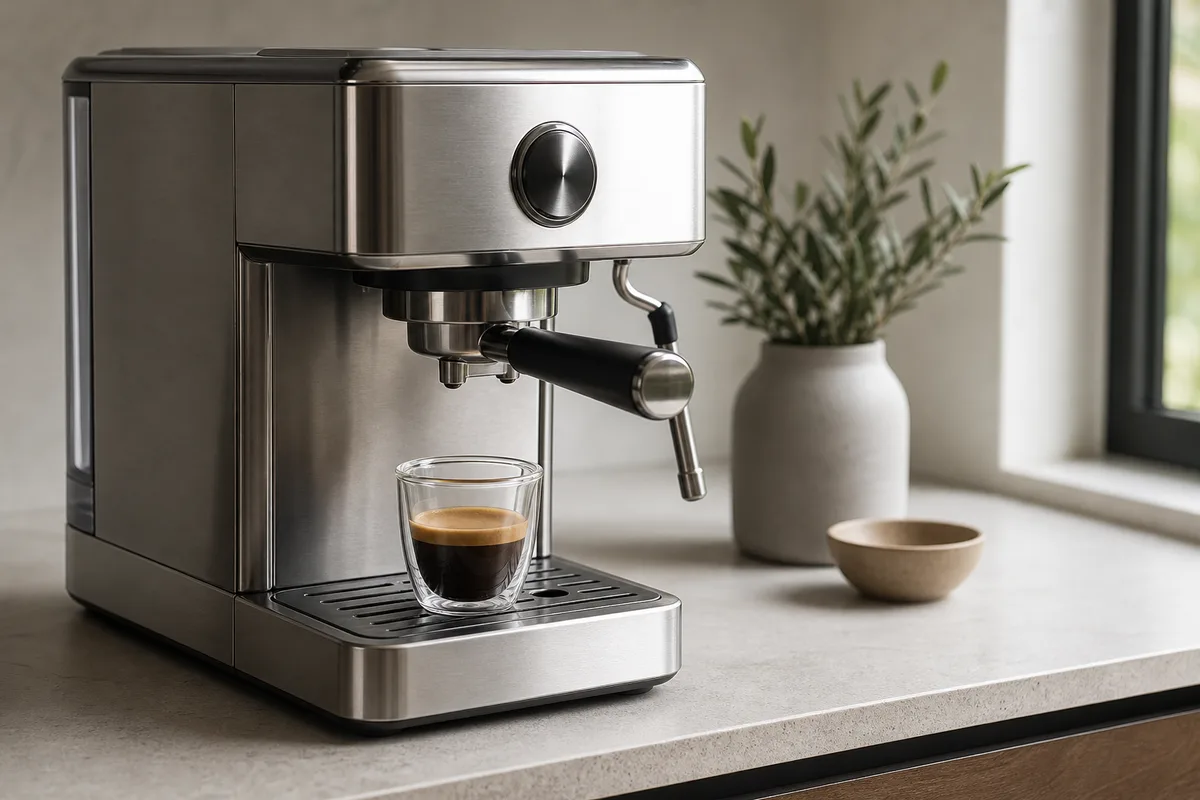
Espresso shot troubleshooting starts at the grinder. A shot that runs fast and tastes thin or sour points to a grind that is too coarse or too little coffee; a shot that drips slowly and tastes bitter points the other way. Breville and Gaggia list grind size first in their troubleshooting tables, and KitchenAid in its espresso FAQ.
Below: each maker’s advice by symptom, where they disagree, and two causes the ranking guides I read skip: the dual-wall basket and a sour taste after descaling. The page is built from manuals, not from pulling shots.
What a Good Shot Looks Like, According to the Makers
The Breville Barista Express manual sets the double-shot target at 16-19 g of coffee in 25-30 seconds, with the flow running slow like warm honey. KitchenAid’s espresso FAQ gives 20-30 seconds for one or two shots. Gaggia gives a lower limit of 20 seconds but no target window: its Classic manual says to stop the shot when the cups are 3/4 full.
Clive Coffee, a retailer, starts at 18 grams in, 36 grams out, in 25 to 35 seconds, and Coffee Bros uses 1:2 in 30-36 seconds. Treat the time as a symptom and let taste decide.
Even the start of the flow is disputed: the Barista Express booklet says espresso should start to flow after 4-7 seconds on one page and 8-12 seconds in its extraction chart. Use the booklet for your own model.
Espresso Shot Troubleshooting by Symptom: What Each Maker Says
| Symptom | Breville (Barista Express BES870) | De’Longhi (Stilosa EC260) | Gaggia (Classic RI9380) | KitchenAid (semi-automatic) |
|---|---|---|---|---|
| Runs too fast | Grind too coarse, not enough coffee, or tamped too lightly. Tamp at 22-33 lb (10-15 kg). | The EC260 table has no row for a fast shot. De’Longhi’s Dedica support page blames beans that are not fresh. | Under 20 seconds: check the grind is not too coarse and the coffee was pressed with the tamper. | Under 20 seconds: grind finer, add coffee, or tamp more firmly at 15-20 kg (30-40 lb). |
| Drips or will not flow | Grind too fine, too much coffee, tamped too firmly, a blocked basket, or the machine needs descaling. | Pressed down too firmly, too much coffee, a clogged filter, or coffee too fine or damp. | “No brewing”: filter clogged because the grind is too fine or the coffee too pressed; dirty screen. | Over 30 seconds: grind coarser and/or tamp more lightly. |
| No crema or pale crema | Tamped too lightly, too coarse, stale coffee, a blocked basket, or a single-wall basket used with pre-ground coffee. | Coffee too old, not suitable for espresso (use finer), too little coffee, or not tamped enough. | Too coarse, not tamped, coffee too old or dry, or the wrong filter fitted with the frothing jet device. | A needle below the espresso range means a watery, flavorless shot with little to no crema. |
| Sour, acid or bitter | Under 20 seconds is “underdeveloped, sour”; over 35 seconds is “bitter, astringent”. | An acid taste can come from inadequate rinsing after descaling. | Not covered in the malfunction table. | Not covered on the two support pages read. |
Tamp force is the clearest disagreement, even inside one brand. The Barista Express and Bambino Plus manuals say 22-33 lb, while KitchenAid and Breville’s own Bambino manual say 30-40 lb, so the ranges overlap only at about 30-33 lb.
Shot Runs Too Fast or Gushes
Grind finer first, then check the dose, then the tamp. If no setting on your grinder gets the shot past 20 seconds, the grinder may not reach espresso fineness; the espresso grinder guide covers which ones do. Stale coffee does it too: Breville’s Bambino Plus manual says stale coffee may pour too quickly and taste bitter and watery.
If it still gushes, look at the basket and the machine. The guide to an espresso machine not building pressure covers the basket swap and the empty-basket test.
Shot Runs Too Slow, Drips or Chokes
Go the other way: a coarser grind, less coffee, a lighter tamp. Breville, De’Longhi and Gaggia all add a blocked basket or filter, and Breville says to clear the holes with the pin tool or soak the basket and portafilter in a cleaning-tablet solution. The espresso machine cleaning guide sets out what each maker says. If water will not run freely even through an empty basket, the restriction is in the machine, and the low-pressure guide above covers that test.
Why Espresso Tastes Sour or Bitter
Breville’s manuals blur the line: its chart calls a shot under 20 seconds sour, but the panel beside it says an under-extracted shot tastes bitter/sharp, weak and watery. So a fast, pale, harsh shot can be under-extracted without tasting sour: read the time and colour as well as the taste.
Seattle Coffee Gear says some shots can taste sour and bitter at once, a sign of channeling, where water flows unevenly through the puck; the puck-prep fixes under Common Mistakes apply.
A sour or acid taste that starts right after a descale may be something else. De’Longhi’s EC260 table lists an acid taste caused by inadequate rinsing after descaling, and of the manuals read, only De’Longhi’s makes that link. Rinse again as the manual describes; how often to descale an espresso machine covers the routine.
Seattle Coffee Gear lists water below 195-205°F and coffee too fresh off the roast as causes of sourness, and Breville’s Dual Boiler manual recommends 194-203°F (90-95°C) from a default of 200°F. On machines without that setting, pre-heating is the lever: Breville says a cold portafilter and basket can reduce the extraction temperature enough to significantly affect the shot. Only machines with adjustable brew temperature let you change it: see the semi-automatic espresso machine guide.
No Crema, Pale Crema or Dark, Spotty Crema
Breville, De’Longhi and Gaggia all tie missing crema to a coarse grind, a light tamp and old coffee. Breville’s chart also reads the colour: thin, pale crema goes with under-extraction, dark and spotty crema with over-extraction.
The basket can override all of that. Breville says dual-wall baskets regulate the pressure and help optimize the extraction regardless of the grind, dose, tamp pressure or freshness, and are meant for pre-ground coffee. Gaggia’s “crema perfetta” filter gives crema from the first use, while its traditional filters require manual skills and experience. So crema from a pressurised basket says little about your grind.
None of the six ranking guides I read mentions pressurised or dual-wall baskets.
Bean Freshness and Storage: Where the Makers Disagree
Breville says beans are best 5-20 days after the roast date and pre-ground coffee should be used within a week of grinding. The Bambino Plus manual ties single-wall baskets to beans roasted less than 30 days ago.
On storage, Breville says a cool, dark and dry container, vacuum sealed if possible, and De’Longhi’s Dedica page says an airtight container. Gaggia’s manual is the outlier, recommending airtight jars in the refrigerator.
Common Mistakes, Including the Tamping Debate
- Tamping harder to slow a fast shot. Clive Coffee argues that once the puck is level and gap-free, adding more pressure does almost nothing to shot time. The Bambino Plus manual says the amount of pressure is not as important as using the same pressure every time, while Coffee Bros recommends about 30 lb.
- Dosing into a wet basket. Breville says moisture in the basket can encourage channeling.
- Uneven puck prep. Breville’s blog describes channeling as multiple thin streams of espresso; spread the grounds evenly, tamp straight down, and do not tap after tamping.
If shot times jump around with no change on your side, check the grinder itself.
How This Page Was Put Together
This is research from makers’ manuals and support pages, not hands-on testing: no shot was pulled, tasted or timed for it. The sources are Breville’s Barista Express, Bambino Plus, Bambino and Dual Boiler manuals and blog, De’Longhi’s EC260 manual and Dedica support page, Gaggia’s Classic RI9380 manual, and two KitchenAid support pages. Retailer figures from Clive Coffee, Coffee Bros and Seattle Coffee Gear are labelled as secondary.
What I could not establish:
- A home espresso recipe from a standards body. The SCA standards list covers machine testing, not a shot recipe, and the INEI parameters for Italian espresso are only available through secondary pages.
- How often each cause occurs. No maker or study publishes failure frequencies, so this page gives the order the makers’ tables list causes in, not how common they are.
- Whether tamp force changes shot time once the puck is level. No independent test with lab data turned up.
- No Rancilio or Lelit manual was read for this page.
- Whether De’Longhi’s descaling-rinse cause applies to other brands, and which of Breville’s two flow-start windows is right.
The Verdict
Read the shot, then change one thing at a time, as the Barista Express manual says: finer for fast and sour, coarser for slow and bitter, and check the basket before blaming the coffee. For the rest of the espresso setup, the coffee equipment hub links every guide on the site, and if the shot is fine but the milk is the problem, see the steam wand guide.
Frequently Asked Questions
Why is my espresso shot running too fast?
A grind that is too coarse is the first cause Breville, KitchenAid and Gaggia list, followed by too little coffee and too light a tamp. KitchenAid treats under 20 seconds as too fast. Grind finer first. Breville’s Bambino manuals add that stale coffee may pour too quickly.
Why does my espresso taste sour?
Breville’s chart treats it as under-extraction, labelling a shot under 20 seconds underdeveloped and sour, so grind finer. Seattle Coffee Gear adds water below 195-205°F and coffee too fresh off the roast. If the sourness started after a descale, De’Longhi blames inadequate rinsing, so rinse again.
Why does my espresso taste bitter?
Breville links bitter, astringent shots to over-extraction, over 35 seconds, so grind coarser or use less coffee. But Breville’s manuals also describe a fast, under-extracted shot as bitter/sharp, weak and watery. Check the shot time and colour before changing the grind.
How long should an espresso shot take?
Breville says 25-30 seconds for 16-19 g in a double basket, KitchenAid says 20-30 seconds, and Gaggia only says under 20 seconds is too fast. Retailers stretch the window to 25-35 or 30-36 seconds. Use the time as a symptom; taste decides.
Why is there no crema on my espresso?
Breville, De’Longhi and Gaggia all point to a coarse grind, a light tamp and old coffee. Breville also lists a blocked basket and a single-wall basket used with pre-ground coffee. Breville says a dual-wall basket helps optimize extraction regardless of grind, dose or tamp, so crema from one proves little.
How hard should you tamp espresso?
The Barista Express manual says 22-33 lb; KitchenAid and the Bambino manual say 30-40 lb. The Bambino Plus manual says consistent pressure matters more than the amount, and Clive Coffee argues extra force does almost nothing after the puck is level. No lab data settles it.

I'm Glenn, and I started Kitchenware Compare to cut through conflicting product reviews and help readers pick kitchen gear with confidence. I don't own or test the products I write about — these guides are built from verified-purchase reviews, manufacturer specifications, and independent testing where it exists, with the reasoning shown, not just a rating.
Leave a Reply