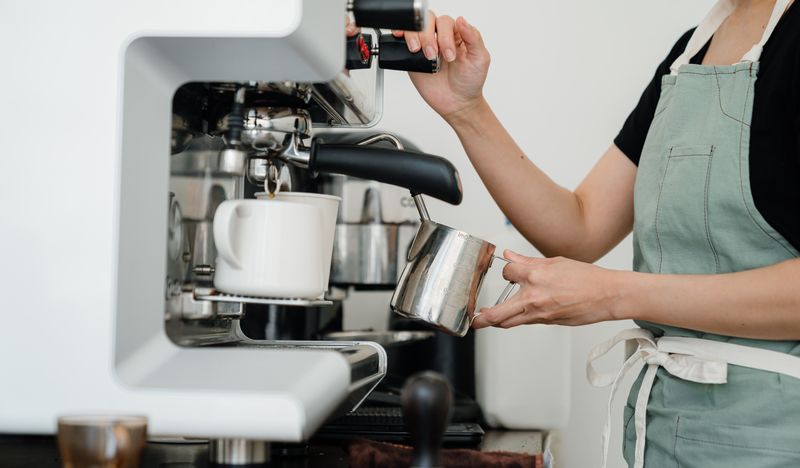
Photo by Ketut Subiyanto from Pexels
This guide has no affiliate links, but some pages it links to do. If you buy through those, I may earn a commission at no extra cost to you.
Cleaning an espresso machine is two jobs: rinsing and wiping what coffee and milk touch, and descaling to remove mineral scale. The first is mostly the same on every machine. The second, and the detergent you use, depends on the machine, and the manuals for three popular machines give different answers.
This guide sets out what the Breville Bambino Plus, Gaggia Classic Pro and Nespresso Essenza Mini manuals say, and where the web’s usual advice, backflushing and vinegar included, goes beyond them.
What the three manuals say
| Machine | Routine in the manual | Detergent or descaler named | Vinegar | Descaling interval |
|---|---|---|---|---|
| Breville Bambino Plus | Wipe and purge the steam wand after milk; rinse the portafilter and baskets under hot water after use; wipe the shower screen; empty and wash the drip tray; automatic cleaning cycle with a cleaning disc and tablet after 200 extractions | Cleaning tablet; a descaling agent | Not mentioned | No fixed interval; the lights signal when it is due |
| Gaggia Classic Pro | Wipe the steam wand and release steam for a second or two after frothing; wash the filters daily in warm water; brush grounds off the screen; wash the grill and drip tray; no backflush procedure | Gaggia cleaning tablets for the filters; Gaggia descaling product only | Never | Every 2 months (the safety page says every 2 to 3 months) |
| Nespresso Essenza Mini | Empty the drip tray, drip base and capsule container daily; wash the tank and lid; wipe the outlet and inside with a damp cloth | Odorless detergent; Nespresso descaling liquid | Its descaling guide says vinegar may cause damage | After 300, 600 or 1,200 cups depending on water hardness |
The daily routine they agree on
- Milk machines: Breville says to wipe the steam wand after texturing milk and let it purge, because a wand that is not purged can block. Gaggia gives the same two steps: wipe, then open the steam knob for a second or two.
- Portafilter and baskets: Breville says to rinse them under hot water straight after use to remove coffee oils. Gaggia says to wash the filters daily in warm water.
- Shower screen: Breville says to wipe the group head and shower screen with a damp cloth, and to run hot water through with the basket in place and no coffee now and then. Gaggia says to brush grounds off the screen.
- Drip tray: Breville says to empty and clean it after each use or when the indicator rises; Nespresso says daily.
The steam wand not frothing guide covers what to check when a wand still performs badly after cleaning.
One machine’s cleaning cycle, step by step
The Bambino Plus is the only one of the three with a built-in cycle, so it is worth seeing what it asks for. This is the sequence in its manual:
- Put the cleaning disc in the filter basket in the portafilter.
- Place a cleaning tablet on top of the disc, then lock the portafilter into the group head.
- Empty the drip tray and put it back, then place a 2 liter (68 oz) container under the portafilter and steam wand.
- Fill the water tank to the MAX line and reattach it.
- Hold the 1 CUP and 2 CUP buttons for 5 seconds, then press either one to start. The lights flash alternately while it runs.
- When it finishes, rinse the portafilter, disc, drip tray and container.
The manual also says you can start the cycle yourself before the 200-extraction alert, by holding 2 CUP and STEAM for five seconds while the machine is off.
Backflushing: community practice, not a manual instruction
Backflushing means putting a solid basket or disc in the portafilter with detergent and running the pump, so that water is pushed back through the group head’s valve. Serious Eats recommends it with Urnex Cafiza tablets, as long as your machine can do it. My Home Barista says to do it weekly on machines with a 3-way solenoid valve, and names the Bambino and the Classic Pro.
None of the three manuals uses the word. The Bambino Plus manual builds a flushing cycle into the machine, with a cleaning disc and tablet, and starts prompting after 200 extractions. The Gaggia manual does not describe a backflush at all, and it warns not to clean the pressurized filter holder in the dishwasher or with washing-up liquid.
So for a Gaggia, backflushing is a widely repeated routine, not a Gaggia instruction. For a Breville, the cycle is the maker’s own version. Check whether your machine’s manual describes it before buying a blind basket.
Vinegar: the one place the sources split
Gaggia’s manual says never to use vinegar or other descaling agents. Nespresso’s descaling guide says vinegar or store-bought descalers may damage the machine. Serious Eats says no, citing strong odors and effects on the machine and the shots. My Home Barista allows it only as an emergency descale, because it is hard to rinse out and can affect seals.
Breville’s own blog guide goes the other way: it says that if you use vinegar, mix one part to one part water. Its Bambino Plus manual names a descaling agent and a cleaning tablet and does not mention vinegar. When the maker’s manual and a general guide disagree, I would follow the manual, especially while a machine is under warranty.
How often to descale, by maker
The intervals are tied to the machine and the water, not a single number. Gaggia says every 2 months, and elsewhere in the same manual 2 to 3 months. Nespresso’s guide says every 3 months or 300 capsules, whichever comes first, while its manual table runs from 300 to 1,200 cups by hardness. Breville’s machine tells you with its lights.
My own descaling guide covers the general reasoning for scheduling it.
What the manuals say not to do
- No dishwasher: Breville says not to clean any parts or accessories in it. Nespresso says never to put the appliance or any part in one. Gaggia says not to put the pressurized filter holder in one.
- No abrasives: Breville and Gaggia both say not to use abrasive pads or scouring cleaners on the machine; Nespresso adds no solvents, brushes or sharp objects.
- No immersion: all three say never to put the machine in water.
- Do not dry the brew group with a cloth: Gaggia says fibers can collect inside it.
If the machine leaks after cleaning, why an espresso machine leaks lists the usual causes.
If the machine will sit unused
- Breville: switch it off, unplug it, empty the water tank and drip tray, and make sure it is cool, clean and dry. Store it upright and put nothing on top.
- Gaggia: do not leave water in the tank for a long period, because it can become contaminated, and use fresh water every time. Do not keep the machine below 0°C (32°F), since water left in the heating system may freeze and cause damage.
- Nespresso: the Essenza Mini has an emptying mode for a long period of non-use and for frost protection. With the tank removed and the lever open, you hold both buttons for 5 seconds and it empties itself and switches off.
For Gaggia, a machine left idle for more than two weeks is treated like a new one, and the manual sends you back to its first-use instructions.
How this guide was put together
The facts come from the Breville Bambino Plus instruction book, the Gaggia Classic Pro US manual, the Nespresso Essenza Mini manual and descaling guide, and the Serious Eats, My Home Barista and Breville blog pages linked above. It does not come from cleaning these machines myself.
Several things could not be established. I did not read a De’Longhi Dedica manual because De’Longhi’s manual page returned an error. I did not read a detergent label, so the Cafiza advice is the guides’ account of it.
Three manuals do not cover every machine, so if yours is not one of them, its own manual comes first. Reviews of two of these machines are at Breville Bambino Plus and Gaggia Classic Pro.
Frequently Asked Questions
How often should I clean my espresso machine?
Wipe the steam wand and rinse the portafilter and baskets after every use; both Breville and Gaggia say so. Drip trays are daily on the Nespresso. Deeper cleaning varies: Breville prompts after 200 extractions, while My Home Barista suggests weekly backflushing.
Do I need to backflush my espresso machine?
Only if your machine is designed for it. Serious Eats says to check first, and neither the Gaggia Classic Pro nor the Bambino Plus manual uses the word. The Bambino Plus has its own cleaning cycle with a disc and tablet, so follow your manual.
Can I clean or descale an espresso machine with vinegar?
Gaggia’s manual says never, and Nespresso’s guide says vinegar may damage the machine. Breville’s blog allows a one-to-one mix, but its Bambino Plus manual does not mention vinegar. Following the manual for your own machine is the safer reading.
Can espresso machine parts go in the dishwasher?
The manuals say no. Breville says not to clean any parts or accessories in the dishwasher, Nespresso says never to put the appliance or any part in one, and Gaggia says not to put the pressurized filter holder in one.
What is the difference between cleaning and descaling?
Cleaning removes coffee oils and milk residue from the parts coffee touches. Descaling removes mineral scale from inside the machine. Breville’s manual calls its cleaning cycle a flushing cycle that is separate from descaling, and each has its own prompt.
How do I clean a steam wand?
Wipe it with a damp cloth after every use and purge it. Breville says that if the holes are blocked you can unscrew the tip and use the cleaning tool stored under the water tank. Gaggia says you can unscrew the nozzle and wash it.
The short version
Wipe, purge and rinse every day, follow your own manual’s cleaning cycle and descaler, and treat vinegar as something the makers warn against. For fixes when something goes wrong, the coffee hub lists the espresso troubleshooting guides.

I'm Glenn, and I started Kitchenware Compare to cut through conflicting product reviews and help readers pick kitchen gear with confidence. I don't own or test the products I write about — these guides are built from verified-purchase reviews, manufacturer specifications, and independent testing where it exists, with the reasoning shown, not just a rating.
Leave a Reply