This guide has no affiliate links, but some pages it links to do. If you buy through those, I may earn a commission at no extra cost to you.
Most toaster ovens draw somewhere between 1,200 and 1,800 watts while the heating elements are on. That works out to roughly 10 to 15 amps on a standard 120-volt U.S. outlet. This page shows you where to find the exact number for your model, how to turn it into amps and cents per use, and what it means for the circuit you plug into. I write it from published specs and official energy guidance, not from handling the appliances myself.
TL;DR
- Typical toaster ovens use 1,200 to 1,400 watts in use, according to the ENERGY STAR scoping report on toaster ovens. Large air fryer ovens can be rated higher.
- Amps = watts ÷ 120. A 1,400 W oven draws about 11.7 amps, and an 1,800 W oven draws 15 amps.
- Running cost is watts × hours ÷ 1,000 × your electricity rate. A half hour of baking at 1,300 W is well under a quarter in most U.S. homes.
- The real risk is the circuit, not the bill. Do not run another high-wattage appliance on the same circuit while the oven is heating.
- The rating sits on the nameplate, usually on the back or bottom of the unit.
How many watts a toaster oven uses
The short answer is 1,200 to 1,400 watts for a typical unit. That figure comes from the U.S. EPA’s ENERGY STAR scoping report, which also puts 6-slice models at 900 to 1,400 watts for baking and toasting. Newer, larger models that combine convection fans and air frying are often rated higher, and published product listings commonly show ratings of 1,500 to 1,800 watts at the top of the range.
Here is how the common size classes line up. The ranges below blend the ENERGY STAR figures with the way manufacturers typically list ratings, so treat them as planning ranges and check your own label.
| Type | Typical rating | Amps at 120 V |
|---|---|---|
| Small 4-slice model | about 900 to 1,200 W | 7.5 to 10 A |
| Standard 6-slice model | 900 to 1,400 W | 7.5 to 11.7 A |
| Large convection or air fryer oven | 1,500 to 1,800 W | 12.5 to 15 A |
The number is a maximum, not a constant. The Virginia Cooperative Extension notes that the wattage listed is the appliance’s power draw, while actual use depends on the setting you choose. A toaster oven also cycles its elements on and off to hold a temperature, so over a 30-minute bake it is drawing full power only part of the time.
Why two ovens of the same size can differ
Three things move the number:
- Element count and design. Models with top and bottom quartz or calrod elements plus a broil element are built to heat fast, so they carry a higher rating.
- Convection fan. The fan motor itself uses little power. The bigger effect is that convection models are often sold with stronger elements.
- Air fryer functions. Air fryer toaster ovens are usually built to move hot air quickly, which tends to push the rating to the upper end. If you are weighing the two appliance types, my air fryer vs toaster oven comparison covers the cooking differences, and the air fryer wattage guide covers the numbers for basket models.
Where to find your model’s wattage
The Virginia Cooperative Extension says appliance wattage is usually stamped on the bottom or back of the unit, or on its nameplate. Look for a small label or engraved plate near the power cord. It will list volts (120 V in the U.S.), watts (W), and sometimes amps (A).
If you cannot find a wattage but you do have an amp figure, the same Extension publication explains how to estimate it: multiply the amperage by the voltage, which is 120 volts in the U.S. A label reading 11 A therefore means about 1,320 watts.
Other places to check:
- The owner’s manual. The specifications page nearly always lists wattage.
- The retailer listing. Most product pages show wattage in the spec table, which is also where I pull the figure from when I compare models on this site. Listings sometimes round, so confirm against the label if you can.
- The box. If you still have it, the rating is printed on the side.
If you are shopping and want to see wattage next to capacity and cooking features, my toaster oven reviews and buying guide lists the rating for each model I cover, and the convection toaster oven comparison puts five convection picks side by side.
Toaster oven amps: the math
People searching for amps usually want to know one thing: will it run on this outlet? The formula is simple, and it is the same one the Virginia Cooperative Extension uses in reverse.
Amps = watts ÷ volts
On a standard U.S. outlet (120 V):
| Rated watts | Amps drawn |
|---|---|
| 1,000 W | 8.3 A |
| 1,200 W | 10 A |
| 1,300 W | 10.8 A |
| 1,400 W | 11.7 A |
| 1,500 W | 12.5 A |
| 1,800 W | 15 A |
A typical oven at 1,200 to 1,400 watts therefore lands at about 10 to 12 amps. That is a large share of a standard 15-amp branch circuit, which is why the next section matters.
What a toaster oven costs to run
The U.S. Department of Energy’s education materials, published with the Alliance to Save Energy, define energy use with this formula: kWh = (watts × hours of use) ÷ 1,000. Multiply the kWh by the per-kWh rate on your utility bill and you have the cost.
I will use an illustrative rate of $0.17 per kWh. Your own rate will differ by state and utility, so swap in the figure from your bill.
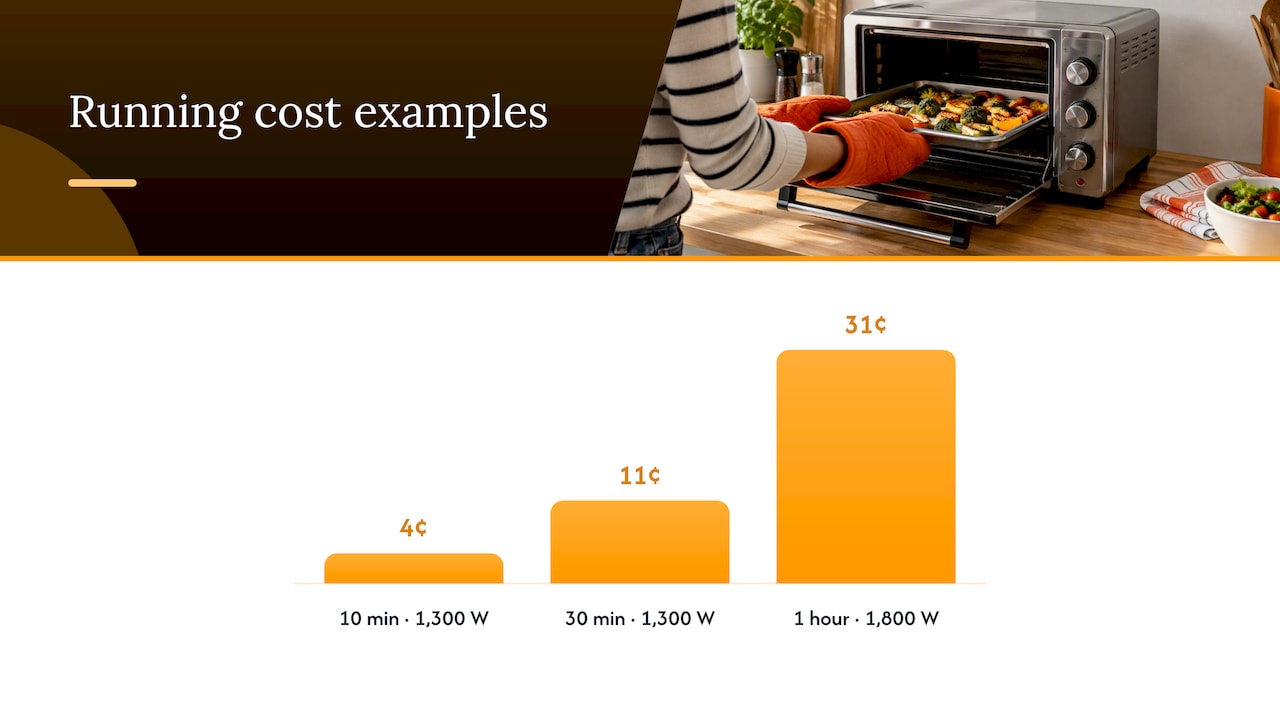
Example 1: reheating or toasting for 10 minutes at 1,300 W
1,300 × 0.167 hours ÷ 1,000 = about 0.22 kWh, or roughly 4 cents.
Example 2: baking for 30 minutes at 1,300 W
1,300 × 0.5 ÷ 1,000 = 0.65 kWh, or roughly 11 cents. Because the elements cycle, the real figure is usually a bit lower than this full-power ceiling.
Example 3: one hour of roasting at 1,800 W
1,800 × 1 ÷ 1,000 = 1.8 kWh, or roughly 31 cents at the full-power ceiling.
The Alliance to Save Energy makes the broader point that small appliances can have high wattage, yet their short run times make them less significant to your bill than appliances that stay on for hours. A toaster oven fits that pattern: it is a high-draw, short-duration appliance.
Standby draw
According to the ENERGY STAR scoping report, digital-control toaster ovens may consume less than 0.2 watts in standby, while manual models typically consume no power when not in use. Even at the digital figure, standby costs next to nothing over a year. Unplugging is still good practice for other reasons, covered below.
Toaster oven vs full-size oven
The same ENERGY STAR report says toaster ovens use about one-third to one-half less energy than conventional electric ovens for small meals. The reason is the combination of a smaller cavity to heat and less preheat time. For a tray of vegetables, a couple of chicken thighs or a frozen pizza, the countertop unit is usually the cheaper way to cook. For a big roast or several racks of food, the math reverses, because a toaster oven would run longer.
Toaster oven vs microwave
For reheating, a microwave is often the more practical tool. Edison, a California utility, says on its energy blog that the average microwave uses 925 watts compared with 1,225 watts for a toaster oven. The microwave also finishes reheating faster, so it uses less energy per portion. The toaster oven wins when you want crispness. If you are curious about the hybrid, I explain how a microwave toaster oven combo works, and the microwave wattage guide covers the microwave side.
Your circuit matters more than your bill
A 1,400 W oven costs pennies per use. A tripped breaker is the more common annoyance, and in the worst case an overloaded circuit is a fire hazard. This is where wattage becomes a safety number.
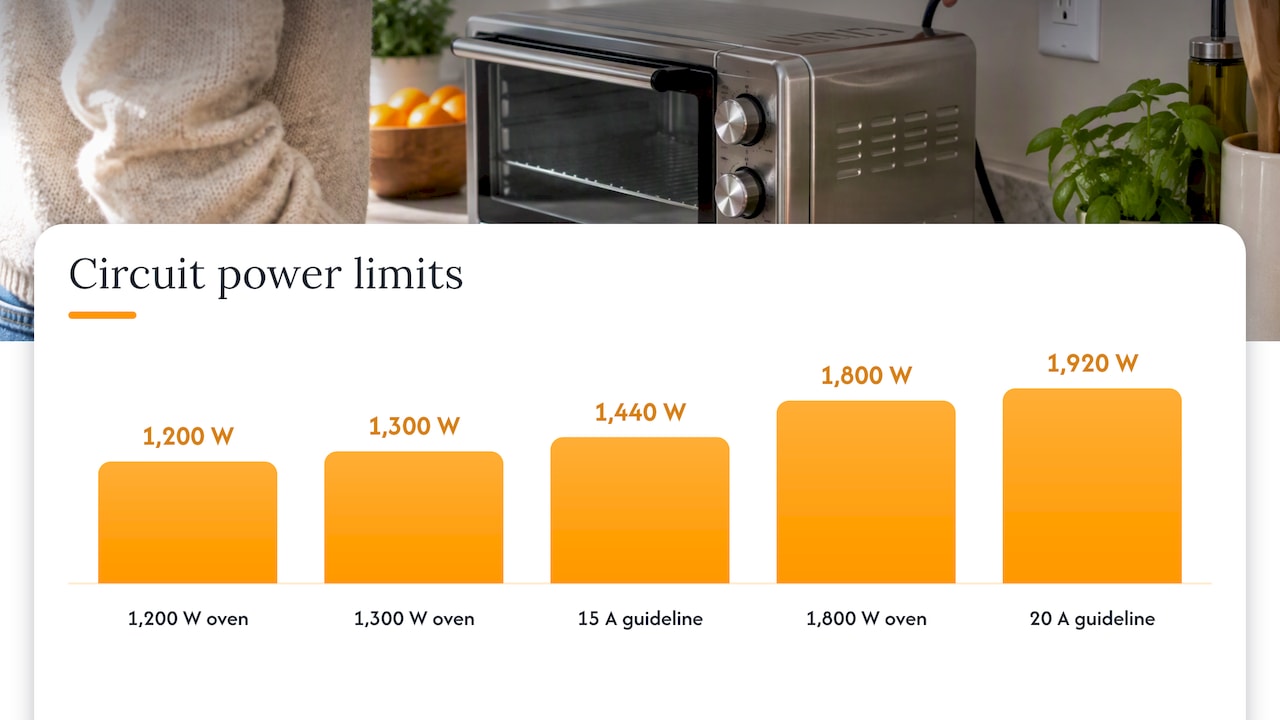
The Electrical Safety Foundation International (ESFI) advises checking the appliance nameplate, identifying the circuit’s amperage, and adding up the power demand of the appliances and fixtures on that circuit. It also advises not exceeding 80% of circuit capacity. In its examples, that means 1,440 watts on a 15-amp, 120-volt circuit and 1,920 watts on a 20-amp circuit.
Put that next to the wattage table above:
- A 1,200 W or 1,300 W toaster oven fits under the 1,440 W figure on its own, but leaves very little room for anything else.
- By simple arithmetic, an 1,800 W oven on a 15-amp circuit already goes past the 1,440 W guideline by itself. If your kitchen outlets share a 15-amp circuit, a unit that large deserves extra care, and it is worth checking which breaker serves the outlet.
- A 20-amp kitchen circuit leaves more headroom, though it is still not unlimited.
The Hamilton Beach owner’s manual for its Toastation toaster oven spells out the practical rule: do not operate another high-wattage appliance on the same circuit, because doing so can overload the household circuit. That means no running the toaster oven at the same time as, say, a space heater, a hair dryer or a second countertop cooker plugged into the same line. If you cook with both an air fryer and a toaster oven, the same logic applies. My guide on what to do when an air fryer keeps tripping the breaker walks through how to figure out which outlets share a circuit.
Safe-use habits
ESFI’s kitchen safety guidance recommends plugging countertop appliances into GFCI-protected outlets and unplugging them when they are not in use. Add three more habits that follow directly from the wattage numbers:
- Plug the oven straight into a wall outlet. Wattage this high is a poor match for a long, thin extension cord. If a breaker keeps tripping or a plug runs warm, stop using the outlet and call a licensed electrician.
- Keep a gap between the oven and other plugged-in appliances so that heat does not build up, and so you are less tempted to run two high-draw items at once.
- Know your breaker panel. Label which breaker serves the kitchen counter outlets, so you can estimate the total load.
Lower wattage or higher wattage?
Shoppers often ask whether the lowest-wattage oven is the better buy. Wattage is power, not energy, so the answer depends on what you cook.
The trade-offs follow from the formula. A lower-rated oven delivers less heat each second, so it generally takes longer to preheat and to cook. Because energy is watts times hours, a lower rating does not automatically mean a lower bill: if the oven needs a longer run time, some of the saving disappears. What a lower rating does buy you is a lighter load on the circuit, which helps if your kitchen shares one 15-amp line between several outlets.
A higher rating typically means faster preheating and stronger browning and broiling. The cost is the load on the circuit, and the need to avoid running anything else at the same time.
Here is how I would match wattage to the way you cook:
| If you mostly… | Consider |
|---|---|
| Toast bread and reheat small portions | A compact model in the 900 to 1,200 W range |
| Bake, roast and cook for two to four people | A mid-range 1,200 to 1,400 W model |
| Want air frying and convection in one unit | A larger 1,500 W or higher model, with circuit headroom confirmed first |
| Share an older 15-amp kitchen circuit | The lower end of the range, and no simultaneous high-draw appliances |
For a deeper look at when an air fryer is the better pick and when the toaster oven is, see my air fryer vs toaster oven guide and the air fryer vs convection oven comparison. Owner-reported satisfaction across appliance types is also something I track in my study of which kitchen appliances have the most unhappy owners.
Worked example: will it fit my kitchen?
Say you are eyeing a 1,500 W air fryer toaster oven and your counter outlets share a 15-amp breaker with the dishwasher outlet and the coffee station.
- Convert to amps. 1,500 ÷ 120 = 12.5 A.
- Apply the 80% guideline. On a 15-amp circuit, ESFI’s figure is 1,440 W. The oven alone already exceeds it.
- Decide. Either confirm that the outlet is on a 20-amp circuit, pick a model rated at or below about 1,400 W, or make a firm rule that the oven runs by itself on that line.
This takes two minutes and it is the check I would run before any purchase of a high-wattage countertop appliance. If you are not sure what your breaker rating is, a licensed electrician can tell you quickly, and I would not guess.
My perspective on wattage
Wattage is the first number I look at on a toaster oven spec sheet, and the last one most shoppers read. Reviews love to talk about capacity, presets and finish. The nameplate figure decides whether the appliance runs happily on your kitchen circuit.
My approach is to treat the rating as a fit question first and a cost question second. The running cost is small for nearly everyone, so a few cents of difference between models should not drive the decision. What should drive it is whether the rating, your circuit and your habits line up. Since I do not own or handle the products I write about, I rely on manufacturer specifications, official guidance from bodies like ENERGY STAR and the Department of Energy, and what owners report, and I attribute each of those where it appears.
When I compare appliances, I look at the wattage and the amps it implies before anything else, because that is what helps you avoid buying an oven you cannot comfortably plug in.
Compare wattage before you buy
If you are choosing between models, the quickest route is to see ratings side by side with capacity, features and owner feedback. My toaster oven reviews and buying guide does that, and the Kitchenware Compare home page links to every category I cover, from air fryers to cookware and coffee equipment.

If you want to know how I evaluate products without handling them, how I review kitchen equipment explains the sources I use. Many of the product links on this site are affiliate links, so I may earn a commission if you buy through them, and that comes at no extra cost to you.
FAQ
How many watts does a toaster oven use?
Most use 1,200 to 1,400 watts while heating, according to the ENERGY STAR scoping report, with 6-slice models at 900 to 1,400 watts. Larger air fryer and convection ovens can be rated higher. Check the nameplate on the back or bottom for your exact figure.
How many amps does a toaster oven draw?
Divide the watts by 120. A 1,200 W oven draws 10 amps, a 1,400 W oven about 11.7 amps, and an 1,800 W oven 15 amps. Those are maximums while the elements are on, since the oven cycles power to hold its temperature.
How much does it cost to run a toaster oven?
Multiply watts by hours, divide by 1,000, then multiply by your rate per kWh, the method given in the Department of Energy education materials. At an illustrative $0.17 per kWh, a 30-minute bake at 1,300 W costs roughly 11 cents at most. Your own rate on your utility bill will change that.
Can I run a toaster oven on the same circuit as other appliances?
It is best not to. The Hamilton Beach manual for its Toastation oven warns against running another high-wattage appliance on the same circuit, and ESFI advises staying within 80% of circuit capacity. If the breaker trips repeatedly, stop and have a licensed electrician look at the circuit.
Does a toaster oven use less electricity than a full-size oven?
For small meals, yes. ENERGY STAR’s scoping report says toaster ovens use about one-third to one-half less energy than conventional electric ovens. For large, long cooks the advantage shrinks, because the countertop unit has to run longer.
Sources
- ENERGY STAR Scoping Report: Toaster Ovens
- Virginia Cooperative Extension: Estimating Appliance and Home Electronic Energy Use
- U.S. Department of Energy and Alliance to Save Energy: Watt Does It Cost To Use It?
- Edison: 7 Energy-Efficient Alternatives to Your Oven or Stove
- ESFI: Indoor Electrical Safety Check Booklet
- Hamilton Beach: Toastation owner’s manual
- ESFI: Kitchen Safety Tips
Recommended
- Air Fryer Wattage: Watts, Amps and Running Cost Explained
- Air Fryer vs Toaster Oven: Which Should You Buy?
- Toaster Ovens: Reviews & Buying Guide
- The Best Way To Clean A Toaster Oven

I'm Glenn, and I started Kitchenware Compare to cut through conflicting product reviews and help readers pick kitchen gear with confidence. I don't own or test the products I write about — these guides are built from verified-purchase reviews, manufacturer specifications, and independent testing where it exists, with the reasoning shown, not just a rating.
Leave a Reply