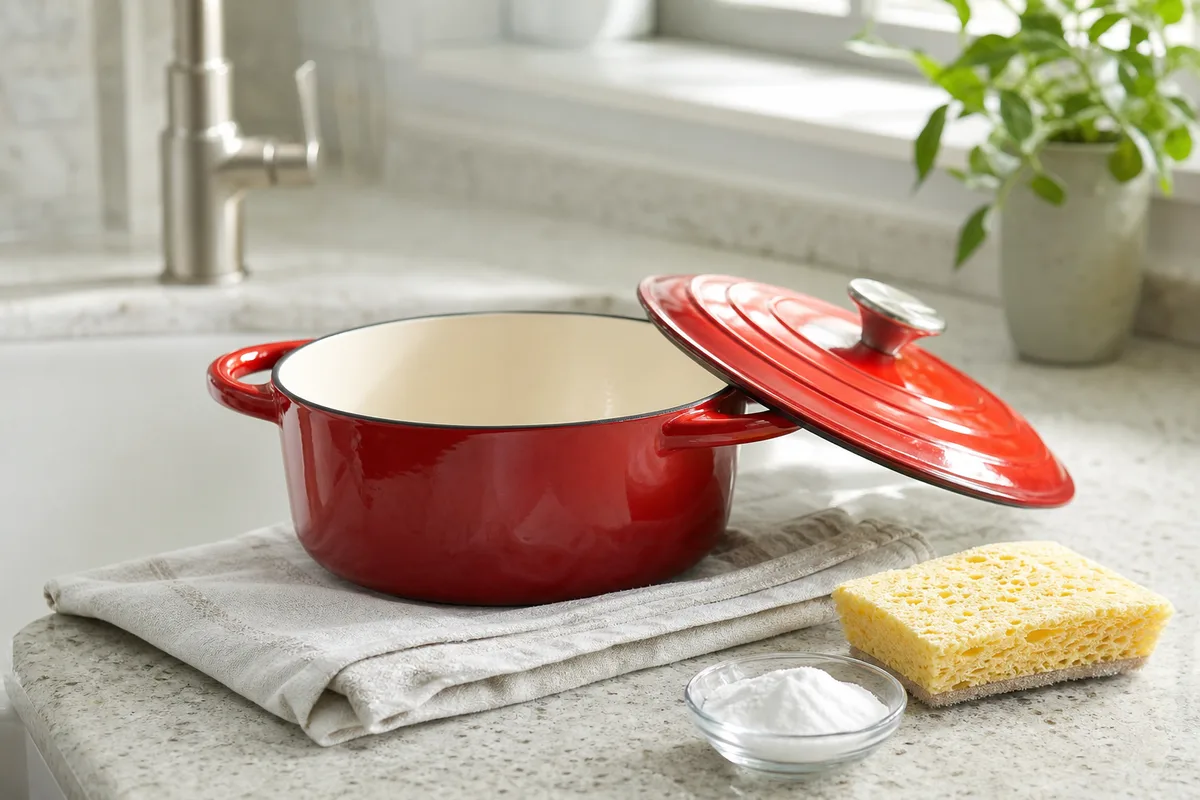
Let the pot cool, wash it with warm soapy water and a soft sponge, then step up to baking soda or an enamel cleaner for stains. That order comes from Le Creuset, Lodge, Staub and Tramontina; Cuisinart’s booklet steps up to Bon Ami or warm vinegar instead. Of the five, only Lodge’s current care pages prescribe a bleach soak, and only for the interior.
The makers agree on the basics of how to clean enameled cast iron, and split on bleach, Bar Keepers Friend, dishwashers and black interiors. The table sets their own instructions side by side.
What Each Maker Says About Cleaning Enameled Cast Iron
| Maker | Everyday wash | Stains | Bleach | Dishwasher |
|---|---|---|---|---|
| Le Creuset | Cool to room temperature; soft natural or nylon sponge; no metal sponges or abrasive cleaners | Blog: its cleaner, Bar Keeper’s Friend or baking soda paste. Care page: an enameled cast iron cookware cleaner only | No bleach instruction on the Le Creuset pages I read | Safe, hand washing recommended; dulling is not covered by the warranty |
| Staub | Cool first; dish soap, soft sponge or brush; no oven cleaners, metal brushes or scouring pads | Soak in hot water and detergent; then boiling water with two or three spoons of baking soda | No bleach step for cocottes on the Staub pages I read | Allowed, but regular use is not recommended; modern detergents may damage the pot |
| Lodge | Cool first; gentle dish soap with a sponge, scrub cloth or brush; dry promptly | Damp cloth with Lodge Enamel Cleaner or another ceramic cleaner | 3 tablespoons of household bleach per quart of water, interior soak for 2-3 hours, for persistent stains | Technically safe, but Lodge prefers hand washing |
| Cuisinart (Chef’s Classic booklet) | Cool slightly, then soak in warm water and dish detergent; no steel wool or metal pads | Bon Ami or a little warm vinegar for tough stains | No bleach instruction on the Cuisinart pages I read | The booklet says it may be cleaned in the dishwasher |
| Tramontina | Cool to room temperature; mild soap, soft sponge or nylon brush; no steel wool | Baking soda and water paste for stubborn residue or light interior staining | No bleach instruction on the Tramontina pages I read | Hand wash its enameled cast iron saucepans |
Smaller makers add more variation. Made In uses a ceramic cleaner and calls Bar Keeper’s Friend an option in a pinch, Chantal suggests a baking soda paste or simmer for discoloration, and Smith & Clark say hand wash only and never soak.
How to Clean Enameled Cast Iron, Step by Step
Start at step one, stop when the pot is clean, and rinse thoroughly between methods.
- Let it cool. Le Creuset says to cool the pot to room temperature and never fill a hot pot with cold water, because thermal shock can crack the enamel. Staub gives the same warning; Cuisinart’s booklet says to cool the pan only slightly before soaking it in warm water.
- Wash with warm water, mild soap and a soft sponge. Le Creuset, Lodge and Tramontina all describe this routine, and Staub warns that metal brushes and scouring pads can permanently damage the cookware.
- Soak stuck-on food. Le Creuset and Tramontina both suggest 15 to 20 minutes in warm soapy water, while Staub says overnight if necessary. Smith & Clark disagree and say never to soak, so check your own maker’s card.
- Simmer with baking soda. The doses differ. Le Creuset simmers a tablespoon or two in a potful of water for 8-10 minutes; Lodge boils 4 tablespoons in 2 cups for a few minutes, then loosens the food with a pan scraper. Staub uses two or three spoons in boiling water, and Made In suggests roughly two tablespoons for every four cups.
- Treat stains with a cleaner. Use an enamel or ceramic cleaner or a baking soda paste, as Le Creuset and Lodge advise. Cuisinart’s booklet allows Bon Ami or a little warm vinegar.
- Bleach only if your maker prescribes it. Lodge’s last step for persistent stains is an interior soak for 2-3 hours with 3 tablespoons of household bleach per quart of water. Rinse out every other cleaner first: the CDC warns that bleach mixed with vinegar or ammonia can release gases that might cause severe lung tissue damage.
- Dry it completely, rim included. Le Creuset says to dry completely to prevent rust on the rim, and Lodge suggests rubbing a little cooking oil around the rim to keep rust away.
Is Bleach Safe on Enameled Cast Iron? The Makers Disagree
This is the widest split in the advice. Lodge prescribes its 3 tablespoons per quart soak, while Smith & Clark say not to use cleaners containing chlorine bleach, and Chantal calls bleach unnecessary for routine care. Misen’s guide says both: harsh chemicals such as bleach should be avoided, and, for extreme cases, the same 3 tablespoons per quart soak Lodge gives.
The Le Creuset, Cuisinart and Tramontina pages I read do not mention bleach, and Staub mentions it only for a flame guard and its Ballarini nonstick pans, not for cocottes. I would not read that silence as permission. Lodge’s soak is Lodge’s instruction for Lodge pieces.
Magazine advice spans both extremes. Chowhound suggests one part bleach to three parts water, far more concentrated than Lodge’s mix, while Tasting Table says to stay away from bleach. If you follow Lodge, use its dilution and keep it inside the pot.
Bar Keepers Friend and the “No Abrasives” Rule
Le Creuset’s blogs name Bar Keeper’s Friend for tough stains, yet the same posts say not to use abrasive cleaners. Bar Keepers Friend lists enamel-coated cast iron for its cookware cleaner, and its ingredients start with a glass oxide abrasive.
The label’s own limits matter here: rub gently, rinse thoroughly within a minute, and leave a paste on hard stains for up to one minute. Its blog also says never to use it on regular cast iron.
The Staub and Lodge pages I read do not name Bar Keepers Friend, and Staub says not to use abrasive cleaners or scouring pads. A Bar Keepers Friend blog quotes a magazine saying Staub recommends it for stubborn stains, but I could not trace that to a Staub page. I would save it for stains a ceramic cleaner and baking soda have not shifted.
Kosher Salt and Hydrogen Peroxide Methods
Two popular methods come from magazines and smaller makers rather than the big five. Martha Stewart and Southern Living suggest a paste of kosher salt and lukewarm water for stuck-on residue, and Misen suggests scrubbing stubborn stains with kosher salt and baking soda on damp paper towels. Tramontina’s salt scrub is written for seasoned cast iron skillets, not enamel, so I would not transfer it.
Misen and Real Simple both suggest hydrogen peroxide with baking soda: cover the bottom of the pot by at least half an inch, add a quarter cup of baking soda, and heat it until it bubbles. Real Simple describes hydrogen peroxide as a mild bleach. None of the Le Creuset, Staub, Lodge, Cuisinart or Tramontina pages I read mentions hydrogen peroxide, so I would try their own baking soda and cleaner steps first.
Black Matte Interiors Need Different Care
Staub’s cocottes and Le Creuset’s skillets and grill pans have a black interior. Le Creuset says its black satin enamel develops a beneficial patina and warns against scrubbing it off. Staub says cooking fat penetrates the pores of the enamel and creates a naturally smooth, non-stick-like coating.
On its grill pans, Le Creuset says a mild dish soap works best for the interior and names its cleaner, Bar Keeper’s Friend and baking soda paste for the exterior.
Lodge takes a simpler line: care for its USA Enamel black satin skillets and grill pans just like an enameled Dutch oven, with no seasoning needed. Staub’s own pages I read do not say whether Bon Ami or Bar Keepers Friend is safe on its matte black enamel, so I would stick to soap, soaking and Staub’s own baking soda boil there. The Staub 5.5 qt cocotte review covers that interior in more detail.
Rust on the Rim, Chips and Dull Patches
Le Creuset’s blog says enameled cast iron will not rust, but its care page warns of rust on the rim if the pot is not dried completely. Lodge blames damp storage, drip drying, the dishwasher or incomplete drying, and fixes it with a nylon sponge, dish detergent and a thin coat of oil. The guide to fixing rusty cast iron has a section on enameled rims.
Chips are the point to stop. Le Creuset says never use a product when the interior enamel has chipped, because chips could cause personal injury if ingested.
A dull exterior is cosmetic, but it can cost you warranty cover. Lodge says citrus juices and citrus-based cleaners, including some dishwasher detergents, can dull the exterior gloss, and that its warranty does not cover their use. Cuisinart’s booklet excludes scratches, stains and discoloration from its warranty.
Common Mistakes
- Mixing cleaners in the pot. Cuisinart suggests warm vinegar and Lodge suggests bleach, and the CDC warns against combining the two. Rinse well before switching methods.
- Preheating the pot empty. Lodge says preheating without oil or water can scorch the pan and damage its finish, and recommends low to medium heat.
- Scouring a black interior back to new. Le Creuset says its grill pan will not look new after cleaning and that the patina is a good thing.
Lodge says stains cannot be completely avoided, but recommends always cooking with oil or cooking spray and using low-to-medium heat to reduce baked-on food. Le Creuset gives a heat setting that is too high as one of the most common reasons for stuck-on food.
When the Pot Is Past Cleaning
A chipped interior means replacement, not a stronger cleaner. The best cast iron Dutch oven guide compares replacements, including light and dark interiors, and bare vs enameled cast iron explains how the care differs if you are weighing a switch. The cookware hub covers the rest of the range.
How This Page Was Put Together
This page is based on the makers’ own care pages and instruction booklets, a cleaner maker’s label and CDC safety pages. It is not based on testing; I do not own or test this cookware. The Cuisinart instructions come from one Chef’s Classic booklet on its Canadian site, and the Staub text is from Zwilling’s Canadian pages.
What I could not establish:
- Which stain method works best. I found no independent head-to-head test on enamel, only editorial claims.
- Whether bleach at Lodge’s dilution harms enamel over repeated use. The warnings I read give no data.
- Whether Bar Keepers Friend, used as the label says, wears enamel over time.
- Le Creuset’s position on bleach: its pages I read neither forbid nor allow it.
- Whether hydrogen peroxide is safe on enamel: none of the Le Creuset, Staub, Lodge, Cuisinart or Tramontina pages I read prescribes or mentions it.
The Verdict
Cool it, wash it gently, and work up through soaking, baking soda and an enamel cleaner before anything stronger. Use bleach only if your maker prescribes it, as Lodge does, at its dilution and never mixed with another cleaner. On a black interior, stick to soap, soaking and, for Staub, its baking soda boil, and stop using any piece once the interior enamel chips.
Frequently Asked Questions
Can you use bleach on enameled cast iron?
Lodge says yes for persistent interior stains: 3 tablespoons of household bleach per quart of water, soaked for 2-3 hours. Smith & Clark say not to use cleaners containing chlorine bleach. Whatever you use, never mix bleach with vinegar, ammonia or another cleaner, and rinse the pot thoroughly first.
Can enameled cast iron go in the dishwasher?
Most makers allow it but prefer hand washing. Le Creuset says constant dishwashing can dull the finish and its warranty does not cover that, Staub says modern detergents may damage the pot with regular use, and Tramontina says its enameled saucepans should be hand washed.
Is Bar Keepers Friend safe on enameled cast iron?
Le Creuset’s blog names it for tough stains, and Bar Keepers Friend lists enamel-coated cast iron, but its ingredients include a glass oxide abrasive and Staub forbids abrasive cleaners. Follow the label: rub gently and rinse within a minute. Use it after gentler methods have failed.
Why is my enameled Dutch oven stained brown?
Lodge says some staining is expected, especially with long cook times, dark or colorful spices and high heat, and that it does not affect performance. Staub calls brown spots on the base a natural consequence of cooking. Le Creuset says stains on its sand enamel are not permanent.
How do you get burnt food off enameled cast iron?
Soak it in warm soapy water first; Le Creuset and Tramontina suggest 15 to 20 minutes. If that fails, simmer water with baking soda: Le Creuset uses a tablespoon or two for 8-10 minutes, and Lodge boils 4 tablespoons in 2 cups, then uses a pan scraper.
Is chipped enameled cast iron safe to use?
Le Creuset says never use a product once the interior enamel has chipped, because chips could cause personal injury if ingested, and to stop using it immediately. Staub says its enamel may chip if the pot collides with other objects or falls. I would replace any pot with interior chips.

I'm Glenn, and I started Kitchenware Compare to cut through conflicting product reviews and help readers pick kitchen gear with confidence. I don't own or test the products I write about — these guides are built from verified-purchase reviews, manufacturer specifications, and independent testing where it exists, with the reasoning shown, not just a rating.
Leave a Reply