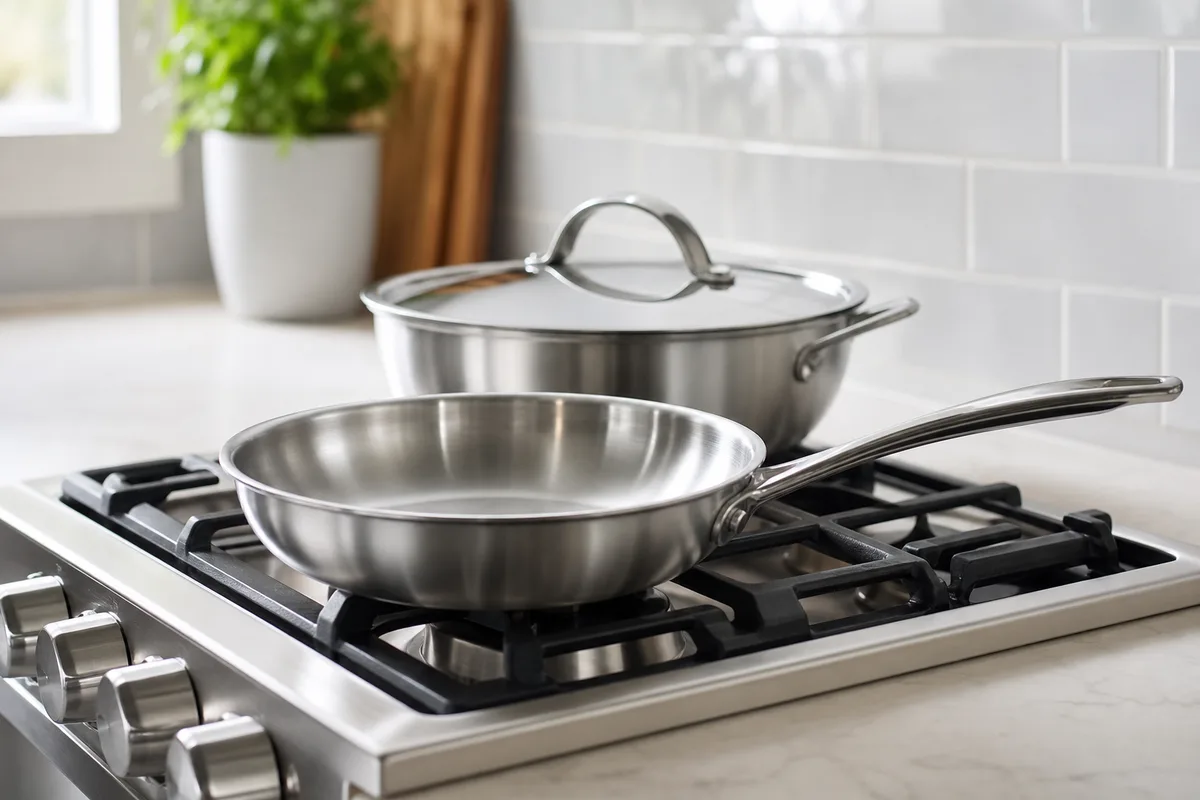
Stainless steel pan sticking is nearly always a heat, moisture or timing problem, not a faulty pan. Preheat on medium, or as your pan’s booklet says, until a few drops of water bead up and glide; drops that only sizzle away mean the pan is not hot enough yet. Then add a thin layer of oil, add dry food, and leave it until it lets go.
Makers agree on that outline but split on the details, including what a sizzling drop means. Below are their positions, the physics, and a symptom table for finding your cause.
Why Food Sticks to Stainless Steel
Sticking is a chemical bond. America’s Test Kitchen explains that heat unravels the proteins in meat and fish, which then form chemical bonds with the metal, and that enough oil to fill the metal’s micro-cracks acts as a barrier. As the surface of the food dries and browns, its proteins bond more to themselves and less to the pan, which is why food that sticks at first often lets go on its own.
Heritage Steel, a cookware maker, describes food bonding most readily between roughly 160°F and 300°F while there is still water at the contact point, which holds the interface at about 212°F; above about 300°F the contact layer dries, browns and releases. Heritage Steel lists sources, including papers on protein fouling of steel and on oil films on stainless steel, but says its temperature figures are its own estimates from published material properties, not lab measurements. Even so, the model explains why wet or crowded food sticks.
Many maker pages blame microscopic “pores” instead, and they disagree on which way the pores move. Made In says the pores contract with heat, GreenPan says they expand as the pan heats, and Viking says stainless steel isn’t porous at all. None of the pore explanations on these maker pages cites a measurement, so treat the idea as disputed. For scale, a Rolled Alloys datasheet gives 304 stainless a thermal expansion of 9.2 millionths of an inch per inch per °F between 68°F and 212°F, which is roughly 0.3% growth if extended to frying heat (my own estimate).
What Stainless Steel Makers Say About Preheating, Water Drops and Oil
Each row comes from the maker’s own care page, blog or manual. Read the water-drop column closely: the makers do not agree on what an instant sizzle means.
| Maker and source | Preheat | Water drops | When the oil goes in |
|---|---|---|---|
| All-Clad (beginners guide, care guide, preheating blog) | Low to moderate heat in the care guide; medium for 2-3 minutes in the beginners guide. Empty pans should not sit on a hot burner except to preheat. | Spheres that dance mean 350-375°F. Drops that evaporate instantly with a sizzle mean too hot; drops that sit mean too cool. | After the preheat, enough to cover the surface. Its preheating blog calls adding cold oil to a hot pan a frequent error. |
| Made In (care and seasoning guides) | Stainless should always be preheated completely empty. | Care guide: drops that bead and roll or dance (not scatter) mean ready; drops that immediately steam or scatter mean too hot. Seasoning guide: ready when the water breaks apart and dances. | After the preheat; wait a minute or two until it shimmers. |
| Misen (how-to-use and searing guides) | Medium for 2-3 minutes on most pages (medium-high for about two minutes when searing steak); high heat can warp the pan. | Drops that immediately evaporate or break apart mean not hot enough. Puts the Leidenfrost effect at around 200°F. One passage on its how-to-use page instead calls a sizzling drop the sign of a properly preheated pan. | After the preheat for searing; with the food for delicate foods and vegetables. |
| Cuisinart (website; older MultiClad Pro booklet) | Website: medium heat for 1-2 minutes before adding oil. Booklet: low to medium, never high, and never leave a pan empty over a hot burner. | Website: drops that bead up and glide mean ready. The booklet has no water test. | After the preheat (website). |
| Zwilling (heating guide) | Heat stainless slowly at medium before oil goes in; do not heat cookware empty for a long time. | Water that evaporates means still too cold; balls that dance like mercury mean the right temperature. | After the slow preheat. |
| Demeyere (use and care manual) | Put the fat in the pan first, then heat 2 to 3 levels below the maximum setting. | No water test in the English section. | From the start; turn down 1 to 2 levels when the oil shimmers, wait about ten seconds, add the food. |
| Chantal (sticking guide) | Empty pan, medium or medium-high, two to three minutes. | Drops that evaporate immediately mean not ready; a smooth gliding bead means a good range. Wipe the water away. | After the preheat. |
The Water Test: Sizzling Drops Mean Keep Heating
All-Clad and Made In read an instant sizzle or burst of steam as too hot. Zwilling, Chantal and most of Misen’s guidance read the same instant evaporation as too cold. The physics sides with the second group.
A review of culinary fluid mechanics by Mathijssen and colleagues says that when the pan is slightly above water’s boiling point, the droplets start vigorously evaporating with a sizzle. Only when the pan becomes considerably hotter do they levitate on a thin cushion of vapour and skate. The review puts the Leidenfrost temperature for water on a metal plate at approximately 150-180°C, roughly 300-355°F, and says the levitation can help stop meat sticking.
So keep heating while drops sizzle away, and treat beading as the sign the pan has passed that point. Misen’s figure of around 200°F sits well below the review’s range, while All-Clad’s 350-375°F overlaps its top end. Beading does not cap the temperature, though: Made In says its 5-ply pans heat quickly enough that it is easy to overshoot the water test, so if the oil smokes as soon as it goes in, the pan is too hot.
Stainless Steel Pan Sticking: Match the Symptom to the Cause
Where and how the food sticks usually points to one cause.
| Symptom | Likely cause | What to change |
|---|---|---|
| Food tears and leaves a pale layer behind | Pan too cool. Hestan says sticking usually happens because food was added to a cold pan. | Preheat longer and repeat the water test. |
| Sticks only in the middle | The oil has pulled away from the hot centre. A study in Physics of Fluids found a surface tension gradient drives oil away from the centre until a dry spot forms; it tested nonstick pans, not stainless. | Its author suggests a thicker oil layer, moderate heat, a pan with a thick bottom and regular stirring. |
| Sticks, smokes and blackens | Too hot for the oil. Chantal says aggressively smoking oil means the pan should come off the heat. | Cool it slightly and restart lower. |
| Steams instead of browning | Crowded or wet food. worldstainless says moisture leaves crowded food faster than it can evaporate, so the food steams. | Cook in batches; pat food dry. |
| Sticks when you try to turn it | Moved too early. Tramontina says to give proteins a full minute to form a crust, then wait another thirty seconds if it sticks. | Wait for the crust to form. |
| An old pan sticks more than it did | Residue. worldstainless says burnt-on residue is sticky and that cooking sprays leave a polymerized layer that food sticks to. | Clean back to bare steel. Calphalon and Viking both advise against aerosol sprays. |
How to Stop Food Sticking to Stainless Steel
- Start with a clean pan. Old oil film gives food something to grab; cleaning a burnt stainless steel pan covers getting back to bare metal.
- Dry the food. Surface water keeps the contact layer in the sticky range. Some makers also suggest taking the chill off food first; if you do, keep it short: the USDA Food Safety and Inspection Service says never to leave food out of refrigeration for more than 2 hours, or more than 1 hour above 90°F.
- Preheat at medium, or whatever your pan’s booklet says. All-Clad says its D3 reaches temperature in 2-3 minutes on medium and its D5 needs extra time.
- Test with water. Keep heating while drops sizzle away. When they bead and glide, pour or wipe the water out, as Chantal and worldstainless advise.
- Add a thin layer of oil that covers the base and wait until it shimmers. Butter needs gentler heat: All-Clad pairs it with low heat, and Demeyere’s manual says to turn the heat down 1 to 2 levels once the foam subsides, wait ten seconds, then add the food.
- Add the food and leave it until the underside browns and releases.
- Deglaze what stays behind. Hestan describes pouring a splash of wine, broth or water into the hot pan and scraping, which turns the browned bits into a sauce.
Common Mistakes and the Genuine Debates
All-Clad’s preheating blog names high heat as a common preheating mistake, and Zwilling says never to heat cookware unattended on induction; the empty-preheat times in the table run from one to three minutes. Where the table shows makers disagreeing, including Cuisinart’s booklet against its own website and Demeyere’s manual against a Zwilling heating guide that names Demeyere, follow your own pan’s booklet.
Seasoning is the other debate. Made In does not recommend seasoning stainless, while Misen gives a method: heat oil until it smokes, cool, and wipe out the excess. Viking says any oil layer on stainless is temporary and won’t survive washing.
When the Pan Itself Is Part of the Problem
Construction changes how forgiving a pan is. The dry-spot study’s author recommends a thick-bottomed pan, and Cuisinart’s booklet warns that even a low setting on some gas burners will overheat thinly sliced onions in its triple-ply pans. Stainless steel cladding explained covers how clad layers spread heat, and white spots and pitting on stainless steel explains when surface damage matters.
If a thin, disc-based pan scorches in the centre whatever you do, it may be time to replace it. The best cookware sets guide compares clad sets, and the Tramontina tri-ply review and Cuisinart MultiClad Pro review cover two sets whose makers’ advice appears on this page. For eggs and delicate fish, Zwilling says nonstick is usually a better choice, and nonstick vs stainless steel weighs the trade; for a coated pan, see why a nonstick pan starts sticking.
How This Page Was Put Together
This page is built from stainless cookware makers’ care pages, blogs and manuals, an industry body’s frying guide, a cooking publisher’s explainer, a physics review and a fluid-dynamics study, each named where used. It is research, not testing: I do not own or test these pans. A few makers’ pages could not be opened and are not cited.
What I could not establish: whether stainless pans have pores that open or close with heat; a measured temperature range for food sticking on a stainless home pan (Heritage Steel’s band is its own estimate); whether the dry-spot result, measured on nonstick pans, holds on stainless; the exact temperature at which drops bead on any particular home pan; and any independent test comparing preheating methods or the water test on stainless.
The Verdict
Food sticks to stainless steel when the pan is too cool, the food is wet or crowded, or it is moved too soon; less often, the pan is too hot or coated in old residue. Preheat at medium, or as your pan’s booklet says, until water beads, wipe it out, add a thin layer of oil, and let the food release. The cookware hub links every pan guide on the site.
Frequently Asked Questions
Why does everything stick to my stainless steel pan?
Usually the pan was not hot enough when the food went in, or the food was wet, crowded or moved too early. Hestan says sticking usually happens because food was added to a cold pan. Preheat until water drops bead and glide, then add oil, then the food.
Should water sizzle or bead in a hot stainless steel pan?
Bead. A physics review says drops sizzle when the pan is just above boiling point and only levitate and skate when it is considerably hotter, around 150-180°C for water on metal. Zwilling, Chantal and most of Misen’s guidance agree; All-Clad and Made In read an instant sizzle as too hot.
Do you add oil before or after preheating stainless steel?
Most makers say after: preheat the empty pan, check with water, then add oil and wait for it to shimmer. Demeyere’s manual is the exception and puts the fat in first. Misen adds oil with the food for delicate foods and vegetables.
Do you need to season a stainless steel pan?
No. Made In does not recommend it, and Viking says an oil layer on stainless is temporary and won’t survive washing. Misen describes a method if you want to try one, but a proper preheat and enough oil matter far more than seasoning does.
Can you cook eggs in stainless steel without them sticking?
Yes, with a full preheat and fat. Made In’s egg guide says the main cause of sticking is a lack of preheating and adds about a tablespoon of fat. Zwilling says nonstick is usually a better choice for delicate foods, so it is a fair alternative.
Is cooking spray bad for stainless steel pans?
Several makers say avoid it. worldstainless says cooking sprays burn quickly and leave a polymerized residue that food sticks to, and Calphalon says aerosol propellant is difficult to remove. Wipe a little oil on with paper towel instead, or use a refillable oil mister.

I'm Glenn, and I started Kitchenware Compare to cut through conflicting product reviews and help readers pick kitchen gear with confidence. I don't own or test the products I write about — these guides are built from verified-purchase reviews, manufacturer specifications, and independent testing where it exists, with the reasoning shown, not just a rating.
Leave a Reply