I earn a commission if you buy through the Amazon links below, at no extra cost to you.
The Cuisinart MultiClad Pro is the Best Triple-Ply pick in my cookware for gas stoves guide, and at $219.95 it is the set I keep pointing people towards when they ask what to buy instead of nonstick.
It is twelve pieces rather than seventeen, it costs about the same as the nonstick set it sits beside, and it asks more of you as a cook. What it gives back is a set with no coating to wear out — and owner reports going back to 2009 that suggest what that actually means.
Quick Verdict
| Score | Price | Rating | Buy |
| 8.5/10 | $219.95 | 4.5★ (11,209) | Check Price on Amazon |
What Comes in the Box

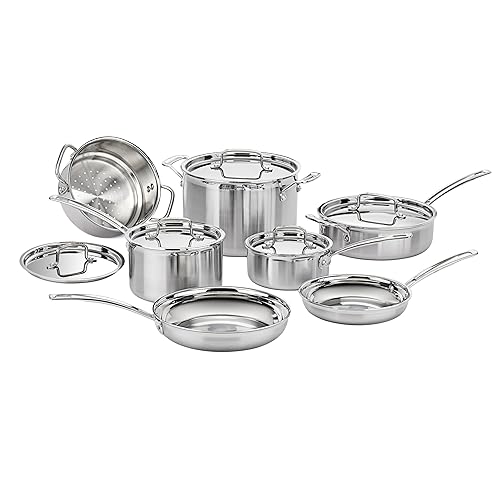
A 1.5-quart saucepan with lid, a 3-quart saucepan with lid, a 3.5-quart sauté pan with helper handle and lid, an 8-quart stockpot with lid, a steamer insert, and 8-inch and 10-inch skillets. Twelve pieces once you count the lids.
It is a smaller set than the seventeen-piece nonstick alternatives at the same money, and that comparison is the wrong way to look at it. There is no griddle and no egg pan here; what there is, is an 8-quart stockpot and a sauté pan with a helper handle, which are the two pieces people most often buy separately later.
The lids are stainless rather than glass. You cannot see through them, which some owners miss, but they take the same 500℉ the pans do — glass lids are usually the piece that caps a set’s oven rating.
Specifications
| Model | Cuisinart MultiClad Pro MCPS-12N, 12-piece |
| Construction | Triple ply — stainless interior, pure aluminium core, brushed stainless exterior |
| Heat Surround | Aluminium core runs up the sides, not only across the base |
| Oven safe | 500℉, lids included |
| Hob compatibility | All hob types including induction |
| Handles | Cool Grip, stainless rivets, helper handle on the sauté pan |
| Lids | Tight-fitting stainless steel, self-basting |
| Rims | Tapered for drip-free pouring |
| Dishwasher | Safe |
| Coating | None — nothing to wear off |
What triple ply actually buys you

Stainless steel is a poor conductor of heat. Left to itself it produces exactly the hot spot over a gas flame that ruins a sauce. Triple ply solves that by sandwiching a layer of aluminium — which conducts heat well but reacts with food — between two layers of stainless, which do not.
The result is a pan that cooks like aluminium and cleans like steel, with no coating in the middle of the transaction. Nothing wears off into your food, nothing needs replacing in three years, and metal utensils are not a problem.
The trade is technique. A stainless pan will stick if you put food into it cold or wet, and that catches out everyone moving over from nonstick. It is a learning curve rather than a fault, but it is a real one, and owners say so.
Who It’s For
- Anyone who wants cookware that outlives the kitchen it was bought for
- Induction owners, now or later — this works on every hob type
- Cooks who sear and build pan sauces, where a stainless surface earns its keep
- Anyone tired of replacing nonstick every few years, or uneasy about coatings in food
- Households who would rather have an 8-quart stockpot than a griddle and an egg pan
Who Should Look Elsewhere
- Cooks who want food to release without technique — stainless will stick if you rush it
- Anyone who wants the most pieces per pound; the seventeen-piece nonstick sets win on count
- People who like seeing into the pot — the lids are solid stainless, not glass
- Anyone unwilling to let a pan cool before washing it; owners report warping, and thermal shock is the usual cause
- Cooks who want a lightweight set — tri-ply is heavy, and that is the point of it
Performance
Heat Surround: the aluminium goes up the sides

Plenty of cheaper stainless cookware is disc-bottomed: a slug of aluminium bonded to the base only, with plain stainless walls. It works, up to the point where you are reducing a sauce and the sides scorch while the middle simmers.
Cuisinart runs the aluminium the full height of the pan, which is what the Heat Surround name refers to. On a gas hob, where the flame heats a ring rather than a disc and licks up the sides, that is worth more than it would be on electric.
It is also the main thing separating this from budget stainless at half the price. If you are comparing tri-ply sets, check whether the cladding is full-height or just a base disc — the listings do not always make it obvious.
It works on induction, and that matters more than it sounds

The stainless exterior is magnetic, so this works on induction as well as gas, electric, halogen and ceramic. That is a genuine advantage over the aluminium-bodied nonstick sets it competes with, including the T-fal Ultimate, which works on everything except induction.
It matters if you are buying cookware to keep. Hobs get replaced; induction is what most new kitchens go to. A set that cannot follow you to the next kitchen has a shorter life than its price implies, whatever the coating does.
Searing, sticking, and the technique you have to learn
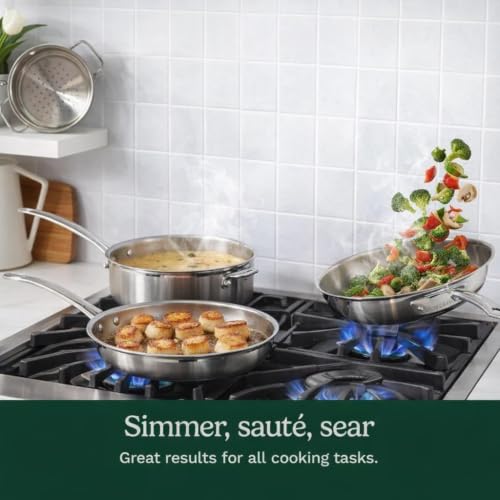
This is the one thing to understand before buying. Stainless does not release food the way nonstick does; it releases food when the pan is hot enough and the food has formed a crust. Put a cold fillet into a cold pan and it will weld itself to the base.
Two owners in the critical reviews report exactly that, one of whom bought separate nonstick frying pans rather than adapt. That is a fair outcome to plan for: many kitchens run a stainless set plus one nonstick pan for eggs, and there is nothing wrong with doing that.
What you get in exchange is fond — the browned residue that makes a pan sauce — which a nonstick surface will not give you. If you never deglaze a pan, that trade is worth less to you, and the nonstick sets guide is the better place to look.
500℉ in the oven, lids included
The whole set including the lids is oven safe to 500℉. That is a full hundred degrees above the hard-anodized nonstick alternative, whose glass lids cap it at 350℉.
It is the difference between a pan that finishes a steak under a hot oven and one that does not. Because the lids are stainless rather than glass, there is no weak link — on most sets it is the lid that sets the ceiling.
Design and Build
Cool Grip handles on stainless rivets, a helper handle on the sauté pan, tapered rims that actually pour, and tight-fitting lids that self-baste. Owners consistently praise the handles, and several note they stay cool on gas where a flame runs up the side.
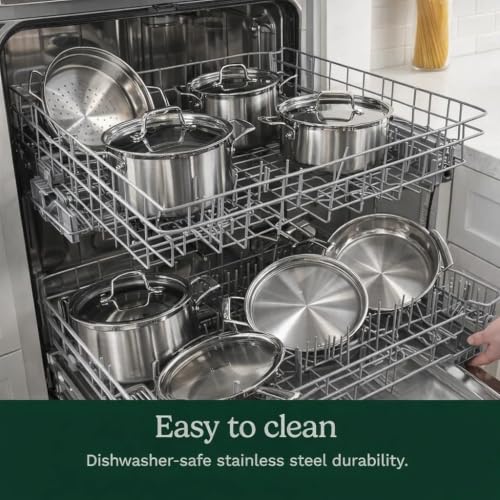
Dishwasher safe is a real advantage here rather than a box-tick, because there is no coating for detergent to degrade. The caveat owners raise is temperature shock: let a hot pan cool before it meets cold water. That is the most likely cause of the warping reports below.
What Owners Report
I have not cooked with this set. What I can do is read what eleven thousand owners say, and on cookware with no coating the interesting question is not how it performs in month one but whether it is still good in year ten. Several owners answer that directly. Here is what recurs on both sides, as of 8 September 2026.
What recurs in the positive reviews
- It lasts, and owners say so with dates. One reports buying the set in 2009 and still cooking on it daily. Another posts a two-and-a-half year update saying everything but the most-used skillet still looks new. A third calls it a set that will last twenty years.
- Even heating. Repeatedly described as heating evenly and cooking consistently, which is what the full-height aluminium is for.
- It replaces failed nonstick. A recurring migration: owners arriving from flaking Revere sets and worn all-aluminium Calphalon, explicitly wanting no coating this time.
- Handles and rivets. Singled out as solidly attached and comfortable, with the longer handles staying cool on the hob.
- The lids fit across pieces. Owners note the saucepan lids fit the skillets, which quietly makes a twelve-piece set more flexible than it looks.
What recurs in the critical reviews
- Warping. The most serious recurring complaint, raised independently by two owners, one of whom found a pan rocking on the hob after less than two months. Thermal shock is the usual cause, but it should not happen that fast.
- Food sticks. Two owners report it plainly; one bought separate nonstick pans instead. This is stainless behaving normally rather than a defect, but it catches people out.
- Slow to heat on a glass cooktop. One owner moving from copper-bottomed Revereware reports water taking several times longer to boil. Worth noting if you are on radiant glass rather than gas or induction.
- Cosmetic and packaging niggles. A handle set subtly askew, a piece described as inferior quality, and one owner reporting the model letters on their box did not match what they ordered.
- Price versus performance. One detailed reviewer rates it mid-level and argues it is priced above what it delivers — a minority view against the rating curve, but a considered one.
The split is unusually clean. Almost everything positive is about longevity and heat; almost everything negative is either warping or the stainless learning curve. Nothing wears out here, so the failure mode is mechanical rather than chemical — which is exactly the trade you are making against a nonstick set.
Value
At $219.95 for twelve pieces this is about $18 a piece, against roughly $13.50 for the seventeen-piece T-fal Ultimate. On a per-piece basis it loses.
On cost per year it very likely wins. The nonstick set carries a consumable surface that owners report failing anywhere between six months and four years; this one has an owner still using it seventeen years on. If those two reports are anywhere near typical, the stainless set is cheaper over a decade even at the higher sticker.
The honest caveat is that a warped pan ends that arithmetic early, and warping is the complaint that recurs here. Let pans cool before washing and the risk drops considerably.
Durability
Across 11,209 ratings the distribution runs 77% five-star, 12% four, 4% three, 2% two and 5% one-star. That 5% one-star tail is higher than the nonstick set it competes with, which is initially surprising for cookware with nothing to wear out.
Reading the tail explains it. Warping and sticking dominate, and both are front-loaded complaints — they show up in the first weeks, when people write reviews. Coating failure, the nonstick equivalent, arrives in year two or three when most buyers have stopped reviewing.
That asymmetry is worth holding on to when comparing star ratings across the two categories. A stainless set shows you its problems early; a nonstick set shows you them late.
Alternatives to Consider
- T-fal Ultimate Hard Anodized 17-piece — $229.99. Five more pieces including a griddle and a Dutch oven, food releases without technique, and it will not work on induction. The nonstick counter-argument.
- T-fal Signature 12-piece — $109.99. Half the money, nonstick, oven-safe to 350℉. The choice if budget is the constraint rather than longevity.
- GreenPan Lima 12-piece — $159.76. Ceramic and PFAS-free if coating chemistry is the worry, though ceramic wears faster than either of the above.
- Tramontina Signature Tri-Ply Clad 12-piece — $315. The same clad construction with a bigger 8-quart stock pot, a 6-quart sauté pan and steel lids that hold 500℉ covered. Ninety-five dollars more.
- See the full ranking in my cookware for gas stoves guide, or the fry pans for gas stoves guide if you only need one good pan.
Verdict
The Cuisinart MultiClad Pro is the set to buy if you want cookware you will not have to think about again. Full-height aluminium cladding rather than a base disc, 500℉ including the lids, every hob type including induction, and no coating that can fail. Owner reports stretching back to 2009 are the strongest evidence any set in this guide has.
Two honest limits. It will stick if you do not heat it properly, and if you are coming from nonstick that will be a genuine adjustment rather than a minor one. And warping is the complaint that recurs — let pans cool before they meet cold water. Buy this instead of nonstick if you are willing to learn the pan; buy nonstick if you are not.
How This Review Was Put Together
Plainly: this is research-based, not a hands-on test. I have not owned or used this cookware set, and nothing here should be read as a report from my own kitchen.
What it rests on: the published specification — the layer construction and where the aluminium core actually runs, hob and oven compatibility, handle and lid design, and the piece count against what is in the box — read against the other sets in my best cookware for gas stoves guide; the shape of the rating distribution across 11,209 Amazon ratings rather than the 4.5 average it produces; and the text of the positive and critical reviews, read for themes that recur across independent owners.
Why owner reviews are treated as evidence here: one reviewer cooking on one unit for a fortnight cannot show a pan warping in its second month, or a set still in daily use seventeen years on. Several thousand owners over years can. A theme is only reported above where more than one unconnected owner raised it.
What I could not establish: how common the warping reports really are, because a rating curve cannot separate a manufacturing fault from a pan taken from a hot hob to a cold sink; whether the reports of mismatched model letters on the box point at a packaging change or a supply problem, since Amazon retitled this listing recently and no longer shows MultiClad Pro in the product name; and how the set behaves on radiant glass, where the one detailed report here is unflattering.
Price, stock and ratings were read from Amazon’s US marketplace on 8 September 2026 and will move.
Frequently Asked Questions
Does the Cuisinart MultiClad Pro work on induction?
Yes. The brushed stainless exterior is magnetic, so it works on induction as well as gas, electric, halogen and ceramic. That is a real advantage over aluminium-bodied nonstick sets such as the T-fal Ultimate, which works on every hob type except induction.
Is this still the MultiClad Pro? The Amazon title does not say so.
Yes. Amazon has retitled the listing to a generic name, but the product description still refers to the MultiClad Pro set and the page carries the model number MCPS-12N. It is the same triple-ply 12-piece set.
Why does food stick to stainless steel?
Because stainless has no release coating. It lets go of food once the pan is properly hot and a crust has formed, so the technique is to preheat, add fat, and leave the food alone until it releases on its own. Cold pan, cold food or too much crowding will all cause sticking.
What is Heat Surround technology?
Cuisinart running the aluminium core up the sides of the pan rather than only across the base. Cheaper stainless is often disc-bottomed, with plain steel walls that scorch a reducing sauce. Full-height cladding is the main thing separating this from budget tri-ply.
Do the pans warp?
Some owners report it, including one at under two months, and it is the most serious recurring complaint. Thermal shock is the usual cause, so let a hot pan cool before washing it and avoid running cold water into it straight off the hob.
How hot can it go in the oven?
Up to 500 degrees Fahrenheit, lids included. Because the lids are stainless rather than glass there is no weaker component setting a lower ceiling, which is often what limits a nonstick set to 350.
Is 12 pieces enough?
It covers most kitchens: two saucepans, a saute pan with a helper handle, an 8-quart stockpot, two skillets, a steamer insert and lids. There is no griddle and no egg pan, and many owners keep one nonstick frying pan alongside it for eggs.
Is it worth more than a nonstick set at the same price?
On cost per year, very likely. There is no coating to fail, and owner reports run to seventeen years of use. On convenience, no: nonstick releases food without technique and gives you more pieces for the money. The question is which of those you are actually buying.

Glenn is the founder of Kitchenware Compare and has spent years researching, testing, and reviewing kitchen appliances, cookware, and gadgets. A lifelong home cook raised in a family that treated every meal as an occasion, Glenn started this site to cut through the noise of conflicting product reviews and give readers honest, practical guidance. When he is not testing the latest air fryer or digging into the specs of a new espresso machine, he can usually be found experimenting with new recipes or hunting for the perfect cast iron skillet at a flea market.
Leave a Reply