What can you put in an air fryer depends on the material and on your maker. COSORI and the Vortex Dual treat metal and glass as the baseline containers, metal utensils are out, and makers split on ceramic and silicone. Pyrex US says its glass cannot go in one; Pyrex UK calls its borosilicate ideal.
Here is what each maker says about glass, metal, ceramic and silicone, and what I could not establish. Foil and parchment have their own pages, and food is in the air fryer guide; this one covers dishes and tools.
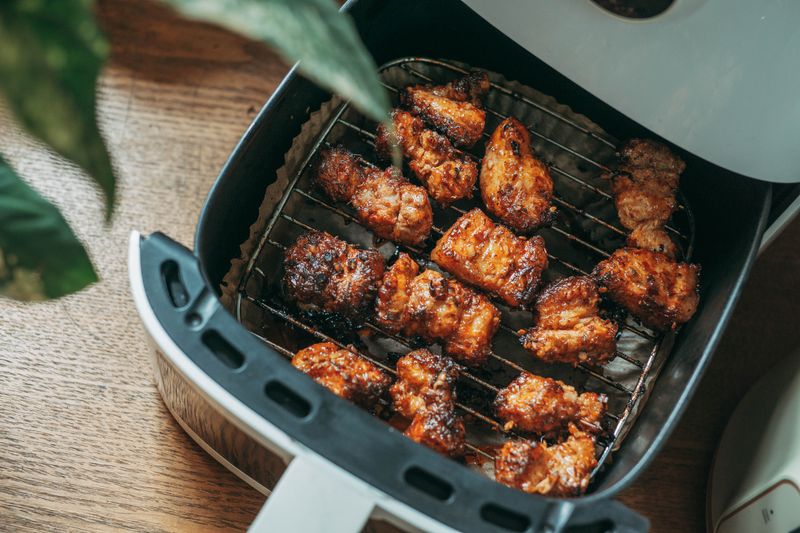
What Can You Put in an Air Fryer, Material by Material
This is the short version, drawn from the makers’ own wording below. Your own manual outranks this page.
| Material | Short answer and basis |
|---|---|
| Glass dish | Maybe. COSORI and the Vortex Dual treat glass as a baseline container, and Philips US allows it with conditions. Pyrex US says no. |
| Metal dish or pan | Usually yes, if it fits and is rated for the heat. COSORI and the Vortex Dual treat metal and glass as the baseline containers. |
| Metal utensils in the chamber or on the coating | No. COSORI and Instant Pot warn against both. |
| Ceramic or stoneware dish | Depends on the maker and unit. Philips Canada allows any ovenproof ceramic dish; the Vortex Dual bans stoneware and ceramic-coated pots, and Pyrex US bars ceramicware from air fryers. |
| Silicone mould, liner or cup | Philips Canada allows ovenproof molds and cups. Other makers say nothing general. |
| Paper, cardboard, non-heat-resistant plastic, wood | Mostly no. COSORI’s Pro LE allows parchment, and Philips Canada allows paper cupcake cups. |
What Air Fryer and Dish Makers Say
Guidance differs by brand, by region and by whether the unit is a basket model or an oven-style one. Where a maker says nothing about dishes, the table says so.
| Maker and source | What it says | What to take from it |
|---|---|---|
| COSORI, Pro LE 5.0 Quart and Lite 2.1 Quart manuals | Use heat-safe containers, and be extremely cautious with any that are not metal or glass. No paper, cardboard or non-heat-resistant plastic (the Pro LE allows parchment or foil), oversized food or metal utensils. | Metal or glass; anything else with great care. |
| Instant Pot, Vortex Dual 8L manual (UK edition) | Use caution with containers other than metal or glass, and no ceramic-coated or stoneware pot. In the Baking program only, a metal or glass dish can hold batter or dough inside the basket, with about 2.5 cm clear on every side. | The strictest on ceramic; dishes only in one program. |
| Instant Pot, Vortex Plus 10 Quart manual (oven-style) | Any oven-safe cookware is fine, such as a dish for cake, pie or quiche covered with foil or an oven-safe lid. Oversized food and metal utensils are barred from the chamber. | The broadest Instant Pot rule, for an oven-style unit. |
| Philips, US Airfryers FAQ | Glass may be used if it is oven-safe, tempered and free of cracks, and any metal, rubber, plastic or ink is removed from the glass container first. | Allowed, with conditions. |
| Philips, Canada baking tin article | Any ovenproof dish or mold works, whether glass, ceramic, metal or silicone, and silicone or paper cupcake cups are fine for cupcakes, muffins or small gratins. Put it in the basket, never directly in the pan, with space either side. Maximum sizes are set by model. | The most permissive, with size limits. |
| Pyrex US (Corelle Brands), FAQ and use-and-care page | A Pyrex glass dish cannot be used in an air fryer, which it calls a direct heat source; ignoring this may cause injury or property damage. The use-and-care list bars glassware and ceramicware from countertop appliances, air fryers included. | No, for Pyrex US glass and ceramic. |
| Pyrex UK, air fryer dish tip | Calls its borosilicate dishes ideal for air fryers and sells dishes sized to baskets. States that borosilicate withstands -40°C to +350°C and a move from a -20°C freezer to a 200°C oven. | Yes, for its own dishes. A retail page, not a test. |
| Ninja, AF100 owner’s guide | Nothing on dish materials. The Roast function mentions a baking dish, with no material or size rule. The basket and crisper plate are ceramic-coated. | Silent. |
| Chefman, TurboFry Touch manual | No statement about glass, ceramic or dishes at all. | Silent. |
Pyrex US and UK are different markets selling different dishes, and basket and oven-style models are different appliances, so the maker of the dish counts as much as the maker of the fryer.
Glass in an Air Fryer: The Makers Disagree
Five positions are on the record: Pyrex US says no, Pyrex UK says ideal, Philips US wants oven-safe, tempered, crack-free glass, Philips Canada allows any ovenproof glass dish, and COSORI and the Vortex Dual treat glass as a baseline container with caution. Those are different products in different markets, so I would follow the instructions that came with your own dish.
Online advice often says tempered or borosilicate glass is fine and soda-lime is not. I did not find that rule in any maker document, and Philips US asks only for tempered glass. Pyrex US says Corelle Brands makes both kinds and gives the same rules for both. If a dish chips or cracks, Pyrex US says to stop using it.
Metal: Dishes, Utensils and Coatings Are Three Questions
The same manuals that treat metal as a baseline container also ban metal utensils, which looks like a contradiction until you split the question. A metal dish in the basket, a metal tool in the chamber and a metal tool on the nonstick coating are three different things.
- A metal dish or pan: generally accepted. COSORI and the Vortex Dual treat metal and glass as the baseline containers, and Philips Canada lists metal among the materials that work. COSORI’s accessory kit includes a cake pan and a pizza pan, and its safety note says not to use the stainless steel accessories if scratched.
- A metal utensil in the chamber: no. COSORI Lite gives fire or electric shock as the reason for barring metal utensils and oversized food, and the Pro LE bars both without saying why. Instant Pot’s Vortex Plus gives fire or injury.
- A metal tool on the coating: no. COSORI says to avoid metal utensils and abrasive materials on the nonstick basket and crisper plate, and Instant Pot says no metal utensils when cleaning its nonstick trays. If the coating has already started to flake, air fryer basket coating flaking covers what to do.
Foil is metal that makers treat separately, and can you put aluminium foil in an air fryer sets out where they differ. COSORI and Instant Pot also warn against metal scouring pads, and the cleaning steps are in how to clean an air fryer.
Check the dish’s own rating against your unit’s top setting: 450°F on the COSORI Pro LE, 400°F on the COSORI Lite and Instant Pot’s Vortex Plus 10 Quart, and 205°C on the Vortex Dual.
Ceramic and Stoneware Depend on Which Type of Air Fryer You Have
Start with the maker and the unit. Philips Canada allows any ovenproof ceramic dish, and Instant Pot’s oven-style Vortex Plus says any oven-safe cookware is fine. The UK dual-basket Vortex Dual bans ceramic-coated and stoneware pots, COSORI says to be extremely cautious with anything but metal or glass, and Pyrex US lists ceramicware in its air fryer ban.
A ceramic-coated basket is a different thing from a ceramic dish. Ninja’s AF100 ships with a ceramic-coated basket and crisper plate, which is the unit’s own coating and no statement about cookware. If you are choosing a model, the best air fryers guide covers the ceramic versus PTFE coating question.
Check that any ceramic piece is made for food. The FDA guidance on traditional pottery says ceramicware that appears suitable for food use is treated as food use unless it carries the ornamental-use labels, and that pottery with extractable lead can contaminate food. It says nothing about heat or air fryers.
Silicone in an Air Fryer: Philips Canada Allows It, Others Are Silent
Philips Canada is the one maker I found that addresses silicone. It says any ovenproof dish or mold works, silicone included, and allows silicone or paper cupcake cups for cupcakes, muffins and small gratins. COSORI rates its own egg bites mold and silicone mat from -105°F to 460°F (-76°C to 238°C), but describes the mat as a heat-resistant surface under pans, so I would not read that rating as approval for every silicone liner.
COSORI, Ninja, Chefman and Instant Pot’s Vortex manuals give no general silicone rule, and the support pages I could reach added none. Instant Pot sells a silicone cake pan, oven-safe to 450°F, listed for its Air Fryer Lids on pressure cookers, which are a different appliance. Consumer Reports suggests silicone liners instead of parchment, as can you put parchment paper in an air fryer explains.
Paper, Cardboard, Plastic and Wood
These are mostly a no. COSORI says no paper, cardboard or non-heat-resistant plastic, though its Pro LE manual allows parchment or foil, and Instant Pot lists paper, cardboard, plastic, Styrofoam and wood as combustible materials that stay out of the cooking chamber. Philips Canada is the exception on paper: it allows paper cupcake cups for baking, where COSORI bars paper, with parchment as the stated exception for the Pro LE.
Parchment and foil are the other exceptions, and makers disagree there too: COSORI’s Pro LE allows both, its Lite allows foil only in the basket, the Vortex Dual says never to cover the tray or any part of the oven with foil, and Philips Canada does not recommend either. The conditions are on the parchment and foil pages linked above.
How to Check a Dish Before It Goes In
- Read your manual for the word “container,” and note whether you have a basket or an oven-style unit.
- Read the dish maker’s instructions. Pyrex US and Pyrex UK say opposite things, so the label on your dish decides.
- Confirm it is oven-safe and undamaged. Oven-safe cookware covers how to check a rating.
- Strip off lids, rubber and printed ink. Philips US names metal, rubber, plastic and ink on glass containers.
- On a basket model, put the dish in the basket and leave room around it. Philips Canada says never to set a dish directly in the pan, because that cuts off airflow so only the top of the food heats. Its size limits run by model, from 17 x 16 cm outer, 16 cm diameter and 6 cm high on compact units, and the Vortex Dual wants about 2.5 cm clear all round.
- Compare the rating with the top temperature, and avoid sudden temperature changes, which is Pyrex US’s oven rule, and no air fryer maker I read mentions it.
Common Mistakes With Dishes and Tools
- Setting the dish in the pan instead of the basket. Philips Canada says that stops the airflow.
- Leaving a plastic lid or rubber seal on glass. Philips US says to remove them.
- Covering the tray in foil on a unit that forbids it. The Vortex Dual does.
The real disagreement is Pyrex US against Pyrex UK and Philips, and this page takes no side in it. If the unit smokes with a dish in it, why an air fryer smokes goes through the causes.
How This Page Was Put Together
This page is based on maker manuals and support pages, not on testing; I do not own or test air fryers. The sources are manuals from COSORI, Ninja, Instant Pot and Chefman, the Philips US and Canadian support pages, the Pyrex US and UK pages, Instant Pot’s product pages and the FDA pottery guidance.
What I could not establish:
- A silicone rule from COSORI, Ninja, Chefman or Instant Pot’s Vortex manuals; only Philips Canada addresses it.
- Any independent test of glass or ceramic breakage in air fryers.
- Whether your own dish counts as an accessory. Ninja and Instant Pot (UK) warn that unrecommended accessories may cause fire or injury, and Chefman and the COSORI Pro LE warn of injury, but none defines the term.
- Whether a dish should go in cold or warm. Instant Pot’s Vortex 6QT page says to preheat the unit when using a baking dish, and no maker I read addresses thermal shock for glass in an air fryer.
- What Ninja and Chefman allow, since their manuals are silent on dishes.
- The US wording of the Vortex Dual rules; the manual I read is the UK edition.
- What makers I did not read, such as Breville, Cuisinart or Tefal, say.
The Verdict
A metal pan that fits the basket and is rated for the heat is the safest bet. Glass and ceramic depend on your maker and your dish, and silicone is allowed by Philips Canada but little discussed elsewhere. Keep metal utensils out of the chamber and off the coating, keep plastic and wood out, and use paper only where your maker allows it; theair fryers hub links every guide and review on the site.
Frequently Asked Questions
Can you put glass in an air fryer?
Sometimes. Philips US and Philips Canada allow oven-safe glass, and COSORI and the Vortex Dual treat glass as a baseline container, but Pyrex US says its glass cannot go in an air fryer. Follow the instructions for your own dish and unit.
Can you put Pyrex in an air fryer?
It depends on the market. Pyrex US says a Pyrex glass dish cannot be used in an air fryer because it is a direct heat source. Pyrex UK calls its borosilicate dishes ideal and sells ones sized for baskets. Check the label on your own dish.
Can you put metal in an air fryer?
Metal dishes and pans, yes, if they fit and are rated for the heat; COSORI and the Vortex Dual treat metal and glass as baseline containers. Metal utensils in the chamber are a fire, shock or injury risk, and COSORI says to keep them off the coating.
Can you put a ceramic bowl or stoneware in an air fryer?
Check your maker and unit. Philips Canada allows any ovenproof ceramic dish, and Instant Pot’s oven-style Vortex Plus accepts oven-safe cookware, but its Vortex Dual bans ceramic-coated and stoneware pots. Pyrex US bars ceramicware from air fryers. Check the label on your own dish.
Can you put silicone in an air fryer?
Philips Canada allows ovenproof silicone molds and silicone cupcake cups. COSORI rates only its own silicone pieces, from -105°F to 460°F, and Ninja, Chefman and Instant Pot’s manuals give no general rule. Check the temperature rating printed on your piece.
What materials should you never put in an air fryer?
Paper, cardboard and non-heat-resistant plastic, according to COSORI, though its Pro LE manual allows parchment and foil, and Philips Canada allows paper cupcake cups. Instant Pot adds Styrofoam and wood as combustible materials. Metal utensils and oversized food are barred too.
Can you put a cold glass dish in a hot air fryer?
No maker I read addresses cold glass in an air fryer. Pyrex US warns against sudden temperature changes in ovens while banning its glass here, and Pyrex UK’s freezer-to-200°C claim is for ovens. Instant Pot’s Vortex 6QT page says to preheat the unit when using a baking dish.

I'm Glenn, and I started Kitchenware Compare to cut through conflicting product reviews and help readers pick kitchen gear with confidence. I don't own or test the products I write about — these guides are built from verified-purchase reviews, manufacturer specifications, and independent testing where it exists, with the reasoning shown, not just a rating.
Leave a Reply