Rust on cast iron looks alarming, but it is a surface problem you can fix at home with a scrubber, water, a towel and oil. Scrub the rust off, dry the pan completely, then coat it with a very thin layer of oil. If the rust was widespread, bake the pan to rebuild the seasoning. I wrote this guide from the published instructions of cookware makers, a university extension service and established kitchen publications. I have not used any of these methods on a pan myself, so every step below is attributed to the source that gives it.
TL;DR
- Light rust: scrub with steel wool or a stiff brush, rinse, dry at once, then wipe on a very thin layer of oil. This is the approach in Lodge’s cleaning guide.
- Heavy rust: scrub it all off, wash, dry, then reseason in the oven with the pan upside down. Oven temperatures vary by source, from 350°F to 500°F.
- Dry the pan immediately and fully every time. Water left on the iron is a common cause of rust, according to The Kitchn.
- Rust on a pan is rarely a reason to throw it away. Only severe rust covering most of a piece is likely to need more than home scrubbing.
Is a rusty cast iron pan ruined?
No. Lodge’s cleaning guide says a rusty pan can be restored at home. It also lists what typically lets rust form: soaking the pan, running it through the dishwasher, air-drying it, or storing it somewhere damp.
That list explains the rust on most pans. Cast iron is bare iron under a layer of baked-on oil called seasoning. Seasoning is a thin, hard coating of polymerized oil that gives the surface its nonstick quality and keeps water off the metal. When the coating wears thin, or water sits on an unprotected patch, orange spots appear. The metal underneath is still sound.
The one exception is severe rust. The Kitchn’s guide says rust covering most of a piece may call for professional sandblasting down to bare iron, followed by immediate seasoning. That is an unusual case. Most pans pulled from a damp cabinet or left in the sink overnight are nowhere near that point.
What you need before you start
You do not need special equipment. The sources I read name the same short list:
- A scrubber. Steel wool, a stiff brush, a scouring pad, or a purpose-made rust eraser. Lodge recommends its rust eraser or steel wool for light rust.
- Warm water and dish soap. Lodge’s guide recommends warm soapy water for routine washing. Soap will not harm a pan that you re-oil afterward.
- A lint-free towel. Drying is half the job.
- Cooking oil. For seasoning, the University of Maine Cooperative Extension recommends a neutral, high-smoke-point oil such as vegetable or canola.
- An oven, foil and a baking sheet, only if you are reseasoning.
Work on a cool, dry pan. Lodge’s instructions for the rust eraser specify a cool, dry skillet, so do not start while the pan is still hot from cooking.
How to remove light rust
Light rust is a scattering of orange spots or a faint film, often on the cooking surface after a pan sat wet. It takes about ten minutes.
- Scrub the rust off. Lodge’s guide says to scour with its rust eraser, or to scrub with steel wool and warm, soapy water. Keep going until the surface shows dark gray or black iron and no orange comes off on the scrubber.
- Rinse. Field Company’s rust guide recommends cold water with a stiff brush or scouring pad for typical surface rust. Either warm or cold water works for the rinse, and what matters is not leaving the pan wet.
- Dry immediately. Towel-dry the pan right away. Field Company then suggests heating it about five minutes over medium-low heat to drive off any moisture left in the pores of the iron.
- Oil it thinly. Lodge says that after removing a small amount of rust, a very thin, even layer of cooking oil inside and out may be enough.
Where it goes wrong: the most common mistake is leaving the pan to air-dry after the rinse. Flash rust can reappear within minutes on freshly scrubbed iron, because the scrubbing removed the protective coating along with the rust. Dry it and oil it while you are still standing at the sink.
How to remove heavy rust
Heavy rust is a thick orange coat, rust that has begun to pit or flake, or rust across the whole pan, including the handle and the outside. The process is the same as above, with more scrubbing and a full reseasoning at the end.
- Scrub the whole piece. Lodge’s restoration guide recommends steel wool or its rust eraser, then washing with warm soapy water. The same page notes that scrubbing may remove some of the existing seasoning. Expect the pan to look patchy and gray when you finish. That is normal.
- Check for leftover rust. Field Company advises repeating the cleaning if rust is still visible or can be smelled. A faint metallic smell after drying means rust is still in the surface.
- Try a baking soda paste if you want a gentler abrasive. The Spruce’s January 2026 guide describes mixing baking soda with water into a paste, applying it to the rusted areas, scrubbing with steel wool or a cast iron brush, then rinsing, drying and reseasoning. The paste is an optional extra, since the scrubbing itself does the work.
- Wash, rinse and dry thoroughly. Then go straight to reseasoning.
A note on soaking: a short soak is not the problem, but a long one is how many pans rust in the first place. Lodge lists soaking among the usual causes of rust. If you do soak a pan to loosen heavy rust, keep an eye on it, and scrub and dry it the moment you pull it out.
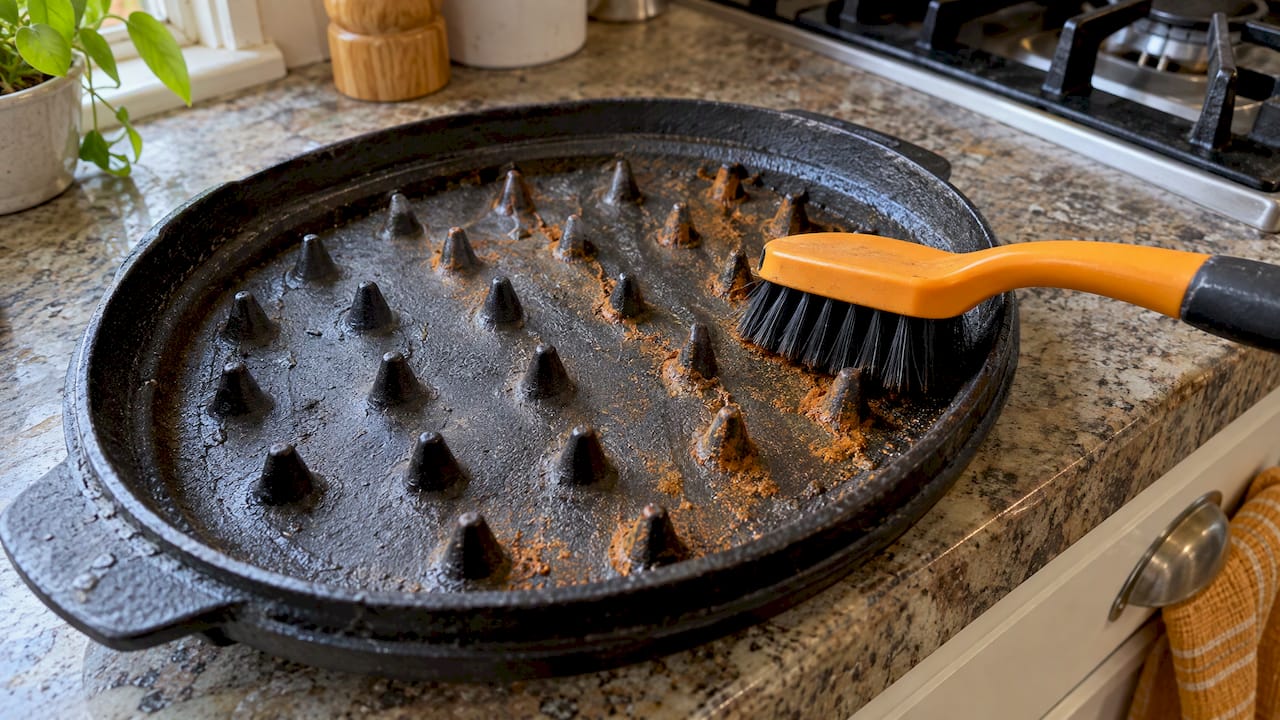
What about a lid with raised spikes or ridges?
Self-basting lids and ribbed grill pans trap rust in the grooves, and a flat scrubber skips over them. A stiff brush, or a wad of steel wool pushed into the grooves, reaches them better. Dry the grooves with a towel and then the heat of a burner or oven, because water pools there.
How to reseason cast iron after rust removal
Reseasoning replaces the coating you scrubbed away. The sources agree on the method: a very thin coat of oil, the pan upside down in the oven, and something underneath to catch drips. They differ on the temperature.
| Source | Oil | Oven temperature | Time |
|---|---|---|---|
| Lodge restoration guide | Thin coat of cooking oil | 450 to 500°F | 1 hour, then cool in the oven |
| University of Maine Cooperative Extension | Neutral, high-smoke-point (vegetable or canola) | About 450°F | 1 hour, foil or baking pan below |
| Martha Stewart | Thin layer of cooking oil | Around 450°F | 1 hour, upside down |
| The Kitchn | Oil on the entire piece, including bottom and handle | 350°F | 1 hour, foil below |
Three of the four sources land at 450°F or a little above, so that is a sensible middle choice. A lower temperature such as the 350°F The Kitchn gives is a gentler option if your oven runs hot or your kitchen has poor ventilation, since oil smokes as it bakes.
The steps
- Heat the oven to your chosen temperature.
- Rub a very thin layer of oil over the whole pan: cooking surface, outside, bottom and handle. The Kitchn specifically says to oil the entire piece.
- Wipe it back off with a clean cloth until the iron looks almost dry. Too much oil is the cause of a sticky, tacky finish. If you have had that problem before, my guide on cast iron that feels sticky after seasoning explains why.
- Put foil or a baking sheet on the rack below and place the pan upside down on the rack above. The upside-down position lets excess oil run off rather than pool.
- Bake for one hour. Lodge then has you let the pan cool in the oven.
- If the rust was widespread, Field Company says one or two rounds of oven seasoning are warranted. For spot rust, it says a full oven reseasoning may not be needed.
For a longer walk-through of oils and layering, see my guide to seasoning a cast iron pan. Layering matters because stacking too many coats at once can cause the surface to peel, which I cover in why cast iron seasoning flakes off.
How to keep cast iron from rusting again
Every source I read comes back to the same short routine.
- Dry it right away, every time. The Kitchn says water left on the pan and incomplete drying are common causes of rust. Its fix is to towel-dry immediately and finish over low burner heat or in the oven.
- Oil it lightly after drying. Field Company recommends drying thoroughly after every use and lightly oiling the pan.
- Store it somewhere dry. The same guide says to keep the pan in a dry area. A cabinet over the dishwasher or next to a sink is a damp spot.
- Keep it out of the dishwasher. Lodge names dishwasher use as a rust trigger.
- Keep cooking in it. Regular use with fat keeps adding to the seasoning, which is the pan’s rust protection.
If you have cast iron that is enameled, such as a Dutch oven with a colored glaze, this guide does not apply, since the glaze covers the iron. My page on cleaning enameled cast iron covers stains on that surface. For the bare-iron interior or rim of a plain Dutch oven, see the best way to clean a cast iron Dutch oven.
Common mistakes when removing rust
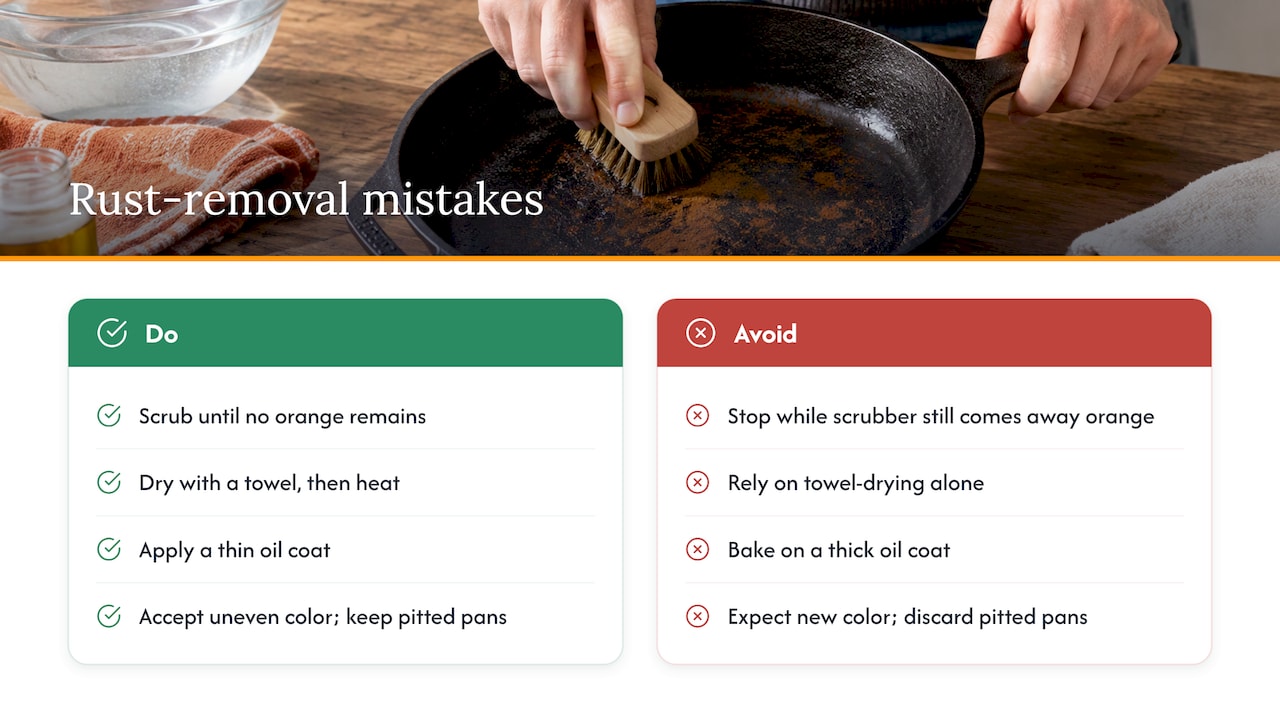
Stopping before the orange is gone. Rust left under new seasoning keeps spreading. If the scrubber still comes away orange, keep going.
Skipping the dry-and-heat step. Towel-drying alone can leave moisture in the iron. A few minutes of low heat fixes it.
Using too much oil. More oil does not mean better protection. A thick coat bakes into a sticky film.
Expecting the pan to look new. After heavy rust removal the pan will be uneven in color until it has been cooked in a few times. Appearance is not performance.
Giving up on a pan with pits. Surface pitting from old rust does not mean the pan is finished, though a deeply pitted cooking surface will be rougher to cook on.
If you are weighing rusty cast iron against a new pan
Restoring a pan costs a few minutes and a little oil, so for most rust it is the better deal. If you are shopping because a pan is beyond saving, or because you are tired of the upkeep, it helps to know what you are choosing between. Carbon steel is a lighter pan that also rusts and needs seasoning; I cover that in carbon steel vs cast iron and why a carbon steel pan rusts. Stainless steel does not need seasoning at all, and cast iron vs stainless steel shows which jobs each handles better.
A note from me
I read a lot of care instructions for this site, and cast iron rust is the topic where they agree most. Scrub, dry, oil, and if the rust was bad, bake. The disagreements are small, like 350°F against 500°F, and I would rather show you that spread than pick one number and pretend the others do not exist.
I do not own or use these pans for reviews, and I do not claim to. What I do is read the makers’ instructions, extension-service guidance and owner reports side by side, then lay out where they match and where they differ. That is also how I approach cookware comparisons, so you can see the specs, the price and the complaints owners report in one place before you buy.
The practical point is that rust is rarely the end of a cast iron pan. A routine of drying it fully and wiping on a thin coat of oil keeps it cooking for years.
Glenn
Browse cookware comparisons
If your rust problem has you rethinking your cookware, I keep side-by-side comparisons, buying guides and owner-reported strengths and complaints for cast iron, stainless, nonstick and more on the cookware reviews and buying guides page. Each one sets specifications, pricing and what owners say next to each other, so you can pick a pan for how you actually cook.

For a shorter route to the same restoration advice, my page on fixing rusty cast iron sets out what the makers say.
FAQ
Does baking soda remove rust from cast iron?
It can help as a mild abrasive. The Spruce’s January 2026 guide describes mixing baking soda with water into a paste, applying it to the rust, scrubbing with steel wool or a cast iron brush, then rinsing, drying and reseasoning. Steel wool and elbow grease do most of the work either way.
Can I use Dawn or other dish soap on cast iron?
Yes. Lodge’s cleaning guide recommends warm soapy water for routine washing, followed by complete drying and a thin layer of oil. Soap becomes a concern mostly when the pan is left to soak or air-dry afterward.
Can rusted cast iron be restored?
In most cases, yes. Lodge says a rusty pan can be restored at home. The exception is severe rust covering most of a piece, which The Kitchn says may need professional sandblasting before seasoning.
Do I always need to reseason after removing rust?
Not always. Lodge says a very thin layer of oil may be enough after removing a small amount of rust, while larger rust areas call for reseasoning. Field Company says widespread rust merits one or two oven-seasoning rounds.
What oil should I use to reseason?
The University of Maine Cooperative Extension recommends a neutral, high-smoke-point oil such as vegetable or canola. Whichever you use, apply it very thinly and wipe off the excess before baking.
Sources
- How to Clean, Lodge Cast Iron
- How to Restore and Season a Rusty Cast Iron Skillet, Lodge
- Cast Iron Basics: How to Clean, Season, and Maintain, University of Maine Cooperative Extension
- How to Remove Rust From Cast Iron, The Kitchn
- How to Deep Clean Cast Iron, The Spruce
- How to Clean a Rusty Cast-Iron Skillet, Martha Stewart
- How to Remove Rust from Cast Iron, Field Company
Recommended
- How to Fix Rusty Cast Iron: What the Makers Say
- Cast Iron Sticky After Seasoning? It’s Too Much Oil
- Cast Iron Seasoning Flaking Off? It Is Too Many Layers
- How to Season a Cast Iron Pan: Oven Steps, Oils, Reseasoning

I'm Glenn, and I started Kitchenware Compare to cut through conflicting product reviews and help readers pick kitchen gear with confidence. I don't own or test the products I write about — these guides are built from verified-purchase reviews, manufacturer specifications, and independent testing where it exists, with the reasoning shown, not just a rating.
Leave a Reply