This post contains affiliate links. If you buy through my links, I may earn a commission at no extra cost to you.
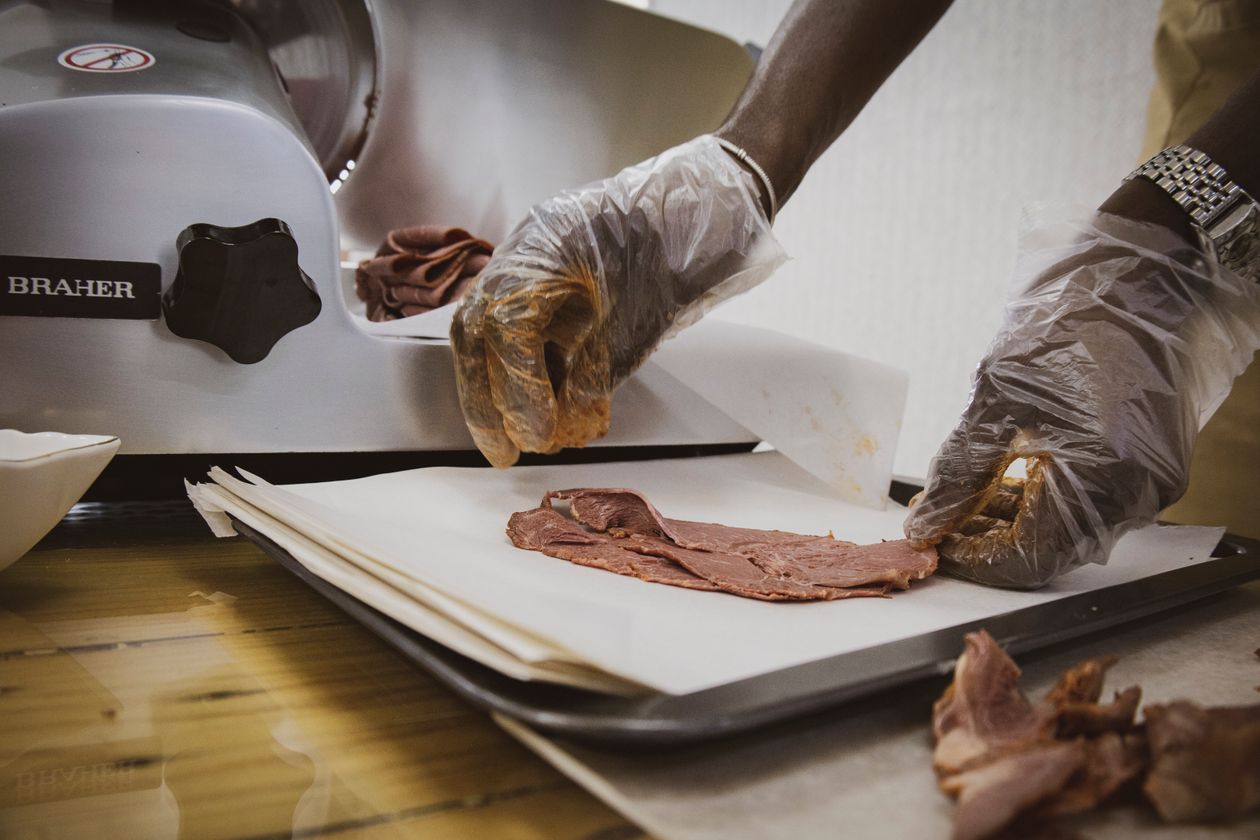
Photo by Tubarones from Pexels
Disclosure: I earn a small commission if you buy through links on this page, at no extra cost to you.
Home meat slicers used to be a professional kitchen item. Now they sit in suburban kitchens next to the stand mixer, used for deli-thin turkey after Thanksgiving, paper-thin prosciutto for charcuterie boards, and uniform cheese slices that a knife will never produce. The market has filled up accordingly — with some genuinely good machines and a lot of cheap hardware that vibrates across the counter and jams on the first pass through roast beef.
The CUSIMAX Electric Deli Meat Slicer is the right starting point for most households: 5,070 reviews at 4.3 stars, a dual-blade setup that handles both smooth and serrated cuts, and an adjustable thickness dial from 1 to 20mm. If you want a trusted consumer appliance brand with simpler operation, the Cuisinart FS-75 has 3,875 reviews at a similar price point. Both are reviewed in full below.
These picks are based on confirmed Amazon product data, verified specifications, and aggregated buyer reviews. All ASINs verified before inclusion.
Best Meat Slicers 2026: Quick Comparison
| Slicer | Best For | Blade | Wattage | Price | Buy |
|---|---|---|---|---|---|
| CUSIMAX Dual Blade | Best overall | 8.7″ dual | 200W | ~$123.98 | Check Price |
| Cuisinart FS-75 | Best brand name | 7.5″ single | 130W | ~$129.95 | Check Price |
| Techwood 9″ Blade | Best for large cuts | 9″ single | 200W | ~$120.35 | Check Price |
| Borlebbi Dual Blade | Best mid-range | 7.5″ dual | 200W | ~$119.99 | Check Price |
| FOHERE Dual Blade | Best budget | 7.5″ dual | 200W | ~$66 | Check Price |
Best Meat Slicers 2026: Full Reviews
1. CUSIMAX Electric Deli Meat Slicer — Best Overall

4.3/5 · 5,070 reviews · ~$123.98 · View on Amazon
With nearly 5,000 reviews, the CUSIMAX is the most validated home meat slicer at this price by a significant margin. It comes with two 8.7-inch blades — one serrated for bread and cured meats, one smooth for cold cuts and cheese — and a thickness adjustment that runs from 1mm to 20mm. That range covers deli-thin turkey slices at the fine end and thick-cut bacon at the other. The food carriage removes for cleaning, which matters a lot with a machine that collects meat debris in every crevice.
4.3 stars across just over 5,000 buyers is a credible validation. Common complaints in the reviews center on the motor running warm during extended sessions — this is a home machine, not a commercial one, and it’s not designed for continuous 20-minute runs. Use it in 5-minute intervals and it handles everything a home kitchen will throw at it. At $123.98 it is no longer the cheapest machine here — the Borlebbi and FOHERE both undercut it, and the Cuisinart FS-75 has now risen past it — but it is the only one at this level that ships both a serrated and a smooth blade.
Pros:
- 5,070 reviews — most validated home slicer in this category
- Dual blade (serrated + smooth) handles bread, cured meats, cheese, and deli cuts
- 1–20mm thickness range covers paper-thin to thick-cut in one machine
- Removable food carriage makes cleaning significantly easier
Cons:
- Motor warms after extended use — designed for home sessions, not continuous commercial runs
- 8.7″ blade limits maximum cut width; won’t handle very large roasts in one pass
- 4.3 stars is good but not exceptional — some buyers report inconsistent thickness at fine settings
Verdict: The right first choice for most households. More buyer validation than any comparable home slicer, dual-blade setup, and genuine thickness range.
2. Cuisinart Kitchen Pro Food Slicer FS-75 — Best Brand Name

4.2/5 · 3,875 reviews · ~$129.95 · View on Amazon
Cuisinart’s FS-75 is the most straightforward slicer on this list. One 7.5-inch stainless blade, a thickness knob that runs from 1/32″ to 1/2″ (roughly 0.8mm to 13mm), a tray that removes for cleaning, and a build quality that reflects Cuisinart’s consumer appliance standards rather than the budget-focused construction you get from lesser-known brands. The motor is 130W rather than 200W, which is the main functional trade-off — it handles standard deli cuts and cheese without issue but can slow on very dense cold cuts or partially frozen meat.
3,875 reviews at 4.2 stars puts it slightly below the CUSIMAX in both validation volume and average rating. The appeal here is the brand: Cuisinart has warranty support, consistent parts availability, and a track record in consumer kitchens. If you’d rather buy from a name you trust than an unknown brand with more reviews, that’s a legitimate preference.
Pros:
- Cuisinart brand — established warranty, parts, and customer support
- 3,875 reviews — well-validated with 10+ years of buyer feedback
- Simple single-blade operation — fewer parts to clean and maintain
- Compact footprint; easier to store than larger commercial-style slicers
Cons:
- 130W motor is weaker than 200W alternatives — slows on dense or semi-frozen meat
- Single blade only — no serrated option included
- 4.2 stars — lowest rating among the first three picks; more durability complaints in reviews
Verdict: Right for buyers who prioritise brand trust over spec-sheet performance. Slightly weaker motor at the same price as the CUSIMAX, but backed by Cuisinart’s consumer support.
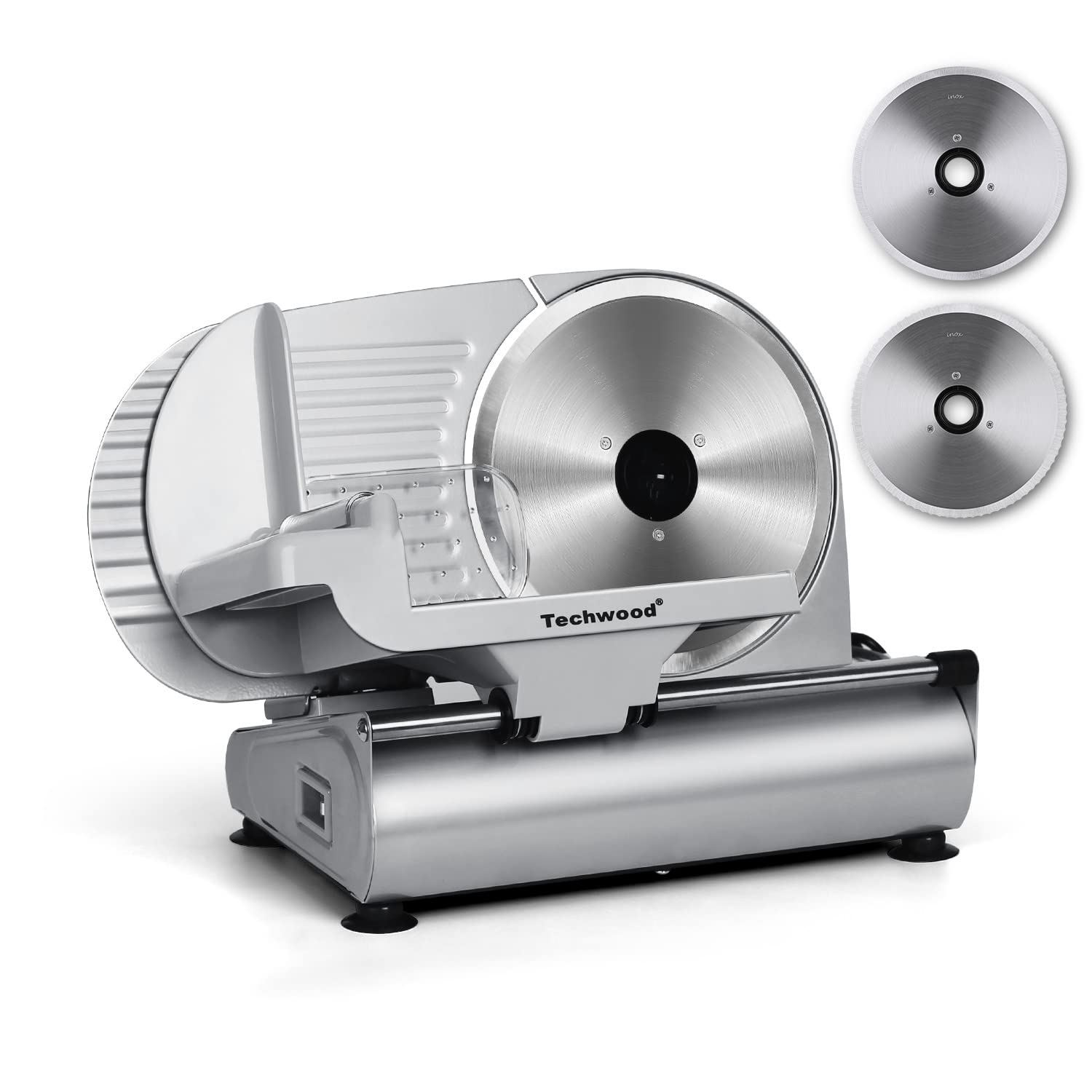
3. Techwood 9-Inch Meat Slicer — Best for Large Cuts
4.3/5 · 1,149 reviews · ~$120.35 · View on Amazon
The Techwood has a 9-inch blade — the largest on this list — which matters if you’re slicing large roasts, full turkey breasts, or wide cuts that a 7.5-inch blade has to make multiple passes on. Aluminum housing, a stainless carriage tray and a 200W motor round it out, with non-slip feet to keep it in place during use.
At $120.35 it undercuts the CUSIMAX and Cuisinart FS-75, and sits within thirty cents of the Borlebbi — the cheapest machine on this list. That makes it the least expensive way to get the largest blade here, though its 1,149-review sample is the smallest of any pick in this guide.
Pros:
- 9″ blade — largest on this list; handles wide roasts and turkey breasts in fewer passes
- Cheapest way onto this list to get a 9-inch blade — barely more than the Borlebbi
- 200W motor, ahead of the Cuisinart FS-75’s weaker motor
- 4.3 stars across 1,149 reviews
Cons:
- Ships one blade, where the CUSIMAX and Borlebbi ship two
- Heaviest machine on this list at 15.42 lb; needs more storage space
- Smallest review sample of any pick in this guide
Verdict: Best choice if you regularly slice large roasts or want the extra blade width without paying a premium for it. The tradeoff is one blade instead of two, and a smaller track record than its rivals here.
4. Borlebbi 200W Dual Blade Meat Slicer — Best Mid-Range

4.3/5 · 4,087 reviews · ~$119.99 · View on Amazon
The Borlebbi runs a 200W motor against two removable 7.5″ stainless blades with a 0–15mm thickness dial. That is the same motor rating and the same blade count as the CUSIMAX, on a blade about an inch smaller, for roughly $15 less. It also lists a child lock, non-slip suction feet, and a food pusher that doubles as a blade guard.
Its 4,087 ratings at 4.3 stars make it the second-largest review base in this guide, behind only the CUSIMAX. That matters more than the score itself. A 4.3 drawn from four thousand buyers is a steadier signal than a higher average drawn from a few hundred, and it is the main reason this machine is here rather than one of the thinly-rated alternatives at the same price.
One thing to check before you buy. The listing copy describes the housing as die-cast aluminium, while Amazon’s own specification table for the same product lists the material as ABS plastic and stainless steel. Those cannot both be right. Judge it as a plastic-bodied machine with stainless fittings at 10.7 pounds, and if the metal housing is the reason you were buying it, ask the seller before ordering.
Pros:
- ~$119.99 — fills the gap between the budget and mid-price machines
- 4,087 ratings — second-largest review base in this guide
- 200W motor with two removable 7.5″ stainless blades
- Child lock, non-slip feet, and a food pusher that doubles as a blade guard
Cons:
- The listing contradicts itself on housing material — the specification table says ABS plastic, not the die-cast aluminium claimed in the description
- Blade types are not specified, so there is no way to tell whether the second blade is serrated
- 7.5″ blade — joint smallest here, so not the choice for large roasts
- Hand wash only
Verdict: The sensible middle. If the FOHERE looks too light and the CUSIMAX is more than you want to spend, this is the machine in between, and it has the review volume to back that up.
5. FOHERE 200W Dual Blade Meat Slicer — Best Budget

4.2/5 · 650 reviews · ~$66 · View on Amazon
At $66.30, the FOHERE is the cheapest machine on this list that still includes two blades (serrated and smooth). The 200W motor matches the CUSIMAX on wattage, the 0–15mm thickness range covers standard home use, and the dual-blade design is the same core feature that makes the CUSIMAX appealing — at $43 less. The trade-off is build quality. The housing is lighter plastic, the blade rotation isn’t as smooth as pricier options, and the 4.2-star rating (the lowest on this list) reflects real buyer dissatisfaction with long-term durability and vibration at full speed.
For occasional use — slicing deli meats a few times a month — the FOHERE does the job. For weekly or heavy use, the build quality will become apparent faster than the CUSIMAX or Techwood. Buy it if budget is the genuine constraint; budget for an upgrade within 2–3 years.
Pros:
- ~$66 — lowest price on this list for a dual-blade slicer
- 200W motor — adequate wattage despite low price
- Dual blades (serrated + smooth) for bread and deli cuts
- 0–15mm thickness adjustment covers standard home use
Cons:
- 4.2 stars — lowest rating on this list; durability and vibration complaints in reviews
- Lighter plastic construction than any other pick here; not built for heavy use
- 650 reviews — moderate validation compared to CUSIMAX (5,070) or Cuisinart (3,875)
Verdict: Adequate for occasional use at the lowest price on this list. If budget is the constraint, it gets the job done. For regular use, add $43 and buy the CUSIMAX instead.
How to Choose a Home Meat Slicer
Blade Size: 7.5″ vs 8.7″ vs 9″
Blade diameter determines the maximum width of cut you can make in a single pass. A 7.5-inch blade (the Cuisinart and FOHERE) handles standard deli cuts and average roasts. An 8.7-inch blade (the CUSIMAX) adds margin for wider cuts.
A 9-inch blade (the Techwood) is the right choice if you regularly slice full turkey breasts or large standing roasts. For sandwich meat and charcuterie, 7.5 inches is sufficient. For whole roasts, go larger.
Above that there is a commercial class again — 10-inch machines built to slice continuously rather than in short bursts, which I cover in my BESWOOD 250 review and my KWS MS-10NT review, or the two compared head to head. For more on cutting-focused cookware, see my cookware hub.
Wattage: Does Motor Power Matter?
For home use, 130W is sufficient for standard deli meats, cooked chicken, and soft cheese. Where motor power becomes relevant is semi-frozen or very dense meat — thick salami, hard sausage, or partially frozen cuts that you’re slicing for portions rather than deli paper.
A 200W motor (CUSIMAX, Borlebbi, FOHERE and Techwood) handles these tasks better than a 130W motor (Cuisinart). At normal home use frequencies, both will perform well. If you process larger volumes, prioritise wattage.
Single Blade vs Dual Blade
A serrated blade cuts bread and cured meats with a sawing action that a smooth blade can’t replicate without tearing. A smooth blade produces clean, precise slices for fresh meats, turkey, and semi-firm cheese. If you want both functions, buy a slicer that includes both blades (CUSIMAX, FOHERE).
The Borlebbi also ships with two blades, though its listing does not say which types or check whether your chosen model offers optional blades sold separately. The Cuisinart FS-75 has aftermarket blade options available. For related equipment guides, see my cookware for gas stoves page.
Frequently Asked Questions
What’s the best home meat slicer for beginners?
The CUSIMAX. It has the most buyer reviews of any home slicer (5,070), a dual-blade setup that handles most home use cases, and a straightforward thickness dial. The main thing to know upfront: don’t run it for more than 5–10 minutes continuously. Let it rest between sessions. It’s designed for home portions, not continuous commercial use.
Can a home meat slicer cut through bone?
No. Every slicer on this list is designed for boneless meat only. Attempting to slice through bone will damage the blade and potentially the motor. For bone-in cuts (lamb chops, ribs, T-bone), use a band saw or ask your butcher to cut them before purchase.
How thick can a home meat slicer cut?
Most home slicers on this list go up to 15–20mm (roughly 3/4 inch). The CUSIMAX reaches 20mm; the others stop at 15mm. For context: standard deli thin is 1–2mm, sandwich-ready is 3–5mm, and thick-cut bacon territory starts at 6mm and up. These machines cover the full range for practical home use.
How do you clean a meat slicer safely?
Unplug it first, put on cut-resistant gloves, and set the thickness dial to zero before you remove anything. Wash the blade, carriage and tray by hand in hot soapy water — hand wash, not the dishwasher, because the detergent is hard on plated and coated blade edges. Wipe the body with a damp cloth and never submerge it.
Dry everything fully before reassembly, and clean after every session rather than letting residue dry on. My full guide to how to clean a meat slicer covers the part most people skip: the area behind the blade, which you cannot reach without taking the machine apart.
Is a 200W or 130W motor better for home use?
For standard deli cuts and cheese, 130W is sufficient. The difference becomes noticeable with semi-frozen meat or dense cured sausage — a 200W motor powers through these more cleanly. If your primary use is turkey and ham for sandwiches, either works. If you process thicker or denser cuts regularly, prioritise 200W.
Do meat slicers need sharpening?
Yes, eventually. Most home slicers include a built-in sharpener on the housing — a ceramic wheel you run the blade through to restore the edge. How often depends on use frequency. For typical home use (a few times a month), most buyers report the blade staying sharp for 6–12 months before the built-in sharpener is needed. Some higher-end models, like the Cuisinart FS-75, also support aftermarket blade replacement.
How These Picks Were Chosen
Plainly: this is a research-based guide, not a hands-on test. I have not run these side by side, and nothing here should be read as a report from my own kitchen.
What the picks rest on: blade diameter and whether it is stainless or carbon, motor wattage against the density of what you are actually slicing, the thickness dial range and whether it holds a setting, and how far the machine strips down for cleaning; plus the complaint patterns across verified-purchase reviews, which for slicers concentrate on two things – blades loosening over time, and food residue trapped in seams that do not come apart.
What I could not establish: slice consistency, which is the whole job. Measuring it means slicing the same chilled product at one setting repeatedly and measuring every slice, and no independent test does that for these machines. Blade size and wattage are used here as proxies, and a proxy is not a measurement.
The Bottom Line
For most households, the CUSIMAX is the right first slicer — the most validated machine at this price, dual blades, and a genuine thickness range. If you want a trusted consumer brand, the Cuisinart FS-75 trades some performance for brand support. Slicing large roasts regularly?
Get the Techwood 9-inch. Want the middle of the range? The Borlebbi sits between the two on price and has the second-largest review base here.
Working to a budget? The FOHERE dual-blade gets the job done for occasional use.
Everything on this site about slicers is collected in my meat slicer hub. For more kitchen equipment comparisons, see my cookware hub and my guide to best cookware sets.
Slicing by hand with good knives instead? The board matters more than most people think — my cutting boards for Japanese knives guide explains why hard boards quietly ruin sharp edges.
For powered prep beyond slicing — chopping, shredding, dough — see my food processors and choppers hub.
The full CUSIMAX review covers what the second blade actually buys, why 200W is a duty-cycle number, and how the recent price rise changes the value case.

I'm Glenn, and I started Kitchenware Compare to cut through conflicting product reviews and help readers pick kitchen gear with confidence. I don't own or test the products I write about — these guides are built from verified-purchase reviews, manufacturer specifications, and independent testing where it exists, with the reasoning shown, not just a rating.