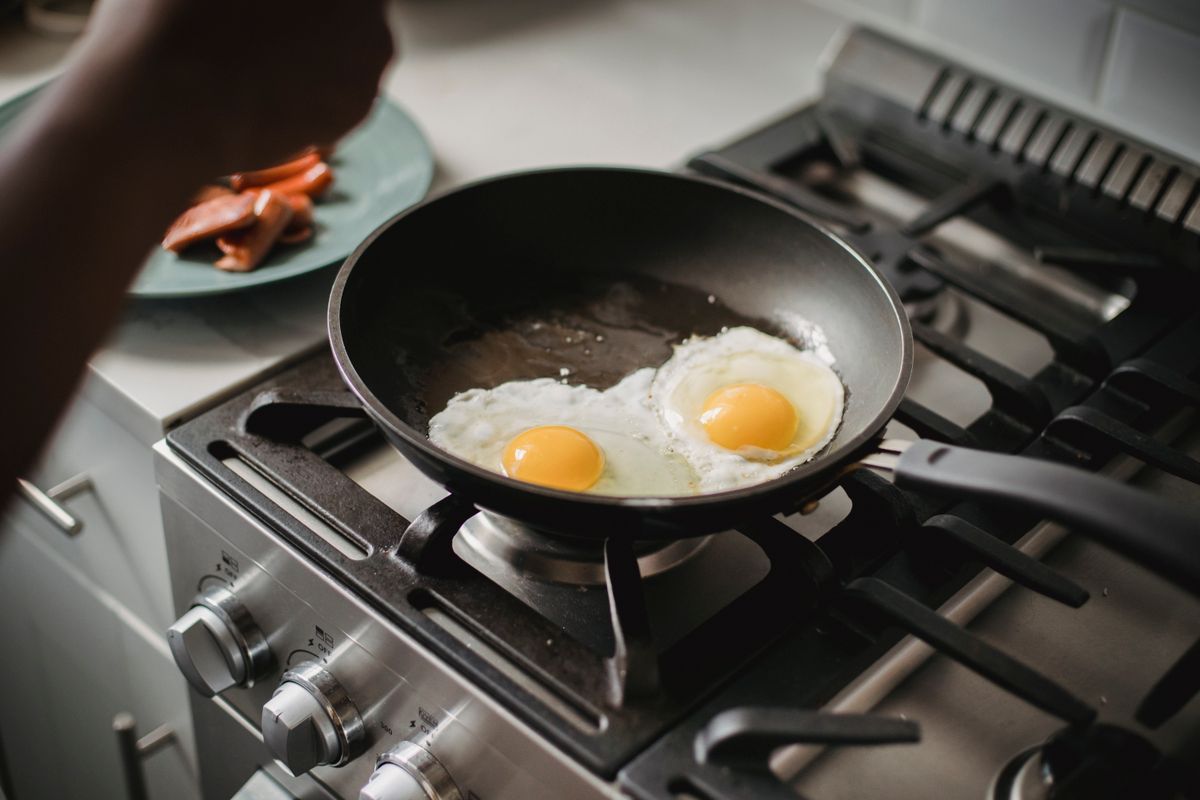
You can cook eggs without butter, and in most cases you do not need to replace it with anything. Butter is not doing anything chemically special — it is a layer of fat keeping egg protein off bare metal.
Once that is clear, the question stops being “what do I substitute” and becomes “what is keeping the egg off the pan”. Sometimes that is oil. Sometimes it is the pan itself. Sometimes it is water.
The short answer, by method
- Scrambled: a teaspoon of any neutral oil, or nothing at all in a good non-stick pan. Low heat, keep them moving.
- Fried: a thin film of oil, or a well-seasoned cast iron pan with none.
- Omelette: oil, and a pan the omelette can slide in.
- Poached, boiled, steamed: no fat of any kind, ever. The water does the whole job.
The rest of this explains why, because knowing the mechanism is what stops eggs sticking — not the particular fat you reach for.
Why eggs stick at all
Egg white is mostly water and protein. Heat unfolds those proteins, and the unfolded chains are chemically reactive — they will bond to whatever they are touching. If that is bare metal, they bond to the metal.
The Royal Society of Chemistry puts the mechanism plainly in its Kitchen Chemistry material on why pans stick: sticking is caused by chemical bonds forming between the food and the material of the pan, and protein-rich foods are especially prone to it “because the proteins can form complexes with metal atoms, such as iron, in the pan.”
That single sentence reframes the whole problem. As the same resource puts it, every method of reducing sticking works by reducing or preventing contact between the food and the metal. Butter is one way of doing that. It is not the only one, and it is not the best one.
What butter is actually contributing
Three things, and only one of them is about sticking.
- A barrier. Fat sits between protein and metal. Any fat does this.
- Flavour. This is the real reason to use butter, and no substitute reproduces it. Butter is about 15–18 percent water and contains milk solids that brown, which is where the nutty flavour of a butter-fried egg comes from.
- A temperature signal. Butter foams, then quietens, then browns. Cooks use it as a thermometer without thinking about it. Lose the butter and you lose that cue, which is a genuine reason eggs go wrong on the first attempt without it.
If the reason for dropping butter is dairy, calories or simply running out, the barrier job transfers to something else without difficulty. The flavour does not transfer, and it is more honest to say so than to pretend olive oil tastes the same.
Route one: another fat
The simplest swap. A teaspoon of neutral oil — sunflower, rapeseed, grapeseed, light olive — does the barrier job as well as butter does, and has a higher smoke point than butter into the bargain, since butter’s milk solids start to burn around 150 °C.
Two practical notes. Use less than you think: a thin film that just wets the surface is enough, and excess oil makes fried eggs greasy rather than less sticky. And get the oil hot before the egg goes in, which matters for the reason in the next section.
One thing to avoid: aerosol cooking spray
Spray seems like the obvious low-fat answer and it is the one genuine trap here. Aerosol sprays contain lecithin as an emulsifier, and lecithin polymerises into a hard, brown varnish that builds up in a thin layer heat cannot easily remove. On a non-stick pan it bonds over the coating and creates a sticky surface that is far worse than the one it replaced — a common cause of a non-stick pan that has started sticking. If the goal is using less fat, a measured half-teaspoon of oil spread with a brush or paper towel achieves it without the side effect.
Route two: no added fat, but the right surface
This is the route most articles skip, and it is the one that actually removes the need for a substitute.
Non-stick
A PTFE coating does not prevent sticking by being slippery so much as by being chemically unavailable. The RSC resource explains that PTFE contains only strong carbon–carbon and carbon–fluorine single bonds, and those bonds would have to break before any new bond could form with the food. There is nothing for the egg protein to grab.
In a genuinely good non-stick pan, eggs need no fat at all. A small amount still improves texture and browning, but it is optional rather than structural. The catch is that PTFE degrades with heat and age, so a pan that used to do this and no longer does is worn rather than dirty. An omelette pan kept for eggs alone, never used for searing and never scoured, will hold that property for years longer than a general-purpose frying pan will.
Seasoned cast iron
Seasoning is the same principle arrived at chemically. The RSC explains what happens when oil is heated in a pan: the oil fills the microscopic valleys in the metal surface, reacts with the metal atoms, and forms a coating — a patina — which “leaves few free metal atoms to react with the food.”
The mechanism it describes is cracking followed by polymerisation: at frying temperatures the long fatty-acid chains break into shorter fragments containing carbon–carbon double bonds, and those polymerise into a molecule large enough to stay solid at cooking heat. That polymer layer is what a seasoned pan is. It is not oil sitting on the surface; it is a plastic-like film bonded to it.
Which means a properly seasoned cast iron pan is doing exactly what butter does, permanently, and eggs can be cooked in one with nothing added. Getting there is the work — see the cast iron skillet guide for how, and note that a tacky pan after seasoning means too much oil was left on, which is the most common way this goes wrong.
The same resource notes why seasoning needs maintaining: detergents strip the patina, so it has to be reapplied.
Route three: methods that never needed fat
Worth stating because the question often assumes frying is the only option.
- Poaching. The egg never touches metal. Simmering rather than boiling water, and the freshest eggs available, since the white of an older egg spreads.
- Boiling. Same reasoning, shell included.
- Steaming. Underrated for both soft-boiled and scrambled. Steam-scrambled eggs in a bowl over water are slow, but they are almost impossible to overcook and use no fat.
- Oven-baked. Eggs cracked into a dish and baked need only a wiped dish, and the gentle even heat suits them.
Heat is the variable people miss
Most eggs that stick without butter stick because of temperature, not because the butter was missing.
Too cold and the protein has time to spread across the surface and bond thoroughly to the metal before it sets. Too hot and the bottom seizes and toughens while the top is still liquid. Medium-low is right for scrambled eggs, and a pan hot enough that a drop of water sizzles but does not skitter is right for frying.
The RSC resource also gives the trick every cook already uses without knowing the reason: keeping the food moving means it is never in contact with the pan long enough for those bonds to form. That is why stirred scrambled eggs stick far less than an egg left to sit — and it is why the low-and-slow, constantly-moving method works with no fat at all.
What changes in the result
Honestly, some things do.
- Flavour is the real loss. Browned milk solids are specific and nothing replicates them. Neutral oil is neutral by design.
- Texture is largely unchanged. Softness in scrambled eggs comes from low heat and stirring, not from butter.
- Browning reduces. The browning on a butter-fried egg is largely the milk solids, not the egg.
- Calories fall a little. A teaspoon of butter is around 34 kcal, a teaspoon of oil around 40 — so swapping butter for the same volume of oil saves nothing. The saving comes from using less, or none.
That last point is worth sitting with, because it is the opposite of what the swap implies. Oil is not lower in calories than butter; it is slightly higher by volume. If the aim is fewer calories, the pan is what makes the difference, not the fat.
How this guide was put together
This is a research-based guide rather than an account of firsthand cooking. The chemistry of sticking — protein complexes forming with metal atoms, the way PTFE resists that, and the cracking-and-polymerisation route by which heated oil forms a patina — is taken from the Royal Society of Chemistry’s Kitchen Chemistry resource, linked above and quoted where the exact wording matters. Composition figures for butter and the calorie comparison are standard published values. The method advice reflects what is consistently reported by cooks and by cookware manufacturers, and is presented as that rather than as a personal verdict.
What this cannot tell you is which route suits your kitchen, because that depends on what you already own. The advice is framed around the pan you have rather than one you would need to buy.
Frequently asked questions
Do you need butter to cook eggs?
No. Butter is a barrier between egg protein and metal, and any fat does that job. In a good non-stick or a well-seasoned cast iron pan, no fat is needed at all. Poaching, boiling and steaming never needed any.
What is the best butter substitute for eggs?
A neutral oil such as sunflower, rapeseed or grapeseed. It matches butter’s non-stick performance and has a higher smoke point. It will not reproduce butter’s flavour, which comes from browning milk solids rather than from the fat.
Can you cook eggs with water instead of butter?
Yes, though not in a frying pan in the usual sense. Poaching and steaming cook eggs in water or steam with no fat. A splash of water in a covered pan will also steam-baste a frying egg, setting the top without turning it.
Why do my eggs stick without butter?
Usually heat rather than the missing butter. A pan that is too cool lets the protein spread and bond to the metal before it sets. A worn non-stick coating or an unseasoned cast iron pan will also stick regardless of what fat is used.
Is cooking eggs without butter healthier?
Only if it means using less fat overall. Swapping a teaspoon of butter for a teaspoon of oil saves nothing — oil is slightly higher in calories by volume. The saving comes from cooking with little or none, which a good pan makes possible.
Can I use cooking spray instead of butter?
It is the one option worth avoiding. Aerosol sprays contain lecithin, which polymerises into a hard varnish that builds up on the pan and is difficult to remove. On non-stick pans it is a common cause of a surface that has started sticking.
How do you scramble eggs without butter or oil?
Low heat, a non-stick pan, and constant movement. Keeping the eggs moving prevents them being in contact with the pan long enough to bond to it. Adding a splash of milk or water helps with texture but is not what stops sticking.
Can you fry an egg in a stainless steel pan without butter?
It is the hardest combination. Bare stainless offers plenty of free metal atoms for the protein to bond with, so some fat is genuinely needed. Heating the pan first, then the oil, then adding the egg gives the best result.

Glenn is the founder of Kitchenware Compare and has spent years researching, testing, and reviewing kitchen appliances, cookware, and gadgets. A lifelong home cook raised in a family that treated every meal as an occasion, Glenn started this site to cut through the noise of conflicting product reviews and give readers honest, practical guidance. When he is not testing the latest air fryer or digging into the specs of a new espresso machine, he can usually be found experimenting with new recipes or hunting for the perfect cast iron skillet at a flea market.
Leave a Reply