I earn a commission if you buy through the Amazon links below, at no extra cost to you.
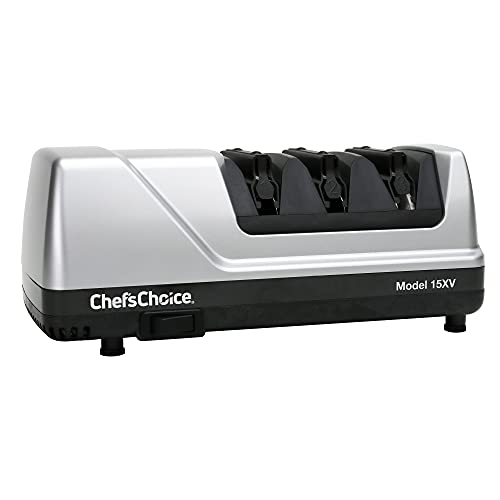
The Chef’sChoice 15XV, sold as the Trizor XV EdgeSelect, is the Best Overall (Electric) pick in my best knife sharpener guide. It costs $165.99 and has three stages: two with diamond abrasives, and a third that strops and polishes the edge.
Amazon shows 4.6 stars across 14,366 ratings. Filtering to this model leaves 4,222 written reviews, and 575 of those are critical, or 13.6%.
Owners who like it praise how sharp it gets their knives, and how much quicker and easier it is than a whetstone. The critical reviews centre on scratched blade faces, knives made worse, motors and wheels that failed, and units that arrived opened or in plain brown boxes.
Quick Verdict
| Score | Price | Rating | Buy |
| 7/10 | $165.99 | 4.6★ (14,366) | Check Price on Amazon |
What Comes in the Box

The sharpener itself, with an instruction booklet that owners mention. The manual describes a clean-out cover on the underside with a magnet that collects metal dust.
It needs no oil or water, and the manual says not to use either. The outside is wiped with a damp cloth, without detergents.
The listing gives a three-year limited warranty. The manual does not state a length, and says post-warranty repairs go back to the EdgeCraft factory for an estimate.
Specifications
| Model | Chef’sChoice 15XV Trizor XV EdgeSelect, Model 15 |
| Stages | Stage 1 sharpens and Stage 2 hones, both with 100% diamond abrasives; Stage 3 strops and polishes |
| Edge angle | Sold as a 15-degree edge; the manual describes a triple-bevel edge with its major facets at 14 degrees |
| Knives | Straight-edge and serrated knives, plus a one-sided method for traditional single-bevel Japanese knives |
| Not for | Scissors, ceramic knives, ax blades or any blade that does not fit freely in the slots |
| Time | About 1 minute for a first sharpening and 10 seconds to resharpen, per the listing |
| Dimensions | 10″ L × 4.25″ W × 4.25″ H, per the listing |
| Weight | 4.19 lb |
| Maintenance | Clean the metal dust off the magnet under the base about once a year; no lubrication |
| Assembly | Assembled in the USA, per the manual |
| Warranty | Three years, limited, per the listing |
What the 15-Degree Conversion Means for Your Knives
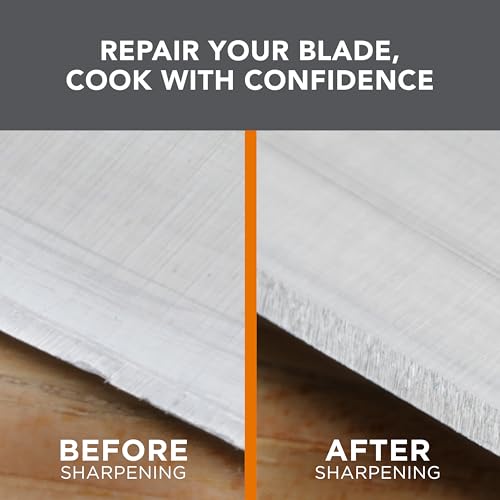
It changes the angle of most Western knives. The listing says it converts traditional 20-degree factory edges into 15-degree Trizor XV edges. The manual describes the result as a triple-bevel edge whose major facets sit at 14 degrees.
The first sharpening is the slow one. The manual says a thin European or American blade may take up to 20 pairs of pulls in Stage 1 to re-angle, and thicker blades more. At its suggested 3 to 4 seconds per pull on a 5-inch blade, that is two minutes or more in Stage 1 alone, where the listing says about a minute.
After that it is mostly Stage 3. The manual says to resharpen a smooth edge in Stage 3 each time, going back to Stage 2 only when that becomes slow. For a toothier edge on meat and fibrous food, it suggests Stage 1 followed directly by Stage 3.
Technique still matters. The manual asks for light downward pressure, a steady pull that never stops mid-stroke, a slight lift of the handle near the tip, and a check for a burr before the next stage. “Instructions” appears in 503 positive written reviews and 51 critical ones.
The written record is mid-table. 575 of the 4,222 written reviews for this model are critical, or 13.6%, and 308 are one star. On the same measure the Sharp Pebble whetstone in my guide is 7.5% and the Work Sharp Precision Adjust 20.1%.
Who It’s For
- Anyone who wants sharp knives without learning a whetstone. Owners who gave up on stones describe it as quicker and easier, and “easy” appears in 844 positive written reviews.
- Households with a drawer of dull Western knives. It is built to reprofile 20-degree factory edges, and owners describe long-owned Wusthof and Henckels knives cutting cleanly again.
- Anyone who also owns serrated knives. The manual gives a Stage 3-only method for them, and “serrated” appears in 145 positive reviews.
- Readers willing to follow the manual. Owners who read it, practise on a cheap knife and learn to feel for a burr describe very sharp results, and “learning curve” appears in 44 positive reviews.
Who Should Look Elsewhere
- Anyone who wants to keep a 20-degree factory angle. It converts edges to 15 degrees; my guide covers guided and whetstone options that do not force a conversion.
- Anyone who wants the blade faces left unmarked. “Scratch” appears in 49 critical reviews, from owners who found marks above the edge.
- Buyers outside the US. Owners who ran it through adapters in Europe and Australia report it not working or failing.
- Anyone who wants replaceable abrasives. Owners say worn wheels cannot be bought separately, and the manual says worn Stage 3 disks need factory replacement.
- Owners of ceramic knives. The manual says not to sharpen ceramic knives or scissors in it.
Performance
Sharpness

Sharpness is the dominant positive. Owners describe knives that slice paper and tomatoes cleanly and shave arm hair, and “razor” appears in 385 positive written reviews.
Owners with long-owned Wusthof, Henckels and Mac knives say the edges came back better than store or mail-in sharpening managed. Others found the result merely adequate, and a few say their knives came out duller than before, often on the first attempt.
The manual warns that properly sharpened knives will be sharper than you expect. My guide to a knife still dull after sharpening covers the usual causes when the edge does not improve.
The first sharpening and the learning curve
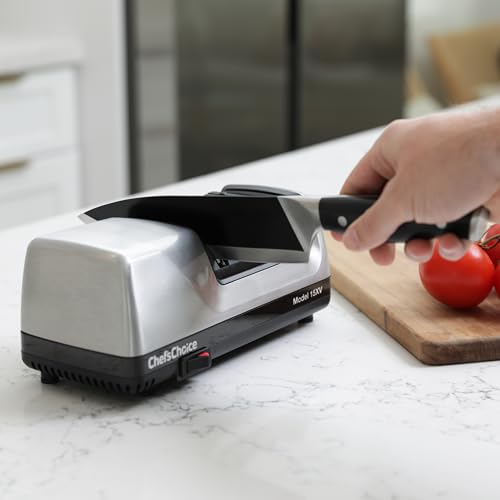
Reports of ruined knives mostly describe early attempts, and “ruined” appears in 28 critical reviews. One positive owner nearly destroyed a knife the first time and got very sharp results after practising.
Positive reviews that mention technique repeat the manual: read it, practise on an old knife, keep the pull steady and learn to feel the burr. Several owners say the instructions give the number of pulls per slot but leave other questions unanswered.
The manual says extra pressure does not speed sharpening, the blade should never stop while it touches the disks, and the handle should lift slightly as the tip approaches. A first sharpening can run to 20 pairs of pulls in Stage 1 alone.
Scratches, the plastic guides and metal removal
“Scratch” appears in 49 critical reviews and 83 positive ones. Critical reviewers describe scuffs and scratches on the blade faces above the edge, while some positive reviewers mention light scuff marks and accept them.
Owners also describe blades cutting into the plastic guides and leaving black bits, and “plastic” appears in 33 critical reviews. The manual says accidental cuts into the enclosure do not affect the sharpener or the edge.
Every sharpening removes some metal, and the first conversion to 15 degrees removes the most. The manual warns against over-sharpening in Stage 1, and my guide to fixing a chipped knife edge covers damage a sharpener alone may not fix.
Serrated and Japanese knives
The manual sharpens serrated knives in Stage 3 only, generally 5 to 10 pairs of pulls, and says their edges will never look as sharp as a straight edge. “Serrated” appears in 145 positive and 9 critical reviews.
For traditional single-bevel Japanese knives it gives a one-sided method that starts in Stage 2 and usually takes 20 to 30 pulls to raise a burr. Contemporary double-bevel Asian knives, which the manual says are probably already at 15 degrees, need only 1 or 2 pairs of pulls in Stage 1.
“Japanese” appears in 145 positive and 15 critical reviews, and one critical reviewer argues it should not be used on Japanese knives at all. My guide to sharpening a chef’s knife with a whetstone covers the hand method.
Design and Build

A silver and black housing with three slots across the top, each with spring guides, and an on/off switch on the front. The listing gives 10 inches long, 4.25 inches wide and 4.25 inches tall, and 4.19 pounds.
The manual says to keep it on a stable counter while it is on, to clear the metal dust from the magnet under the base about once a year, and to use the Stage 3 dressing lever on the back only when the white disks are badly darkened, because it wears them.
Noise draws mixed comments. “Noise” appears in 24 critical and 25 positive reviews, and critical reviewers describe a loud motor, a high-pitched Stage 3 and wheels that began to wobble.
What Owners Report
Of the 4,222 written reviews filed under this model, 3,257 are five stars and 308 are one star; 3,647 are positive and 575 critical. The themes below each appear in more than one unconnected review.
What recurs in the positive reviews
- Very sharp. Knives that slice paper and tomatoes cleanly.
- Easier than stones. Owners who gave up on whetstones.
- Quick resharpening. A few pulls to restore an edge.
- Old knives revived. Long-owned Wusthof, Henckels and Mac knives.
- Serrated knives. Bread knives sharpened in Stage 3.
- Longevity. Units still working after several years, and older Chef’sChoice models after decades.
What recurs in the critical reviews
- Scratched blades. Marks on the blade faces above the edge.
- Knives made worse. Duller or damaged edges, often on early attempts.
- Failures. Motors that stopped, and wheels that loosened, vibrated or stopped touching the blade.
- Opened or used units. Sharpeners that arrived in plain brown boxes, dirty, or with metal dust already on the magnet.
- Support and parts. Hard-to-start returns, return shipping costs, and no replacement wheels.
- Noise. A loud motor or a high-pitched Stage 3.
- Voltage. Failures when run outside the US through adapters.
Most critical reviews are not about whether it can get a knife sharp. They are about marks on the blades, results that depend on technique, and units that fail or arrive opened; owners who follow the manual describe very sharp knives in a few minutes.
Value
At $165.99 it costs far more than a whetstone or a pull-through sharpener, so the case for it is time and consistency rather than price.
On the same basis as this review, the Sharp Pebble 1000/6000 whetstone in my guide has 7.5% critical written reviews, and the Work Sharp Precision Adjust 20.1%.
The listing gives a three-year limited warranty, and Amazon itself sells it. One owner who bought from Amazon Warehouse Deals says Chef’sChoice would not honour the warranty, so check the seller before buying.
Durability
Durability reports cover the whole range. Owners describe units still working after six years and older Chef’sChoice sharpeners after decades, alongside units that stopped after two uses, ten uses, two months, ten months or about two years.
Some failures are mechanical: wheels that loosened and vibrated, a wheel that stopped touching the blade, and plastic guides that came apart. “Motor” appears in 15 critical reviews and “stopped working” in 13.
Worn abrasives are the long-term limit. Owners say the wheels cannot be replaced at home, and the manual says overusing the Stage 3 dressing lever wears the disks out, after which factory replacement is needed.
Two avoidable problems recur. Owners who used it through adapters in Europe and Australia describe it failing or smoking, and “brown box” appears in 28 critical reviews from buyers who suspected an opened or used unit.
None of this is a failure rate. Unhappy owners write more reviews than happy ones, and written reviews are not a random sample of units.
Alternatives to Consider
- For guided, whetstone and pull-through alternatives, my best knife sharpener guide compares all five picks.
- For the hand method, see my guide to sharpening a chef’s knife with a whetstone.
- If you are choosing knives as well, my best chef’s knife guide covers German and Japanese-style picks, and my Wusthof Classic review covers one of the German knives owners mention.
- Everything else on knives is in the knives hub.
Verdict
The Chef’sChoice 15XV is a three-stage electric sharpener that owners credit with very sharp knives in minutes, without the skill a whetstone needs, and its manual covers serrated and single-bevel knives too.
Against that, 575 of its 4,222 written reviews are critical, led by scratched blade faces, results that depend on technique, failed motors and wheels, and units that arrived opened, and at $165.99 it is a large outlay.
Seven out of ten: marked up for sharpness, ease against a whetstone and versatility, marked down for blade scratches, the reliability record, the lack of replaceable abrasives and the price.
How This Review Was Put Together
Plainly: this is research-based, not a hands-on test. I have not owned or used this knife sharpener, and nothing here should be read as a report from my own kitchen.
What it rests on: the published specification — the stage design, edge angle, sharpening procedures, knife types and care instructions in Chef’sChoice’s Model 15 manual (EdgeCraft, 2019), and the timing, dimensions and warranty on its Amazon listing — read against the other sharpeners in my best knife sharpener guide; the split of the 4,222 written reviews filed under this exact model rather than the 4.6 average across 14,366 ratings; and the text of the positive and critical reviews, read for themes that recur across independent owners.
Why owner reviews are treated as evidence here: one reviewer cooking on one unit for a fortnight cannot show whether a sharpener scratches blades, keeps its abrasives working or fails after a year. Thousands of owners over more than a decade can. A theme is only reported above where more than one unconnected owner raised it.
What I could not establish: how much metal the first 15-degree conversion removes from a given knife, since neither Chef’sChoice nor owners measure it; why some owners get scratched blades and others do not; and what share of units fail, since unhappy owners are over-represented in written reviews.
Price, stock and ratings were read from Amazon’s US marketplace on 15 September 2026 and will move.
Frequently Asked Questions
What angle does the Chef’sChoice 15XV sharpen to?
Chef’sChoice sells it as a 15-degree edge that converts traditional 20-degree factory edges. Its manual describes a triple-bevel Trizor edge with the major facets at 14 degrees.
Does the Chef’sChoice 15XV scratch knives?
Some owners say it does: “scratch” appears in 49 critical written reviews, describing marks on the blade faces above the edge. Others report light scuffs or none. The manual asks for light downward pressure and a steady pull.
Can the Chef’sChoice 15XV sharpen serrated knives?
Yes. The manual says to use Stage 3 only, generally 5 to 10 pairs of alternating pulls, with one fast pull in each slot of Stage 2 first if the edge is badly damaged.
Can the Chef’sChoice 15XV sharpen Japanese knives?
The manual gives a method for traditional single-bevel Japanese knives that sharpens one side in Stage 2 and finishes in Stage 3. Contemporary double-bevel Asian knives need only 1 or 2 pairs of pulls in Stage 1.
What should you not sharpen in the Chef’sChoice 15XV?
Scissors, ceramic knives, ax blades and any blade that does not fit freely in the slots, according to the manual.
How long does the first sharpening take?
The listing says about a minute for a first sharpening and about 10 seconds to resharpen. The manual says a thin European or American blade may need up to 20 pairs of pulls in Stage 1 to re-angle, at 3 to 4 seconds a pull, and thicker blades more.
How do you clean the Chef’sChoice 15XV?
Wipe the outside with a damp cloth, without detergents. About once a year, remove the clean-out cover under the base and brush the metal dust off its magnet. Never use oil or water on the abrasives.
What is the warranty on the Chef’sChoice 15XV?
The Amazon listing gives a three-year limited warranty. The manual does not state a length, and says post-warranty repairs go back to the EdgeCraft factory for an estimate.

Glenn is the founder of Kitchenware Compare and has spent years researching, testing, and reviewing kitchen appliances, cookware, and gadgets. A lifelong home cook raised in a family that treated every meal as an occasion, Glenn started this site to cut through the noise of conflicting product reviews and give readers honest, practical guidance. When he is not testing the latest air fryer or digging into the specs of a new espresso machine, he can usually be found experimenting with new recipes or hunting for the perfect cast iron skillet at a flea market.
Leave a Reply