This post contains affiliate links. If you buy through my links, I may earn a commission at no extra cost to you.
If I had to own one knife, I would choose an 8-inch chef knife. A santoku makes more sense if vegetables dominate the cutting board, hands are small, or counter space is tight. The real difference comes down to blade geometry: length, edge angle, and belly curve, which is what the rest of this comparison breaks down with specs and a simple decision matrix.
TL;DR:
- Choose a santoku if vegetable prep, small hands, or space constraints are priorities, as it offers better control and reduced fatigue.
- Opt for a chef knife when working with whole proteins, larger cuts, or when a rocking motion enhances efficiency and ease of use.
- Match the knife’s blade length and edge angle to your typical tasks: santokus are 5–7 inches with 10–15 degree angles, while chef knives are 8–10 inches with 20–25 degrees.
- Prioritize sharpness maintenance by hand washing, immediate drying, and suitable sharpening angles based on steel hardness and blade geometry.
- Use a wood or plastic cutting board to minimize edge dulling, avoid glass or stone surfaces, and adopt proper safety grips for each blade style.
Santoku vs Chef Knife at a Glance
Before getting into the specs, here is a scannable summary of where each knife pulls ahead. According to Knife Depot, the santoku wins for vegetable-dominant cooking, smaller hands, and compact prep spaces, while the chef knife wins for mixed Western cuisine, whole proteins, and rocking-motion technique. That single distinction explains most of the disagreement in kitchen forum threads.
- Blade length: santoku runs shorter, which suits tight boards; chef knives run longer, which suits reach and bigger cuts.
- Edge profile: santoku blades are flatter and favor a straight push-cut; chef knives carry more curve (belly) for rocking.
- Weight and control: santoku’s lighter build reduces fatigue for smaller hands, according to Knife Depot.
- Maintenance: the narrower santoku edge needs more careful sharpening technique than the more forgiving chef knife bevel.
None of this means one knife is objectively better. It means each one is built for a different motion, and matching the motion to the task is the whole game.
Blade Geometry and Specs That Actually Matter
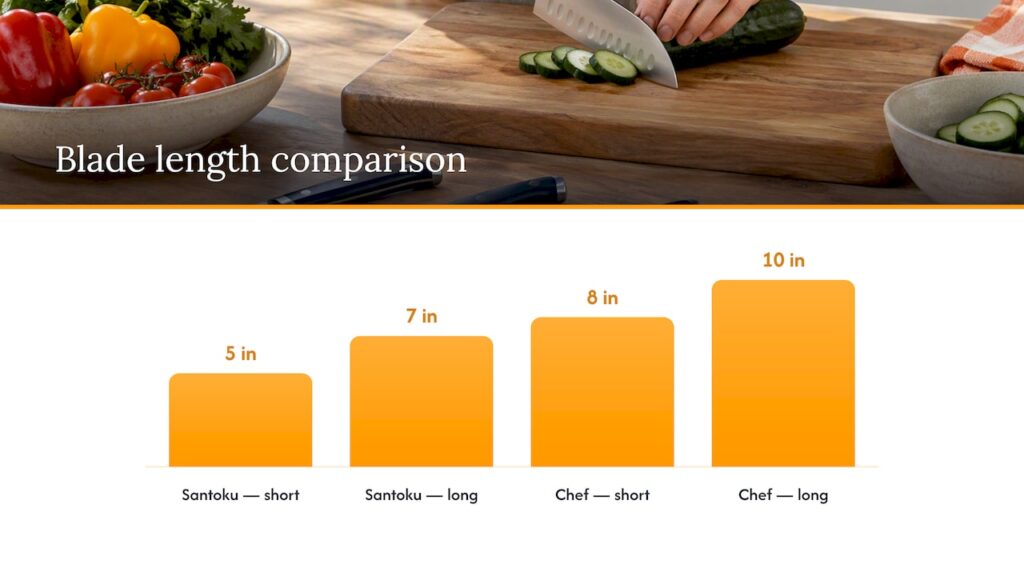
A santoku blade typically measures between 5 and 7 inches, while a chef knife typically runs between 8 and 10 inches. That length gap changes how much reach a cook has and how much board space the knife needs to work efficiently.
Edge angle is where the two knives diverge most sharply. A santoku’s edge typically sits around 10 to 15 degrees per side, while a Western chef knife typically sits around 20 to 25 degrees per side, according to Knife Depot. A narrower angle cuts with less resistance and feels sharper on contact, but it also chips more easily against bone or a hard squash.
A santoku’s edge angle (roughly 10 to 15 degrees per side) is about half as wide as a standard chef knife’s (20 to 25 degrees), according to Knife Depot, which is the single biggest reason the two knives feel so different in use.
- Santoku blades are mostly flat with a small curve near the tip, built for straight-down cuts.
- Chef knives carry a pronounced belly along the front third of the blade, built for rocking.
- Santoku edges are often set in harder steels that hold an edge longer but chip more readily, per Knife Depot.
- Chef knife steels tend to run slightly softer and tougher, trading some edge retention for resilience.
Harder steel sharpens less often but demands more care near the edge. Softer steel dulls sooner but tolerates the occasional mistake, which matters if the knife lives in a shared kitchen drawer.
Which Tasks Favor Each Blade Shape
The flat edge on a santoku favors a push-cut or straight chop, according to The Kitchn, which is why it excels at thin slices, fish fillets, and fast vegetable prep on a tight board. The curved belly on a chef knife is built for a rocking motion, which makes it the better pick for herbs, mincing, whole proteins, and bread.
- Vegetable-forward prep: a santoku’s flat edge moves straight through onions, cucumbers, and cabbage with less lifting.
- Fish and delicate proteins: the thinner santoku edge produces cleaner slices with less tearing.
- Herbs and mincing: a chef knife’s rocking motion covers more surface area per stroke.
- Whole proteins and bread: the longer chef blade and its curve handle larger cuts and crusts more efficiently.
Using the wrong motion wastes a knife’s design: rocking a flat-edged santoku instead of push-cutting it loses most of its speed advantage, according to The Kitchn. Hand size and board length matter too. An 8-inch chef knife needs roughly 15 inches of board space to complete its full rocking arc, according to Knife Depot, which rules it out on a cramped countertop. Smaller hands and compact kitchens tend to do better with a 6 or 7-inch santoku, which also reduces wrist fatigue over a long prep session.
Pro Tip: Match the knife to the motion before worrying about the brand: a push-cut knife used with a rocking stroke feels dull even when it is not.
Sharpening and Everyday Care for Each Knife
A santoku’s narrower edge, around 10 to 15 degrees per side, needs a sharpening angle that matches that geometry closely; sharpening it at a chef knife’s wider 20 to 25 degree angle blunts its main advantage. Harder steels, common on santoku blades, hold that edge longer between sharpenings but chip more easily if the blade strikes bone or a frozen surface, according to Knife Depot.
- Hand wash both knives and dry them immediately; the dishwasher’s heat and motion dull edges and can crack handles.
- Hone a chef knife every few uses with a honing steel to keep the edge aligned between sharpenings.
- Store either knife in a block, on a magnetic strip, or with blade guards, never loose in a drawer.
- Address small chips early with a finer-grit stone pass rather than waiting for the damage to spread.
For a full walkthrough, I rely on this guide to sharpening a chef’s knife with a whetstone, and if an edge still feels dull after sharpening, the burr troubleshooting guide usually explains why.
A Simple Decision Matrix for Choosing One
Here is a repeatable way to settle the choice instead of landing on “it depends.” Pick the 3 priorities that matter most to a kitchen (vegetable volume, hand size, board space, protein work, or sharpening patience), score each knife 1 to 5 on each priority, then total the scores. A gap of 3 points or more between the two totals points to a clear winner, according to Knife Depot.
- Vegetable-first cook: high score for prep speed and board fit favors the santoku by a wide margin.
- Omnivore home cook: balanced scores across protein work, herbs, and bread tip the total toward the chef knife.
- Small-handed beginner: lighter weight and shorter length push the santoku ahead on comfort and control.
As a rule of thumb: buy a santoku if 2 or more priorities point to vegetables, small hands, or tight boards; buy a chef knife if whole proteins or mixed cooking dominate; keep both once cutting volume justifies owning two knives, which is common among cooks who prep daily. Readers set on the chef knife route can see how one popular model performs in this Mac MTH-80 8-inch review.
Handle Materials and Grip Comfort
Handle material changes how a knife feels well before the blade ever touches food. Most santoku and chef knives come with either a full-tang riveted handle, usually wood, resin, or composite, or a stamped handle with a lighter polymer grip. Riveted handles tend to balance the weight of a forged blade closer to the bolster, which reduces strain during long prep sessions.
Smaller hands generally do better with a santoku’s shorter handle and overall lighter build, since there is less blade weight out front to control. Larger hands often prefer a chef knife’s longer handle, which gives the fingers more room and keeps the knuckles clear of the cutting board during a rocking motion. A handle that is too short for a hand forces a cramped pinch grip, which tires the hand faster regardless of how sharp the blade is.
Composite and resin handles resist moisture better than untreated wood and are generally easier to keep clean, though either material holds up fine with regular hand washing and prompt drying. The grip shape matters as much as the material: a rounded spine is more comfortable for a pinch grip, while a squared-off spine gives more leverage when pushing through dense vegetables.
Does the Cutting Board Material Matter?
Both knives perform best on wood or quality plastic cutting boards, which absorb some of the impact of each stroke and let the edge glide rather than skid. Glass and stone boards look clean but are hard on any blade’s edge, and the narrower santoku edge is especially vulnerable since a 10 to 15 degree angle has less steel behind it to resist micro-chipping on a hard surface.
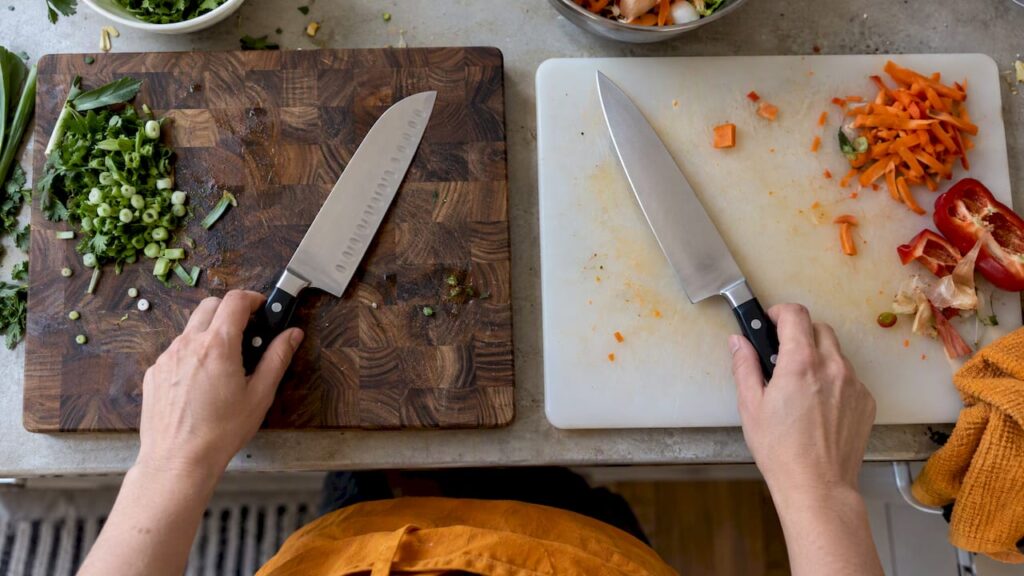
A wood board is generally the gentler choice for a santoku’s thinner geometry, while a dense plastic cutting board works well for either knife and is easier to sanitize after raw protein. Glass boards should be avoided with both knife styles if edge retention matters, since repeated contact with a hard surface dulls the edge faster than normal use would.
Safety Habits That Differ by Knife Style
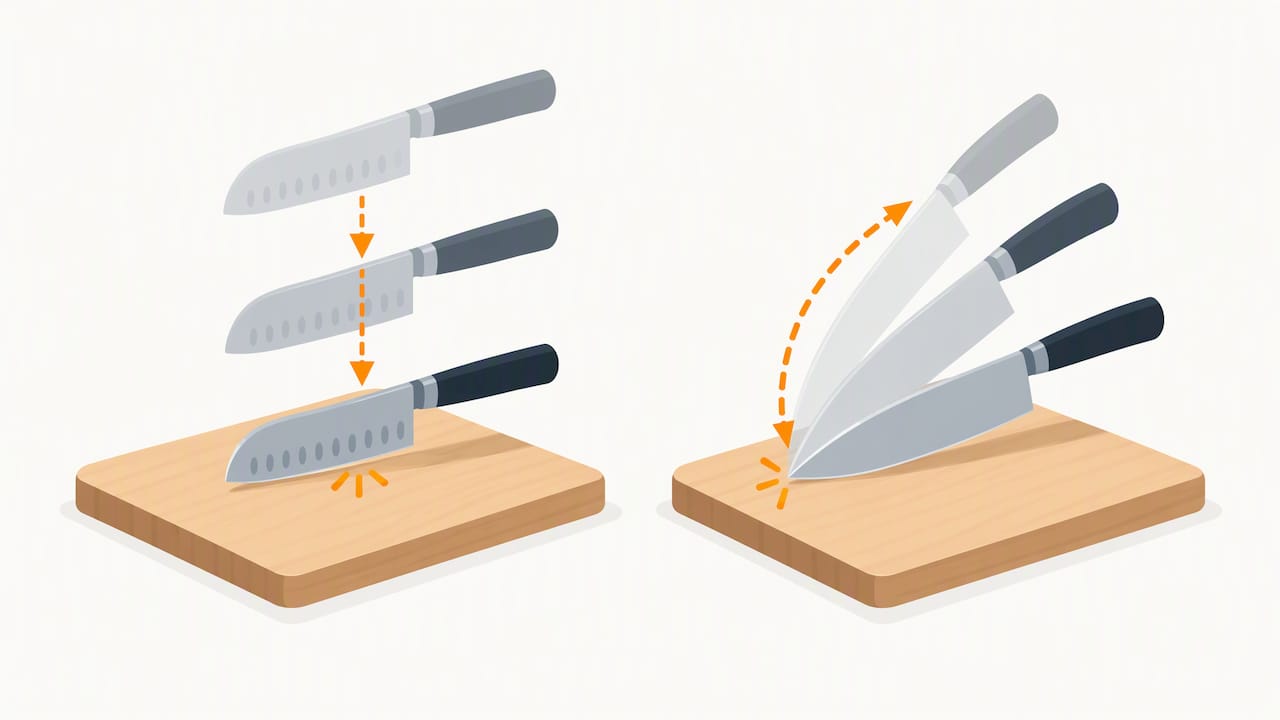
A chef knife’s longer blade and curved belly are built around a rocking motion, which keeps the tip anchored on the board while the back of the blade lifts and falls. That motion is safer when the non-cutting hand uses a proper claw grip, since the knuckles guide the blade and keep fingertips clear.
A santoku’s flat edge is used with a straight up-and-down chop, which carries a different risk: without the rocking motion to keep the tip grounded, it is easier to lift the whole blade too high and lose control on the downstroke. A santoku’s flatter edge can also pull slightly off-track on dense items, which is worth testing at low speed before cutting anything that requires precision.
Either knife should be kept sharp, since a dull blade requires more downward force and is more likely to slip off a vegetable’s skin than a sharp one. Drying a blade immediately after washing also prevents it from slipping in a wet hand, which is a more common cause of kitchen cuts than the blade shape itself.
How I Weigh Specs Against Owner Feedback
My approach starts with published specs: blade length, edge angle, and steel hardness, then checks those numbers against what owners report after months of real use. A spec sheet tells me what a knife should do; owner feedback tells me whether it holds up. For deeper, model-specific guidance, I point readers to the full chef’s knife reviews on the site.
— Glenn
Where to Find Curated Knife Reviews and Buying Guides
Choosing between a santoku and a chef knife is only the first step. Picking the right model at the right price is where a side-by-side comparison of specs, pricing, and owner feedback saves the most time, which is the approach I rely on for every review on Kitchenware Compare.

- Compare two popular 8-inch options in the Wusthof Classic vs Mac MTH-80 review before buying.
- Learn proper blade motion with this external knife skills guide covering rocking and push-cut technique.
- Build a full starter set with the kitchen essentials list, which covers knives alongside the rest of the basics.
Start with the kitchenware reviews and comparisons hub for the full lineup of kitchen tools, researched from specifications and owner reports.
FAQ
Can a santoku be used as a chef knife?
A santoku can handle most everyday chopping and slicing tasks a chef knife does, but its flatter edge is not built for the rocking motion used on herbs or whole proteins. It works best as a chef knife substitute for vegetable-heavy meals rather than a full replacement.
What knife does Gordon Ramsay recommend?
Specific celebrity chef endorsements are not consistently documented across reliable sources, so no single model is confirmed here. The broader principle that holds up across expert sources, including The Kitchn, is that blade geometry, not a chef’s name, should drive the choice.
Can I use a santoku knife to cut meat?
A santoku handles boneless cuts and thin slices of meat reasonably well, but its thinner, harder edge is more prone to chipping on bone or connective tissue than a chef knife. For whole proteins or anything requiring a rocking motion, a chef knife is the steadier choice, according to Knife Depot.
Why do chefs prefer Japanese knives?
Many cooks favor Japanese-style blades like the santoku for their thinner edge angle, which cuts with less resistance and produces cleaner slices on vegetables and fish. That same thinness trades off durability, since a narrower edge chips more easily than a Western chef knife’s wider bevel.
Sources
- Santoku Vs Chef Knife: Which Should You Buy? | Knife Depot blog
- What’s the Difference Between a Chef’s Knife and a Santoku Knife? | The Kitchn
Recommended
- Mac MTH-80 8-Inch Chef’s Knife Review 2026
- Wusthof Classic vs Mac MTH-80: Which Chef’s Knife Wins?
- Wusthof Classic 8-Inch Chef’s Knife Review (2026)
- How to Sharpen a Chef’s Knife with a Whetstone

I'm Glenn, and I started Kitchenware Compare to cut through conflicting product reviews and help readers pick kitchen gear with confidence. I don't own or test the products I write about — these guides are built from verified-purchase reviews, manufacturer specifications, and independent testing where it exists, with the reasoning shown, not just a rating.
Leave a Reply