This guide has no affiliate links, but some pages it links to do. If you buy through those, I may earn a commission at no extra cost to you.
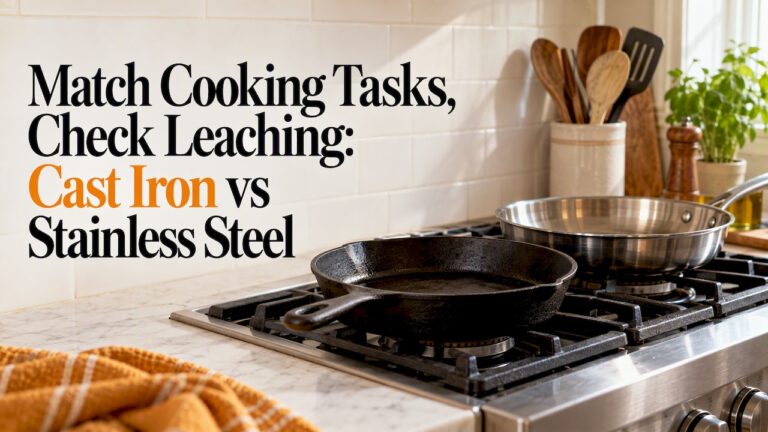
For long sears and oven-to-table braises, reach for cast iron. For quick temperature control and acidic pan sauces, reach for stainless steel. The right choice depends on what matters more in your kitchen: steady, retained heat and a nonstick-like finish once seasoned, or fast responsiveness and a nonreactive surface that handles tomatoes and wine without a second thought. Below, I break down the material science, technique fit, safety data, and care routines behind that answer.
TL;DR:
- Cast iron heats slowly but holds heat, which suits long sears and braises; stainless steel cools faster when food hits it, so cook in smaller batches.
- Choose clad stainless with an aluminum core, as in the three-ply and five-ply skillets Food & Wine lists; single-layer stainless conducts heat poorly, and cast iron is heavy.
- In an Oregon State study, nickel and chromium leached from stainless steel into simmering tomato sauce, most from new cookware and with longer cooking; cooks with known sensitivities can use enameled cast iron.
- Bare cast iron needs seasoning and dry storage, while enameled versions avoid seasoning but can chip; hand wash stainless to preserve its finish.
How Material Properties Shape Cooking Performance
Cast iron and stainless steel behave so differently in a kitchen because they are built on opposite principles. Cast iron is dense, single-material, and slow to heat up, but once hot, it holds that heat with remarkable stubbornness. That’s why it excels at heat retention and works across every cooktop type, including induction, making it a strong pick for braising and long, steady cooking.
Stainless steel on its own is a poor heat conductor, which is why nearly every quality stainless pan is actually a sandwich. Manufacturers bond a core of aluminum or copper between layers of stainless steel, a construction method called cladding. Most high-quality stainless skillets use this three-ply or five-ply construction, which lets the conductive core spread heat quickly while the stainless exterior stays durable and nonreactive. A cheap, single-layer stainless pan skips this core and heats unevenly, with hot spots directly over the burner.
Weight and durability track differently, too. ABC News says cast iron is heavy, especially when filled with food, and needs ongoing maintenance. It lists durable, hard and non-corrosive as the main pros of stainless steel.
A few practical distinctions worth knowing before you shop:
- Bare cast iron needs seasoning (a polymerized oil layer) to develop nonstick properties and resist rust.
- Enameled cast iron skips seasoning entirely and resists acidic reactions, though the enamel coating can chip with rough handling.
- Induction cooktops require a magnetic base, which both bare cast iron and most clad stainless pans provide, unlike aluminum or copper-only cookware.
- Oven use favors cast iron for high-heat roasting, though fully metal stainless pans (no plastic handles) also go oven-safe to high temperatures.
If you’re shopping specifically for an induction setup, it helps to check compatibility before buying either material; a guide to induction-friendly cookware walks through what to look for, and cast iron on an induction cooktop covers the handling rules for cast iron.
Which Pan Wins for Each Cooking Technique
Matching the pan to the technique solves most of the “which one should I buy” debate, because each material has a clear comfort zone.
- Searing: Cast iron’s heat retention means the pan temperature doesn’t crash the moment food hits it, which suits a deep crust on a steak or chicken thighs. It heats slowly, so give it time to come up to temperature before adding food. Stainless steel can sear well too, but it cools faster on contact, so preheat it hot and work in smaller batches.
- Frying and sautéing: Stainless steel’s responsiveness makes it easier to fine-tune heat mid-cook, which matters when you’re reducing a sauce or adjusting for a delicate protein. The classic complaint about food sticking to stainless usually comes down to a cold pan or disturbing the food too early. Let the pan preheat, add oil, and wait until the oil shimmers before adding ingredients; food naturally releases once a crust forms.
- Braising and baking: Cast iron’s ability to go from stovetop to oven and hold low, even heat for hours makes it the default choice for braises, cornbread, and baked dishes that need a head start on the stove.
- Boiling and quick-temperature work: Stainless steel adjusts faster to changes in burner heat, which is useful for boiling pasta, simmering stock, or building a pan sauce with wine and acid, tasks where a nonreactive surface also protects the flavor of the dish.
Pro Tip: Let both materials preheat empty for a minute before adding fat. A pan that’s hot before the oil goes in releases food far more reliably than one that’s still climbing to temperature.
What the Research Says About Metal Leaching and Food Safety
Bare cast iron has its own acid caveat. ABC News says it is not suitable for cooking acidic foods at first, and that it needs several uses to build up seasoning before long cooking of acidic dishes. Enameled cast iron skips that step.
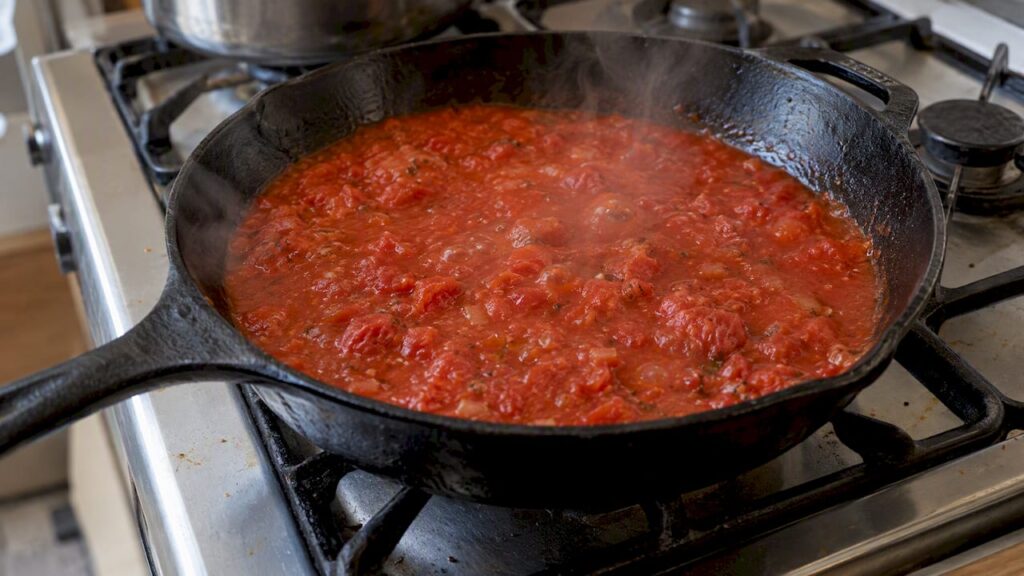
Stainless steel raises a different question: nickel and chromium. A 2013 Oregon State University study by Kamerud, Hobbie and Anderson simmered four commercial tomato sauces in three types of stainless steel and a stainless steel saucepan, for 2 to 20 hours. After 6 hours, nickel in the sauce had risen up to 26-fold and chromium up to 7-fold, depending on the steel grade, and new stainless steel leached the most. Leaching fell with repeated cooking and stabilized after the sixth cycle, but the tenth cycle still added about 88 micrograms of nickel and 86 of chromium per 126-gram serving.
The test used simulated long simmers of tomato sauce, so it shows what can happen in an all-day acidic cook, not what a pan does in an ordinary sauté. The authors’ conclusion is that stainless steel cookware can be an overlooked source of nickel and chromium, depending on steel grade, cooking time and how much the pan has been used.
If you are cautious or have a known sensitivity, a few habits follow from those findings:
- Keep very long tomato simmers for enameled cast iron when you can, since cooking time was one of the two drivers of leaching in the study.
- Be most careful with brand-new stainless steel, which leached the most; leaching fell over the first six cooking cycles.
- Choose enameled cast iron for frequent acidic, long-cook dishes if you have a known nickel or chromium sensitivity.
Anyone with a diagnosed metal sensitivity should treat these as general kitchen habits, not medical guidance, and talk to a healthcare provider about specific dietary restrictions. For a broader look at how cast iron stacks up against another popular nonreactive surface, a comparison of cast iron and ceramic cookware covers similar ground from a different angle.
Keeping Either Pan Working Well for Years
Care routines diverge sharply between the two materials, and knowing the basics upfront saves a lot of trial and error.
- Season bare cast iron regularly. A thin coat of oil, wiped nearly dry, then baked on at high heat, builds the polymerized layer that makes the surface nonstick. Re-season whenever food starts sticking or the surface looks dull and gray rather than dark and semi-glossy. If food keeps sticking after seasoning, cast iron sticky after seasoning covers the usual causes.
- Treat enameled cast iron as lower maintenance. It skips the seasoning step. ABC News says the enamel can chip and scratch, and that a little oil on the exposed areas protects them from rusting; Adulting With Food adds that enameled pans are sensitive to thermal shock.
- Hand-wash stainless steel to keep its finish. Food & Wine says some skillets are advertised as dishwasher-safe but it always recommends hand-washing, and it names Bar Keepers Friend as its favorite cleaner for staining. ABC News calls stainless steel dishwasher-safe, so treat hand-washing as care advice rather than a requirement. See also white spots on a stainless steel pan.
- Store both materials dry. Cast iron rusts if it is left wet or stacked damp; a light wipe of oil before storage helps prevent flash rust.
Pro Tip: If a cast iron pan already has surface rust, a scrub with steel wool and a fresh seasoning cycle usually brings it back; don’t throw it out. The guide to fixing rusty cast iron has the steps.
How to Choose Based on Grade, Construction, and Cooking Habits
ABC News notes that enameled cast iron tends to be more expensive than bare cast iron, a price paid for not needing seasoning.
Stainless steel grades are written as two numbers such as 18/10. Food & Wine explains that stainless steel adds chromium and nickel to iron and carbon to make the metal more corrosion-resistant, and ABC News says quality pots are usually 18/10: 18 per cent chromium for rust resistance and 10 per cent nickel for acid resistance. A tri-ply pan has three bonded layers (steel, conductive core, steel) and a five-ply pan has five; every skillet on Food & Wine’s tested list is one or the other, with an aluminum core.
For scale, here are the numbers behind that comparison. They come from Food & Wine’s list of seven tested stainless skillets and from this site’s Lodge 12-inch cast iron skillet review, which read them from the maker’s listing. Sizes differ, so treat the weights as indicative rather than like-for-like.
| Detail | Seven stainless skillets (Food & Wine) | Lodge 12-inch cast iron |
|---|---|---|
| Construction | Four five-ply and three three-ply, all stainless steel with aluminum | One piece of pre-seasoned cast iron |
| Weight | 2.25 to 3.5 pounds | About 7.9 pounds |
| Oven limit listed | 500°F to 800°F | 500°F |
| Dishwasher | All seven marked dishwasher-safe; Food & Wine recommends hand-washing | Not dishwasher safe |
A quick way to match material to habit:
- Frequent bakers and braisers tend to get more daily use out of cast iron’s retention and oven versatility.
- High-tempo cooks who sauté, deglaze, and adjust heat often usually prefer stainless steel’s responsiveness.
- Cooks managing a metal sensitivity often lean toward enameled cast iron for acidic, long-simmer dishes.
- Budget-focused kitchens can start with a basic bare cast iron skillet before investing in multi-ply stainless.
For model-level comparisons once you’ve settled on a material, cookware reviews and buying guides break down specific pans by price, construction, and owner feedback.
Where This Comparison Comes From
This comparison draws on four sources: ABC News’s guide to cookware surfaces, Food & Wine’s tested list of stainless steel skillets, an Oregon State University study of nickel and chromium leaching, and a cast iron care guide from Adulting With Food. It is not a lab test of any pan and is not based on hands-on use. What could not be established is how much nickel or chromium a modern clad pan releases in everyday cooking, because the study used long tomato-sauce simmers, and the sources used here give no comparable measurement for cast iron.
For a closer look at how pages on this site are built, how I review kitchen equipment explains the process. Readers who want more on durability can check the most durable cookware types page.
A Simple Rule of Thumb
A simple way to split the job is to let the dish decide. A pot roast or a pan of cornbread suits cast iron, since it holds low, even heat in the oven for hours. A weeknight pan sauce with wine or a quick sauté suits stainless, since it responds as soon as the burner changes. Neither material is better in general; the choice is about how long the dish needs heat and how reactive the ingredients are.
— Glenn
Compare Specific Models Before You Buy
Once you know which material fits your cooking habits, compare actual pans rather than guessing from specs. This site’s cookware hub collects its cookware guides and reviews.
A few starting points:
- Browse the full cookware category for current model comparisons across both materials.
- Check the cast iron skillet guide for sizing and care specifics before buying your first piece.
- Review the most durable cookware types if longevity is the deciding factor.
FAQ
Which is healthier, stainless steel or cast iron?
Neither is clearly healthier across the board. In the Oregon State study, stainless steel leached nickel and chromium into long-simmered tomato sauce, mostly from new cookware, and ABC News says new bare cast iron is not suited to acidic foods at first. This guide cites no study that ranks one pan as healthier.
Do chefs prefer stainless steel or cast iron?
No chef survey is cited here, so there is no verified preference to report. What the sources support is a split by task: cast iron retains heat well for searing and oven-to-table cooking, while stainless steel responds faster to changes in burner heat.
Why did people stop using cast iron as often?
This guide found no sourced account of that trend, so it makes no claim about it. The sources do show the trade-off behind the question: ABC News lists ongoing maintenance, initial seasoning and weight as cast iron’s main drawbacks.
Is cast iron better than stainless steel?
Neither material is better in every case: cast iron wins for heat retention, searing, and long oven-to-table cooking, while stainless steel wins for responsiveness, acid resistance, and lower maintenance. The right pick depends on which techniques you cook most often and how much upkeep you’re willing to do.
Sources
- Stainless steel, cast iron, or non-stick? Choosing the best cookware surface – ABC News
- The 5 Best Stainless Steel Skillets, Tested & Reviewed – Food & Wine
- Stainless steel leaches nickel and chromium into foods during cooking – Kamerud, Hobbie and Anderson, Oregon State University, Journal of Agricultural and Food Chemistry, 2013
- Cast iron care for beginners – Adulting With Food
Recommended
- Carbon Steel vs Cast Iron: Which Should You Choose?
- Cast Iron vs Ceramic Cookware: Which Is Healthier?
- Bare vs Enameled Cast Iron Dutch Oven: Which Should You Buy?
- Can You Use Metal Utensils on Stainless Steel Pans?

I'm Glenn, and I started Kitchenware Compare to cut through conflicting product reviews and help readers pick kitchen gear with confidence. I don't own or test the products I write about — these guides are built from verified-purchase reviews, manufacturer specifications, and independent testing where it exists, with the reasoning shown, not just a rating.
Leave a Reply