I may earn a commission if you buy through links on this site, at no extra cost to you. See the affiliate disclosure.
Induction is the better pick for most home cooks. It heats faster, holds low temperatures more steadily, wastes less energy and keeps combustion gases out of your kitchen. Gas still wins on upfront price, on very high flame heat for searing and stir-frying, and where you already have a gas line and cheap gas.
I don’t own or use any of the appliances below. This comparison rests on government data, field studies and published kitchen reporting, and each claim names its source.
TL;DR
- Speed and control: According to the U.S. Department of Energy, induction can boil water 20 to 40% faster than gas, and it holds a simmer more evenly. Gas gives stronger, more visible high heat.
- Upfront cost: Gas is usually cheaper to buy. Induction ranges and cooktops tend to cost more, and a gas-to-induction switch may need a new 240-volt circuit.
- Running cost: It depends on local electricity and gas prices. A 2026 Michigan field study found induction used about 45% less cooking energy but cost more to run in those two utility territories.
- Health and safety: Gas cooking releases combustion pollutants indoors. Induction has no flame, and the surface stays cooler.
- Who should pick which: Choose induction if you cook often and value speed, simmering and clean indoor air. Choose gas if you rely on a hot flame for wok cooking or already have a cheap gas hookup.
How the two cooktops actually heat food
A gas burner burns fuel and sends flame heat to the pan by radiation and conduction. The U.S. Department of Energy describes traditional cooktops this way, and says induction works differently. An electromagnetic field passes currents directly into the cookware through a glass surface. Heat is created inside the pan itself and stops the moment you lift it.
PBS NOVA adds the detail that the coil underneath is not a heating element. It only creates a magnetic field. The cookware heats itself by resisting the currents that field induces. Iowa State University Extension adds that the glass warms only by contact with the hot pan and never gets as hot as a traditional radiant electric top, though it should not be assumed cool to the touch.
That difference drives almost every comparison below: how much heat reaches the food, how fast it arrives, and how much escapes into your kitchen.
Speed, temperature control and simmering
The DOE cites a consumer testing organization’s finding that induction cooktops can boil water 20 to 40% faster than the gas and conventional electric models it compared. The DOE also says the electromagnetic field gives more precise, even heating than traditional cooktops.
The Los Angeles Times food desk ran a side-by-side comparison of flame, electric and induction in 2022. Columnist Ben Mims reported that induction pans reach cooking temperature in under a minute, against several minutes on gas. He also found that induction holds a steady low temperature better than a gas flame that tends to make hot spots. For sauces, custards, melted chocolate and long simmers, that steadiness matters.
The same piece names gas’s advantage. Mims found that induction could not reach or maintain the extreme heat of a gas flame for stir-frying and steak searing. He also said gas remains the standard for him and most professional cooks, because the flame gives nimble heat control you judge by eye. He conceded that induction and electric produce “pretty much the same results” for most home cooking.
What this means at the stove
| Cooking task | Better fit | Why |
|---|---|---|
| Boiling pasta water | Induction | Faster boil, per DOE-cited testing |
| Gentle simmering, sauces | Induction | Steadier low heat, no flame hot spots |
| High-heat wok cooking | Gas | Flame reaches very high heat, per the Los Angeles Times comparison |
| Searing steak | Gas, or a preheated heavy pan on induction | Flame heat and visual control |
| Cooking in a hot summer kitchen | Induction | Less excess heat released into the room |
If stir-frying is your main reason to hesitate, my wok picks for induction and electric stoves are built around the flat-base designs those cooktops need.
Upfront cost: what you will pay to buy and install
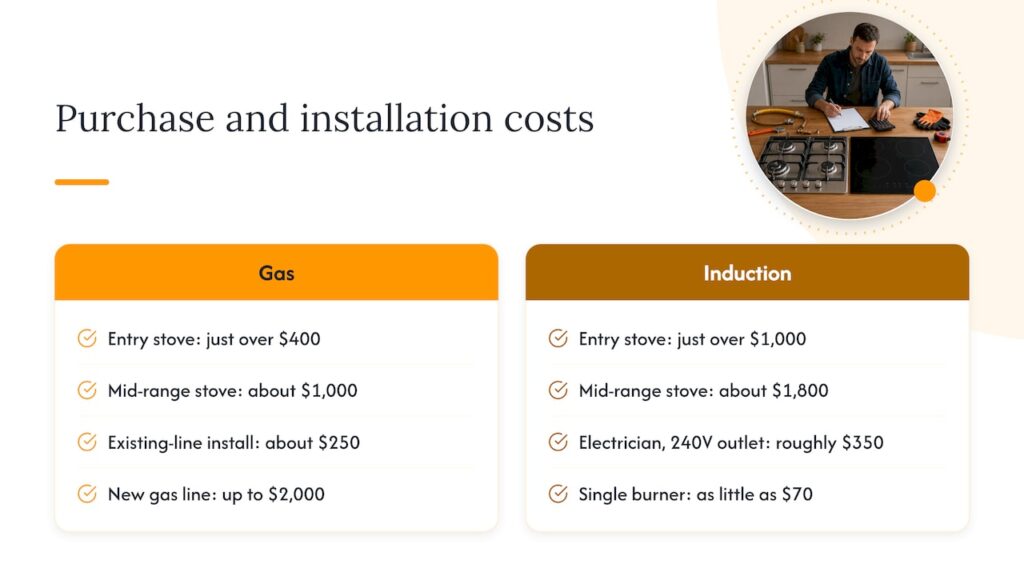
Gas is cheaper at the register. Grist reported in 2022 that entry-level induction stoves at a major home-improvement retailer started just over $1,000, while gas stoves started just over $400.
The DOE says four-burner induction ranges now cost around $1,000 and single-burner induction units can cost as little as $70. A portable single burner is a low-risk way to try induction before you commit to a full range.
Installation can change the math in either direction. The Takeout, in May 2026, quoted an appliance repair expert who put a mid-range gas stove at about $1,000 plus $250 to install where a gas connection already exists. Running a new gas line can cost up to $2,000. The same expert put a mid-range induction stove at about $1,800, plus roughly $350 for an electrician to add a 240-volt outlet.
The Michigan study below found a similar pattern in the field. Ranges there cost $1,500 to $1,700 including taxes, delivery and installation, and a new 30-amp circuit for gas-to-induction homes typically added $200 to $300.
Rebates
The DOE notes that the Inflation Reduction Act was set up to make many Americans who replace a gas or conventional electric cooktop with induction eligible for rebates of up to $840. Rebate programs are run through states and have changed over time, so check your state energy office for what is available now before you budget.
Running costs: efficiency is not the same as a lower bill
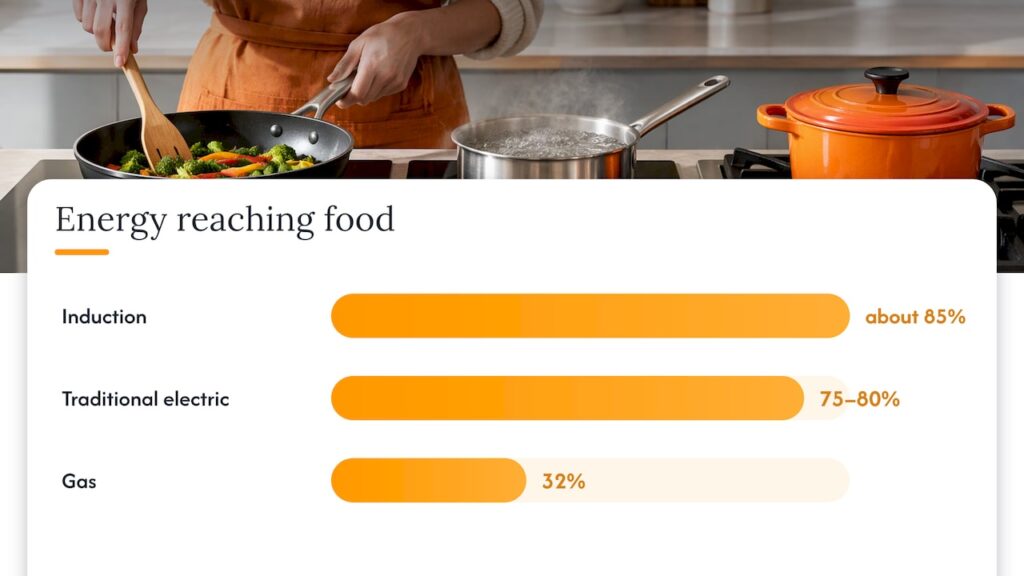
Induction wastes less energy. The DOE says induction appliances are up to three times more efficient than gas stoves and up to 10% more efficient than conventional smooth-top electric ranges. Energy Star figures quoted by PBS NOVA put the share of energy that reaches the food at roughly 85% for induction, 75 to 80% for traditional electric and 32% for gas.
A lower energy use does not always mean a lower bill, because electricity and gas are priced differently. A January 2026 field study by Slipstream, an energy research nonprofit, followed households in Michigan that switched. It found gas-to-induction retrofits cut cooking energy use about 45%, roughly 396 kWh a year. Yet cooking energy costs rose about $100 a year under one utility’s rates and about $35 a year under the other’s, because electricity cost more than gas there.
Grist’s 2022 reporting reached a similar conclusion: running an electric or gas stove costs about the same, and in a few states induction could save or cost about $20 a year depending on local energy prices.
The practical takeaway: the running-cost difference is small either way. Do not buy induction to save money on bills, and do not skip it for fear of bills. Decide on cooking feel, safety and air quality, and use the purchase price and installation as your real cost comparison.
Repairs and upkeep
The Takeout’s expert says gas igniters need replacing about every five years at a couple hundred dollars. Induction glass-top damage, outside warranty, can run up to $1,000 to repair. Iowa State University Extension adds that induction’s glass-ceramic surface can scratch, and can crack if heavy pots are set down hard. A flat glass top does wipe clean in seconds, while gas grates and burner caps take more scrubbing.
Air quality, safety and health
This is where the gap is widest. The DOE says gas cooking produces nitrogen oxides, carbon monoxide and formaldehyde, which can have negative health effects. It also cites a 2022 study attributing 12.7% of current U.S. childhood asthma to gas stove use.
A 2022 literature review by the consultancy ICF, published by the American Lung Association, concluded that indoor exposure to nitrogen dioxide or gas cooking can worsen asthma symptoms and wheezing in children, particularly without ventilation and in children with asthma or allergies. It describes the evidence for adults as limited and inconsistent. If your household includes a child with asthma, that points toward induction. If you keep gas, a range hood vented outdoors is the sensible companion.
On burns and accidents, the DOE says induction surfaces do not get as hot as other cooktops once the pan is removed. It also says the stove cannot be turned on by accident and that most models switch off automatically when no pan is detected.
A note for pacemaker wearers
If you have a pacemaker, talk to your cardiologist before choosing induction. WBUR quoted cardiologist Mark Estes, who said pacemaker patients can use an induction stove safely if the device stays about two feet from the stovetop, a number he called very conservative.
The downsides of induction, plainly
People also ask about the drawbacks of induction, so here they are. Iowa State University Extension’s list of induction downsides includes higher cost, a learning curve, some buzzing or humming at high settings, and magnetic fields that can interfere with digital thermometers. It also notes the glass can get warm from the hot pan, repairs after warranty can be expensive, and a 240-volt outlet is required, with an electrician needed when converting from gas.
Most of these are handled by planning. Budget the electrical work before you order, expect a few days of adjusting to how quickly the heat responds, and keep a plug-in or probe thermometer away from the cooktop surface when it is running.
Your pans may need to change
Gas works with whatever pans you own. Induction does not: the Los Angeles Times comparison notes that induction needs magnetic material in the pot to react with the coil, and The Takeout’s appliance repair expert lists magnetic cookware as a requirement. A magnet that holds firmly to the base is the quick check. My guide to cookware types for induction cooktops goes through each material, and cast iron on an induction cooktop covers that pairing in detail.
One more practical point. If you stay with gas, the pans you choose still matter for even heating and durability. My guide to the best cookware material for a gas stove covers that. If you are weighing two workhorse materials for either cooktop, see cast iron vs stainless steel.
Do chefs prefer induction or gas?
Professional kitchens lean toward gas, mainly because of the visible flame and the ability to change heat instantly by eye. Ben Mims says that is true for him and most professional cooks. Home cooking is a different job. The appliance repair expert quoted by The Takeout says the best value depends on the person: frequent cooks who want efficiency should choose induction, while cooks who prefer flame control and already have a gas line are better served by gas, particularly where gas is the cheaper fuel.
Which should you choose?
Use this as a quick filter:
- Pick induction if you cook most days, simmer a lot, want a cooler kitchen, have children with asthma at home, or are already planning electrical work.
- Pick gas if you already have a gas line, gas is cheap where you live, you stir-fry at very high heat, or the install budget for a 240-volt circuit is out of reach.
- Try before you commit: a single-burner induction unit, which the DOE says can cost as little as $70, shows you how the heat feels before you replace a range.
What I would do
I read owner reviews, spec sheets and published reporting, and I own none of the appliances I write about, so I weigh what published sources and owners report. On the cooktop question, the sources point in one direction. If I were buying for a household that cooks daily, I would choose induction, mainly for the steady low heat, the speed and the cleaner indoor air.
Gas earns its place for wok cooks and for anyone with a cheap gas hookup and a good hood. I treat the honest complaints, such as install cost, humming and glass repair costs, as part of the decision rather than something to hide. The cookware you pair with either one matters about as much as the cooktop, and that is where my comparisons are most useful.
Choosing pans for whichever cooktop you pick
Once the cooktop is settled, the pans decide how it performs day to day. My cookware reviews and buying guides cover sets and single pans for gas, induction and electric cooktops, with the sources behind each pick named. If you want to know how I reach conclusions without handling products myself, how I review kitchen equipment explains the sources I use.

If you are replacing a stove, also read my sizing guide for pots, pans and Dutch ovens so the pans you buy fit your burners.
FAQ
Is induction really faster than gas?
Yes for boiling. The DOE cites a consumer testing organization finding that induction can boil water 20 to 40% faster than the gas and conventional electric cooktops it compared. The Los Angeles Times comparison also found induction pans hot in under a minute, against several minutes on gas.
Which is healthier, a gas stove or an induction stove?
Induction produces no combustion gases. The DOE says gas cooking produces nitrogen oxides, carbon monoxide and formaldehyde. A 2022 literature review published by the American Lung Association found that indoor gas cooking exposure can worsen asthma symptoms in children, especially without ventilation. If you cook with gas, run a hood that vents outdoors.
Is induction cheaper to run than gas?
Not necessarily. Induction uses less energy, and a 2026 Michigan field study found about 45% less cooking energy. But cooking costs still rose by about $35 to $100 a year there, because local electricity cost more than gas. Grist found that in a few states the difference could go either way by about $20 a year.
How much does it cost to switch from gas to induction?
Plan on the appliance plus electrical work. The Takeout’s expert cited about $350 for an electrician to add a 240-volt outlet, and the Michigan study put a new 30-amp circuit at $200 to $300. Rebates of up to $840 may apply for some households, so check your state’s programs.
Do chefs prefer induction or gas?
Most professional cooks still lean toward gas for flame control and very high heat, according to Los Angeles Times columnist Ben Mims. He also said induction gives about the same results for most home cooking.
Sources
- Making the Switch to Induction Stoves or Cooktops, U.S. Department of Energy
- How do induction stoves work? PBS NOVA
- Are gas stoves better than electric or induction? Los Angeles Times
- What’s the true cost of an induction stove? Grist
- Gas Vs Induction: Which Stove Has The Best Value, The Takeout
- Michigan Induction Cooktop field study, Slipstream
- Induction Cooking: What You Need to Know, Iowa State University Extension
- Impacts of Residential Combustion, American Lung Association
- Gas vs. electric stoves: health questions, WBUR
Recommended
- Cookware Types for Induction Cooktops: Complete Guide
- What Cookware Material Works Best on a Gas Stove?
- Best Cookware for Gas Stoves: 5 Sets Compared
- Cast Iron on an Induction Cooktop: What to Watch For

I'm Glenn, and I started Kitchenware Compare to cut through conflicting product reviews and help readers pick kitchen gear with confidence. I don't own or test the products I write about — these guides are built from verified-purchase reviews, manufacturer specifications, and independent testing where it exists, with the reasoning shown, not just a rating.
Leave a Reply