
I earn a commission if you buy through the Amazon links below, at no extra cost to you.
The Timemore Chestnut C3S Pro is the travel pick in my espresso grinders guide, and it is the only manual grinder there that a lot of people buy instead of an electric one rather than as well as.
It rates 4.7 stars across 1,715 ratings, with 90% of them five-star — the highest five-star share of any product in that guide. That is the headline, and it is earned.
The interesting part is the 3% at the other end, because those reviews are unusually specific. They name a part, and in one case they contradict something Timemore prints on its own listing.
Quick Verdict
| Score | Price | Rating | Buy |
| 8.5/10 | $95.00 | 4.7★ (1,715) | Check Price on Amazon |
What Comes in the Box

The grinder, a cleaning brush, and the folding crank handle. That is the box. There is no stand, no case and no spare burr.
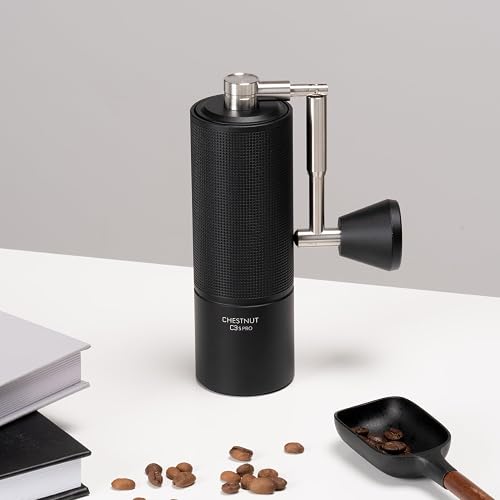
The handle is the point of difference. It folds flat against the body instead of sticking out, which is what makes the thing packable — the grinder is 15.2 ounces and about the size of a large travel mug, and it holds 25 grams of beans, which is two doubles.
It is worth being clear about what that costs. The C2S sits alongside it in the same guide at $75 and grinds with the same S2C burr family. You are paying $20 for the folding handle, the full-metal body and the wider adjustment range — not for better coffee.
Specifications
| Model | TIMEMORE Chestnut C3S Pro, black |
| Type | Manual hand grinder |
| Burr | S2C660 stainless steel conical, 55–58 HRC |
| Body | Aluminium alloy, full-metal construction |
| Adjustment | Approximately 36 clicks, stepped |
| Capacity | 25 g — two double shots |
| Weight | 15.2 oz |
| Handle | Folding crank |
| Cleaning | Brush only — the packaging carries a no-washing symbol |
| Amazon rank | #3 in Manual Coffee Grinders |
What a stainless burr buys over ceramic

Cheap hand grinders use ceramic burrs. Ceramic is hard but brittle, and the edges round off rather than wearing evenly, so the grind gets progressively less uniform without ever obviously failing. One owner here describes exactly that arc: their Porlex ceramic burrs dulled and the handle attachment stripped, and this was the replacement.
The S2C660 is hardened stainless at 55–58 HRC, cut rather than moulded. In practice that means it holds its geometry far longer and shears beans instead of crushing them, which is what keeps the particle distribution tight enough for espresso.
This matters more on a hand grinder than an electric one. An electric grinder can brute-force its way through a dull burr with motor torque; you cannot. A worn burr on a manual grinder means more turns, more effort and a worse cup at the same time.
Who It’s For
- Anyone who travels or camps and wants real espresso grind rather than pre-ground
- Kitchens with limited counter space, or anyone who wants a grinder that lives in a drawer
- People replacing a ceramic-burr grinder that has gone dull
- Anyone who wants a grinder that works in a power cut — one owner bought it for exactly that
- Cooks who want espresso-capable grinding without the $200 the Breville Smart Grinder Pro costs
Who Should Look Elsewhere
- Anyone grinding for more than two or three cups at a sitting — 25 g per fill, by hand
- People who want to rinse a grinder out; this one is brush-clean only
- Anyone who will not dial in. The grind chart is a starting point and, as below, not a reliable one
- Buyers who want the cheapest route to the same burr — the C2S is $20 less and grinds the same
- Anyone who wants a machine that survives being knocked off a counter
Performance
The grind chart is wrong, and owners have already worked around it

Timemore prints a grind guide on the listing: espresso at 7–8 clicks, pour over at 13–16, and French press at up to 13. Those last two are the wrong way round. French press is the coarsest common brew method and pour over sits finer than it — every brewing reference puts them in that order, and the chart puts pour over coarser.
An owner has already run into it. They report using 20 clicks for a coarse French press grind and 13 for a moka pot, which is both sensible and well past the ceiling the chart gives for French press.
None of this makes the grinder worse. It means treat the chart as a rough starting point, expect to go coarser than it says for immersion brewing, and dial in from there. The espresso figure of 7–8 is the one most people will actually use, and nobody disputes it.
The full-metal claim, and the cap that keeps cracking
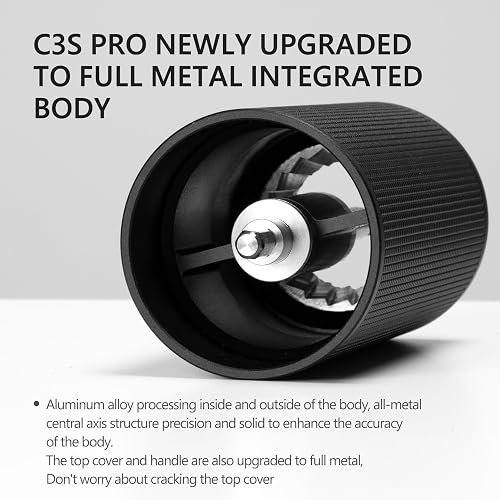
Timemore makes a specific promise in its own product image: the C3S Pro has been upgraded to a full metal integrated body, the top cover and handle are now metal too, and — in so many words — do not worry about cracking the top cover.
One owner filed a review headed “Cap design/manufacturing flaw” reporting that the plastic cap spontaneously cracked, and prefaced it with “as others have had”. That is a direct collision between the marketing and the field.
I cannot resolve it from outside. Either some units still ship with a plastic cap, or the “full metal” upgrade covers the body and handle but not the part that cracks. What I can say is that the manufacturer raised the subject first, which is usually a sign it had a history.
Effort, and who can actually turn it
The standing objection to hand grinding is that it is work. For espresso it is the hardest case, because fine grinds take the most turns — the guide puts a double shot at roughly 45 to 60 seconds.
The most useful review here is from an owner with bad shoulders who was nervous about whether they could crank it at all, and reports that it is “a piece of cake”. That is a more informative data point than a dozen people saying it feels smooth, because it sets a floor rather than describing a preference.
Another owner keeps it specifically because the power goes out where they live, and says it grinds where their electric grinder chops. A hand grinder that only gets used in an outage still has to be pleasant enough to use, and this one clears that bar.
Brush only — and what turns up inside on arrival

The grinder strips down to the burr, a spring, a washer and a retaining plate, and Timemore includes a brush. It also prints a crossed-out water symbol: this is not washable. Aluminium and a steel burr in water is how you get corrosion and a seized adjustment nut.
That makes two arrival complaints more awkward than they would otherwise be. One owner opened theirs to find coffee residue already inside from someone else’s grinding. Another describes finding grime in the cladding of what is meant to be a food-grade tool, and was plainly upset about it on a purchase they had treated themselves to.
Two unconnected owners reporting foreign matter inside a sealed product is a quality-control signal rather than bad luck. Strip it and brush it out before the first grind, because rinsing it is not an option.
Design and Build
Aluminium alloy inside and out, a knurled grip, a folding crank and a stepped adjustment nut under the base. It is 15.2 ounces, which is heavy for its size and is the main reason owners describe it as feeling like a tool rather than a gadget.
The metal body has a downside nobody advertises. One owner reports it rolling off a counter once and denting permanently, badly enough that the handle no longer seats correctly. Aluminium dents where plastic bounces, and a dent near the top is a dent in the part the burr has to stay concentric with.
A separate owner reports a high-pitched squeak developing after about a week when screwing and unscrewing the adjustment, contacted Timemore about it, and was told it was normal. Both complaints are about the mechanism rather than the grind.
What Owners Report
I have not ground coffee with this. What owner reviews are good for on a hand grinder is the second year — whether the burr holds its edge, whether the threads gall, whether the body survives being carried around. Here is what recurs across 1,715 owners on both sides, as of 9 September 2026.
What recurs in the positive reviews
- It is the grinder people buy repeatedly. One owner reports this as their fourth Timemore purchase, having bought them as gifts, and says everyone is happy with theirs.
- It fixes a dull ceramic grinder. An owner upgrading from a Porlex with dulled burrs and a stripping handle reports the steel burr as the clear improvement.
- Genuinely easy to turn. An owner with bad shoulders who expected to struggle reports it is not hard work — the single most useful positive here.
- It beats an electric grinder on grind quality. One owner has stopped using their electric because it chops the beans where this one grinds them.
- It dials in. Moka pot and pour over owners both report finding a setting that works within a few brews and staying there.
What recurs in the critical reviews
- The plastic cap cracks. Reported as a design or manufacturing flaw, with the owner noting others have had the same — against a listing that promises the opposite.
- Foreign matter inside on arrival. Coffee residue in one case, grime in the cladding in another, on a product you cannot wash.
- Micro-fines. One owner measures 7–10% fines, enough to clog filters and leave a cake-like layer on a pour-over bed at every setting they tried.
- A squeak after about a week when adjusting, which the manufacturer told the owner was normal.
- It dents. One counter roll left a permanent dent and a handle that no longer fits correctly.
Ninety per cent five-star is not an accident, and most of the 3% at the bottom is about hardware rather than coffee — a cap, a squeak, a dent, grime in the box. The micro-fines complaint is the only one that touches the grind itself, and it is a single detailed report against a very large number of satisfied pour-over and espresso owners.
Value
At $95 this is the more expensive of the two manual grinders in my espresso guide, and the second cheapest grinder on it overall — only the C2S at $75 undercuts it, and the electric Capresso Infinity Plus sits just above at $99.95.
The comparison that decides it is the C2S. Same S2C burr family, same 4.7 stars, $20 less, and an owner who has both reports the grinding experience is the same. If you are grinding at home on a counter, buy that one.
The $20 buys a handle that folds, a full-metal body and a wider adjustment range. If the grinder is going in a bag, that is a real difference. If it is going in a cupboard, it is not.
Durability
Across 1,715 ratings the distribution runs 90% five-star, 5% four, 1% three, 1% two and 3% one-star. That 90% five-star share is the highest of anything in the espresso grinder guide, and the 3% one-star is low for a product with moving parts.
It also ranks #3 in Manual Coffee Grinders on Amazon, so the sample is a current seller rather than a legacy listing coasting on old reviews.
The caveat is what the complaints are about. Cracked caps, squeaking threads and dents are wear-and-handling failures that take months to appear, and a grinder released recently has not had many owners reach that point yet. The burr itself is the part most likely to outlast the body, which is the reverse of how most kitchen tools fail.
Alternatives to Consider
- Timemore Chestnut C2S — $75. The same burr family and the same rating for $20 less. The right choice unless the folding handle earns its keep.
- OXO Brew Conical Burr Grinder — $109.95. Electric, 23,346 ratings, and no cranking. The obvious answer if the grinder never leaves the counter.
- Breville Smart Grinder Pro — $199.95. Sixty settings and a portafilter cradle if espresso is the only thing you make.
- See the full ranking in my best espresso grinders guide.
Verdict
The C3S Pro is a very good hand grinder and the reviews say so more emphatically than for anything else in the guide. The S2C660 steel burr is the reason: it is the part that decides the cup, and it is better than anything else at this money.
Buy it for the folding handle. That is the honest case — it is the C2S with a handle that packs, a metal body and more adjustment range, for $20. If none of those matter to you, the C2S is the same grinder for less.
Go in knowing three things. It is brush-clean only, and worth stripping before first use given what two owners found inside. The grind chart transposes pour over and French press, so dial in rather than trusting it. And the top cover has a history the manufacturer addresses on the listing itself.
How This Review Was Put Together
Plainly: this is research-based, not a hands-on test. I have not owned or used this coffee grinder, and nothing here should be read as a report from my own kitchen.
What it rests on: the published specification — the burr material and geometry, the adjustment range and what the manufacturer recommends at each setting, the body and cap construction, and the cleaning method the packaging actually permits — read against the other grinders in my best espresso grinders guide; the shape of the rating distribution across 1,715 Amazon ratings rather than the 4.7 average it produces; and the text of the positive and critical reviews, read for themes that recur across independent owners.
Why owner reviews are treated as evidence here: one reviewer cooking on one unit for a fortnight cannot show a cap cracking after months, or a grinder still working on its fourth purchase. Several thousand owners over years can. A theme is only reported above where more than one unconnected owner raised it.
What I could not establish: whether the cracked caps owners report are the current full-metal version or older stock, since Timemore addresses cap cracking in its own marketing and I cannot see which unit each reviewer received; how common the micro-fines complaint is, because one owner measured it carefully and nobody else raises it; and how the burr performs after two or three years, because the listing is not old enough for that evidence to exist.
Price, stock and ratings were read from Amazon’s US marketplace on 9 September 2026 and will move.
Frequently Asked Questions
Is the Timemore C3S Pro good enough for espresso?
Yes. It uses the S2C660 stainless conical burr at 55-58 HRC, and Timemore puts espresso at 7 to 8 clicks on its adjustment scale. Owners grinding for moka pot and espresso report finding a repeatable setting within a few brews.
What is the difference between the C3S Pro and the C2S?
A folding handle, a full-metal body and a wider adjustment range, for about $20 more. The burr family and the star rating are the same, and one owner who has both reports the grinding experience is the same. The Pro is worth it if the grinder travels.
How many clicks for each brew method?
Timemore states espresso at 7 to 8 and pour over at 13 to 16. Its French press figure of “up to 13” appears to be transposed with the pour over one, since French press is normally the coarser of the two – and an owner reports using 20 clicks for French press. Treat the chart as a starting point.
Can you wash the Timemore C3S Pro?
No. The packaging carries a no-washing symbol and a brush is included instead. The body is aluminium and the burr is steel, so water invites corrosion and a seized adjustment nut. Strip it and brush it – which is also worth doing before the first grind, as two owners report finding residue or grime inside a new one.
How long does it take to grind a double shot?
Roughly 45 to 60 seconds by hand at espresso fineness, which is the slowest setting because fine grinding takes the most turns. An owner with shoulder problems who expected to struggle reports it is easy to crank.
How much coffee does it hold?
Twenty-five grams, which is two double shots. If you are grinding for more than two or three cups at once you will be refilling, which is the main argument for an electric grinder instead.
Does the cap really crack?
One owner reports the plastic cap cracking spontaneously and says others have had the same. Timemore addresses cap cracking directly in its own listing images, stating the top cover is now full metal. I cannot tell from outside whether the affected units are older stock.
Is it better than an electric grinder at the same price?
For grind quality at under $100, a good manual grinder generally beats an electric one, because the money goes into burrs rather than a motor and housing. One owner here reports stopping using their electric grinder because it chops beans where this grinds them. The trade is time and effort per cup.

Glenn is the founder of Kitchenware Compare and has spent years researching, testing, and reviewing kitchen appliances, cookware, and gadgets. A lifelong home cook raised in a family that treated every meal as an occasion, Glenn started this site to cut through the noise of conflicting product reviews and give readers honest, practical guidance. When he is not testing the latest air fryer or digging into the specs of a new espresso machine, he can usually be found experimenting with new recipes or hunting for the perfect cast iron skillet at a flea market.
Leave a Reply