I earn a commission if you buy through the Amazon links below, at no extra cost to you.
The Capresso Infinity Plus is the multi-style pick in my espresso grinders guide, at $99.95. Its argument is range: sixteen grind settings from Turkish through cold brew, on a slow gear-reduction motor that keeps the beans cool.
It rates 4.4 stars across 1,685 ratings, which is the lowest average of the five grinders in that guide, with an 8% one-star share to match. Both figures are worth taking seriously and neither is about the grind.
Almost the entire complaint is one thing, and long-standing Capresso owners are the ones raising it.
Quick Verdict
| Score | Price | Rating | Buy |
| 7/10 | $99.95 | 4.4★ (1,685) | Check Price on Amazon |
What Comes in the Box
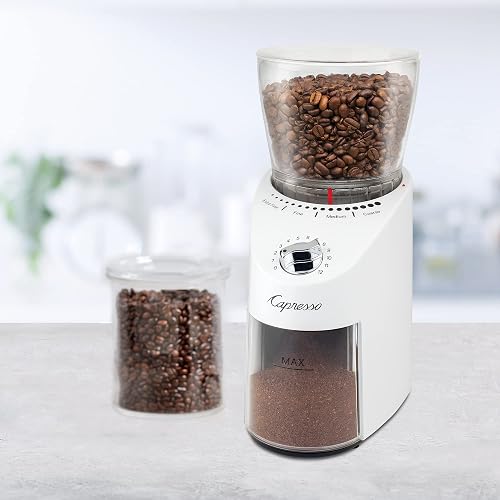
The grinder and nothing else. No brush, no scoop, no portafilter holder — Amazon lists the included components simply as “Grinder”.
The hopper holds 11 ounces of beans and the removable container catches up to 4 ounces of grounds, which is a lot for a domestic machine and the reason it suits people brewing several ways in a week rather than pulling one shot a day.
It draws 100 watts, which is low for an electric grinder and deliberate: the gear-reduction motor turns the burr slowly to limit friction and heat. It also weighs four pounds, and Amazon lists the material as plastic.
Specifications
| Model | Capresso Infinity Plus, white — 570.02 |
| Type | Electric conical burr grinder |
| Burr | Solid steel conical |
| Motor | Gear reduction, low speed — 100 watts, 120 V |
| Grind settings | 16, across four bands: Extra Fine, Fine, Medium, Coarse |
| Timer | Separate dial marked 0–12 |
| Bean hopper | 11 oz |
| Grounds container | 4 oz, removable |
| Housing | Plastic, per Amazon’s specification table |
| Weight / warranty | 4 lb / 1 year |
How you actually set the grind

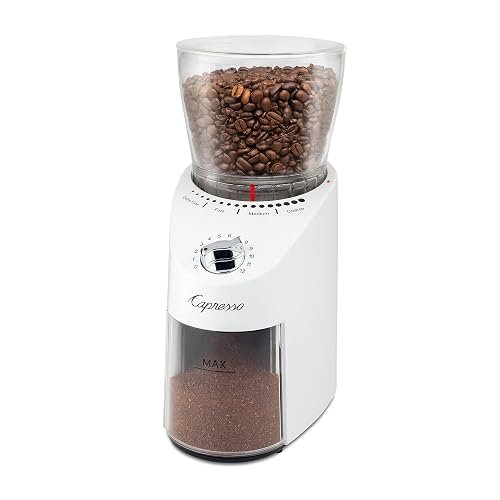
There are two controls and they do different jobs. Fineness is set by rotating the bean hopper against a collar marked Extra Fine, Fine, Medium and Coarse, with sixteen dot positions across those four bands. The numbered dial on the front, running 0 to 12, is a timer — it controls how long the motor runs, not how fine it grinds.
That trips people up. One owner describes playing around with the dial to work out what the numbers equate to, which is exactly the confusion the layout invites. If you are dialling in espresso, the collar is the control that matters and the dial is how you hit a dose.
Sixteen settings is generous next to a basic grinder and modest next to the Breville Smart Grinder Pro with sixty. For pour over, French press and drip it is more than enough. For espresso, where the useful range is narrow and the steps between settings matter most, it is the specification to think hardest about.
Who It’s For
- Households brewing several ways — drip one day, French press the next, cold brew at the weekend
- Anyone who wants a large hopper and a big grounds bin rather than dosing shot by shot
- Cooks replacing a blade grinder, where the step up in consistency is largest
- People who want an electric burr grinder under $100 with a real steel burr
Who Should Look Elsewhere
- Anyone who keeps a tidy counter. Static is the dominant complaint and it is not a minor one
- Espresso-first buyers — an owner of the previous model reports this one does not go as fine at its lowest setting
- Anyone expecting metal. Amazon lists the housing as plastic, and owners who had the older aluminium version notice
- Buyers who want the finest steps available; the Breville offers sixty settings to this one’s sixteen
- Anyone who would rather have grind quality than convenience — for that the Timemore C2S is $25 less and hand-powered
Performance
The static, and why long-time Capresso owners are the ones complaining

Static is the single most common complaint and it is reported vividly. One owner describes grind dust flowing around the unit like a fine mist and getting on everything near it. Another calls the machine excellent at grinding but incredibly messy.
The most useful version comes from a repeat customer: this is their third Capresso burr grinder, they bought it in January, and they say it is by far the messiest — none of their previous Capresso grinders had a static problem anywhere close to it. That is a comparison within the brand rather than a general grumble about grinders.
It is not unanimous, which matters. One five-star owner says it does not blow grinds all over the counter. Another says there is a little static, they are fine with it, and they assume all grinders do that. So severity is genuinely disputed — but enough owners raise it that you should plan on tapping the bin before opening it.
The housing is plastic, and owners of the old one can tell

Amazon’s specification table gives the material type as plastic, and two owners raise it independently. One calls the machine flimsy and notes that most of the grinding components are plastic, with the bean container awkward to seat.
The more specific report comes from someone who bought a Capresso Infinity over two years ago from another retailer: that one had an aluminium housing and was clearly a more industrial machine than the current one, which they describe as plastic, lightweight and a cheaper version.
I cannot verify what changed or when. What I can say is that the current listing states plastic, that four pounds is light for a burr grinder, and that two people who owned an earlier Infinity say the build went backwards. If you are buying on the strength of the model’s reputation, that is the caveat.
A slow motor, a steel burr, and a fineness question

The 100-watt gear-reduction motor is the interesting engineering here. Turning a burr slowly generates less friction and less heat, which preserves aroma, and it is the same reasoning behind expensive grinders running low RPM. Low wattage on this machine is a design choice rather than a corner cut, and owners consistently report the grind itself as even and easy to adjust.
One five-star owner retired a Baratza Encore after well over a decade to try this and reports it exceeded expectations. Another, on their fourth grinder in fifteen years from four different makers, calls this the best of them for consistency and adjustment.
The exception is fineness, which is the one that matters in an espresso guide. An owner who had the previous stainless model reports that one ground finer, and that this one at its smallest setting is good but not as fine — wondering whether tolerances changed. If espresso is the only thing you make, that is worth weighing.
Cleaning, and the part that is genuinely awkward

Nothing comes in the box to clean it with. The upper burr lifts out for access, which is more than many grinders at this price allow, but an owner three weeks in describes it as nearly impossible to clean properly while still rating the grind even and the grounds consistent.
Retained grounds are part of the same story as the static. Coffee that clings inside the chute is coffee that turns up in tomorrow’s dose, which matters more if you switch between beans than if you buy one bag on repeat.
A longer-term owner reports it leaving a lot of bean dust after several years of use. Treat a brush and a regular strip-down as part of owning it, not an optional extra.
Design and Build
A white plastic body, a clear 11-ounce hopper, a removable 4-ounce grounds container with a MAX line, a rotating grind collar and a numbered timer dial. It stands about the height of a kettle and weighs four pounds.
Noise is a genuine improvement. An owner who had the earlier model says this one is a lot quieter and looks good on a counter, and the slow motor is the reason — a grinder that turns its burr slowly makes less noise as well as less heat.
Model numbers are inconsistent across the range and worth checking before you buy a part or compare a review. Amazon lists this one as 570.02; owners in the reviews reference a 575.05 and an earlier 565, which is the stainless version some of them preferred.
What Owners Report
I have not ground coffee with this. On an electric grinder the questions that need owners rather than a bench test are how it behaves on a real counter over months and whether the motor lasts. Here is what recurs across 1,685 owners on both sides, as of 9 September 2026.
What recurs in the positive reviews
- Fifteen years from the first one. An owner on their second Capresso Infinity reports the first lasted fifteen years. That is the longevity anchor for the whole review.
- It replaced a Baratza Encore. An owner retired one after well over a decade to try this and reports it exceeded expectations.
- Best of four grinders in fifteen years. An owner comparing across four different manufacturers rates this the most consistent and the easiest to adjust.
- Quieter than the old model, which is what the slow gear-reduction motor is for.
- Some owners get no mess at all. One five-star owner states plainly that it does not blow grinds over the counter — the direct counterweight to the static reports.
What recurs in the critical reviews
- Static, and a lot of it. Described as a fine mist over everything nearby, and as the messiest of three Capresso grinders one household has owned.
- Plastic housing. Two owners raise it; one who owned an aluminium-bodied Infinity says the current machine is a cheaper build.
- Not as fine as the previous model. An owner of the 565 reports the lowest setting no longer goes as fine.
- Hard to clean, with no brush supplied and grounds retained in the chute.
- Repeat failures for one owner, who reports junking three Capresso machines.
The pattern is a grinder people rate highly on grind and poorly on housekeeping. Nobody says it grinds badly; the 8% one-star share is static, plastic and cleaning. Whether that is a dealbreaker depends entirely on whether a dusting of coffee round the base of your grinder is something you would notice every morning or something you would wipe and forget.
Value
At $99.95 it sits in the middle of my espresso guide: $25 above the Timemore C2S, $5 above the C3S Pro, $10 below the OXO Brew and half the Breville.
Against the OXO at $109.95 the case is close and the OXO has fourteen times the review base. Against the Breville at $199.95 you are trading sixteen settings for sixty and a portafilter cradle. Against the two Timemore hand grinders you are trading grind quality per dollar for not having to turn a handle.
The honest position is that this is a good grinder bought for range and convenience rather than for the best grind at the price, and that the money buys a large hopper and sixteen usable settings rather than a premium build.
Durability
Across 1,685 ratings the distribution runs 74% five-star, 12% four, 4% three, 2% two and 8% one-star. That 8% is the highest one-star share of the five grinders in my espresso guide, against 3% for both Timemore hand grinders.
Reading the text, most of that tail is static and build rather than failure. That is a real warning about living with it, but it is a different thing from a grinder that stops working.
On the question of whether it lasts, the evidence is genuinely good: a fifteen-year first unit, a fourth-grinder-in-fifteen-years owner rating it best of the four, and a Baratza Encore owner switching to it. Set against one owner reporting three junked machines. The motor is not what people complain about.
Alternatives to Consider
- OXO Brew Conical Burr Grinder — $109.95. Ten dollars more, 23,346 ratings against 1,685, and the safer choice if you want the most-validated electric grinder under $120.
- Breville Smart Grinder Pro — $199.95. Sixty settings and a portafilter cradle. The one to buy if espresso is the point.
- Timemore Chestnut C2S — $75. Manual, and better grind per dollar, if you will turn a handle for one or two cups.
- See the full ranking in my best espresso grinders guide.
Verdict
The Capresso Infinity Plus does what it is picked for. Sixteen settings from Turkish to cold brew, an 11-ounce hopper, a slow motor that keeps the beans cool, and a grind owners describe as even and easy to adjust. If you brew several different ways, that range is the reason to buy it.
The reason people mark it down is static. It is the dominant complaint, it comes from long-standing Capresso owners comparing it against their own earlier machines, and it is the main driver of an 8% one-star share — the highest in my guide. Two owners also report the housing going from aluminium to plastic.
Buy it for range and accept the housekeeping. If espresso alone is the goal, the Breville has sixty settings for twice the money, and one owner here reports this model no longer grinds as fine as the one it replaced.
How This Review Was Put Together
Plainly: this is research-based, not a hands-on test. I have not owned or used this coffee grinder, and nothing here should be read as a report from my own kitchen.
What it rests on: the published specification — the burr type, the motor speed and wattage, how the grind is actually selected, the housing material Amazon lists, and what owners of the earlier models say changed — read against the other grinders in my best espresso grinders guide; the shape of the rating distribution across 1,685 Amazon ratings rather than the 4.4 average it produces; and the text of the positive and critical reviews, read for themes that recur across independent owners.
Why owner reviews are treated as evidence here: one reviewer cooking on one unit for a fortnight cannot show static that only shows up on a kitchen counter, or a grinder still running at fifteen years. Several thousand owners over years can. A theme is only reported above where more than one unconnected owner raised it.
What I could not establish: whether the aluminium-bodied Infinity two owners describe was an earlier revision of this model or a different one entirely, since Amazon lists 570.02 while owners cite 575.05 and 565; whether the fineness at the lowest setting genuinely changed or that owner had a tolerance outlier; and how much of the static is the machine rather than dry beans and a dry kitchen, because nobody reporting it says what they were grinding.
Price, stock and ratings were read from Amazon’s US marketplace on 9 September 2026 and will move.
Frequently Asked Questions
How many grind settings does the Capresso Infinity Plus have?
Sixteen, arranged across four labelled bands – Extra Fine, Fine, Medium and Coarse – and selected by rotating the bean hopper against the collar. The numbered dial on the front running 0 to 12 is a timer that controls how long the motor runs, not the grind size.
Is it fine enough for espresso?
It reaches an extra-fine setting intended for Turkish coffee, so yes in principle. One owner who had the previous stainless model reports this one does not go quite as fine at its lowest setting. For espresso-only use the Breville Smart Grinder Pro offers sixty settings rather than sixteen.
Does the Capresso Infinity Plus make a mess?
Static is the most common complaint by a wide margin. One owner on their third Capresso grinder says this is by far the messiest and that their earlier ones were nothing like it. Other owners report no problem at all, so severity varies – but plan on tapping the grounds bin before you open it.
Is the body metal or plastic?
Amazon lists the material type as plastic. Two owners raise the build, and one who bought an earlier Capresso Infinity says that machine had an aluminium housing and felt more industrial than the current one.
How long does it last?
Owner evidence is good. One reports their first Capresso Infinity lasted fifteen years and they bought a second; another rates it the best of four grinders they have owned across fifteen years. The complaints in the low ratings are about mess and housing rather than the motor failing.
Why is it only 100 watts?
Deliberately. It uses a gear-reduction motor that turns the burr slowly, which generates less friction and less heat and so preserves more aroma. It is also why owners report it as quieter than the model it replaced.
How much does it hold?
The bean hopper takes 11 ounces and the removable grounds container catches up to 4 ounces. That is generous for a domestic grinder and suits brewing several ways in a week rather than dosing a single shot at a time.
Does it come with a cleaning brush?
No. Amazon lists the included components as just the grinder. The upper burr lifts out for access, but one owner three weeks in describes it as nearly impossible to clean thoroughly, so budget for a brush.

Glenn is the founder of Kitchenware Compare and has spent years researching, testing, and reviewing kitchen appliances, cookware, and gadgets. A lifelong home cook raised in a family that treated every meal as an occasion, Glenn started this site to cut through the noise of conflicting product reviews and give readers honest, practical guidance. When he is not testing the latest air fryer or digging into the specs of a new espresso machine, he can usually be found experimenting with new recipes or hunting for the perfect cast iron skillet at a flea market.
Leave a Reply