
I earn a commission if you buy through the Amazon links below, at no extra cost to you.
The Timemore Chestnut C2S is the budget manual pick in my espresso grinders guide, at $75. It uses the same S2C stainless burr family as the C3S Pro above it, which is the entire reason it is on the list.
It rates 4.7 stars across 986 ratings. That is the same average as the Pro, but the shape is different: 84% five-star here against the Pro’s 90%, on a sample roughly half the size.
The gap between those two figures is the interesting part, and the reviews explain it. It is not about the coffee.
Quick Verdict
| Score | Price | Rating | Buy |
| 8/10 | $75.00 | 4.7★ (986) | Check Price on Amazon |
What Comes in the Box
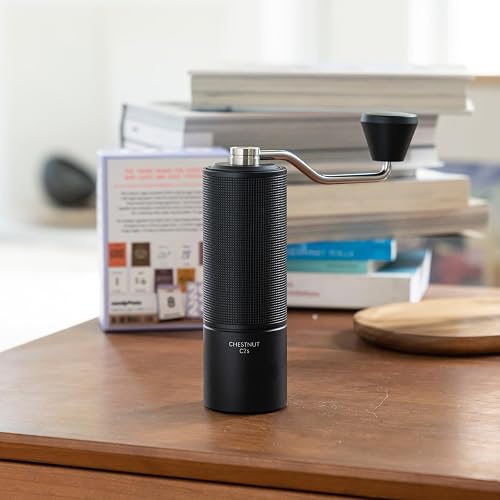
The grinder, a cleaning brush and a drawstring storage bag. One owner singles out the bag as part of what makes it feel like a considered product rather than a cheap one.
It holds 25 grams of beans, which is two double shots. The listing’s own specification table says 0.25 kg, which would be 250 grams and is out by a factor of ten — the title is the figure to trust. The same table lists the included components as “Cups, Mugs & Saucers”, which tells you how much attention it has had.
The burr is 38 mm. That number matters more than any other on this page, and it is the one thing the C2S shares completely with the grinder costing $20 more.
Specifications
| Model | TIMEMORE Chestnut C2S, black |
| Type | Manual hand grinder |
| Burr | S2C stainless steel conical, 38 mm, 55–58 HRC, 5-axis CNC |
| Body | Anodised aluminium alloy, full-metal unibody |
| Axis | Double bearing central-axis positioning |
| Adjustment | Approximately 36 clicks — espresso marked 10–14 on the dial |
| Capacity | 25 g — two double shots |
| Handle | Fixed crank — it does not fold |
| Cleaning | Brush only — the packaging carries a no-washing symbol |
| Amazon rank | #14 in Manual Coffee Grinders |
The same burr, for $20 less

A hand grinder is a burr, a shaft to keep it centred, and a tube to hold both. The C2S has a 38 mm S2C conical burr cut on a 5-axis machine at 55–58 HRC, and a double-bearing axis to stop the burr wandering under load. That is the specification that decides what the coffee tastes like, and it is effectively the same one you get for $95.
Owners notice. One tells you outright to look at the interior before judging it, because the materials and machining are where the difference against cheap grinders sits. Another puts the value argument more plainly: you are paying for a good burr in a well-machined metal tube, and not for a motor.
So the honest starting position is that the C2S is the cheapest way into this grind quality, and everything below is about whether the rest of the grinder keeps up with its burr.
Who It’s For
- Anyone who wants espresso-capable grind quality for $75
- Home brewers grinding one or two cups a day on a counter, where a folding handle is pointless
- People replacing a cheap ceramic-burr grinder and wanting the biggest single upgrade for the money
- Anyone who wants a grinder with no motor to fail and no plastic in the grind path
Who Should Look Elsewhere
- Anyone grinding more than two or three cups at a time — owners are blunt about this
- Travellers. The handle does not fold; the C3S Pro is the one for a bag
- People who want to rinse a grinder out; this is brush-clean only
- Anyone who cannot accept a hardware risk on the top cover and handle, which is where the critical reviews concentrate
- Buyers who want a warranty story — one owner reports no replacement part being available
Performance
The grind scale is not the same as the C3S Pro’s

The C2S dial marks espresso at 10–14 clicks and pour over at 16–24. The C3S Pro marks espresso at 7–8. These are different scales on two grinders from the same manufacturer, sold side by side, and a setting carried across from one to the other will be wrong.
The C2S chart is also the better of the two. It orders the brew methods correctly — French press coarse, pour over medium, mocha fine — where the Pro’s chart puts pour over coarser than French press, which is backwards.
If you own both, or you are moving from one to the other, count clicks from zero on the grinder in your hand rather than trusting a number you remember. Roughly 36 clicks of range is enough that being four or five out is the difference between a shot and a puddle.
Timemore says it fixed the top cover. Owners say it still breaks

Timemore is unusually direct about this. The first feature bullet on the listing says the C2S “solved the problem that the top cover of the C2 coffee bean grinder would break easily”, and the product image above repeats it: full metal top cover and handle, do not worry about cracking it. A manufacturer naming a failure in its own previous generation is not something you see often.
Owners of the C2S still report it. One describes the plastic piece on top breaking after less than a year of mild use, with the burr still working but beans going everywhere, and adds that they know of no replacement part. Another reports the bottom chamber no longer seating against the top after under a year.
The most telling one is a five-star review. An owner who has used it for several years, takes it on long trips and calls it hardy still raises the top plastic cover attached to the handle as the exception. When the same part comes up in the positive reviews as well as the critical ones, it is the part to watch.
The handle, and two that broke
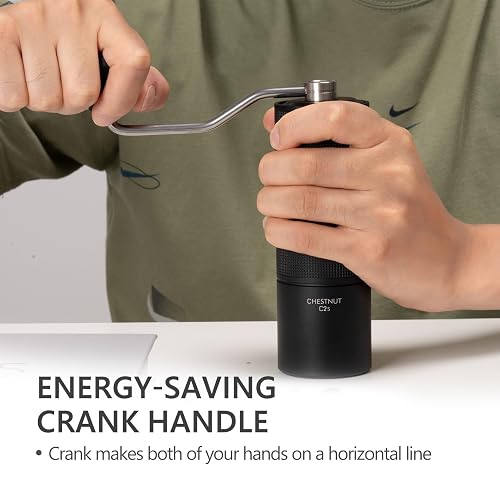
Timemore’s design argument for the crank is that it keeps both hands level, which makes the turn easier than a handle you reach up to. In use most owners agree, describing the action as smooth and the bearing as good enough that the handle keeps spinning after you let go.
One owner reports something harder to dismiss: they have had two of these, and in both cases the handle broke under normal use. Not dropped, not abused. One person with two failures of the same part is a weaker signal than two people with one each, but it is a specific claim about a specific component and it belongs on the record.
Set against that, nobody reports the burr failing, the bearing going, or the body deforming. Every hardware complaint here is about a part attached to the top of the grinder.
How much grinding you are actually signing up for

The most useful critical review here is not a complaint about a fault. An owner writes that it is for occasional use, because hand-grinding two servings for two morning mugs gets old quickly — you switch hands, and your back starts to notice.
That is worth more than a star rating. Twenty-five grams is the ceiling per fill, so two large mugs means two fills and two rounds of cranking at whatever fineness you brew at. For espresso, which is the finest and therefore the slowest, that is real work twice over.
It also strips to five parts and a brush, and the packaging carries a no-washing symbol, so maintenance is dry only. One owner received a unit with grounds already in it and paid full price for what was plainly a return — a problem that shows up on the C3S Pro listing too, and one you cannot solve by rinsing.
Design and Build
An anodised aluminium unibody knurled along its full length, a fixed steel crank, a double-bearing central axis and a stepped adjustment nut under the base. Owners describe the machining as the thing that separates it from cheap grinders, and one calls it precision machined with steel working parts.
A genuinely useful detail from an owner: the base that catches the grounds holds exactly 100 grams, so it doubles as a rough measure and saves reaching for scales for a routine dose.
The listing gives the weight as 1.52 pounds while the C3S Pro is listed at 15.2 ounces. Those are the same digits in different units and cannot both be describing what they appear to, so I would not use either figure to compare the two. What owners say is that it is heavy enough to feel solid and light enough to travel with.
What Owners Report
I have not ground coffee with this. On a hand grinder the questions that matter take a year or more to answer — whether the burr dulls, whether the threads hold, whether the parts attached to the top survive. Here is what recurs across 986 owners on both sides, as of 9 September 2026.
What recurs in the positive reviews
- Several years and still going. An owner who takes it on long trips where coffee facilities are poor calls it hardy and reports it has never failed them.
- The interior is the argument. One owner tells prospective buyers to look at the materials and machining inside, which is where the difference against cheap grinders shows.
- Fine enough for espresso. An owner buying it as a gift tested it first and was surprised it ground fine enough for espresso.
- Smooth and consistent. Repeatedly described as silky in operation with an even grind, particularly for French press and pour over.
- You pay for the burr, not a motor. The value case, made by owners in almost those words.
What recurs in the critical reviews
- The top cover breaks. Reported at under a year of mild use, with no replacement part available — against a listing that says this was fixed.
- The handle broke on two units belonging to the same owner, under normal use.
- The bottom chamber stops seating against the top after less than a year.
- Too slow for daily volume. One owner is clear it suits occasional use rather than two mugs every morning.
- Sold used as new. One owner received a unit with grounds already inside.
The split is clean and it is not about the coffee. Nobody reports a bad grind; the complaints are the top cover, the handle and the chamber fit. That is consistent with the six-point gap in five-star share against the C3S Pro, which costs $20 more and is built around the same burr — the extra appears to buy a sturdier top end rather than better grinding.
Value
At $75 this is the cheapest grinder in my espresso guide, $20 under the C3S Pro and $35 under the electric Capresso Infinity Plus.
Judged on grind alone it is the best value on the list by a wide margin, because the burr is the expensive part of a hand grinder and this one is not compromised. An owner who has both Timemore models reports the grinding experience is the same.
Judged on the whole product it is closer. The C3S Pro costs 27% more and carries a folding handle, a wider adjustment range and a meaningfully better five-star share. If the grinder lives on a counter and you are comfortable with the hardware reports above, the $20 stays in your pocket.
Durability
Across 986 ratings the distribution runs 84% five-star, 9% four, 2% three, 2% two and 3% one-star. The average matches the C3S Pro at 4.7, but the Pro puts 90% in the top box against this 84%, on nearly twice the sample.
The one-star share is identical at 3%, so the difference is in the middle: more four and three-star reviews here, which is the signature of a product people like with a reservation rather than one that fails outright.
It also sits at #14 in Manual Coffee Grinders where the Pro is #3. That is a sales position rather than a quality measure, but it means the C2S sample is smaller and accumulating more slowly, so the long-term picture is thinner here than the star rating suggests.
Alternatives to Consider
- Timemore Chestnut C3S Pro — $95. The same burr family with a folding handle, a wider range and a better five-star share. The upgrade that makes sense.
- OXO Brew Conical Burr Grinder — $109.95. Electric, 23,346 ratings, no cranking. The answer if the volume complaint above worries you.
- Breville Smart Grinder Pro — $199.95. Sixty settings and a portafilter cradle for espresso-first kitchens.
- See the full ranking in my best espresso grinders guide.
Verdict
The C2S is the cheapest way to grind coffee properly. The 38 mm S2C burr, the double-bearing axis and the machining are the parts that decide the cup, and at $75 nothing else on my list comes close on that basis alone.
The reservation is everything attached to the top. Timemore states on the listing that it fixed the previous model’s breaking top cover, and owners of this one still report the top cover breaking, the handle breaking and the chamber ceasing to seat — including an owner who otherwise loves it after several years.
Buy it if the grinder stays on a counter, you grind one or two cups, and you would rather have a great burr with a hardware risk than a lesser grinder without one. If you want the same burr in a body with a better track record, the C3S Pro is $20 away.
How This Review Was Put Together
Plainly: this is research-based, not a hands-on test. I have not owned or used this coffee grinder, and nothing here should be read as a report from my own kitchen.
What it rests on: the published specification — the burr size and material, the adjustment scale printed on the grinder itself, what Timemore says it changed from the previous model, and the cleaning method the packaging permits — read against the other grinders in my best espresso grinders guide; the shape of the rating distribution across 986 Amazon ratings rather than the 4.7 average it produces; and the text of the positive and critical reviews, read for themes that recur across independent owners.
Why owner reviews are treated as evidence here: one reviewer cooking on one unit for a fortnight cannot show a top cover breaking at eleven months, or a grinder still working after several years of travel. Several thousand owners over years can. A theme is only reported above where more than one unconnected owner raised it.
What I could not establish: whether the top covers owners report breaking are current stock or older units, since Timemore markets the C2S specifically as the fix for that failure and I cannot see which version each reviewer received; whether a replacement top cover is available anywhere, because one owner says they could not find one; and what the true weight is, since the listing figure for this grinder and the one for the C3S Pro use the same digits in different units.
Price, stock and ratings were read from Amazon’s US marketplace on 9 September 2026 and will move.
Frequently Asked Questions
Is the Timemore C2S good enough for espresso?
Yes. The dial marks espresso at 10 to 14 clicks and the burr is the same 38 mm S2C stainless conical set used further up the range. An owner who bought one as a gift tested it first and reports it grinds fine enough for espresso.
What is the difference between the C2S and the C3S Pro?
The Pro costs $95 against $75 and adds a folding handle, a wider adjustment range and a different click scale. The burr family is the same and an owner who has both reports the grinding experience is the same. The Pro also holds a higher five-star share, 90% against 84%.
How many clicks for espresso on the C2S?
Ten to fourteen, marked on the dial itself, with pour over at 16 to 24. Do not carry these numbers over from the C3S Pro, which marks espresso at 7 to 8 – the two grinders use different scales despite coming from the same brand.
Does the top cover really break?
Timemore states on the listing that the C2S solved the previous model breaking its top cover, and its product images repeat the promise. Owners of the C2S still report the plastic piece on top breaking under a year of mild use, including one long-term five-star owner, and one reports being unable to find a replacement part.
Can you wash the Timemore C2S?
No. It strips to five parts and comes with a brush, and the packaging carries a no-washing symbol. The body is anodised aluminium and the burr is steel, so water risks corrosion and a seized adjustment nut.
How much coffee does it hold?
Twenty-five grams, which is two double shots. The specification table on Amazon says 0.25 kg, which would be ten times that and appears to be an error – the product title gives the correct figure.
Is it practical for two cups every morning?
One owner says plainly that it is not, describing it as suited to occasional use because grinding two servings by hand gets old quickly. If you brew two large mugs daily, an electric grinder such as the OXO Brew is the more realistic choice.
Does it come with anything else?
A cleaning brush and a drawstring storage bag. One owner mentions the bag specifically as part of what makes the package feel considered for the money.

Glenn is the founder of Kitchenware Compare and has spent years researching, testing, and reviewing kitchen appliances, cookware, and gadgets. A lifelong home cook raised in a family that treated every meal as an occasion, Glenn started this site to cut through the noise of conflicting product reviews and give readers honest, practical guidance. When he is not testing the latest air fryer or digging into the specs of a new espresso machine, he can usually be found experimenting with new recipes or hunting for the perfect cast iron skillet at a flea market.
Leave a Reply