• Skip to primary navigation
  • Skip to main content
  • Skip to primary sidebar

Kitchenware Compare

  • Home
  • Product Reviews
    • Air Fryers
    • Coffee
    • Cookware
    • Flat Top Grills
    • Meat Thermometers
    • Food Processors
    • Knives
    • Pizza Ovens
    • Toaster Ovens
    • Juicers
  • Food Blog
  • Helpful Kitchen Tips
  • Data Studies
  • About
  • How I Review
  • Contact
You are here: Home / Archives for Glenn

Air Fryer Keeps Tripping the Breaker? How to Fix It

Last Updated October 22, 2026

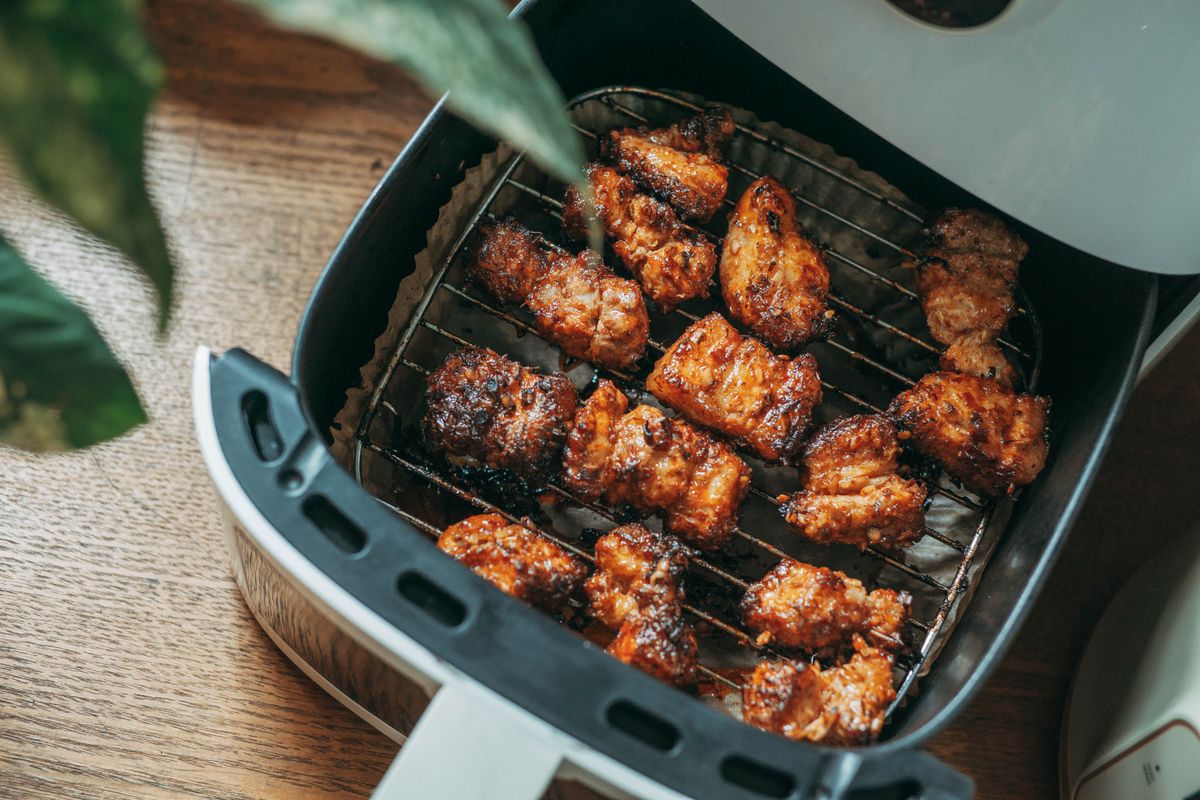
Air fryer basket pulled out with cooked chicken pieces inside, on a kitchen worktop

An air fryer that trips the electrics is telling you one of two completely different things, and the timing separates them. A trip that happens minutes into cooking is an overload — the circuit is carrying more than it is rated for.

A trip the instant the air fryer is switched on, or one that happens when the machine is damp, is a fault in the appliance. The first is usually solvable by moving the plug. The second means stop using it.

First: which device actually tripped?

Go and look at the panel before doing anything else, because the answer changes the diagnosis entirely.

A standard circuit breaker protects the wiring from carrying too much current. It trips on overload, and it usually takes time — the element runs, the current stays high, and after several minutes the breaker gives up. In a UK or Irish consumer unit this is the MCB for the kitchen ring.

A GFCI or RCD is doing a different job. The Electrical Safety Foundation International describes a ground fault circuit interrupter as “a device designed to protect people from electrical shock and electrocution”, which “constantly monitors electricity flowing in” a circuit. It trips when current is escaping somewhere it should not — through moisture, or through damaged insulation. In an American kitchen, countertop receptacles are GFCI-protected, and ESFI advises plugging countertop appliances into them.

So: breaker equals too much load. GFCI or RCD equals leakage. They are not interchangeable, and treating a leakage trip as an overload is how a genuinely faulty machine stays in service.

The arithmetic, which is closer to the limit than most people expect

An air fryer is a heating appliance, and heating appliances draw far more than the small motors most kitchen gadgets contain. Divide the wattage by the supply voltage to get the current. For typical wattage ranges by size and the amps each draws, see my air fryer wattage guide.

On a 120 volt supply, air fryer ratings, including models covered on this site, work out roughly like this:

  • A 1,550 W compact model draws about 12.9 amps.
  • A 1,750 W model draws about 14.6 amps.
  • An 1,800 W model draws about 15 amps.
  • A twin-drawer model near 2,600 W, the top of the range EcoFlow reports, would draw about 22 amps. The Ninja DZ201 I cover is rated 1,690 W, about 14 amps.

A standard American kitchen small-appliance circuit is 15 or 20 amps. An 1,800 watt air fryer therefore asks for essentially the entire rated capacity of a 15 amp circuit on its own, before the kettle, the microwave or the toaster is plugged in anywhere else on the same run. And because breakers are sized so that a sustained load should sit below the full rating rather than at it, a machine drawing 15 amps on a 15 amp circuit is not operating with any margin at all — which is exactly why the trip tends to arrive part-way through a cook rather than immediately.

The 2,600 W figure is the one worth pausing on, though it is not typical: EcoFlow reports some twin-drawer models that high, while the one two-basket model I cover, the Ninja DZ201, is rated 1,690 W. At around 22 amps, a machine that large would exceed what a 20 amp circuit is intended to carry continuously. That is not a defect. It would need a circuit of its own.

On a 230 volt supply the current is roughly half for the same wattage, which is why this problem is much less common in the UK and Ireland — there the more likely symptom is the fuse in the plug failing, or an RCD tripping on leakage.

If it trips several minutes into cooking

This is the overload pattern, and it is the good outcome, because nothing is broken.

Work out what else is on the circuit

Kitchen circuits usually feed more sockets than people assume, and often reach beyond the kitchen. Switch the air fryer on alone, with the kettle, microwave and toaster unplugged, and see whether it completes a full cook. If it does, the air fryer is not the problem — the total load was.

ESFI lists the warning signs of an overloaded electrical system as “frequent tripping of circuit breakers or blowing of fuses”, along with lights dimming when other devices switch on, buzzing from switches or outlets, and discoloured outlets. If any of the others are present alongside the tripping, the wiring deserves attention rather than a workaround.

Move it to a different circuit, not just a different socket

Two sockets on the same wall are frequently on the same circuit, so moving the plug a metre sideways changes nothing. A socket in another room, ideally on another part of the house, is a real test. If the air fryer runs happily there, the diagnosis is settled.

Take the extension lead out of the equation

What a suitable outdoor lead actually has to be — jacket rating, earth, gauge and length — is covered in the best extension cord for an electric smoker, which applies to any heating appliance rather than only to smokers.

Light-duty extension leads and travel adapters are not built for a sustained 15 amp draw, and a coiled lead makes it worse by trapping heat. Plug a heating appliance straight into a wall socket. If the trip only happens on the extension, the lead was the fault and it should be retired rather than reused elsewhere.

If it trips instantly, or only when damp

An immediate trip on switch-on, or a trip that appears after the air fryer has been washed or has sat somewhere humid, points at current leaking to earth rather than at too much load. Water inside the base, a cracked heating element, or damaged insulation on the cord will all do it.

This is where the guidance stops being about convenience. ESFI is direct about an appliance that shows electrical symptoms: turn the power to it off at the circuit breaker, and do not touch it until it has been checked by a licensed, qualified electrician. An air fryer that trips a GFCI or RCD repeatedly is not a machine to keep resetting and trying again.

If the unit is out of warranty and the trip is instant and repeatable, replacement is usually the sensible answer rather than repair — the air fryer buying guide covers what is worth buying, and the cheap air fryer picks cover the budget end if this was an inexpensive unit to begin with.

What usually goes wrong

The most common mistake is treating a repeat trip as a nuisance to be reset around. A breaker doing its job is not a faulty breaker, and resetting it repeatedly while the same load is applied is the one response that carries actual risk.

The second is the extension lead, usually introduced because the air fryer ended up somewhere without a convenient socket. The third is assuming a bigger air fryer is simply a bigger version of the small one: some twin-drawer models are rated near 2,600 W, roughly double a compact one, while others such as the Ninja DZ201 sit at 1,690 W, so read the nameplate.

One more worth naming, because it produces a confusing intermittent fault: a socket that is itself worn or loose gives a poor contact, which heats up under a heavy load and can trip protective devices unpredictably. If one socket trips and others do not, and that socket is warm or discoloured, the socket is the suspect rather than the air fryer.

When to stop and get help

Some symptoms are not troubleshooting problems. Stop using the machine, and get an electrician, if the trip is instant every time on more than one circuit, if there is any burning smell or scorching around the plug or socket, if the plug or cord is hot to the touch, or if anyone has felt a shock or tingle from the appliance. Those are not overload symptoms.

The order worth working through

  1. Check which device tripped — breaker, or GFCI/RCD.
  2. Note the timing: instant, or several minutes in.
  3. Run the air fryer alone, with other kitchen appliances unplugged.
  4. Remove any extension lead and plug directly into a wall socket.
  5. Try a socket on a different circuit, not just a different socket.
  6. If it still trips instantly, stop, and have it looked at.

How This Guide Was Put Together

Plainly: this is a research-based guide, not a hands-on test. I have not put a set of air fryers on a meter to measure inrush current, and nothing here is a report from my own kitchen.

What it rests on: the published wattages of the air fryers covered on this site, and the arithmetic that follows from them at 120 and 230 volts; the guidance published by the Electrical Safety Foundation International on ground fault protection, overloaded circuits and when an appliance should be taken out of service; and the pattern of what owners report, where shared circuits and extension leads dominate the overload cases and moisture dominates the leakage cases.

Also not established: how much current these machines draw at the moment of switch-on, as opposed to while running. Inrush is what actually trips some breakers, it varies by model and by the type of breaker fitted, and no manufacturer in this category publishes the figure. Any number here would be invented, so none is given.

More air fryer troubleshooting

If the machine runs but will not get hot, see what to check when an air fryer is not heating up. If there is smoke rather than a trip, there is a separate guide to an air fryer that smokes.

Frequently Asked Questions

Why does my air fryer trip the breaker but the microwave does not?

Air fryers run a heating element at full power for the whole cook, while a microwave cycles on and off. Sustained current is what heats wiring and trips breakers, so a lower-rated appliance running continuously can trip a circuit that a higher-rated intermittent one does not.

Can I run an air fryer on an extension lead?

It is best not to. Light-duty leads are not rated for a sustained draw of this size, and coiling one traps heat. Plug a heating appliance directly into a wall socket. If tripping only happens on the extension, the lead is the fault.

Does an air fryer need its own circuit?

A compact model usually does not. Ninja asks for the DZ201, at 1,690 W, to be on a 15 amp circuit with nothing else plugged in, and a twin-drawer unit near 2,600 W would draw about 22 amps at 120 volts, which is more than a 20 amp circuit is meant to carry continuously, so check the nameplate and give a large one a dedicated circuit.

Is it dangerous if the breaker keeps tripping?

The breaker itself is protecting you and doing its job. The risk comes from repeatedly resetting it while the same load is applied. Repeated tripping, especially with dimming lights, buzzing outlets or a burning smell, means the wiring should be checked.

Why does it only trip when the air fryer is wet?

That is leakage rather than overload, and it is a GFCI or RCD tripping rather than a breaker. Moisture inside the base or a damaged element lets current escape to earth. Stop using it and have it checked.

My air fryer trips the breaker in one socket but not another. What does that mean?

Usually the two sockets are on different circuits and one is more heavily loaded. It can also mean the socket itself is worn and making poor contact, which heats up under load. A warm or discoloured socket points at the socket, not the appliance.
Filed Under: Helpful Kitchen Tips

Wireless Meat Thermometer Not Connecting? How to Fix It

Last Updated September 23, 2026

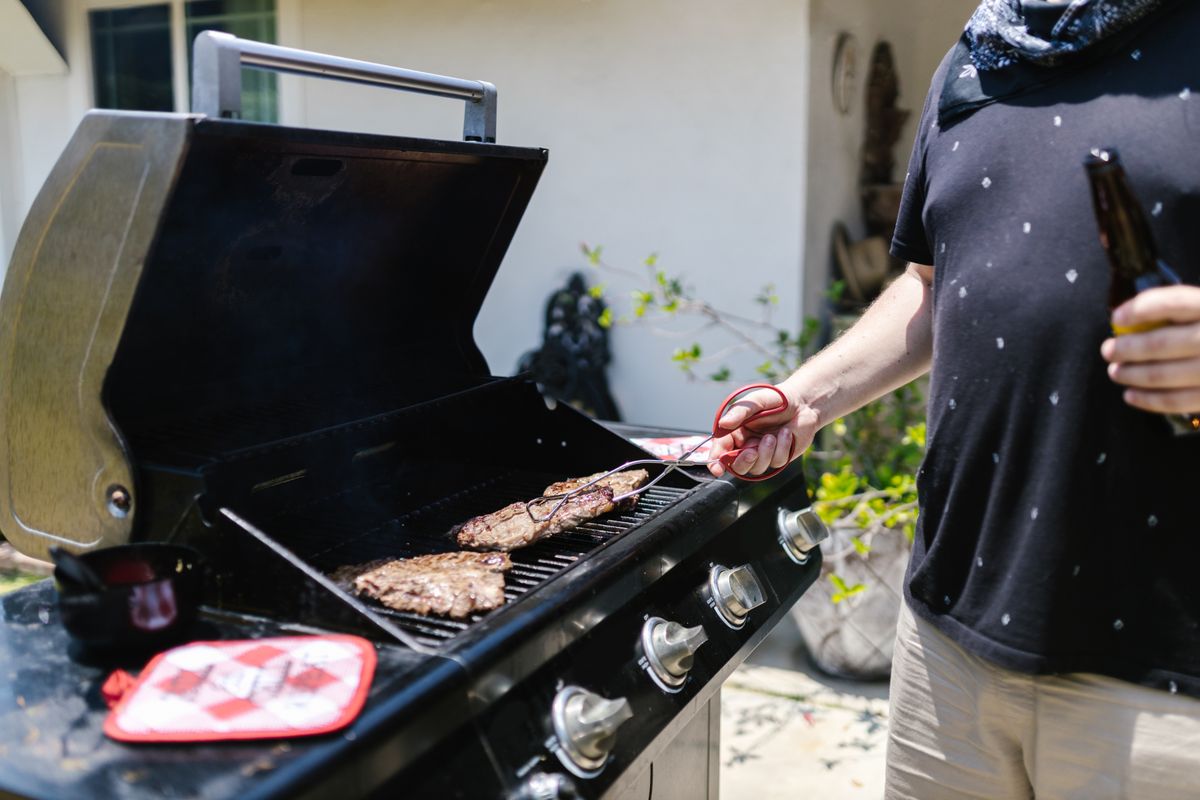
Gas barbecue with the lid open and steaks on the grate, the setting where a wireless thermometer link usually drops

A wireless meat thermometer that will not connect is nearly always one of three things, and they need completely different fixes: the probe is still paired to another device, the phone is blocking the Bluetooth scan, or the signal is being absorbed before it reaches you. Work through them in that order — the first two take under a minute and account for most failures.

First, work out which radio you actually have

Three quite different designs are sold under the word “wireless”, and the thing that breaks is different in each. Check which one is on the counter before troubleshooting anything.

Probe-only. The probe is the transmitter. There is no box and no cable — the metal spike itself holds the battery and the radio, and it charges in a separate block. MEATER-style thermometers work this way.

The quoted range is measured from the probe to the phone, or from the charging block acting as a repeater.

Probe plus transmitter. One or more wired probes plug into a small display box, and the box talks to the phone over Bluetooth. The Inkbird IBT-4XS and the ThermoPro TP25 are built like this. Here the probe cable is a separate failure point from the radio, which matters: a dead reading on one channel is a cable or probe fault, not a connection fault.

Wi-Fi or bridge models. A base station joins the home network and relays readings, so the phone does not need to be in Bluetooth range at all. When these fail it is usually the router relationship rather than the thermometer. If the difference between the two systems is what you are actually trying to resolve, the comparison of Bluetooth and Wi-Fi meat thermometers covers which one suits which kind of cooking.

The checks that take a minute

It is still connected to something else

This is the single most common cause and the least obvious, because nothing on the thermometer indicates it. A Bluetooth device holds one active connection at a time. If the thermometer is still paired to a tablet on the kitchen counter, a partner’s phone, or the phone it was set up on last summer, a second phone will see it and fail to connect — often with no error message beyond a spinner that never resolves.

Turn Bluetooth off on every other device in the house, or walk the thermometer out of range of them, then try again. If that fixes it, the long-term answer is to decide which device owns the thermometer and forget it on the others.

Bluetooth is on, but the app is not allowed to scan

An app cannot connect to a device it is not permitted to look for, and on Android the permission that blocks this is not the one most people expect. Google’s Bluetooth permissions documentation states that for apps targeting Android 11 or lower, location access “is necessary because, on Android 11 and lower, a Bluetooth scan could potentially be used to gather information about the location of the user”.

In practice that means an older thermometer app will refuse to find the probe when Location is switched off, even though nothing about the task involves GPS. Newer apps built against Android 12 or higher can declare that they never use Bluetooth for location and skip the requirement, which is why the same advice works on one phone and appears to be nonsense on another. If the app has not been updated in a while, turn Location on, grant the Bluetooth permission when prompted, and try the scan again.

On iPhone the equivalent is simpler: Settings, then the app, then check Bluetooth is enabled for it specifically.

The battery is low enough to stop transmitting but not to look flat

Radio transmission is the most power-hungry thing these devices do. A probe with just enough charge to light its display or show a status LED may not have enough to hold a link, so the symptom is a device that looks alive and behaves as though it is broken. On probe-only models this is especially easy to miss, because the probe gives almost no feedback.

Charge it fully before concluding anything else is wrong. On transmitter models, check that the transmitter itself has charge or fresh batteries — charging the probes and forgetting the box is a common and frustrating mistake.

It connects, then drops out mid-cook

A link that establishes and then fails is a different problem from one that never forms. This is almost always physics rather than a fault.

2.4 GHz does not travel well through meat, water or metal

Bluetooth runs in the 2.4 GHz band — 2400 to 2483.5 MHz, according to the Bluetooth SIG, which notes that the choice of radio spectrum is a trade-off, with lower frequencies travelling further and higher ones carrying more data.

The practical consequence for cooking is awkward: a large wet roast sitting between the probe and the phone is an effective absorber, and a closed metal lid is close to a shielded box. A probe-only thermometer buried in a brisket, inside a kettle grill with the lid down, is being asked to transmit through the two materials that block it best. Signal that was solid at the start of a cook can degrade as the joint is turned or the lid closed.

The quoted range is line-of-sight, and nothing else

Rated figures are measured in open air with nothing in between. The numbers on the box vary enormously — the Inkbird IBT-4XS is rated at 150 feet, the TempPro TempSync at 650 — but every one of them assumes a clear path. Through a wall, an oven door, or a closed grill, the usable distance is a fraction of the claim.

If the readings hold while standing next to the grill and fail from the sofa, the thermometer is working exactly as designed and the range is simply not enough for the layout. That is a buying problem rather than a fault, and it is the main thing worth paying for: the guide to wireless meat thermometers sets out which models hold a link at distance and which do not.

The transmitter is standing on metal

A transmitter box placed on a grill shelf, a metal worktop or against an appliance will perform far worse than the same box moved two feet onto a wooden surface. Metal both blocks and reflects at this frequency. Moving the base station is the cheapest fix available and it is frequently the whole answer.

Re-pairing properly

Half-finished pairings cause persistent, hard-to-diagnose failures. If the checks above have not resolved it, clear the pairing completely rather than trying to connect again on top of it.

  1. In the phone’s Bluetooth settings, find the thermometer and choose Forget This Device — not just disconnect.
  2. Force-close the thermometer app.
  3. Power the thermometer down fully. On probe-only models, seat the probe in its charger for a few seconds.
  4. Turn the phone’s Bluetooth off, wait ten seconds, turn it back on.
  5. Open the app first, then power the thermometer on, and pair from inside the app rather than from the phone’s Bluetooth menu.

That last step matters more than it sounds. Several of these thermometers are designed to be paired through the app, and pairing them at operating-system level instead produces a device that appears connected in Bluetooth settings while the app still cannot see it.

What usually goes wrong

The recurring mistakes are rarely technical. Charging the probes but not the transmitter accounts for a good share of apparently dead units. Standing the base station on the grill itself is another, and it is often introduced by the magnetic back that many transmitters have, which invites exactly the wrong placement. Assuming a rated range applies through a closed lid leads people to return working thermometers.

Two further traps are worth naming. Firmware updates for these devices are delivered through the phone app and are easy to postpone indefinitely; a stalled update can leave an app and a device on incompatible versions, and the symptom is a connection that fails for no visible reason. And a probe run past its rated temperature — pushed into a searing zone, or left in during a high-heat clean cycle — can be damaged permanently even though it still charges and still pairs, which reads as a connection problem but is not one.

When it is broken rather than disconnected

A few signs point to hardware rather than a link. A probe that reads wildly wrong while connected has a damaged sensor, not a radio problem. A single dead channel on a multi-probe transmitter, with the others fine, is a cable or probe fault. A probe that will not take charge at all, after trying a different cable and a different power source, has usually reached the end of its life.

These are consumable items in a way that is not always made obvious at purchase. Probes wear, cables fail at the strain point, and cheap units fail sooner. If replacement is the conclusion, the Bluetooth meat thermometer picks cover what holds up.

The order worth working through

  1. Disconnect every other device that has ever been paired to it.
  2. Check Bluetooth permission for the app, and Location on older Android builds.
  3. Charge the transmitter as well as the probes.
  4. Move the base station off metal.
  5. Forget the device and re-pair from inside the app.
  6. Test the range in open air before blaming the thermometer.

How This Guide Was Put Together

Plainly: this is a research-based guide, not a hands-on test. I have not bench-tested a set of thermometers for connection stability, and nothing here is a report from my own kitchen.

What it rests on: the published behaviour of Bluetooth itself, including the 2.4 GHz band figures from the Bluetooth SIG and the Android permission requirements documented by Google, both of which explain symptoms that are otherwise reported as folklore; the rated ranges published for the models covered on this site; and the pattern of what owners report across product listings and support threads, where stale pairings, permissions and base-station placement dominate the causes by a wide margin.

Also not established: a reliable figure for real-world range as a percentage of the rated figure. It depends on the meat, the cooker, the building and the phone, the published numbers are all line-of-sight, and no source found offers a controlled measurement across models. Any single percentage here would be invented, so none is given.

More thermometer troubleshooting

If the reading rather than the connection is the problem, see how to calibrate a meat thermometer, or the assessment of how accurate wireless meat thermometers really are.

Frequently Asked Questions

Why will my wireless meat thermometer not connect to my phone?

Most often it is still actively paired to another device, because Bluetooth holds one connection at a time. Failing that, the app has not been granted permission to scan, or the probe has too little charge to transmit even though it powers on.

Does Location have to be switched on for a meat thermometer app?

On Android apps targeting version 11 or lower, yes. Google documents that location access is required because a Bluetooth scan could be used to infer the user’s position. Apps updated for Android 12 or higher can declare they never use Bluetooth for location and skip it.

Why does my thermometer disconnect when I close the grill lid?

A closed metal lid behaves like a shielded box at 2.4 GHz, and wet meat absorbs the same frequency. A probe inside a large joint inside a closed grill is transmitting through both. Moving the phone closer usually restores it.

Can two phones use the same meat thermometer at once?

Not on Bluetooth models, which support a single active connection. Wi-Fi and bridge models can serve more than one device because readings go through the network rather than a direct link.

Is the range on the box realistic?

Only in open air with nothing in the way. Rated figures such as 150 or 650 feet are line-of-sight measurements. Through a wall, an oven door or a closed grill the usable distance is much shorter, and that is normal rather than a fault.

How do I know if the probe is broken rather than disconnected?

If it connects but reads obviously wrong, the sensor is damaged. If one channel of a multi-probe unit is dead while the others work, it is that cable or probe. If it will not charge on a second cable and power source, it has failed.

Filed Under: Helpful Kitchen Tips

Best Countertop Dishwasher

Last Updated October 8, 2026

Woman Arranging Plates In Dishwasher

A countertop dishwasher is an excellent choice if you have limited space in your kitchen. They are more compact while promising to deliver the same cleaning power as traditional dishwashers. One thing that ruins either kind quickly: putting washing-up liquid in a dishwasher.

Although they can’t tackle heavy tasks like cleaning multiple dishes after a party, they are great for small families that need to reduce their chores. That said, here are five of the best countertop dishwashers available today. 

I earn a commission if you buy through the Amazon links below, at no extra cost to you.

Quick Comparison

Product Best For Price Rating Buy
COMFEE Portable Mini Best Overall $309.99 4.2★ (3,726) Check Price
AIRMSEN Portable Best No-Hookup Flexibility $339.99 4.6★ (1,631) Check Price
NOVETE Countertop Best for Larger Dishes $289.99 4.4★ (2,515) Check Price
EUHOMY Countertop Cheapest No-Hookup $249.00 4.5★ (1,007) Check Price
Hermitlux Countertop Most Polished Build $299.99 4.4★ (4,577) Check Price

Best Countertop Dishwasher Reviews

COMFEE Countertop Dishwasher

Uenxnudbl. Sl300

Check on Amazon

The COMFEE countertop dishwasher weighs 46 pounds and has a yearly energy consumption of 174 Kilowatt hours. It comes with a push-button control console and has eight cycle options. The dishwasher’s primary material consists of plastic and stainless steel. The package includes a dishwasher, a user manual, a drain hose, an inlet hose, and a power cord. 

Review

One of the first things you will notice about this dishwasher is its easy installation. You can quickly combine accessories and make simple connections like regular dishwashers. The only thing that might need to be added to the instruction manual is how to get rid of errors. Also, connecting it to some faucets might require an adapter. 

The dishwasher can go anywhere in your cupboard or the table. You can put up to about 70 tableware pieces inside. Plates also fit, as long as they are 10 inches in diameter or less.

The washing cycles include Normal, Heavy, ECO, Speed, Glass, and Baby-care. It also has an extra drying function which aids in delivering sparkly clean, dry dishes. The compact dishwasher also has Rinse, Mini-part, and Speed. 

The Baby-care wash cycle prevents bacteria growth and aims to keep children’s bottles and dinner sets clean. Speaking of children, you won’t have to worry much about accidents as the dishwasher has a child safety lock. 

One of the highlight features of this dishwasher is the heavy program. It cleans heavily soiled dishes courtesy of the 12 washing nozzles and the 360° spiral spray wash. The two allow for complete cleaning from all angles.

In addition to the 150°F water temperature and the high pressure, you won’t have to deal with tough stains anymore. An extra drying option allows extended drying time by increasing the final rinsing temperature.        

It takes about 45 minutes to clean the dishes. Lastly, the COMFEE compact dishwasher is certified by Energy Star as it consumes as little as 2.77 gallons of water. 

Pros

  • It fits a large number of utensils
  • Installation is easy
  • Several washing cycles
  • Convenient heavy program
  • Does the job fast and efficiently

Cons

  • The manual is not clear on how to remove errors 

AIRMSEN Portable Countertop Dishwasher

Qknlzgeyl. Sl300

Check on Amazon

This dishwasher from AIRMSEN is packed with unique features that make it not only efficiently functional but also convenient. It weighs around 26.4 pounds and has a 3-cup capacity. It comes in white, features a touch control console, and has five option cycles.

Review

From an aesthetic point of view, this dishwasher has built-in light functions which are pleasing to the eye. Since it’s a lightweight appliance with small dimensions (16 x 16 x 17.5 inches), you can easily carry it around. This makes it a convenient unit for a small apartment, a camper, a boat, or a dorm. Despite its small size, the dishwasher can easily fit different dishes as long as they are up to 12 inches in diameter. 

Some of the different multi-washing programs include Dry, Fruit, ECO, Strong, and Quick. You also enjoy deep cleaning without streaks, courtesy of the upper and lower spray arms. 

The panel is easy to use and the LED digital controls clearly display the wash controls. In addition, an automatic water level indicator alerts you when you have reached the ideal water level.  

The portable countertop dishwasher features two channel options for filling it out. A water hose or a tank option adds to the convenience of storage and portability.

You can use any detergent from powder, liquids, or pods with the dishwasher — if your home is on a septic tank, see my septic-safe dishwasher detergent guide. If you are running long cycles, manufacturers recommend using detergent tablets to ensure they get fully dissolved. 

There are a few downsides to having this dishwasher. For example, some of your pots may not fit inside the dishwasher. Some people also find the dishwasher to be noisy during operation. 

Pros

  • You can place it almost anywhere
  • The control panel is pretty easy to use
  • Offers several washing programs
  • Two channel filling up is convenient
  • Accepts most types of detergents

Cons

  • Noisy when in use
  • Big pans will not fit in the dishwasher

NOVETE Portable Countertop Dishwasher

Cyw8utfal. Sl300

Check on Amazon

If you were looking for a dishwasher with a stylish and compact design, this is the one to get. NOVETE is not only known for its unique and innovative products; they are also dependable, whether for customer support or any other inquiry.

The company is committed to making work in the kitchen much easier and more efficient with its products. NOVETE makes other products like stainless steel cookware and ceramic and non-stick tools. They bring innovation, value, design, and durability to the table.

Review

For this dishwasher, you don’t need a water hookup. That makes it the easiest unit here to move between kitchen, RV, and storage. It offers five washing programs, including Glass, Baby-care, Fruitwash, Rapid and Normal. For effective cleaning, you also get upper and lower spray arms. 

Using the Baby-care wash program generates steam, conveniently giving glassware a sparkling clean result. 

It is also relatively fast and you can clean your dirty dishes in 40 minutes. In addition, the air circulation is automatic, which helps to dry your dishes. 

The fruit wash feature is convenient for cleaning your vegetables and fruit and having them ready from the dishwasher. 

When you use the Baby-care program, you might notice that your baby bottles have a powdery residue. This usually means you use a lot of detergents and might have to reduce the quantity.

Plates and dishes 12″ in diameter can fit in this dishwasher; thus, you are covered for most dishes. The overall compact design makes it great for campers or small-sized apartments. 

It has a 5-liter tank and the package includes a water hose to connect to your kitchen faucet. If it doesn’t fit, you can buy an adapter. 

The constituted material also makes this dishwasher durable, meaning it will last a long time. When you initially receive the packaging, you might notice a bit of residual water inside, don’t worry; this is normal. Dishwashers are usually tested first in the factory before release. You can reach NOVETE by phone or email if you experience issues with your dishwasher. 

Overall this dishwasher is an aesthetically pleasing unit to add to your kitchen. In addition to the nice looks and finishes, it’s also functional and reliable. 

Pros

  • Compact and stylish design
  • It does not require hookups
  • It fits a variety of dishes
  • Convenient steam cycle for washing baby utensils
  • Numerous wash cycles

Cons

  • Your dishes might come out soapy at times

EUHOMY Countertop Dishwasher


EUHOMY portable countertop dishwasher

The EUHOMY replaces the discontinued hOmeLabs unit that used to hold this spot — hOmeLabs has left the countertop dishwasher category entirely. It is a strong swap: 6 programs, a 5-liter built-in tank for hookup-free use, and a 167°F high-temp cycle for sanitizing baby items, all at $249.00 — the cheapest pick on this list. The trade-off for the price is a smaller review base (1,007 ratings at 4.5 stars) than the longer-established brands here.

Pros:

  • Cheapest pick on the list, with the same no-hookup tank design as units costing $40 or more
  • 167°F high-temperature sanitize cycle
  • Compact footprint fits under most cabinets

Cons:

  • Smallest review base on this list
  • Air-dry only — no heated drying

Verdict: Buy this if you want the no-hookup convenience at the lowest price and don’t mind a newer brand. Skip it if a proven track record matters more than saving $40.

Check Price on Amazon →

Hermitlux Countertop Dishwasher


Hermitlux Countertop Dishwasher with glass door

The Hermitlux runs 7 washing programs from a 5-liter built-in tank, so like the AIRMSEN it needs no plumbing hookup at all. The glass door and interior LED are genuinely useful rather than decorative — you can see whether that baking dish actually came clean without opening the door mid-cycle. At $299.99 it costs less than the COMFEE ($309.99) and the AIRMSEN ($339.99), and its 4.4-star average across 4,577 ratings is the largest review base on this list.

Pros:

  • No water hookup needed — 5L built-in tank
  • Glass door with interior light to check cycle progress
  • 7 programs including high-temp 167°F sanitize

Cons:

  • Priciest option on this list
  • Tank filling adds a manual step every cycle if you skip the hookup

Verdict: Buy this if you want the no-hookup convenience with the most polished build. Skip it if you have a faucet connection available — the COMFEE does more programs for less.

Check Price on Amazon →

Conclusion

All the countertop dishwashers reviewed not only add to the functionality of your kitchen but are also designed to be aesthetically pleasing. The COMFEE Countertop Dishwasher is my top pick: Energy Star certified, eight wash programs, and the largest proven track record on this list (3,604 ratings). If you are looking for a dishwasher that you can fill up using your jug, get the AIRMSEN countertop dishwasher which offers two filling options. The NOVETE dishwasher is an excellent choice for those with dishes bigger than 10 inches but smaller than 12 inches. 

How These Picks Were Chosen

Plainly: this is a research-based guide, not a hands-on test. I have not run these side by side, and nothing here should be read as a report from my own kitchen.

What the picks rest on: place-setting capacity and what that means in real crockery, whether the unit needs a tap connection or fills from an internal reservoir, cycle length, stated water use per cycle, and whether there is a heated dry; plus the complaint patterns across verified-purchase reviews, which for countertop units concentrate on tap adapters leaking and on drying performance disappointing buyers used to a full-size machine.

What I could not establish: actual cleaning performance, which needs standardised soiled loads of the kind consumer test labs use. No independent test covers these models. Capacity, water use and cycle options are specifications you can act on; cleaning quality here rests on owner consensus.

Frequently Asked Questions

What is the best countertop dishwasher overall?

The COMFEE Portable Mini. It is Energy Star certified, runs eight wash programs, and its 3,604 ratings are the largest proven track record on this list — the surest bet in a category full of newer brands.

Do countertop dishwashers need a plumbing hookup?

Not all of them. The AIRMSEN, EUHOMY, and Hermitlux all have built-in water tanks you fill with a jug, needing no faucet connection at all. The COMFEE and NOVETE connect to a standard faucet with a quick-connect adapter — no permanent plumbing either way.

How many dishes fit in a countertop dishwasher?

Most handle 4-6 place settings — realistically, dinner dishes for two people or a day’s worth for one. Plates larger than about 10-12 inches will not fit in most units; the NOVETE handles up to 12-inch plates, the most of any pick here.

Do countertop dishwashers actually get dishes clean?

Yes — they use the same spray-arm and heated-water approach as full-size machines, just in a smaller chamber. The main compromises are capacity and cycle time, not cleaning quality. High-temp cycles on the EUHOMY and Hermitlux reach 167°F, hot enough to sanitize.

How much counter space does one need?

Plan for roughly 17-22 inches wide, 20 inches deep, and 17-18 inches tall — about the footprint of a large microwave. Check clearance under your cabinets before buying; most standard 18-inch cabinet gaps fit these units with little room to spare.

Planning a full countertop setup? A countertop ice maker has roughly half this footprint if you are budgeting space for both.

Are countertop dishwashers worth it compared to hand washing?

For one- and two-person households, usually yes — they use 2-5 gallons per cycle versus up to 20 gallons of running-tap hand washing, and the high-temperature wash is more hygienic than any sink scrub.

Filed Under: Product Reviews

Best Sous Vide Precision Cookers

Last Updated November 9, 2026

cooking food using sous vide technology

Sometimes it is nice to have restaurant-quality food in your home without paying too much money or exerting too much effort. You can only do that if you have a sous vide cooker at your disposal for a precision cooking option. Getting the target right matters more than the machine does — the meat temperature guide covers the safe and preferred finish temperatures.

In-home fine dining is now within your reach, with great options available on the marketplace at very affordable prices. This article looks at some popular and best sous vide cookers to help you make the best choice.

Here’s a closer look at what these sous vide cookers have to offer, so you can make the best purchasing decision for your needs and budget.

I earn a commission if you buy through the Amazon links below, at no extra cost to you.

Quick Comparison

Product Best For Price Rating Buy
Anova Nano 2.0 Best Overall $71.99 4.6★ (15,079) Check Price
INKBIRD ISV-100W WiFi Best WiFi Features $95.99 4.5★ (5,362) Check Price
Breville Joule Turbo BSV600 Premium, App-Controlled $229.39 4.3★ (742) Check Price
Greater Goods 1100W No App Needed $89.99 4.6★ (1,901) Check Price
Wancle 1100W Best Budget $43.99 4.3★ (1,617) Check Price

Best Sous Vide Precision Cookers – Reviews

Anova Precision Cooker Nano (listed on Amazon as the Nano 2.0)

Anova Precision Cooker Nano sous vide circulator

Check Price on Amazon


Anova’s own page sells model AN400-US00 as the Precision Cooker Nano, in a US-plug (120 V) version. It is the top pick here because Anova’s spec sheet covers every figure this guide compares: flow rate, accuracy, low-water cutoff, water resistance and warranty.

One conflict to know about: the Amazon listing linked here is titled “Nano 2.0”, gives no model number and lists 800 W, while Anova’s AN400-US00 spec sheet says 750 W. The other listed figures (120 V, 12.8 inches tall, 0 to 92 °C, ±0.1 °C, Bluetooth app control) match. The figures below are Anova’s.

Anova lists 750 W of heating power, an 8-litre-per-minute pump and a range of 0 to 92 °C (32 to 197 °F) at ±0.1 °C (0.2 °F) accuracy. Its sensors shut it off when the water drops below 85 mm. Anova rates the body IPX7 water and splash resistant, and at 12.8 inches tall the Nano is short enough for a kitchen drawer. You set it with the buttons on the unit or through the Anova app over Bluetooth, which Anova pitches as monitoring from any room in the house.

The trade-offs come from the same spec sheet. Its 750 W is the lowest heating power of the five picks, which are otherwise listed at 1000 W or 1100 W, so I would expect it to take longer to bring a large pot up to temperature; that is reasoning from the wattage, not an Anova figure. Anova lists Bluetooth BLE 4.2 as the only connection, so the app cannot reach it from outside Bluetooth range. The warranty is two years.

Pros

  • ±0.1 °C (0.2 °F) accuracy rating from the maker
  • IPX7 water and splash resistance
  • Controls on the unit as well as the app
  • Two-year warranty
  • Short enough to store in a drawer

Cons

  • 750 W, the lowest power here, so a big pot should take longer to heat
  • Bluetooth only, with no Wi-Fi remote control
  • Needs at least 85 mm of water before it will run

ISV-100W/1000W Sous Vide Precision Cooker From Inkbird

INKBIRD ISV-100W Wi-Fi sous vide cooker

Check Price on Amazon


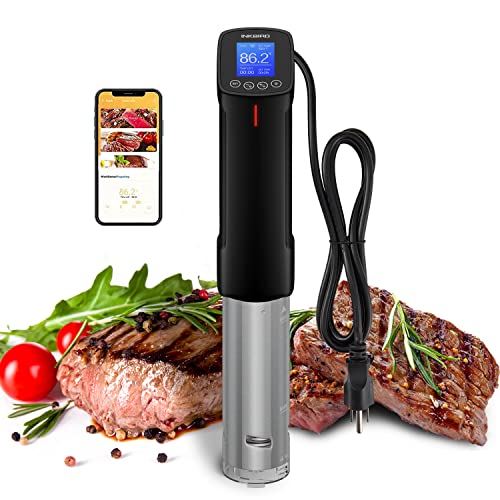
The ISV-100W is one of INKBIRD’s Wi-Fi models, set from the touch buttons on the unit or from the INKBIRD app. It is the pick for long cooks you want to watch from outside the house.

INKBIRD lists 1000 W, a range of 25 to 99 °C (77 to 210 °F) and a 15-litre capacity. Control accuracy is given as 1 °F/0.1 °C; those two figures are not equivalent, since 0.1 °C is about 0.2 °F. The timer runs to 99 hours 59 minutes. The app offers remote monitoring over 2.4 GHz Wi-Fi and can be shared with other users.

INKBIRD lists alarms for low water and for reaching the target temperature, and says the unit keeps its preset values through a power outage. Its product page calls the operation “whisper-quiet”, which is the maker’s description, not a measured noise figure.

The trade-offs are in INKBIRD’s own manual: the ISV-100W is rated “Non water-proof”, the warranty is one year, and the manual states that the warranty does not include water damage. The manual also warns never to use deionized water in it. The box holds the cooker, the manual and a warranty card, so bags are extra.

Pros

  • Wi-Fi app control that can be shared with other users
  • Low-water and target-temperature alarms
  • Range up to 99 °C (210 °F)
  • Keeps its settings through a power cut

Cons

  • Not waterproof, by the maker’s own rating
  • One-year warranty that excludes water damage
  • 2.4 GHz Wi-Fi only
  • No bags in the box

Breville Joule Turbo BSV600 Sous Vide

Breville Joule Turbo sous vide circulator with a white body and stainless steel cap

Price: $229.39 | Rating: 4.3★ (742 ratings)

This pick replaces the original Breville Joule (CS10001). When I checked Amazon US in November 2026 the original had no featured offer, only third-party sellers asking $299.99 and up, so the links here go to its successor. The Joule Turbo’s listing describes an 1100 W immersion circulator with a Turbo feature that Breville says cooks selected dishes about twice as fast, an Autopilot mode, and Wi-Fi.

It is an app-controlled circulator. Breville’s safety guide lists Wi-Fi and Bluetooth radios and notes that unplugging the unit stops any cook program or remote control at once. If you would rather not depend on a phone, the Anova Nano above has controls on the unit.

The trade-offs are cost and seller. At $229.39 it is roughly three times the price of the budget picks here, the buy box was held by a third-party seller (Essentials Supplied) rather than Amazon, and 15% of its 742 ratings are one or two stars, a larger critical share than the 4.3 average suggests. The “twice as fast” figure is Breville’s own claim for the dishes it names, not an independent measurement.

Pros

  • 1100 W, per the listing
  • Turbo and Autopilot modes for the dishes Breville supports
  • Wi-Fi and Bluetooth, so long cooks can be watched from a phone

Cons

  • The most expensive pick here
  • Sold by a third-party seller, not Amazon
  • Built around the app
  • 15% of ratings are one or two stars

Check Price on Amazon

Greater Goods Sous Vide Cooker, 1100W

Greater Goods 1100W sous vide precision cooker

Check Price on Amazon

Greater Goods’ Sous Vide (model 0535 in its product guide) suits anyone who wants no app at all. Temperature and timer are set by twisting a knob and pressing a button on the unit.

Greater Goods lists 1100 W at 120 V, a pump of up to 8.5 litres per minute, a range of 20 to 95 °C (68 to 203 °F) and a maximum bath of 15 litres. A calibration mode lets you adjust the reading if a thermometer in the bath disagrees. Greater Goods says the brushless motor makes very little noise, and that a red light on the display means there is not enough water.

It states temperature stability as plus or minus 1%, not as a degree figure, so it cannot be compared directly with the 0.1 °C ratings from INKBIRD and Anova. Its warnings say the cooker requires a 4.25-inch-deep pot and should not run for more than 99 hours in a row. Greater Goods lists no Wi-Fi or Bluetooth, so there is no remote monitoring.

The warranty is five years from purchase, for U.S. residents only, and active on registration. Greater Goods excludes water immersion from that warranty, and says only the pump housing and water cap are dishwasher safe, so I would not treat it as waterproof.

Pros

  • 1100 W with an 8.5 L/min pump
  • Five-year warranty on registration (U.S. only)
  • Built-in calibration mode
  • Brushless motor the maker says is very quiet

Cons

  • No app or wireless control
  • Accuracy given as ±1% stability, not a degree figure
  • Warranty excludes water immersion, so treat it as not waterproof
  • Needs a pot at least 4.25 inches deep

Wancle Sous Vide Cooker, 1100W

Wancle 1100W sous vide immersion circulator

Check Price on Amazon

The budget pick in the table is also the least documented. The wancle.com domain is listed for sale, so the only Wancle description I could find is the seller’s own Amazon listing, which has gone in and out of stock: it showed as currently unavailable on one check and back in stock, shipped by Amazon, on the next.

That listing describes an 1100 W, 120 V circulator with a 25 to 90 °C range, ±0.1 °C temperature control and a timer from 1 minute to 99 hours 59 minutes. It also lists a reservation (delayed-start) function and an IPX7 waterproof rating.

None of those figures could be checked against a manual or a maker spec sheet, and the listing gives no warranty term or minimum water depth. Its 90 °C ceiling is also lower than the 92 to 99 °C that Anova, Greater Goods and INKBIRD list. If documented specs matter more than the price gap, the Anova Nano and Greater Goods picks above publish theirs; if you do buy the Wancle, check the bath with a thermometer on arrival.

Pros

  • The budget pick in the table
  • 1100 W and ±0.1 °C control, per the seller listing
  • Reservation (delayed-start) function, per the listing

Cons

  • Specs rest on the seller listing alone
  • No warranty term or minimum water depth on the listing
  • Stock has come and gone on Amazon
  • Top temperature of 90 °C, below the Anova, Greater Goods and INKBIRD ratings

Conclusion

For most cooks the Anova Nano is the best overall pick, for the reasons in the FAQ below. The Breville Joule Turbo is the premium choice if app control and Turbo mode matter more to you than price. For those with a small budget, the very affordable sous vide cooker from Wancle is a great option.

How These Picks Were Chosen

Plainly: this is a research-based guide, not a hands-on test. I have not run these side by side, and nothing here should be read as a report from my own kitchen.

What the picks rest on: stated temperature accuracy and stability, wattage against the water volume each unit is rated for, circulation design and the minimum water depth required, clamp design and whether it fits a stockpot as well as a container, and connectivity where fitted; plus the complaint patterns across verified-purchase reviews, which for circulators concentrate on units failing after a year and on apps being abandoned by the manufacturer.

What I could not establish: actual temperature accuracy, which is the entire specification of a sous vide device. Every figure quoted is a manufacturer tolerance and none is independently verified for these models. A calibrated thermometer in the bath is the only way to know, and it is worth doing on arrival.

Frequently Asked Questions

What is the best sous vide precision cooker overall?

The Anova Nano 2.0. At $71.99 with 15,027 ratings averaging 4.6 stars, only the thinly documented Wancle costs less, and it still delivers the accurate temperature control that matters most — the extra wattage on pricier models mainly speeds up preheating, not cooking quality.

Do I need WiFi on a sous vide cooker?

Only if you run long cooks away from home — WiFi lets you monitor a 24-hour brisket from work. For steaks, fish, and anything under a few hours, Bluetooth range (or no app at all) is fine.

Does higher wattage make sous vide food better?

No — wattage affects how fast the water bath reaches temperature, not the cooking result. An 800W unit and an 1100W unit hold the same 135°F bath equally well; the 1100W just gets there a few minutes sooner.

Do I need a vacuum sealer for sous vide?

No. A freezer-grade zip bag with the water-displacement method works for most cooks. A vacuum sealer helps for long cooks (12+ hours) where bag seams are stressed, and for batch meal prep.

What container should I use with an immersion circulator?

Any heat-safe vessel deep enough for the circulator’s minimum water line — a large stockpot works fine. Polycarbonate containers with lids reduce evaporation on long cooks, which stops the circulator’s low-water shutoff from triggering overnight.

How long do sous vide precision cookers last?

None of the manuals, maker pages or the Wancle seller listing I read gives a lifespan figure, so the warranties are the firmest guide: five years for Greater Goods on registration, two for Anova, one for INKBIRD and Breville. For care, Anova recommends heating equal parts water and white vinegar to 60 °C (140 °F) to clear mineral build-up from tap water.


Filed Under: Product Reviews

Best Gooseneck Kettle: 5 Picks Compared

Last Updated October 29, 2026

Barista pouring hot water from a white gooseneck kettle into a pour-over coffee dripper

This post contains affiliate links. If you buy through my links, I may earn a commission at no extra cost to you.

A gooseneck kettle exists for one reason: flow control. Pour-over coffee lives or dies by how evenly water hits the grounds, and a standard kettle dumps and sloshes where a gooseneck spout draws slow, precise spirals. The COSORI Electric Gooseneck is the pick for most people — five temperature presets, a precise spout, and a 4.6-star average across 19,500+ reviews for $69.99. Below it: the Fellow Stagg EKG Pro for those who want the best, the stovetop Hario classic, a full pour-over starter set, and a $28 budget option with a built-in thermometer.

Best Gooseneck Kettles — Quick Comparison

Product Best For Price Rating Buy
COSORI Electric Gooseneck (5 presets) Best Overall $69.99 4.6★ (19,562) Check Price
Fellow Stagg EKG Pro Best Premium $179.95 4.4★ (295) Check Price
Hario V60 Buono 1.2L Best Stovetop $59.50 4.5★ (10,287) Check Price
Bonavita 1L Digital Variable Best Temperature Precision $99.99 4.4★ (7,195) Check Price
Coffee Gator Gooseneck 40oz Best Budget $28.04 4.5★ (6,828) Check Price

How I Picked

Every pick was verified live on Amazon on 29 August 2026 — price, rating, availability. Three picks from the previous version of this guide were cut because their Amazon listings had gone dead: the original Fellow Stagg EKG, a Mueller starter set and a budget stovetop kettle. Selection weighed spout flow control, temperature capability (the category’s real differentiator), build quality, and owner reports at scale — the five picks here carry over 37,000 reviews combined. Research-based and spec-verified; the brewing temperatures cited come from standard specialty-coffee practice.

The 5 Best Gooseneck Kettles in 2026

1. COSORI Electric Gooseneck — Best Overall

COSORI electric gooseneck kettle with five temperature presets

The COSORI nails the two things a pour-over kettle must do: a spout that pours slow and steady without dribbling, and temperature control that means your light roast gets 205°F water instead of a rolling boil. Five presets cover coffee and every major tea style, a hold function keeps the water at temperature for an hour, and the whole interior is stainless — no plastic touching hot water. At $69.99 with a 4.6-star average across 19,500+ reviews, nothing else in the category matches its trust-to-price ratio.

Temperature is only half of brew water — what’s dissolved in it matters too. If your tap water tastes of chlorine, a faucet water filter is a cheaper fix than bottled water for coffee.

Downsides: 0.8L fills two mugs, not a carafe for guests. The five presets are fixed — if you want 203°F precisely, you get 205°F. And the flow runs slightly faster than a Fellow’s, which matters only if you’re chasing barista-level bloom control.

Check Price on Amazon

2. Fellow Stagg EKG Pro — Best Premium

Fellow Stagg EKG Pro electric gooseneck kettle

The Stagg EKG Pro is the kettle people buy when the brewing has stopped being casual. Fellow gives it variable temperature control to the degree, a built-in brew timer, and a 0.9 litre body with the counterweighted handle and precision spout the range is known for. It costs $179.95, which is more than twice the COSORI, and most of that premium buys build quality and the stopwatch rather than better water.

One caveat worth stating plainly: this is the Pro variant, and it carries 295 ratings at 4.4 stars — a far thinner evidence base than the COSORI’s 19,562. The original Stagg EKG that this guide used to recommend is no longer sold on Amazon at a sensible price, which is why the Pro is here in its place. Buy it if the design and the timer matter to you; the COSORI pours nearly as well for $110 less.

3. Hario V60 Buono — Best Stovetop

Hario V60 Buono stainless steel stovetop gooseneck kettle

The Buono has been the specialty-coffee stovetop kettle since before electric goosenecks existed — Hario designed it to feed its own V60 dripper, and the spout geometry is still the reference. 1.2L of capacity is the most in this guide, the stainless body works on gas, electric, and induction, and there’s no electronics to fail. Ten thousand reviews at 4.5 stars for a product this simple is telling.

Downsides: no temperature control and no thermometer — you’re timing off-boil rests or clipping on a separate thermometer for light roasts. The handle sits close to the body and picks up heat over a high gas flame. And the steel is thin enough to dent if it takes a fall.

Check Price on Amazon

4. Bonavita 1L Digital Variable Temperature — Best Temperature Precision

Bonavita 1L digital variable temperature gooseneck kettle

If the reason you want a gooseneck kettle is control rather than looks, the Bonavita is the most precise option here that does not cost $180. It sets to the single degree between 140°F and 208°F, which covers everything from delicate green tea at the bottom of the range to a light-roast pour-over just under boiling at the top.

The body is 304 stainless with BPA-free plastics, and the spout delivers the slow steady stream that makes pour-over repeatable. At $99.99 it sits between the COSORI and the Fellow, and its 7,195 ratings at 4.4 stars make it the second best-evidenced kettle in this guide. Choose it over the COSORI if you want degree-level control rather than five presets.

5. Coffee Gator Gooseneck Kettle — Best Budget

Coffee Gator stovetop gooseneck kettle with built-in thermometer

At $28.04 this is the cheapest way into proper pour-over, and it does the one thing budget kettles usually skip: it puts a thermometer in the lid, so you can see the water temperature without a separate probe. The 40oz stovetop body works on gas, electric and induction.

It is a stovetop kettle, so there is no holding a temperature and no presets — you watch the dial and pull it off the heat. What it does have is evidence: 6,828 ratings at 4.5 stars, which is more owner data than every pick here except the COSORI, and vastly more than the budget kettle this guide previously recommended.

Gooseneck Kettle Buying Guide

Why the spout shape matters

Pour-over extraction depends on saturating the coffee bed evenly — a slow spiral at roughly 6 grams of water per second. A gooseneck’s long, narrow spout delivers exactly that; a standard kettle’s wide spout delivers a splash that digs craters in the grounds and extracts unevenly. This is the entire reason the shape exists, and why it pairs with a proper burr grinder as the two upgrades that most improve manual brewing.

Temperature control is the real upgrade

Boiling water scorches light roasts and delicate teas. The specialty targets: around 205°F for light roasts, 195°F for dark, 160–175°F for green tea — and water temperature matters just as much in a press, as my French press brewing guide breaks down. Variable-temperature electric kettles hit these numbers on a button; stovetop models need a thermometer and attention.

Electric or stovetop?

Electric wins on convenience and temperature precision, and never occupies a burner. Stovetop wins on capacity, price, durability, and working during a power cut — plus a portable hot plate can heat one anywhere. If you brew one or two cups daily, go electric with presets. If you want one kettle for coffee, tea, and general kitchen duty, the stovetop Hario is the buy-once answer.

Capacity reality check

Gooseneck kettles run small — 0.8 to 1.2L against a standard kettle’s 1.7L — because slow pouring from a heavy kettle is miserable. Brewing for a crowd? Use the gooseneck for your V60 and keep a French press in the cupboard for batch duty.

Frequently Asked Questions

Do I really need a gooseneck kettle for pour-over?

For consistent results, yes. The spout controls flow rate and placement in a way standard kettles physically can’t — it’s the difference between an even extraction and a lottery.

What temperature should I brew coffee at?

Around 205°F for light roasts, 200°F for medium, 195°F for dark. Off the boil, water sits near 212°F — waiting 30–60 seconds or using a preset kettle gets you into range.

Are gooseneck kettles good for tea?

Very — variable-temperature models are arguably better for tea than coffee, since green and white teas want 160–175°F water that a standard kettle can’t give you without guesswork.

Can I use a gooseneck kettle on an induction stove?

Stovetop models with magnetic stainless bases work — the Hario Buono does. Electric goosenecks make the question moot; they’re their own heat source.

Why are gooseneck kettles so small?

Control. A full 1.7L kettle held at a slow pour angle strains your wrist and wobbles the stream. Smaller capacity is a feature, not a flaw.

Is the Fellow Stagg EKG worth it over the COSORI?

If you brew daily and want to-the-degree control with the best pour balance made, yes. For everyone else the COSORI does 90% of the job for a third of the MSRP.

Bottom Line

The COSORI is the right kettle for almost everyone starting or upgrading a pour-over setup — presets, precision, and 19,500 owners behind it. Choose the Fellow Stagg EKG Pro when the ritual justifies the spend, and the Hario Buono if you’d rather own one indestructible stovetop tool. All my coffee gear guides live in one place: the coffee equipment hub.

How These Picks Were Chosen

Plainly: this is a research-based guide, not a hands-on test. I have not run these side by side, and nothing here should be read as a report from my own kitchen.

What the picks rest on: spout geometry and how much control it gives over a slow pour, whether temperature is variable and to what precision, hold time at a set temperature, handle balance when the kettle is full, and capacity against what you actually brew; plus the complaint patterns across verified-purchase reviews, which for gooseneck kettles concentrate on temperature readings drifting from the display and on lids that drip when pouring slowly.

What I could not establish: whether the displayed temperature is the water temperature. That needs an independent thermometer checked against the display across the range, and no published test covers these kettles. It matters for pour-over, where a few degrees is the difference people buy these for, so treat the display as indicative rather than calibrated.

You Might Also Like

  • Best stovetop espresso maker (moka pots)
  • Best stainless steel moka pot
  • Best electric kettle without plastic

How do I descale a gooseneck kettle?

Follow your kettle’s manual, because makers disagree on the acid, the ratio and the soak time; the kettle descaling guide sets out what nine makers prescribe, gooseneck models included.

Filed Under: Product Reviews

  • « Go to Previous Page
  • Page 1
  • Interim pages omitted …
  • Page 49
  • Page 50
  • Page 51
  • Page 52
  • Page 53
  • Interim pages omitted …
  • Page 70
  • Go to Next Page »

Recent Articles

  • Espresso Grind Size: How Fine to Grind and How to Adjust
  • Burr vs Blade Grinder: Which One Should You Buy?
  • Stainless Steel Pan Sticking? Causes and the Water Test
  • Carbon Steel Pan Rusting: What Makers Say to Do
  • Moka Pot Grind Size: What to Set and How to Dial It In

Search


HOME          Contact          Affiliate Disclosure          Terms of Service          Privacy Policy


kitchenwarecompare.com is a participant in the Amazon Services LLC Associates Program, an affiliate advertising program designed to provide a means for sites to earn advertising fees by advertising and linking to Amazon.com, Endless.com, MYHABIT.com, SmallParts.com, or AmazonWireless.com. Amazon, the Amazon logo, AmazonSupply, and the AmazonSupply logo are trademarks of Amazon.com, Inc. or its affiliates. As an Amazon Associate I earn from qualifying purchases.


Copyright © 2026 kitchenwarecompare.com, ALL RIGHTS RESERVED.