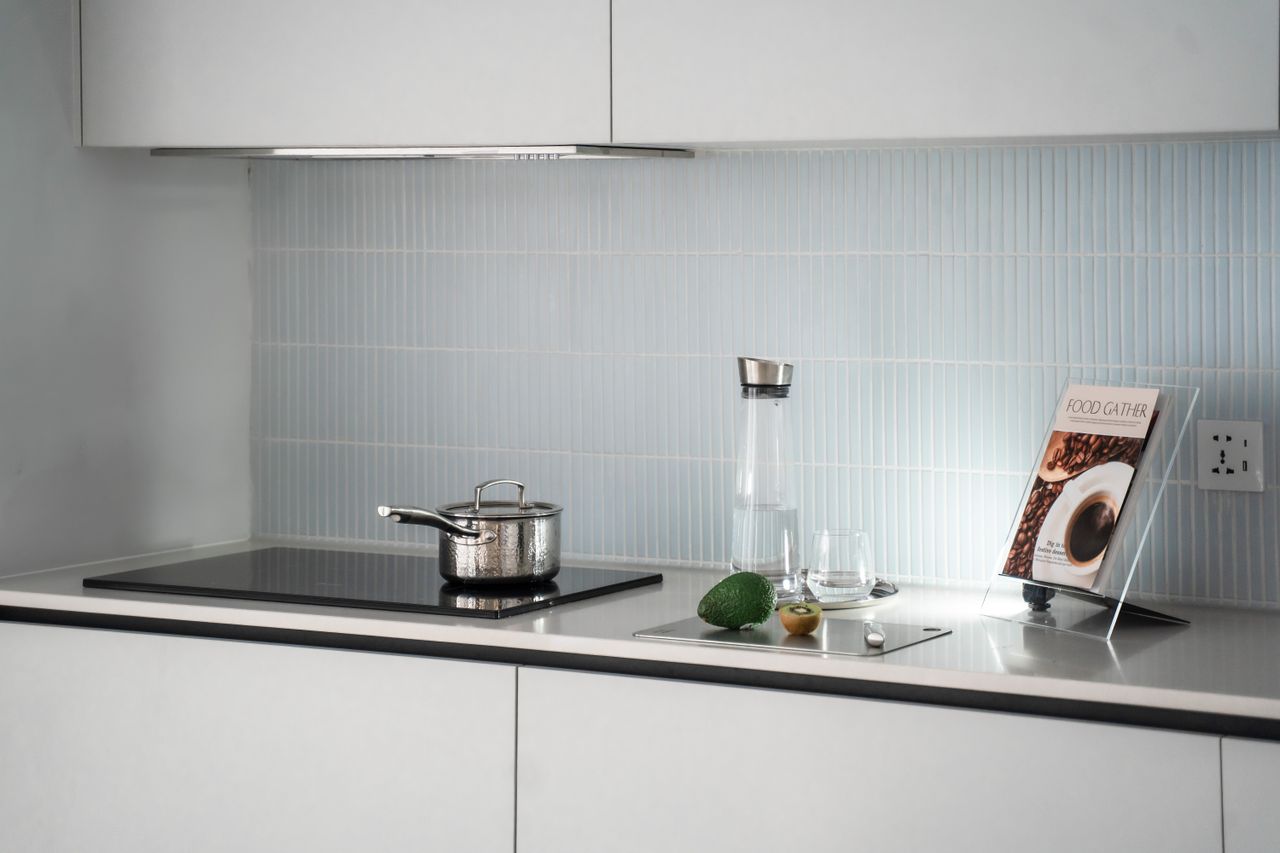
Cookware for induction cooktops has to be magnetic: cast iron, carbon steel, enameled cast iron and magnetic stainless steel work, while plain aluminum and copper only work with a magnetic base, and glass never does. That is the rule GE Appliances, Whirlpool and Bosch all publish. Below is how to check a pan you already own, which size matters, and what the Amazon listings for 13 pans on this site say about induction.
I earn a commission if you buy through the Amazon links on the review and guide pages linked below, at no extra cost to you.
Which Cookware Materials Work on Induction Cooktops
This table follows the three makers’ own wording. Each of them gives the same test for the cases in between: if a magnet sticks firmly to the bottom, the pan will work.
| Material | Works on induction? | What the makers say |
|---|---|---|
| Bare cast iron | Yes | Listed as compatible by GE and Bosch. |
| Enameled cast iron | Yes | GE lists enameled cast iron and steel; Bosch lists enameled pots with an iron body. |
| Carbon steel | Yes | Listed as compatible by GE. |
| Stainless steel | Depends on the grade | GE lists it, but says some stainless steel products will not attract and hold a magnet. Bosch specifies magnetic stainless steel. |
| Clad (multi-ply) stainless | Yes, if the base is magnetic | Whirlpool lists certain multi-layer cookware with magnetic bases. GE names All-Clad D3 and Copper Core among its examples. |
| Aluminum and anodized aluminum | No, unless the base has a magnetic layer | GE says aluminum or aluminum-clad cookware cannot be used; Bosch lists aluminum as not working; Whirlpool says it typically fails unless it has a magnetic base. |
| Copper | No, unless the base has a magnetic layer | GE says copper or copper-clad cannot be used; Bosch and Whirlpool say copper fails unless it has a magnetic layer on the bottom. |
| Glass | No | GE and Bosch both list glass as not working. |
| Ceramic | Only ceramic-clad pots with an iron body | Bosch says ceramic-clad pots with an iron pan hidden in the ceramic layer work; GE lists glass and ceramic as unusable. |
| Silicone | No | Not a stovetop material. It is not magnetic and is meant for baking and utensils. |
GE says its own brand list is not comprehensive and tells you to check with the cookware maker if the label does not mention induction. The sources are GE Appliances’ compatible cookware page, GE’s size and shape page, Whirlpool’s “Induction Compatible Cookware: How to Tell” help article and Bosch’s “What is induction cookware?” page.
How to Check a Pan Before You Use It
A magnet is the quickest screen, and every maker above recommends it. Work through these in order.
- Hold a magnet to the bottom. If it grips firmly, the pan is compatible. Whirlpool says a magnet that slides off or does not stick at all means the pan is not suitable.
- Check the whole base, not one spot. Whirlpool notes that some pans have only part of the bottom in a magnetic material, and those areas can heat at different levels. GE gives an example of an 11-inch fry pan with only about 7.25 inches of magnetic area.
- Look for a flat bottom. GE says pans should have a flat bottom at least 5 inches across, and that cookware should make full contact with the glass.
- Turn it over and look for paint. GE does not recommend painted-bottom cookware, because the paint may fuse to the glass during cooking and lead to glass chipping.
- Consider the weight. GE says lighter-weight magnetic steel pans tend to rattle while cooking and are not recommended.
- Look for the induction symbol. ENERGY STAR says many induction-compatible pots and pans carry an induction logo on the box. The logo is the maker’s claim, so the magnet test still has the final say.
A pan can pass the magnet test and still go undetected. Owner reports say some hobs do not detect the TECHEF tamagoyaki pan in the table below, and Whirlpool says a pan that is too small is not sensed by the cooking area.
Pan Size and Burner Size
Size matters more on induction than on gas or an electric coil, because the burner only heats what sits over its coil.
- Too small: GE says a pan smaller than the burner gets less power. An 8-inch pan on an 11-inch burner will not receive full output on high and will take longer to boil water. If the pan is too small, the burner may not switch on at all; Whirlpool says the cooking area will not sense it.
- Too large: larger pans can be used, but heat is generated only above the burner’s cooking circle, so the further the pan extends past the ring the less the burner performs. GE adds that the base must not touch the metal trim or overlap the controls.
- Measure the magnetic area: GE says to measure the flat, magnetic part of the base rather than the rim, because a pan marketed as 11 inches may only be magnetic across a smaller circle.
- Shape and thickness: square pans work but round pans that match the coil size work best, and most ferrous metal thicker than 0.008 inch (0.2 mm) works.
Noise and a Safety Note
Some noise is normal. Electrolux explains one cause: pans built with composite or “sandwich” bases can make sounds ranging from squeals to clicking and tapping, because the layers heat up and expand unequally. Iowa State University Extension’s AnswerLine says some owners report a buzz or hum on higher settings from the high energy transfer between coil and pan, and cites Consumer Reports in saying heavy, flat-bottomed pans help reduce the vibrations behind it.
If anyone in your household has a pacemaker or a similar implanted device, KitchenAid’s help page says to use care when standing near an induction cooktop that is on, because its electromagnetic field may affect the device, and to ask your doctor or the device manufacturer.
Material by Material
Stainless steel
Stainless steel is the material where the label matters most, because grades differ. GE lists stainless steel as compatible but says some stainless steel products will not attract and hold a magnet; Bosch says “magnetic stainless steel”. The magnet test settles it. For full sets that are induction-ready, see best cookware sets, and cast iron vs stainless steel compares the two on other terms.
Cast iron and enameled cast iron
Bare cast iron is on every maker list above. Enameled cast iron works for the same reason: the enamel is a coating over an iron body, and the iron is what the cooktop heats. GE lists enameled cast iron and steel, and its own brand list names Le Creuset’s porcelain enamel on cast iron. Handling rules are in cast iron on an induction cooktop; for choosing between finishes see bare vs enameled cast iron Dutch ovens and best cast iron skillet.
Carbon steel
GE lists carbon steel as compatible. Carbon steel is lighter than cast iron and heats faster, and carbon steel vs cast iron covers how the two differ. If you want a wok, a round-bottomed one will not sit flat on glass, so my best wok for induction and electric stoves guide compares four flat-bottom carbon steel woks.
Clad (multi-ply) cookware
Clad pans bond layers of stainless steel with aluminum or copper. What matters for induction is the outer layer of the base: Whirlpool lists certain multi-layer cookware with magnetic bases as working. GE’s brand list names All-Clad’s D3 stainless with an aluminum core and its copper-core 5-ply line. The Cuisinart MultiClad Pro review is a clad set whose listing names induction, in the table below.
Aluminum and anodized aluminum
Aluminum conducts heat very well but is not magnetic, so on its own it will not heat on induction. GE says aluminum or aluminum-clad cookware cannot be used, Bosch lists aluminum as not working, and Whirlpool says it typically fails unless it has a magnetic base. In practice, an aluminum-bodied pan works when its base carries a steel plate and the listing says so, and does not when the listing excludes induction, as with both T-fal sets in the table below.
Copper
Plain copper has the same problem as aluminum. Mauviel M’6 S, All-Clad Copper Core and Hestan CopperBond are copper lines whose makers say they work on induction, while traditional copper such as Mauviel’s M’Heritage needs a magnetic interface disk. Copper pans on an induction cooktop sorts the kinds, and best non-stick copper cookware covers the coated pans.
Glass, ceramic and silicone
Glass has no iron to heat; GE and Bosch both list it as not working, and GE lists ceramic the same way. The exception is a ceramic-clad pot with an iron body, which Bosch says works. Silicone is not stovetop cookware at all. Keep glass, ceramic bakeware and silicone for the oven.
Pans on This Site, Checked Against Their Listings
Material guides only go so far, because the product listing is what settles it. The table shows what each pan’s Amazon listing said about induction when it was read on 7 October 2026, with a link to the full review.
| Pan | Works on induction? | What the listing says | Review |
|---|---|---|---|
| All-Clad HA1 2-piece fry pan set | Yes | Title says “Induction Ready”; “compatible with any stovetop including induction” | All-Clad HA1 review |
| Cuisinart MultiClad Pro 12-piece | Yes | Title says “Induction Compatible” | Cuisinart MultiClad Pro review |
| Cuisinart Chef’s Classic enameled oval casserole | Yes | “Induction stovetop compatible” | Cuisinart Chef’s Classic review |
| CAROTE 14-piece set | Yes | Extended bottom “on all cooktops, including induction” | CAROTE 14-piece review |
| CAROTE 8-inch granite pan | Yes | Works “on all cooktops, including induction” | CAROTE 8-inch review |
| Gotham Steel Hammered 10-piece | Yes | “Works on every stovetop, including induction” | Gotham Steel Hammered review |
| Copper Chef Titan pan | Yes | “Compatible with an induction cooktop” | Copper Chef Titan review |
| NutriChef 18-piece set | Yes | Compatible with gas, electric, ceramic and induction | NutriChef review |
| SENSARTE 9.5-inch ceramic pan | Yes | Induction named in the product title; the base carries a plate | SENSARTE review |
| TECHEF tamagoyaki pan | Yes, with a caveat | Induction named in the product title; owners report some hobs do not detect it | TECHEF review |
| T-fal Ultimate hard anodized 17-piece | No | “Suits all stove tops, excluding induction” | T-fal Ultimate review |
| T-fal Signature 12-piece | No | Listed as excluding induction | T-fal Signature review |
| Tramontina Professional 8-inch | No | “Safe for gas, electric, and ceramic glass cooktops (not induction)” | Tramontina Professional review |
Ten of the 13 listings say the pan works on induction, and three say it does not: both T-fal sets and the Tramontina Professional. My T-fal Ultimate review gives the reason for that set: aluminium is not magnetic and there is no steel disc in the base, so an induction hob never sees it. The GreenPan Lima is left out of the table because its listing does not say either way.
For full sets that suit induction, see my best cookware sets guide. For a single pan, best non-stick pan and best non-stick pan without Teflon both say which picks work on induction, and moka pot on an induction stove covers the stovetop espresso case.
How This Guide Was Put Together
This guide uses the published guidance of four appliance makers, GE Appliances, Whirlpool, Bosch and Electrolux, plus ENERGY STAR, KitchenAid’s help page and Iowa State University Extension, and the Amazon listings of 13 pans reviewed on this site. The pan table records what each listing says, not how the pan performs on a hob. One thing I could not establish is a single minimum pan size: GE’s and Whirlpool’s figures describe their own cooktops, and other makers set their own, so your cooktop’s manual has the final word.
What to Do Next
Hold a magnet to the pans you already own and sort them into keep and replace piles. For replacements, start with the induction-ready picks in my best cookware sets guide, and read the listing for the word induction before you buy. The table above shows how often a listing says so and how often it does not.
Frequently Asked Questions
Does all stainless steel cookware work on induction cooktops?
No. GE says some stainless steel products will not attract and hold a magnet, so they cannot be used. Hold a magnet to the base: if it sticks and holds firmly, the pan works. If it slides off or barely grips, it will not heat reliably.
Why do glass and silicone cookware not work on induction?
An induction cooktop heats the pan with a magnetic field, and glass and silicone contain no iron for that field to heat. GE and Bosch both list glass as unusable. Silicone is meant for baking, molds and utensils, not direct cooktop heat.
Can I use my existing cookware on induction, or do I need new pieces?
Test each piece with a magnet first. Cast iron, carbon steel, enameled cast iron and magnetic stainless steel normally pass. Aluminum, copper, glass and most ceramic pieces fail unless the base has a magnetic layer, so those are the ones you may need to replace.
Is enamel-coated cast iron good for induction cooktops?
Yes. The enamel is a coating over an iron body, and the iron is what the cooktop heats. GE lists enameled cast iron and steel as compatible, and Bosch lists enameled pots with an iron body. Handle it as you would bare cast iron.
What size pan do I need for an induction burner?
GE says the base should be flat, at least 5 inches across, and centered on the burner circle. A pan smaller than the burner gets less power: an 8-inch pan on an 11-inch burner will not reach full output. Measure the flat magnetic area, not the rim.
Why does my induction pan buzz or rattle?
GE says induction cooking makes some noise and that the cookware contributes to it. Lighter-weight magnetic steel pans tend to rattle while cooking, and GE does not recommend them. A pan that rattles badly may be too light for the job.

I'm Glenn, and I started Kitchenware Compare to cut through conflicting product reviews and help readers pick kitchen gear with confidence. I don't own or test the products I write about — these guides are built from verified-purchase reviews, manufacturer specifications, and independent testing where it exists, with the reasoning shown, not just a rating.
Leave a Reply