This guide has no affiliate links, but some pages it links to do. If you buy through those, I may earn a commission at no extra cost to you.

The best time to buy kitchen equipment is not one date. It is a short list of sale windows, and each one suits a different product. Small appliances such as air fryers tend to be cheapest around the summer Prime Day event and again at Black Friday and Cyber Monday. Cookware sets and espresso gear follow the same big events, but the discount only matters if the reference price was real. This guide gives the calendar, the logic behind it and a way to check any deal before you click.
I write this as a researcher and comparison editor. I do not own or use the products I discuss. Everything below rests on published specifications, owner reviews and the named outside sources, which are linked where they appear.
TL;DR
- Air fryers and other small kitchen appliances see their deepest markdowns during the summer Prime Day event and the Black Friday to Cyber Monday stretch.
- Cookware sets and espresso equipment are worth watching at the same events, plus holiday weekends such as Memorial Day and Labor Day.
- A discount is only a saving if the “was” price was a genuine, regularly charged price. Check price history and a second store.
- Add up the full cost: shipping, accessories, warranty terms and return window.
- If you need the item now, a fair everyday price beats waiting for a sale that may not beat it.
The sale calendar at a glance
Retail discounting in the US clusters around a handful of events. The table below summarizes the pattern for the three categories this site covers. It describes typical behavior, not a promise: retailers set their own schedules each year, so confirm the current dates on the retailer’s own page.
| Window | Air fryers | Cookware sets and pans | Espresso and coffee gear |
|---|---|---|---|
| Presidents’ Day and late winter | Occasional | Common for sets | Occasional |
| Memorial Day (late May) | Common | Common | Occasional |
| Summer Prime Day (typically June or July) | Strongest for small appliances | Frequent | Frequent on entry-level machines |
| Fourth of July | Moderate | Moderate | Moderate |
| Labor Day (early September) | Moderate | Moderate | Moderate |
| Black Friday and Cyber Monday | Strongest | Strongest | Strongest |
| Mid-December | Leftover stock | Gift sets | Gift bundles |
Treat “Occasional” and “Common” as my reading of how these categories are usually promoted, not as measured discount rates. The sections below explain where each pattern comes from and what to do with it.
Prime Day: the summer window for small appliances
Amazon’s Prime Day is the biggest mid-year event for kitchen small appliances. Amazon Business states that its 2026 Prime Day deals event for business members ran June 23 to 26, according to its Prime Day 2026 announcement. The consumer event has historically run in a similar summer slot, though the exact dates move from year to year, so check Amazon’s own page for the current schedule rather than relying on last year’s calendar.
If you want an air fryer, a drip coffee maker or an entry-level espresso machine, the summer event is a sensible first checkpoint to measure against the price you have been watching.
Air fryers are light, easy to ship and sold in many near-identical sizes, which makes them natural promotional items. That also means the field is crowded with lookalike models, and a headline percentage tells you little. Compare capacity in quarts, wattage, basket design, and whether the control panel is analog or digital before you compare prices.
How to shop Prime Day without overbuying
- Decide the product and your ceiling price before the event starts.
- Put two or three candidates on a watch list a few weeks ahead so you know their normal price.
- Compare the event price against that normal price, not against the crossed-out number.
- Check whether the discount is a coupon you must clip or an automatic markdown.
- Buy only if the final price at checkout matches what you saw.
The last step matters online, where bundled coupons and third-party sellers can change the number at the last screen.
Black Friday and Cyber Monday: the second big window
For most shoppers, the strongest all-category window is the stretch from Black Friday through Cyber Monday. Air fryers, cookware sets and coffee equipment are all routinely promoted, and most buyers are after one of two things: a cheaper version of a model they already know, or a gift.
Because I cannot point to a verified, published schedule of Cyber Monday air fryer prices, I do not quote percentages here. What I can give you is what to compare when a Cyber Monday listing appears:
- Capacity. Two- to three-quart units suit one or two people. Five to six quarts is the usual family size. A discount on the wrong size is not a saving.
- Wattage and preheat. Higher wattage generally means faster heating, but check owner reviews for real cook times rather than the box claim.
- Basket coating. Nonstick baskets vary in durability. Owner reviews that mention peeling after several months are worth more than a spec line.
- Dual zone versus single basket. Dual-zone models cost more and take more counter space. Decide whether you cook two items at once before paying for it.
- Warranty and return window. Holiday purchases often come with extended return periods, but read the terms for the specific listing.
- Seller. Buy from the retailer itself or a seller it fulfills for. A third-party seller with a lower price may carry a different warranty.
Gift shoppers have one extra rule: confirm the item can be returned by the recipient, and keep the gift receipt. Late-season returns are easier when the retailer’s holiday return window is clearly stated on the product page.
Memorial Day, Fourth of July and Labor Day
Long holiday weekends are the “in between” windows. Kitchen items often appear in holiday-weekend promotions, but the bigger markdowns usually go to furniture, mattresses and large appliances, and the dates and depth change every year.
I would use these weekends in two situations:
- You missed the last big event and the item is on your list now.
- A model you already researched drops to its lowest price in your watch history.
If neither is true, waiting for the summer or November event is usually the more patient path. If you do shop a holiday weekend, apply the same rules: know the normal price, confirm the checkout total, and read the return policy.
Timing cookware purchases
Cookware behaves differently from appliances. A good pan can last for years, so the savings from timing are real, but the choice of material matters more than the sale. Before you chase a discount, settle what you need:
- Everyday nonstick and ceramic. These wear out faster, so a deeply discounted set can make sense as a replacement purchase. My comparison of ceramic versus nonstick cookware covers lifespan, and the page on ceramic versus Teflon pans covers heat limits.
- Stainless, cast iron and copper-look sets. These are long-term purchases. Wait for the Black Friday window or a holiday weekend, and focus on the number of pieces you will actually use. My review of non-stick copper cookware sets shows what to weigh in that category.
- Gas stove owners. Material choice affects how the pan responds to open flame. The guide to the best cookware material for a gas stove helps you narrow the field before you watch prices.
Cookware sets are a common place for padded value. A 15-piece set often counts lids, utensils and a trivet as pieces. Count the pans, not the pieces, and price each pan against buying it alone. For a new home or first kitchen, the list of kitchen essentials shows which pieces matter most, so you can skip the filler in a set.
A worked example
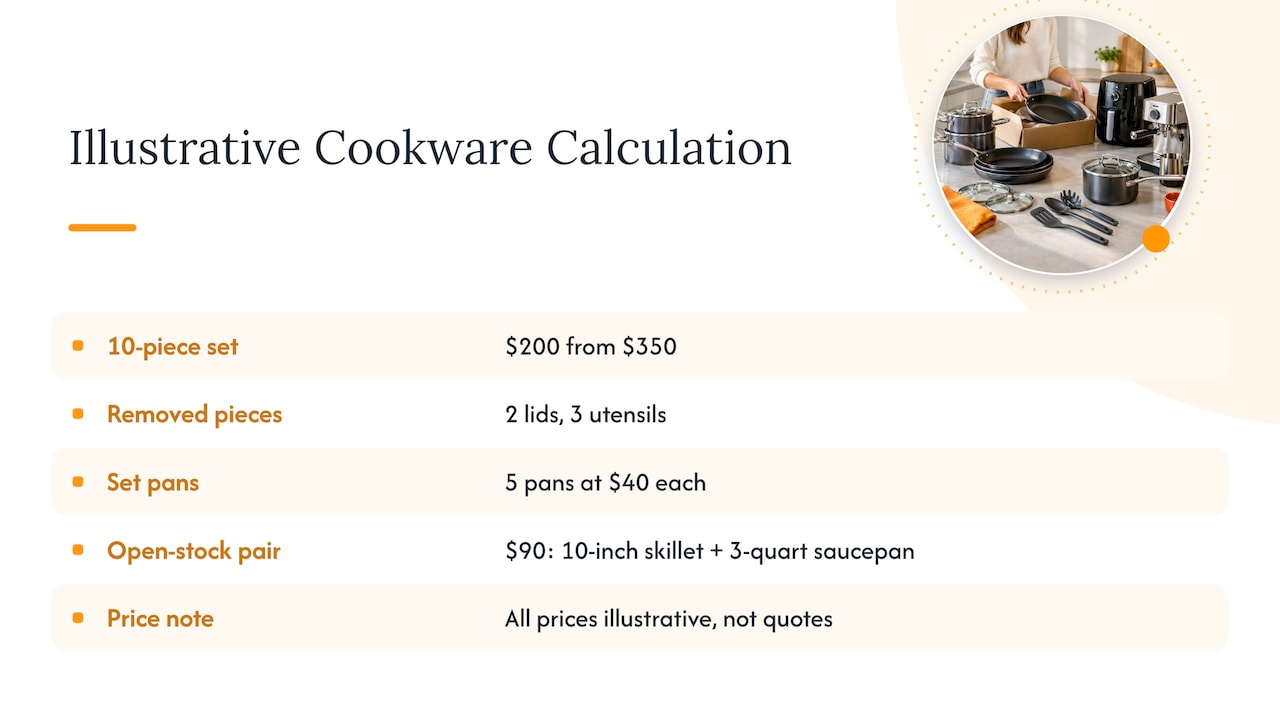
Say a ten-piece set is listed at $200 “from $350”. Strip out two lids and three utensils and you have five pans for $200, or $40 each. Now look at the same brand’s open-stock pans: if a 10-inch skillet and a 3-quart saucepan together cost $90 at their regular prices, the set’s pans may not be a bargain at all. The arithmetic takes two minutes and often decides the purchase. The prices in this example are illustrative, not quotes for a real product.
Timing espresso and coffee equipment
Espresso machines and grinders are the category where timing and tier interact most. Entry-level machines and drip brewers see frequent promotions, especially around Prime Day and Black Friday. Higher-end machines tend to be discounted less often and by smaller amounts, in my reading of how they are marketed, and bundles with accessories are more common than straight price cuts.
When you evaluate a coffee-equipment deal, compare these items:
- Included accessories. A bundle that adds a tamper, milk pitcher and portafilter basket can be worth more than a small price cut on the bare machine.
- Boiler type and pressure claims. Marketing pressure figures, often quoted as bar, describe the pump, not the pressure at the coffee. Look for the type of boiler and temperature control instead.
- Grinder pairing. An espresso machine without a capable grinder underperforms. If the sale is on the machine alone, factor the grinder into the total.
- Service and parts. Check how long the warranty runs and whether replacement gaskets and baskets are sold separately.
How to tell a real discount from a staged one
The headline percentage is the least reliable number on the page. Two official sources give a practical frame.
According to the New York City Department of Consumer and Worker Protection’s guidance on false advertising, shoppers should check that the regular price is clearly stated, compare prices at other stores, and ask the business when the real savings are unclear. It is local guidance, but the steps work anywhere in the US.
The FTC addresses the “was” price directly. Its Guides Against Deceptive Pricing say a former price is a fair basis for a comparison only if it is the actual price at which the item was offered to the public on a regular basis for a reasonably substantial period of time, and that a fictitious higher price makes the advertised bargain false.
In practice, that gives you a short checklist:
- Find the price history. Browser tools and price-tracking sites show whether the item was ever sold at the “was” price.
- Check a second store. If three retailers sit at $90 and one claims $90 is 40% off, the discount is the claim, not the price.
- Compare model numbers. Retailers sometimes sell a model made only for one chain, with a slightly different spec. A price match is hard when no two stores sell the identical item.
- Read the final total. Taxes, shipping and membership requirements change the real price.
- Note the return rules. A cheaper price with a restocking fee is not cheaper.
What to add up besides the sticker price
The lowest advertised price is not always the lowest cost. Before buying, list:
- Shipping or delivery charges, especially for heavy cookware sets.
- Accessories you need on day one, such as air fryer liners, a second basket, a milk pitcher or a pan lid that is not in the set.
- Warranty length and who services it, the retailer or the maker.
- The return window and who pays return shipping.
- Storage. Large sets need space, and my notes on pan storage ideas show how to fit them in.
Wait or buy now?
Waiting pays when you have time, a defined budget and a short list of models. It does not pay when your current pan is warped, your air fryer has died or a gift deadline is close. A fair regular price on a product with good owner reviews is a better outcome than a rushed purchase of a heavily discounted model that does not suit how you cook.
A simple rule I use in my own research: if the product is on sale within 30 days of when I need it, buy. If the next big event is further out and the current price is not close to the lowest recorded, wait.
My perspective
The cheapest price is only half of a good purchase. The other half is whether the product fits how you cook, and that is where most deal-hunting goes wrong. A discount on the wrong air fryer, or a 14-piece cookware set where six pieces get used, is money spent on the sale rather than on the kitchen.
That is why I compare products side by side on specifications, pricing, owner-reported performance and the complaints that show up after months of use. I own and test none of these products, and I say so plainly. What I do is read the specs, read the owner reviews, weigh the strengths against the repeated complaints, and cite the outside sources by name. Sale season makes that work more valuable, not less, because the crossed-out price is designed to make everything look like a bargain.
My advice: shortlist two or three products now, learn their normal prices, and let the sale calendar do the rest.
Find the right product before the sale starts
Sale events reward people who arrive with a shortlist. My cookware reviews and buying guides compare materials, specifications and owner feedback, so you can decide what you want before a discount tempts you into something else. Start with the cookware reviews and buying guides, or browse the full range of comparisons on the Kitchenware Compare home page. If you want to know how the research behind each page works, read how I review kitchen equipment.

FAQ
When is the best time to buy an air fryer?
The two strongest windows are the summer Prime Day event and the Black Friday to Cyber Monday stretch. Check the retailer’s own page for the current schedule, since dates shift each year.
Are Cyber Monday air fryer deals better than Prime Day deals?
Neither is reliably better for every model. Both events promote air fryers heavily, and the same model can be cheaper at one event than the other from year to year. Track the price of the specific model over a few weeks and buy when it reaches its lowest recorded level.
Is it worth waiting for a sale on cookware?
It depends on the material and how urgently you need it. For long-lasting stainless or cast iron, waiting for a major event is usually sensible. For a worn nonstick pan you use daily, a fair price now may serve you better than a wait of several months.
How do I know a “was” price is real?
Look at the price history and compare with a second store. The FTC’s pricing guides say that a former price used for comparison should be genuine and offered regularly for a reasonably substantial period. If you cannot find evidence the item ever sold at that price, treat the discount as marketing.
Should I buy a cookware set or individual pans?
Count the pans you will actually use. Sets can include lids, utensils and storage pieces that inflate the piece count. If you already own a good pot or two, buying a few open-stock pans on sale may cost less than a full set.
Sources
- Prime Day 2026, Amazon Business
- False Advertising, NYC Department of Consumer and Worker Protection
- Guides Against Deceptive Pricing, 16 CFR 233.1 (FTC, eCFR)
Recommended
- Best Cheap Air Fryer 2026: Top Picks Reviewed
- Best Air Fryers 2026: 5 Picks for Every Budget
- Air Fryer vs Convection Oven: Which Should You Buy?
- Best Espresso Machine Under $200 in 2026: Reviews + Guide

I'm Glenn, and I started Kitchenware Compare to cut through conflicting product reviews and help readers pick kitchen gear with confidence. I don't own or test the products I write about — these guides are built from verified-purchase reviews, manufacturer specifications, and independent testing where it exists, with the reasoning shown, not just a rating.
Leave a Reply