• Skip to primary navigation
  • Skip to main content
  • Skip to primary sidebar

Kitchenware Compare

  • Home
  • Product Reviews
    • Air Fryers
    • Coffee
    • Cookware
    • Flat Top Grills
    • Meat Thermometers
    • Food Processors
    • Knives
    • Pizza Ovens
    • Toaster Ovens
    • Juicers
  • Food Blog
  • Helpful Kitchen Tips
  • Data Studies
  • About
  • How I Review
  • Contact
You are here: Home / Archives for Glenn

Lodge Bare Cast Iron 5 Qt Review: Cheap, Versatile, High-Maintenance

Last Updated October 8, 2026

I may earn a commission from purchases made through the Amazon links in this article, at no extra cost to you.


Lodge Bare Cast Iron Dutch Oven with Loop Handle, 5 Quart

Lodge’s bare cast iron 5-quart Dutch oven is the pick the Dutch oven buying guide calls the most flexible budget option, and at $59.90 with over 17,000 ratings, it’s easily the most-reviewed pot in that comparison. It isn’t enameled, it isn’t a heritage French brand, and its lid quietly doubles as a second cooking surface. Here’s what the specs, Amazon’s own owner-review data, and a closer look at the listing itself say about whether it earns its spot.

Quick Facts

  • Model: Lodge Cast Iron Double Dutch Oven, 5 Quart
  • Price: $59.90
  • Rating: 4.7 out of 5 stars (17,348 ratings)
  • Material: Bare, pre-seasoned cast iron (no enamel, no synthetic coating)
  • Capacity: 4.7 liters / 5 quarts
  • Compatible surfaces: Stovetop (incl. induction), oven, grill, campfire
  • Made in: USA
  • Warranty: Lifetime limited warranty

What Is the Lodge Bare Cast Iron 5 Qt Dutch Oven?

This is Lodge’s Double Dutch Oven in the 5-quart size — the company’s own name for a bare (uncoated), pre-seasoned cast iron pot whose domed lid inverts to work as a 10.25-inch skillet or griddle. It’s a single 4.7-liter vessel, not a bundle: one pot, one lid, two cooking configurations. Lodge seasons it at the factory with 100% vegetable oil, so there’s no synthetic non-stick coating and nothing to strip or replace — the seasoning is meant to build with use.

It ships flat-bottomed with two loop handles, not the legged, wire-bail design associated with dedicated coal-fired camp ovens. That distinction matters if you’re shopping specifically for a legged campfire pot; this one is built to move between stovetop, oven, grill, and campfire, but it sits flat like a standard kitchen Dutch oven.

Design and Build Quality

At 4.7 liters and made from a single cast iron casting, this is a heavy, simple piece of cookware with almost nothing to fail mechanically — no enamel to chip, no non-stick coating to wear through, no rivets or plastic handles. Lodge backs it with a lifetime limited warranty against manufacturing defects, and the company has made cast iron in the USA for more than 125 years.

The 2-in-1 lid is the standout design choice. Flipped over, it becomes a flat griddle-style surface for searing, frying eggs, or making pancakes — genuinely useful if kitchen storage space is tight, since it replaces a second pan rather than just sitting on top of the pot. The trade-off is that a flat inverted lid seals less tightly than a domed lid designed purely to send condensation back into the pot, a detail worth knowing if you braise often and want maximum moisture retention.


Lodge Bare Cast Iron Dutch Oven lid inverted as a skillet

Cooking Performance

Cast iron’s core selling point is even heat distribution and strong heat retention, and Amazon’s own review-attribute data backs that up here: cooking performance is tagged positive across 704 mentions, alongside positive tags for quality (2,716 mentions) and versatility (335 mentions). Lodge markets it for searing, sautéing, baking, braising, frying, and grilling, and being oven-, stovetop-, grill-, and campfire-compatible (including induction) covers essentially every heat source a home kitchen or campsite has.

Bare cast iron isn’t a fast-heating material — it takes longer to come up to temperature than enameled cast iron or stainless steel, but it holds that heat far more evenly once it gets there, which is why it’s a favorite for sourdough bread, braises, and stews that need slow, steady heat over an hour or more.


Lodge Bare Cast Iron Dutch Oven bread baking result

Price and Sizing: How the 5-Quart Compares

Lodge sells this same bare, pre-seasoned cast iron across several sizes and handle styles, all sharing the same seasoning, induction compatibility, and PFAS-free construction. According to Lodge’s own published comparison data, the lineup runs from a 2-quart at $47.95 (2,818 ratings) up through this 5-quart Double Dutch Oven at $59.90 (17,348 ratings, the most popular size by far), a 5-quart wire-bail-handle version also at $59.90, a 7-quart wire-bail version at $79.90, and a 9-quart at $94.95. The wire-bail versions swap the loop handles for the classic legged-camp-oven look but carry the same bare cast iron construction underneath.

At $59.90, this 5-quart sits well below Lodge’s own enameled Dutch ovens (typically $70–$100 depending on size and color) and dramatically below premium enameled brands. For buyers comparing strictly on price per quart of usable cast iron, it’s difficult to beat within Lodge’s own catalog, let alone against enameled competitors. For a fuller look at how many quarts a household needs, see my Dutch oven size guide.

What Owners Report

Amazon aggregates its own attribute-level sentiment from the full set of 17,348 ratings on this listing. Five attributes are tagged positive: quality (2,716 mentions), cooking performance (704), value for money (687), ease of cleaning (340), and versatility (335). Two are tagged mixed: weight (409 mentions) and durability (388 mentions). One is tagged negative: rust resistance (353 mentions).

The star breakdown reinforces the positive side: 86% five-star, 8% four-star, and only 3% one-star out of 17,348 ratings — a strong distribution for a budget-tier product. The rust-resistance flag is the one caveat worth taking seriously, and it’s consistent with how bare cast iron behaves generally, not a defect unique to this pot: any bare cast iron surface will develop surface rust if it’s left wet, air-dried instead of towel-dried, or stored without a thin coat of oil. Lodge’s own care instructions call for hand-drying immediately after washing and a light oil wipe before storage.

Rust, Maintenance, and Long-Term Durability

Because this is uncoated cast iron, it comes with the maintenance routine that enameled Dutch ovens are specifically designed to avoid: no soap-and-scrub-and-done washing, no leaving it to air dry in the rack, and periodic re-seasoning if the surface ever looks dull or starts sticking. Acidic ingredients — tomato sauce, wine reductions, citrus-heavy braises — can strip seasoning and pick up a metallic taste if simmered for long periods, which is the main functional trade-off against an enameled pot like the ones higher up in the buying guide.

The “durability” attribute being tagged mixed rather than cleanly positive lines up with this: cast iron itself is close to indestructible under normal use, but a bare pot’s surface condition depends heavily on how consistently it’s dried and oiled, so outcomes vary more by owner habits than with an enameled pot where the porcelain surface does the protecting for you. If you already own bare cast iron and are comfortable with the seasoning-and-drying routine, this isn’t a new burden. If you want to buy a Dutch oven and never think about maintenance again, the enameled options in the buying guide are the better fit.

The routine that avoids rust and keeps the seasoning intact is short but non-negotiable:

  1. Wash with hot water and a stiff brush or non-metal scrubber right after cooking — skip soap, which can strip seasoning, though a small amount occasionally won’t ruin it.
  2. Dry immediately and completely with a towel. Never leave it in a dish rack to air dry — this is the single most common cause of rust spots, especially around the lid rim where water pools.
  3. While still slightly warm, wipe the entire surface — inside, outside, and lid — with a thin layer of neutral cooking oil using a paper towel.
  4. Store it with the lid slightly ajar or with a paper towel between pot and lid, so trapped moisture can escape instead of condensing overnight.

If light surface rust does appear, it’s rarely fatal to the pan: a scrub with steel wool, a rinse, and a fresh coat of oil baked on in a low oven typically restores it. It’s an extra 20 minutes most enameled Dutch ovens never require, which is the trade-off this product’s price and versatility are built around.

How This Pick Was Evaluated

A search for independent reviews of this exact product turned up a genuine naming trap worth flagging: Homes & Gardens publishes a hands-on “Lodge Dutch Oven” review, but it’s testing Lodge’s enameled porcelain Dutch oven ($99.90, porcelain-enamel finish) — a different product line entirely from the bare, uncoated $59.90 pot reviewed here. Its findings (rust on the lid rim after one use, a loosely fitting lid, enamel that “feels ever-so-slightly faded”) describe Lodge’s enameled cookware, not this one, so none of it is cited above. A search for reviews of Lodge’s “Double Dutch” style specifically surfaced only a UK retailer review of a different combo variant and several unrelated Lodge Dutch oven videos — no independent lab or hands-on test of this specific bare 5-quart model turned up. In the absence of that, this review relies on Lodge’s own published specifications and Amazon’s attribute-level sentiment data across 17,348 verified ratings, both cited and attributed throughout rather than presented as firsthand testing.

Who Should Buy This (and Who Shouldn’t)

  • Buy it if: you want the least expensive way into a genuinely flexible cast iron Dutch oven, you don’t mind (or actively prefer) building your own seasoning over time, or you want a lid that doubles as a skillet to save cabinet space.
  • Skip it if: you want to cook acidic sauces regularly, you want a “wash and forget” pot with zero drying routine, or you specifically need a legged, wire-bail camp oven for coal cooking rather than a flat-bottomed stovetop-to-campfire pot.

Lodge Bare Cast Iron Dutch Oven with lid on stovetop

Lodge Bare vs. Enameled: Which Should You Choose?

This bare pot and an enameled Dutch oven solve different problems. Enameled cast iron — like the Lodge Enameled and Le Creuset models compared here, or the Staub 5.5-Qt Cocotte reviewed separately — trades a higher price for a porcelain interior that shrugs off acidic ingredients, needs no seasoning, and never rusts. Bare cast iron trades that convenience for a much lower price, campfire-safe durability, and a surface that actually improves with age instead of wearing down. Neither is objectively better; the right choice depends on whether you want to manage seasoning or pay to avoid managing it.

For the full cost, durability, and task-by-task breakdown, see bare vs enameled cast iron Dutch oven: which should you buy.

Frequently Asked Questions

Is this the same as Lodge’s enameled Dutch oven?

No. This is Lodge’s bare, pre-seasoned cast iron “Double Dutch Oven,” with no porcelain enamel coating. Lodge sells a separate enameled Dutch oven line at a higher price point with a colored porcelain interior and exterior finish.

Can the lid really be used as a skillet?

Yes. The domed lid inverts to a flat, 10.25-inch cooking surface suitable for searing, frying, or griddle-style cooking, which is part of Lodge’s official “2-in-1” design for this specific model.

How do you stop it from rusting?

Dry it by hand immediately after washing — never let it air dry — and wipe on a very thin coat of cooking oil before storing. Surface rust is a known characteristic of bare cast iron generally and is the most common negative attribute Amazon’s own review data flags for this listing.

Is 5 quarts big enough for a family?

A 5-quart Dutch oven comfortably handles a braise, soup, or stew for four to six servings. It’s on the smaller end for large-batch cooking or a whole chicken with vegetables, where a 6-to-7-quart size gives more room.

Can it go on a campfire or grill?

Yes. Lodge markets it as safe across stovetop (including induction), oven, grill, and campfire use, though it’s flat-bottomed rather than the legged, wire-handle style built specifically for direct coal cooking.

Does it need to be re-seasoned before first use?

No. It ships pre-seasoned with vegetable oil and is ready to cook with out of the box, though seasoning builds and improves with regular use and proper drying.

Is it heavier than an enameled Dutch oven of the same size?

Weight is comparable size-for-size, since both are solid cast iron — the enamel coating itself adds relatively little mass. Amazon’s own review data tags “weight” as a mixed attribute on this listing, reflecting that a full 5-quart cast iron pot, loaded with food, is genuinely heavy for some users regardless of finish.

Check Price on Amazon →

For the full lineup this pick comes from, see the best cast iron Dutch oven guide, and for care instructions that apply directly to this bare pot, see the best way to clean a cast iron Dutch oven.
Filed Under: Product Reviews

INKBIRD Hybrid Thermometer review

Last Updated October 8, 2026

I earn a commission if you buy through the Amazon links in this review, at no extra cost to you.

Part of my meat thermometer guide — all reviews, comparisons, and buying advice in one place.

The INKBIRD Hybrid is built for anyone juggling separate thermometers for a grill, a smoker and a quick spot check: one unit that works as an instant-read thermometer and also runs two external probes with an app for longer cooks.

Introducing the INKBIRD Hybrid Thermometer. This device combines the functionality of an instant-read thermometer and a Bluetooth BBQ meat thermometer with 2 probes, giving you the freedom to monitor your food’s temperature without constantly checking on it.

Here is what the INKBIRD Hybrid Thermometer actually does. The 328ft Bluetooth range is the headline specification, and the point of it is being able to leave the grill rather than stand over it. The two external probes plus the additional probe allow several items to be tracked at once, which is what suits it to cooking for a group.

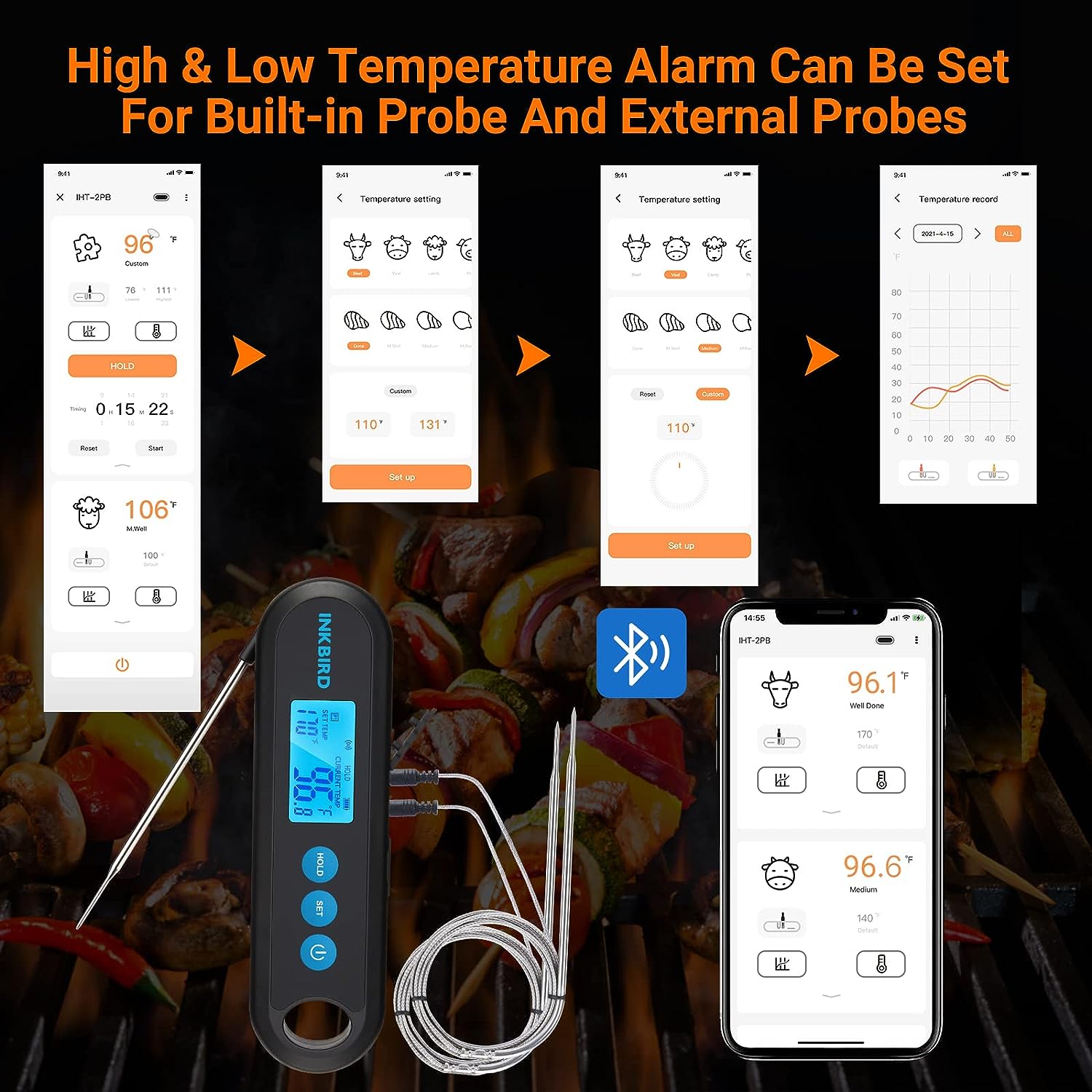
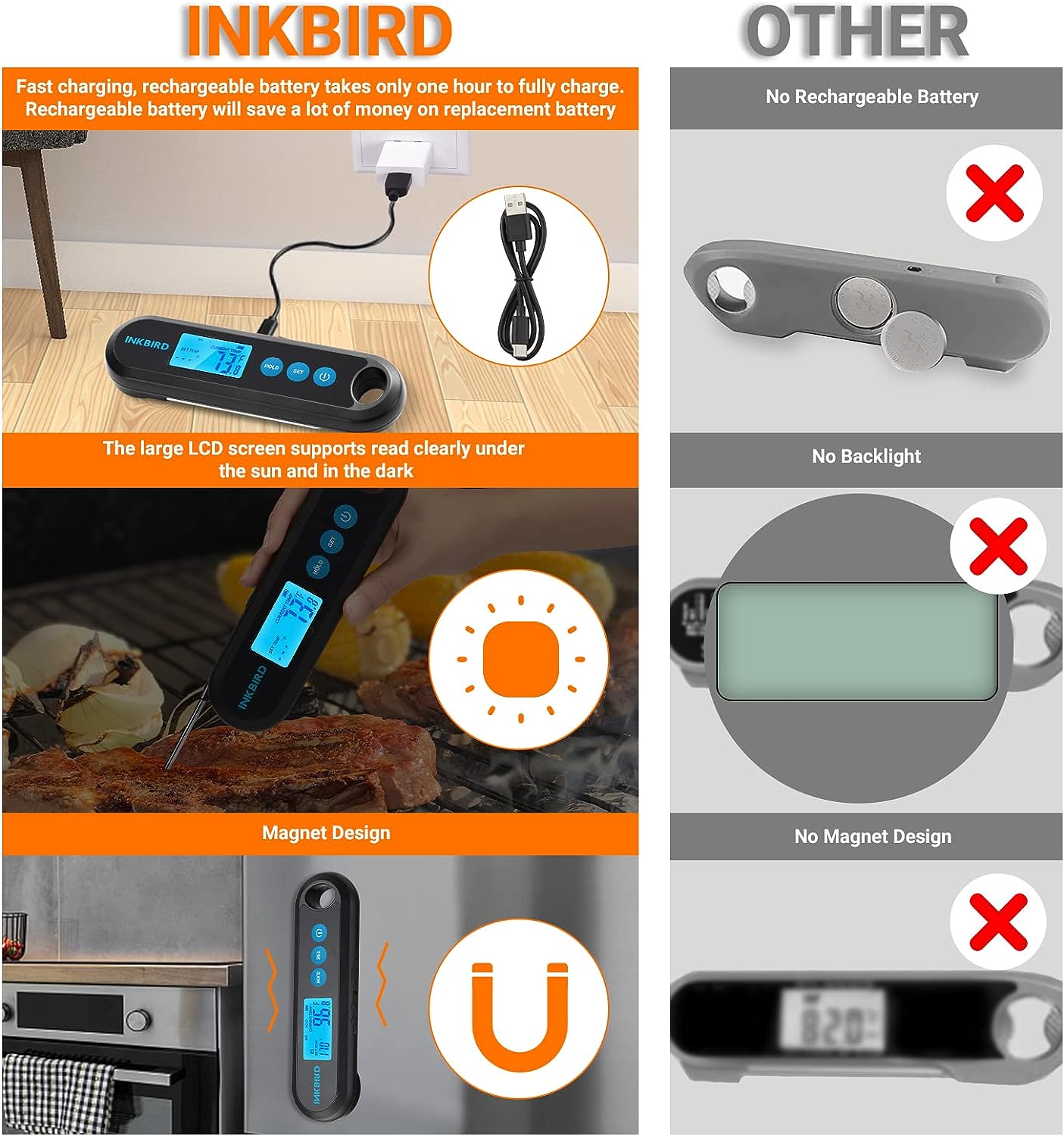
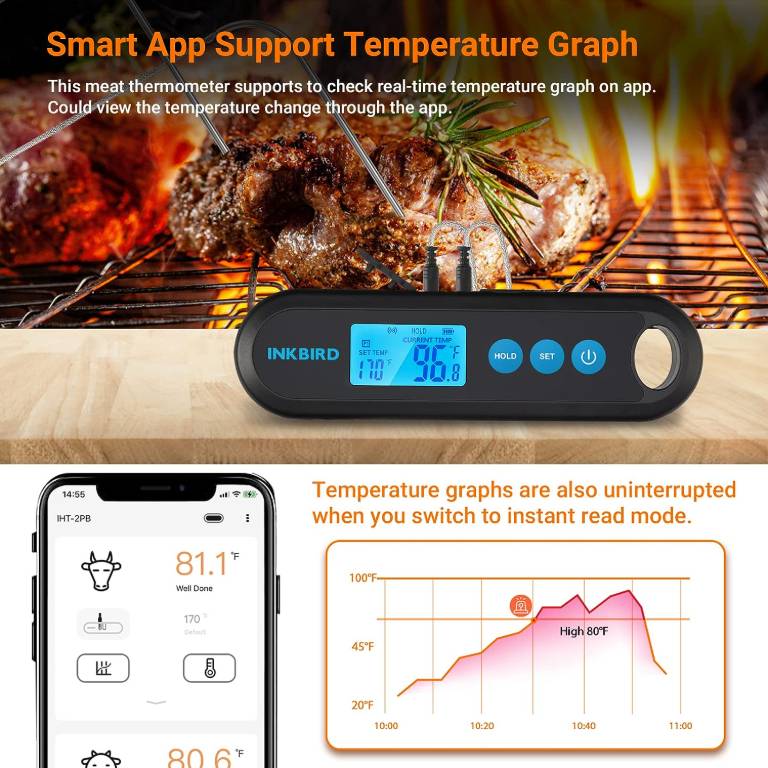
The fast readout is rated at two seconds, with a stated accuracy of ±1.0℉. The app adds high and low temperature alarms and temperature graphs, and INKBIRD lists a rechargeable battery, a backlight and a magnet for mounting.

INKBIRD Hybrid Thermometer Between a Remote Bluetooth BBQ Meat Thermometer with 2 Probes and an Instant-Read Thermometer,Rechargeable Grill Thermometer with Temperature Alarms and Graph, Calibration

Get your own INKBIRD Hybrid Thermometer Between a Remote Bluetooth BBQ Meat Thermometer with 2 Probes and an Instant-Read Thermometer,Rechargeable Grill Thermometer with Temperature Alarms and Graph, Calibration today.

Check Price on Amazon →

Features and Benefits

The INKBIRD Hybrid Thermometer is an innovative kitchen tool that combines the functionalities of a remote Bluetooth BBQ meat thermometer and an instant-read thermometer. With its 2 probes and impressive features, this thermometer is designed to take your cooking and grilling experience to the next level.

Hands-Free Cooking with Bluetooth Technology

One of the standout features of this thermometer is its Bluetooth capability, allowing you to monitor your cooking temperature remotely from up to 328ft away. Simply download the free INKBIRD app on your IOS or Android smartphone, and you can easily control and monitor the thermometer without being tied to the grill or smoker. This hands-free functionality makes grilling or smoking meat a breeze, giving you the freedom to socialize or attend to other tasks while ensuring your food is cooked to perfection.

Instant Read and External Probe Support

In addition to its remote capabilities, the INKBIRD Hybrid Thermometer also functions as an instant-read thermometer. With 2-second readout and high measurement accuracy of ±1.0℉, you can quickly and accurately check the temperature of your food. The thermometer comes with 2 external probes that can be used simultaneously to measure different areas of your meat or grill. This feature is especially useful for cooking larger cuts of meat or achieving different levels of doneness for multiple pieces of meat.

High and Low Temperature Alarm and Temperature Graph

This thermometer is equipped with programmable temperature alerts, ensuring that you never overcook or undercook your food again. Simply set your desired temperature range, and the thermometer will alert you when the temperature reaches your desired level. Additionally, the thermometer supports real-time temperature graphing through the INKBIRD app. You can monitor the temperature changes of your food over time, allowing you to make precise adjustments and achieve consistent and delicious results.

Ways to Use It

The INKBIRD Hybrid Thermometer offers a wide range of uses for both grilling and cooking in the kitchen. Here are a few examples:

Perfect Steaks Every Time

With the INKBIRD Hybrid Thermometer, you can easily achieve the perfect steak. Simply insert the probes into your steak, set the desired temperature range on the app, and let the thermometer do the work. The high and low temperature alarms will notify you when your steak reaches your desired level of doneness, ensuring that you always cook your steak to perfection.

Smoked Brisket Made Simple

Smoking a brisket can be a long and challenging process, but the INKBIRD Hybrid Thermometer makes it easier than ever. Insert the probes into the thickest part of the brisket, set the desired temperature range, and let the smoker do its magic. The remote Bluetooth capabilities allow you to monitor the temperature of the brisket from the comfort of your home, ensuring that you maintain consistent heat throughout the smoking process.

Oven Roasting with Precision

Whether you’re roasting a whole chicken or a rack of lamb, the INKBIRD Hybrid Thermometer is your perfect kitchen companion. Use the external probes to monitor the temperature of your meat, set the desired temperature range, and wait for the alarms to alert you when your meat is perfectly cooked. With the temperature graph feature, you can track the changes in temperature and adjust your cooking accordingly for optimal results.

INKBIRD Hybrid Thermometer Between a Remote Bluetooth BBQ Meat Thermometer with 2 Probes and an Instant-Read Thermometer,Rechargeable Grill Thermometer with Temperature Alarms and Graph, Calibration

See the INKBIRD Hybrid Thermometer Between a Remote Bluetooth BBQ Meat Thermometer with 2 Probes and an Instant-Read Thermometer,Rechargeable Grill Thermometer with Temperature Alarms and Graph, Calibration in detail.

Product Specifications

Feature Specification
Probes 2 external probes and 1 normal probe
Bluetooth Range Up to 328ft
Measurement Range -58℉ to 572℉ (-50℃ to 300℃)
Measurement Accuracy ±1.0℉ (0.5℃)
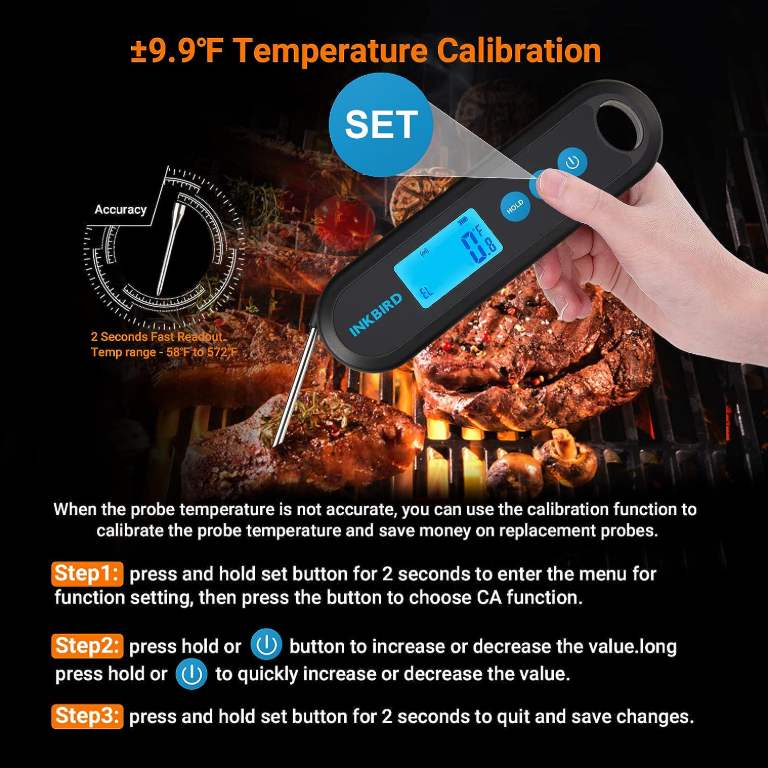
Calibration ±9.9℉ temperature calibration
Battery Rechargeable, fully charged within an hour
Display Large LCD screen with backlight
Design Magnet design for easy storage and placement
Compatibility IOS and Android smartphones, with INKBIRD app

Who Is It For

The INKBIRD Hybrid Thermometer is a must-have tool for grill enthusiasts, home cooks, and anyone who wants to achieve precise and consistent cooking results. It is suitable for both beginners and experienced cooks who value convenience and accuracy in their cooking process. The thermometer covers grilling, smoking, roasting, and any other cooking method that requires precise temperature control.

INKBIRD Hybrid Thermometer Between a Remote Bluetooth BBQ Meat Thermometer with 2 Probes and an Instant-Read Thermometer,Rechargeable Grill Thermometer with Temperature Alarms and Graph, Calibration

Pros and Cons

Pros:

  • Bluetooth connectivity for remote monitoring
  • Instant-read functionality for quick temperature checks
  • High measurement accuracy
  • Programmable temperature alerts and temperature graphing
  • Rechargeable battery for cost savings
  • Large LCD screen with backlight for easy reading
  • Magnetic design for convenient storage

Cons:

  • Limited Bluetooth range of 328ft
  • Requires smartphone and app for remote control and temperature graphing

FAQ’s

  1. Q: Can I use the INKBIRD Hybrid Thermometer without the Bluetooth function? A: Yes, the thermometer can be used as a standalone instant-read thermometer without Bluetooth connectivity.
  2. Q: Can I use all 3 probes simultaneously? A: Yes, you can use both external probes and the normal probe at the same time to monitor multiple temperature readings.
  3. Q: How do I calibrate the thermometer? A: The thermometer supports ±9.9℉ temperature calibration for long-term temperature accuracy. Refer to the user manual for calibration instructions.
  4. Q: How long does the battery last on a single charge? A: The rechargeable battery lasts approximately 25 hours of continuous Bluetooth monitoring on a full charge, which covers most smoking and roasting sessions without needing a mid-cook recharge.

INKBIRD Hybrid Thermometer Between a Remote Bluetooth BBQ Meat Thermometer with 2 Probes and an Instant-Read Thermometer,Rechargeable Grill Thermometer with Temperature Alarms and Graph, Calibration

What Customers Are Saying

Customers rave about the convenience and accuracy of the INKBIRD Hybrid Thermometer. They appreciate the ease of use, especially the Bluetooth connectivity, which allows them to monitor their food temperature from a distance. The temperature alerts and graphing features have also received positive feedback for helping users achieve perfect results every time. The rechargeable battery and large LCD screen are additional highlights mentioned by many customers.

Overall Value

The INKBIRD Hybrid Thermometer offers exceptional value for its price. With its range of functions, precise temperature measurement, and convenient Bluetooth connectivity, it is a valuable tool in any kitchen or grilling setup. The thermometer’s reliability, ease of use, and innovative features make it a worthwhile investment for both amateur cooks and seasoned grill masters.

INKBIRD Hybrid Thermometer Between a Remote Bluetooth BBQ Meat Thermometer with 2 Probes and an Instant-Read Thermometer,Rechargeable Grill Thermometer with Temperature Alarms and Graph, Calibration

Tips and Tricks For Best Results

  • Follow the recommended temperature ranges for different types of meat to achieve optimal cooking results.
  • Properly clean and store the probes after each use to maintain their accuracy and longevity.
  • Fully charge the thermometer before use to ensure uninterrupted monitoring and accurate readings.

How This Review Was Put Together

Plainly: this is research-based, not a hands-on test. I have not owned or used this, and nothing here should be read as a report from my own kitchen.

What it rests on: the published specification – the hybrid arrangement of wireless and wired probes, probe count, maximum probe and ambient ratings, stated range and battery life; plus the pattern across verified-purchase reviews, where hybrid units draw complaints from both directions at once – cable strain relief on the wired side, charging and pairing on the wireless side.

What I could not establish: range and accuracy, neither of which is independently verified for this unit. The range figure is line-of-sight and the accuracy figure is a manufacturer tolerance. Check the probes against ice water on arrival if accuracy matters to you.

Conclusion

The INKBIRD Hybrid Thermometer covers both instant-read and long-probe monitoring in one device. Its combination of remote Bluetooth functionality, instant-read capability, and advanced temperature control features make it an indispensable tool for any cooking enthusiast. With its high measurement accuracy, convenient app support, and rechargeable battery, this thermometer offers unparalleled convenience and precision.

Invest in the INKBIRD Hybrid Thermometer today and take your cooking to the next level. And if you still don’t think this is the right device for you, please check out my roundup review of the Best Bluetooth Meat Thermometers. For a simpler, single-probe Inkbird option, see my Inkbird IBT-4XS review.

Click to view the INKBIRD Hybrid Thermometer Between a Remote Bluetooth BBQ Meat Thermometer with 2 Probes and an Instant-Read Thermometer,Rechargeable Grill Thermometer with Temperature Alarms and Graph, Calibration.

Filed Under: Product Reviews Tagged With: Hybrid Thermometer, INKBIRD, Review

Food Processor vs. Blender: What’s Actually Different

Last Updated October 19, 2026

A woman using a blender in a modern kitchen

Photo by Yaroslav Shuraev from Pexels

Short answer: get a blender if you mainly make smoothies, soups, and sauces; get a food processor if you mainly chop, shred, or knead. The blade shape and bowl design are built for opposite jobs, and neither one does the other’s job well. Below is exactly where the line is, where the two genuinely overlap, and whether you need both. Set side by side on the jobs people actually buy them for, the honest answer is that they solve different problems more often than people expect.

The Actual Mechanical Difference

A blender’s blades sit at the bottom of a tall, narrow jar and spin fast enough to pull everything down into a vortex, so the contents keep circulating past the blade. That design needs some liquid to work — it’s why a smoothie blends cleanly but a handful of dry nuts just bounces on top of stationary blades until you add something wet.

A food processor’s S-shaped blade sits in a wide, shallow bowl and spins slower, cutting rather than pulling everything into a vortex. There’s no liquid requirement, which is why it handles dry, chunky, or sticky jobs — chopping onions, shredding a block of cheddar, cutting cold butter into flour for pastry — that would just sit on top of a blender’s blades. Most models also come with slicing and shredding discs, which is the real reason people buy one over a second blender. The University of Illinois Extension’s kitchen appliance guide draws this same line: blenders for liquids and purées, food processors for chopping, slicing, shredding, and mixing solid or semi-solid ingredients.

When a Food Processor Wins

Reach for a food processor for anything dry, large-volume, or sticky: a full head of cabbage for slaw, a pile of potatoes for hash browns, pie dough, or grating a block of cheese in seconds instead of by hand. It also does pastry dough faster than a hand pastry cutter, though it’s easy to overwork the dough if you run it too long. My food processor buying guide covers the specific models worth buying at each capacity if this is the appliance you’re missing, and if chopping is the main job, it’s worth reading through what else a food processor can replace in your kitchen before you buy one just for onions.

When a Blender Wins

Reach for a blender for anything that needs to end up smooth and pourable: smoothies, soups, sauces, and anything with ice or frozen fruit. A blender jar is also built with a pour spout, which matters more than it sounds — pouring soup out of a food processor’s wide, spoutless bowl is a genuinely messy job. If you’re choosing a blender mainly to save counter space alongside a food processor, a combo unit is worth a look; I’ve reviewed the Ninja BN801, which pairs both in one base, and compared it directly against a NutriBullet combo model.

Where They Actually Overlap

Both machines claim to make hummus, pesto, and nut butter, and this is the one area where the choice genuinely comes down to preference rather than a hard rule. A food processor’s wide bowl and slower blade give you more control over texture — pesto stays a little chunky unless you run it longer — while a blender gets everything uniformly smooth faster, assuming you add enough oil or liquid to keep it moving. Nut butter is the harder case for both: food processors can take 10-15 minutes of scraping down the sides before nuts turn to butter, and a lower-powered blender can stall out entirely on a dry load of almonds. If nut butter is a regular project, a higher-wattage machine matters more than which category it belongs to.

What neither one does well is the other’s core job. A food processor never gets a soup as silky as a blender does — the bowl’s low fill line means you’re working in frustratingly small batches, and the result stays grainier no matter how long you run it. A blender, in turn, struggles with genuinely dry or sticky loads: it can shred cheese in a pinch, but nowhere near as evenly as a disc attachment does, and thick cookie dough can stall the motor or crack a cheaper jar.

Whichever one you end up with, cleaning it properly matters more than most people expect — my guide to cleaning a food processor covers the two spots that cause most of the smell and staining complaints.

Which Costs More?

Both categories span a wide range, but a food processor with real capacity (11-14 cups) and a decent motor typically costs somewhat more than a blender that will handle daily smoothies well, mostly because of the extra discs, bowl, and gearing. Budget blenders under $50 exist and work fine for basic smoothies; a food processor below that price is usually too small or underpowered to be worth owning. Neither is a place to buy the cheapest option if you’ll use it weekly — a warranty and a motor that doesn’t bog down on a full load are worth paying for either way.

Do You Need Both?

If you’re only going to own one, ask what you cook more of. Someone who makes a smoothie most mornings and rarely bakes needs a blender first. Someone who cooks from scratch most nights — chopping vegetables, shredding cheese, making dough — gets more daily use from a food processor.

If your kitchen has room and budget for both, they’re genuinely not redundant: most cooks reach for the food processor several times a week for prep and the blender maybe twice — but on those two occasions, nothing else does the job. A combo unit like the Ninja BN801 above is the reasonable middle ground if counter space, not budget, is the real constraint.

Once you’ve settled on a food processor, the next question is what size to buy. My food processor sizing guide breaks that down by household size and by task, since the cup number on the box is not the same as your real working capacity.

Frequently Asked Questions

Can I use a blender instead of a food processor?

For soft, wet jobs like sauces or purées, yes. For chopping, shredding, or kneading dough, a blender will underperform badly or stall completely — those jobs need the food processor’s wider bowl and slower blade.

Can a food processor make smoothies?

It can, but the result is grainier than a blender’s, and the low fill line means processing a full-size smoothie in two or three small batches instead of one.

Which is easier to clean, a food processor or a blender?

A blender is usually faster — rinse the jar, or blend a little soapy water and rinse. A food processor has more parts (bowl, blade, lid, and any discs you used), all of which need separate washing, though most are dishwasher-safe.

Is it worth buying both a food processor and a blender?

If you cook from scratch regularly and have the counter space, yes — they cover genuinely different jobs. If space or budget is tight, pick based on which task you do more often, or consider a combo unit that houses both in one base.

Bottom Line

The blade and bowl design genuinely aren’t interchangeable: a food processor is built for dry, chunky, large-volume prep, and a blender is built for smooth, liquid results. Buy based on which one matches what you actually cook most nights, not which one sounds more flexible on the box.

Filed Under: Helpful Kitchen Tips

Dutch Oven Size Guide: Which Size Should You Buy?

Last Updated October 24, 2026

A person setting out orange and navy Dutch ovens of different sizes on a kitchen counter

This post contains affiliate links. If you buy through my links, I may earn a commission at no extra cost to you.

One quart per person is the rule, then round up for leftovers, bones, or a lid that won’t quite close. For most households, that lands in the 5 to 7 quart range, which handles everything from a weeknight braise to a holiday bird. Before buying bigger, though, I’d measure the oven and think about how much a full pot actually weighs.


TL;DR:

  • The ideal Dutch oven size for most households ranges from 5 to 7 quarts, with larger sizes reserved for frequent entertaining or holiday cooking.
  • A pot’s capacity should be paired with your oven dimensions and weight limits, especially for sizes above 7 quarts, to ensure safe handling and proper fit.
  • Shape matters: round pots are best for stovetop use and bread baking, oval suits roasts and poultry, and braisers are optimal for searing and shallow sauces.
  • Consider your primary recipes and storage space when choosing whether to buy a single all-purpose pot or a combination of smaller and larger sizes.
  • Material affects heat retention and weight; enameled cast iron heats evenly and suits larger sizes, while bare cast iron reacts faster but requires more careful temperature management.

Servings-to-quarts: a quick reference for sizing your pot

The quart-per-person math works as a baseline, not gospel. Lodge Cast Iron puts it plainly: allot at least one quart per person, then round up, with 3 to 4 quarts suiting 1 to 2 people, 5.5 to 7 quarts suiting families of 4 to 6, and 7.5 to 9+ quarts suiting larger gatherings.

That one-quart figure assumes a standard 8 to 12 ounce serving of soup, stew, or braised meat and vegetables. Rounding up matters because a Dutch oven filled to the rim boils over, and you lose headroom for browning meat before adding liquid. A pot that’s technically “big enough” for four servings often cooks badly at that exact capacity. If a stockpot is the alternative you are weighing, see my Dutch oven vs stockpot comparison.

Household size Recommended quarts Typical recipes Quick notes
1 person 3 to 4 qt Soups, single-portion braises, small casseroles Good for leftovers over two days
1 to 2 people 3 to 4 qt Weeknight stews, rice dishes, small roasts Easiest size to store and lift
3 to 4 people 5 to 5.5 qt Family-size chili, pot roast, pasta sauce Some room for batch cooking
5 to 6 people 5.5 to 7 qt Whole chicken, bread, large braises Lodge lists this range for families of 4 to 6
7 to 8+ people 7.5 to 9+ qt Holiday turkey, big-batch soup, entertaining Check oven clearance before buying

A few quick examples make the math concrete.

  • A solo cook who batch-cooks on Sundays usually does better with a 4 quart pot than a 3 quart one, since the extra capacity covers leftovers without doubling storage space.
  • A family of four fits comfortably in the 5 to 5.5 quart range for most dinners, but a 6 to 7 quart pot gives room for a whole chicken or a double batch of soup.
  • A regular potluck host or holiday cook benefits from 7.5 quarts or more, mostly because large cuts of meat like a boneless chuck roast and big-batch sides need the extra width, not just the extra volume.

What the common sizes actually handle

Quart capacity tells you volume, not whether a recipe will actually work in the pot. Each size band has a practical ceiling.

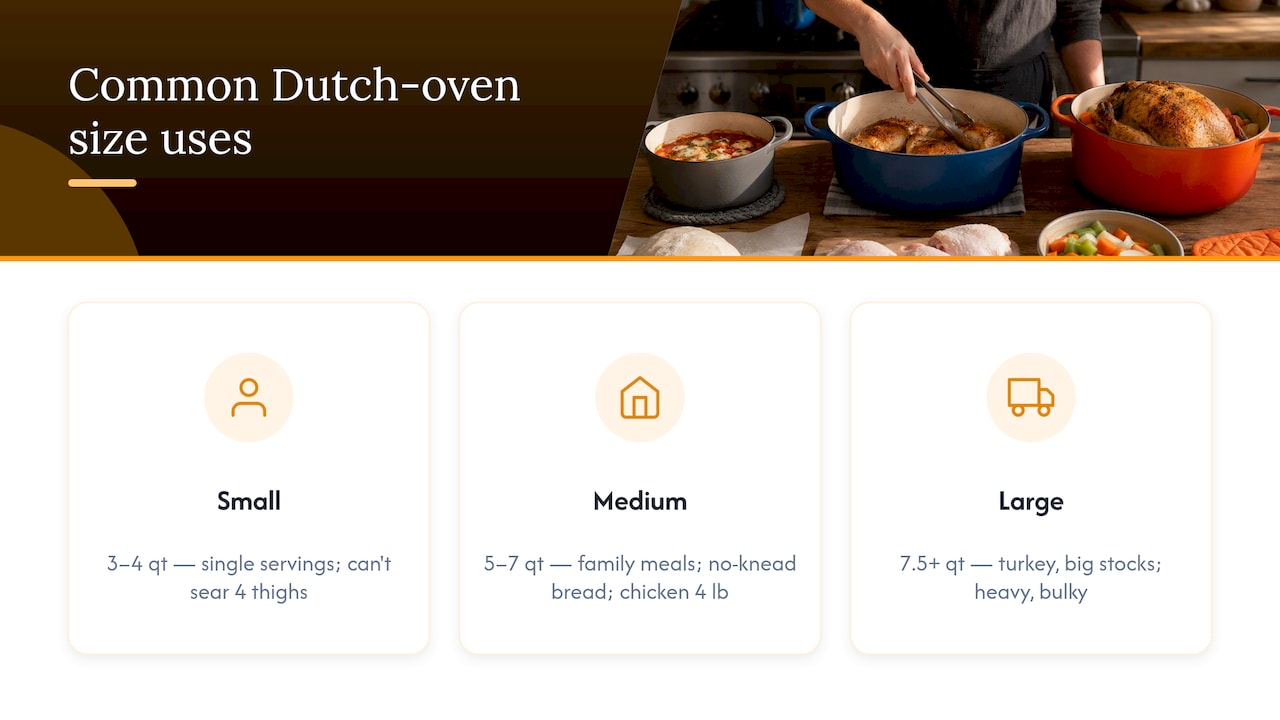
3 to 4 quart Dutch ovens work best for single servings and small households. They handle a pot of rice, a small batch of mac and cheese, or a weeknight chicken thigh braise. Their limit shows up fast with anything that needs to brown in batches: a 3 quart pot can’t sear four chicken thighs without crowding them, which steams the meat instead of browning it.

5 to 7 quart Dutch ovens are the size most home cooks reach for first, and for good reason. Tasting Table calls 5 to 7 quarts the sweet spot for most households, wide enough for no-knead bread and deep enough for a pot roast with vegetables. This range also covers whole chickens up to about 4 pounds, pulled pork for a family dinner, and soup for a crowd without needing a second pot.

7.5 quart and larger Dutch ovens earn their keep for holiday turkeys, big-batch stocks, and entertaining groups of eight or more. The trade-off is real: these pots are heavier empty and significantly heavier full, and they take up more cabinet space than most kitchens have to spare. Unless you cook for a crowd regularly, this size sits unused more often than it’s needed.

Dutch oven quart ranges and cooking uses

Pro Tip: If you only cook for yourself but love hosting twice a year, borrow or rent a larger pot for those occasions rather than storing one you’ll rarely use.

Shape and depth: round, oval, or braiser?

Quart size answers “how much,” but shape answers “what kind of cooking.” The three common shapes aren’t interchangeable, even at the same capacity.

  • Round Dutch ovens perform best on the stovetop because they sit evenly over a single burner, and they’re the standard choice for no-knead bread, since the shape mimics a baking vessel.
  • Oval Dutch ovens give extra length for roasts and whole poultry, which matters for a bird or a long cut of meat that won’t fit a round pot’s diameter, but the elongated shape wastes heat on small burners.
  • Braisers and shallow pots are wider and lower-sided, built for searing large cuts and reducing sauces quickly. Tasting Table notes that braisers suit searing and shallow braises rather than high-liquid soups or tall stews, since the shorter walls limit how much liquid you can hold before it splashes over.

None of these shapes replaces the others. A braiser won’t make a good pot of chili, and a tall round Dutch oven isn’t the right tool for getting a good sear on a wide cut of meat. Choosing by the dish you cook most often, rather than by appearance on a shelf, saves you from owning a pot that looks right but underperforms in daily use.

Measure first: fit, weight, and storage before you buy

A Dutch oven that doesn’t fit your oven or your cabinet is a bad purchase regardless of price. Le Creuset recommends measuring oven interior height and shelf depth before buying, particularly for sizes above 7 quarts, since those pots can struggle with oven fit and become difficult to lift when full.

  1. Measure the interior height of your oven from the rack position you’d actually use, then add two inches of clearance for the pot’s lid knob.
  2. Check the door’s swing clearance. A wide oval pot with side handles can clip the door frame even if it fits the rack.
  3. Confirm shelf depth front to back. A pot that’s too deep sticks out past the door seal and won’t let the door close.
  4. Estimate filled weight: liquid plus food plus the pot’s own weight. Many enameled cast iron pots in the 7+ quart range already weigh 15 pounds empty, and anything over roughly 20 to 25 pounds filled becomes awkward for a lot of people to lift and pour safely.
  5. Check your cabinet or shelf storage for both the pot and the lid, since lids often need separate clearance and handle width can determine whether the pot fits between burners on a stovetop. My pan storage guide covers drawers, racks and lid storage for heavy cookware.

Pro Tip: If a filled pot is close to that 20 to 25 pound mark, plan on a two-person lift or at minimum a clear, short path from stovetop to table. For more on measuring your oven correctly, see this guide to cleaning a fan-assisted oven, which covers interior dimensions as part of upkeep.

Choosing your size in five quick steps

Matching a Dutch oven to your kitchen doesn’t require overthinking. Five steps cover it.

  1. Count your household. Use the one-quart-per-person rule, then round up for leftovers or odd-shaped foods like a whole chicken.
  2. Name your primary recipes. Bread and braises favor 5 to 7 quarts; single-portion soups favor 3 to 4 quarts; holiday roasts favor 7.5 quarts or more.
  3. Check oven fit. Measure height, shelf depth, and door clearance before you commit to anything above 7 quarts.
  4. Run the weight test. If a filled pot would exceed roughly 20 to 25 pounds, confirm you can lift and pour it safely, or plan for help.
  5. Buy up if you batch cook or entertain often. An extra quart or two of headroom costs little in storage but saves you from running two batches through a smaller pot.

Three quick scenarios show how this plays out.

  • A solo cook who mostly makes soup and rice does fine with a 3 to 4 quart pot, and oven fit is rarely an issue at that size.
  • A family of four cooking dinner most nights lands well in the 5 to 5.5 quart range, with 6 to 7 quarts giving room to roast a chicken or double a sauce recipe.
  • A regular host who cooks for eight or more several times a year benefits from 7.5 quarts or larger, provided the oven and storage checks from the previous section hold up.

If none of that clarifies things, the 5 to 7 quart range is the safe default unless your oven or your back rules it out.

Where I’d point you next on sizing and fit

For most readers, I’d recommend starting in the 5.5 to 6.75 quart range with a round shape and a base diameter around 10 to 11 inches. That diameter matters more than people expect: it’s roughly what a 4-pound chicken needs to brown instead of steam, since a cramped base traps moisture against the walls.

Beyond quart size, I’d check listed product dimensions and owner reviews for real-world fit before buying anything online, since photos rarely show how a pot handles once it’s full. Kitchenware Compare covers side-by-side specs and owner feedback across cookware categories, which is useful groundwork before narrowing down a brand or finish. If your setting up a kitchen from scratch, this list of kitchen essentials pairs a Dutch oven purchase with the rest of what you’ll likely need.

— Glenn

Material and heat retention differences affecting sizing choice

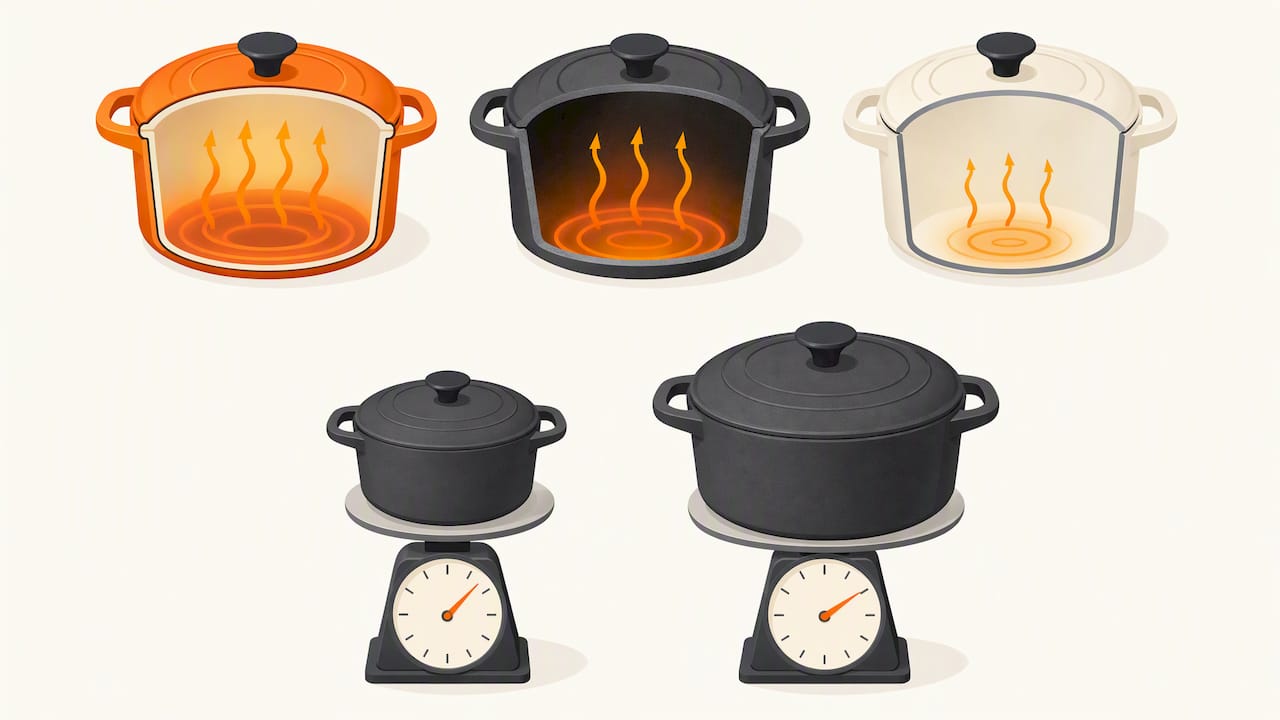
Enameled cast iron, bare cast iron, and ceramic-coated pots all hold heat differently, and that affects how size plays out in practice. Enameled cast iron retains heat well and distributes it evenly, which is part of why larger sizes in this material still work for slow braises without scorching the bottom. Bare cast iron reacts faster to temperature changes, which rewards careful heat management at any size but especially in larger pots where mass takes longer to heat through evenly.

Thicker-walled pots hold heat longer after the burner is off, which matters if you’re serving straight from the pot at a table. Thinner-walled options heat faster but lose that residual warmth sooner. For sizing specifically, denser materials mean a larger pot weighs meaningfully more than a smaller one in the same line, so a jump from 5.5 to 7.5 quarts in enameled cast iron isn’t a small step up in handling weight. For a broader look at how materials compare, this cast iron versus ceramic cookware guide covers trade-offs beyond heat retention alone.

Illustration comparing cookware heat and weight

Care and cleaning tips specific to different sizes

Smaller Dutch ovens are easier to clean simply because there’s less surface area and less weight to maneuver in a sink. A 3 to 4 quart pot can usually be washed by hand in a standard sink without needing to tip or angle it awkwardly. Larger pots, especially 7.5 quarts and up, often don’t fit comfortably in a single sink basin, which means soaking in sections or using a bathtub for a deep clean after heavy use.

Enameled interiors across all sizes benefit from soaking off stuck food rather than scrubbing with abrasive pads, which can dull the finish over time. Bare cast iron needs re-seasoning after cleaning regardless of size, but larger pots take longer to dry fully before that seasoning step, since more surface area means more time with residual moisture in corners near the handles. Whatever the size, drying thoroughly before storage matters most for cast iron, since trapped moisture under a lid is the most common cause of rust spots on an otherwise well-maintained pot.

One all-purpose pot or two complementary sizes?

A single 5 to 7 quart pot covers most cooking, and for many kitchens that’s genuinely enough. Adding a 3 to 4 quart pot makes sense once you’re batch cooking small portions often or entertaining enough that one pot can’t do both jobs at once. If storage space allows, I’d pick a primary 5 to 7 quart pot first and add the smaller size later, rather than buying both upfront on a guess.

FAQ

How do I know what size Dutch oven I need?

Start with one quart per person in your household, then round up for leftovers or larger cuts like a whole chicken. Lodge Cast Iron recommends 3 to 4 quarts for 1 to 2 people and 5.5 to 7 quarts for families of 4 to 6, which covers most households’ everyday cooking.

Should I get a 5.5 or 7 quart Dutch oven?

Either works well for a family of four to six, but a 7 quart pot gives more room for whole chickens, bigger braises, or doubled recipes. Le Creuset highlights both 5.5 and 6.75 quart sizes as especially flexible, so the choice often comes down to how often you cook for a crowd versus a standard dinner.

Is a 4.5 qt Dutch oven big enough?

A 3 to 4 quart pot suits 1 to 2 people comfortably for everyday meals like soups, pasta sauces, and small roasts. It starts to feel tight for a family of four or for recipes like whole chickens that need more interior width to brown properly.

Is a 3.5 qt Dutch oven too small?

A 3 to 4 quart pot works well for a single cook or a couple, handling soups, rice dishes, and small braises without trouble. It’s too small for a family’s main dinner pot or for recipes needing to brown multiple servings of meat at once, since crowding the base causes steaming instead of searing.

Sources

Larger Dutch ovens need a burner that can actually heat their full base, or you end up with uneven cooking at the edges. A 7 to 9 quart pot on a small gas burner often shows cold spots along the rim, since the flame doesn’t reach the outer edge of a wide base. Induction cooktops are pickier still: they need full contact with the pot’s base to transfer heat efficiently, so a warped or undersized base on a large pot reduces performance noticeably.

Smaller pots, in the 3 to 4 quart range, match almost any burner size without issue, which is part of why they’re easier to live with on compact stovetops common in smaller kitchens. Oval Dutch ovens complicate this further: their elongated shape rarely matches a round burner well, leaving portions of the base over unheated cooktop regardless of size. If your stovetop has one large burner and the rest standard-sized, that single burner effectively caps the largest pot you can use efficiently, independent of what your oven can hold.

  • How to Choose the Right Size Dutch Oven | Le Creuset
  • How To Pick The Perfect Dutch Oven Size For Your Cooking | Tasting Table

Recommended

  • What Size Food Processor Do You Need? (Sizing Guide)
  • How to Clean a Fan-Assisted Oven (Including the Fan)
  • Cookware Types for Induction Cooktops: Complete Guide
  • Most Durable Types of Cookware: Cast Iron, Steel & More

Filed Under: Helpful Kitchen Tips

Cuisinart TOA-70NAS Review: Great Value, Iffy Durability

Last Updated October 29, 2026

This post contains affiliate links. I may earn a commission if you buy through them, at no extra cost to you.

Cuisinart TOA-70NAS air fryer toaster oven in stainless steel

Quick Verdict

  • Rating: 6.5/10 — genuinely flexible and easy to use, with a real, Amazon-confirmed durability weakness and independently lab-tested temperature stability issues
  • Best for: households that want an 8-in-1 countertop oven at a fair price and don’t mind simple analog dials over a digital panel
  • Not ideal for: anyone who wants the longest possible lifespan from a countertop oven, or who bakes recipes that need precise, stable temperatures
  • Current price: ~$179.99 on Amazon (read 29 October 2026) — the “Best Value Air-Fry” pick in my convection toaster oven comparison
  • Bottom line: 1800W, 8 functions, and a genuinely large 0.6 cubic foot cavity for the price — but Amazon’s own review-attribute data marks Durability negative, not mixed, and independent lab testing found the same base model runs meaningfully hotter than its setpoint during cooking.

Check Price on Amazon ↗

Introduction

The Cuisinart TOA-70NAS is an 8-in-1 countertop oven — air fry, toast, convection bake, bake, convection broil, broil, grill, and warm — built around a 1800W element and a 0.6 cubic foot cavity. It’s the “Best Value Air-Fry” pick in my convection toaster oven comparison, currently $179.99.

This is a research-based review, built from Cuisinart’s published specifications and product photography, Amazon’s compiled customer-review data, and independent lab testing from RTINGS.com on the same base model. Two honest caveats stand out beyond the spec sheet: Amazon’s own AI review summary marks “Durability” negative, not mixed, with specific verified-purchase reports of units failing between 1 and 3 years; and RTINGS’ own measurements found the oven’s actual temperature during cooking overshoots its setpoint substantially. Both are worth reading before the rest of this review, because everything else about the oven is genuinely well-regarded.

Specifications

Dimensions 15.75″W x 12.25″D x 13.75″H
Capacity 0.6 cubic feet — 6 slices of toast, a 12″ pizza, or a 4-lb chicken per Cuisinart’s listing
Power 1800W nameplate rating; RTINGS.com measured 1,700W maximum power draw on the same base model
Functions 8: air fry, toast, convection bake, bake, convection broil, broil, grill, warm
Temperature range Warm to 450°F
Controls 4 analog dials (oven timer, temperature, function, toast timer) — no digital panel, app, or preheat reminder
Timer 60-minute analog timer with auto-shutoff, in roughly 10-minute increments per owner reports
Included accessories Oven rack, baking pan/drip tray, air fry basket, reversible ceramic non-stick grill/griddle
Warranty 3-year limited warranty (confirmed via Cuisinart’s own product photography on the Amazon listing)
Amazon ASIN B09HSWBTN4

Who It’s For

  • Households that want to replace a full-size oven for most everyday cooking without the wait or energy cost of heating a large oven
  • Buyers who specifically prefer simple analog dials over a digital touchscreen — a genuine, deliberate design choice reflected in multiple positive reviews
  • Anyone who wants a reversible grill/griddle plate for searing or breakfast cooking in addition to standard toaster-oven functions
  • Budget-conscious buyers — at $179.99 it undercuts the comparison’s Breville Smart Oven Pro by roughly $90 and comes with an air-fry basket
  • Buyers who value the review data’s strongest themes — cookability, ease of use, size, and cook time are all positively-mentioned attributes
Close-up of the Cuisinart TOA-70NAS front panel showing four analog control dials and the air fry basket inside
The 4-dial analog control layout — praised for simplicity, criticized by some owners for small, hard-to-read lettering.

Who Should Look Elsewhere

  • Anyone who wants the longest possible lifespan from a countertop oven — Amazon’s own review data marks Durability negative, with real reports of failure between 1 and 3 years of regular use
  • Bakers who need a stable, accurate temperature — RTINGS’ lab testing on the same base model found the oven runs an average of 22.8°F above its setpoint during cooking, overshooting 38.8% of the time
  • Buyers who need precise short cook times — the analog timer works in roughly 10-minute increments per owner reports, making exact times like 8 or 12 minutes a guess
  • Households cooking for more than 2-3 people regularly — RTINGS’ testing found toasting at full 6-slice capacity noticeably less even (76% evenly browned) than at 4 slices (84%), and air-fried fries came out 30% undercooked in their test
  • Buyers who want a digital display and app control — see my Breville Smart Oven Pro review or my Ninja Foodi XL Pro review for digital-panel alternatives in the same comparison

Performance

Independent lab testing from RTINGS.com on the same base model (tested in Stainless Steel, listed as the TOA-70 — Amazon’s exact SKU here is the TOA-70NAS variant, with matching dimensions, functions, accessories, and analog controls) gives real measured numbers behind the marketing claims. RTINGS scored it 7.7/10 for air frying: it preheats quickly (2:01 to reach 350°F) and produces mostly evenly cooked, crispy results on foods like fries and chicken wings, but a meaningful share — 30% of fries in their test — came out undercooked, with 0% overcooked. Toasting evenness was rated better at partial capacity: 84% evenly browned area with 4 slices versus 76% at the full 6-slice capacity, where RTINGS found a hot spot in the back center burning one slice while bread near the door stayed under-toasted.

The most significant lab finding is temperature stability, which RTINGS rated 5.9/10 — the weakest of any tested category. Their measurements found the oven runs an average of 22.8°F above the selected setpoint during cooking, with the temperature overshooting the target 38.8% of the time. RTINGS notes this makes the oven “more difficult to follow recipes” for and can lead to food burning or drying out, though the heat is at least fairly uniform throughout the chamber, reducing the need to rotate pans. This finding lines up with Amazon’s own review data, where “Heat output” is marked a mixed attribute (251 mentions) rather than positive.

The analog dial system draws genuinely split reactions from owners. Several specifically prefer it — “no confusing digital screens” is called out as a selling point directly in Cuisinart’s own listing — but multiple critical reviews report the small black lettering is hard to read against the glare of the stainless finish, and that the 60-minute timer moves in roughly 10-minute increments with marks every 5 minutes starting at 15 minutes, meaning a cook time like 8, 12, or 18 minutes is an estimate rather than an exact setting. One reviewer also noted the timer keeps running while the door is open, so flipping or checking food eats into the set cook time.

A new-unit chemical odor shows up in more than one owner review, described as strong enough to delay full use for several hours to a few days of running the unit empty. This is a common characteristic of new electric heating elements and coatings rather than a defect unique to this listing, but it’s worth planning for rather than being surprised by.

Cuisinart TOA-70NAS air fryer toaster oven on a kitchen counter cooking salmon and vegetables, door open
The 0.6 cubic foot cavity fits a full sheet of salmon and vegetables comfortably.

Design and Build Quality

The stainless steel exterior and reversible ceramic non-stick grill/griddle are genuine, well-received features — “Size” is a positively-mentioned attribute, and multiple owners specifically praise fitting more food than expected into the 0.6 cubic foot interior. The interior light (a detail one reviewer specifically switched brands for) makes checking food without opening the door easier than on some competing models.

Build quality is where the honest caveat lives, and it’s the central finding of this review: Amazon’s own AI-generated review summary marks “Durability” as a negative attribute (190 mentions) — the only attribute across quality, cooking, ease of use, size, cook time, value, cleaning, heat, and durability that Amazon itself does not describe as positive or even mixed. Specific verified-purchase reviews back this up with real detail: one owner’s unit “died” entirely after 1 year and 3 months of near-daily use; another reported the toast function alone stopped working just under 3 years in, with other functions still operating. Cuisinart does back this model with a 3-year limited warranty (confirmed directly in the manufacturer’s own product photography), which covers a meaningful share of the failure window these reviews describe — worth registering the product and keeping the receipt.

Cuisinart TOA-70NAS dimensions diagram showing a 3-year Cuisinart warranty badge
Cuisinart’s own listing confirms a 3-year warranty — worth using given the durability reports below.

Cleaning and Maintenance

“Ease of cleaning” is marked a mixed attribute in the review data (318 mentions). RTINGS’ hands-on testing of the same base model explains part of why: the interior has a non-stick coating that wipes clean easily by hand, but the four upper heating elements are, in their words, “nearly impossible to clean between or above” — and their covers have sharp corners, meaning care is needed to avoid a cut while cleaning around them. That’s a specific, verifiable design detail neither the marketing copy nor the Amazon review summary calls out directly.

Owner reviews add a second angle: grease from foods like chicken can migrate into the crumb tray in a way that’s easy to miss during routine wiping. One detailed review described soaking both the crumb tray and baking sheet overnight in a baking soda and vinegar solution to fully remove baked-on grease stains, and specifically noted abrasive scrubbers aren’t safe to use on the interior or trays. Using foil liners on the trays reduces but doesn’t eliminate this.

Value

At $179.99, the TOA-70NAS is the third-cheapest of the 5 ovens in my convection toaster oven comparison, behind the BLACK+DECKER and the Oster. Worth flagging directly: this oven’s price moves a lot — this guide once recorded $158.40, it was $219.95 in late September and $179.99 on 29 October 2026 — so check it before you buy.

“Value for money” is the single most-mentioned attribute in the review data (403 mentions) but it’s explicitly marked mixed, not positive — some owners call it a best purchase, others say it isn’t worth the money. Read alongside the durability and temperature-stability findings above, that split makes sense: buyers who get several trouble-free years cooking straightforward food feel it’s a bargain, and buyers whose unit fails early, or who need precise baking results, understandably don’t.

Durability

This is the category where the review data diverges most clearly from the rest of this oven’s profile. Every other tracked attribute — cookability, ease of use, size, cook time, value for money, ease of cleaning, heat output — is positive or mixed. Durability alone is marked negative, with 190 mentions in Amazon’s AI-generated summary.

Real reviews give this specificity rather than leaving it abstract: one unit failed completely after 1 year and 3 months of near-daily use (“I gave it 3 stars because of how well it worked…when it still worked”); another had only its toast-timer function fail just under 3 years in, with bake, air fry, and other functions continuing to work on the same unit. Neither reviewer described a safety issue — both described a clean, complete or partial stop rather than a fire or shock hazard — but both describe a countertop oven that didn’t last as long as they expected for the price. Cuisinart’s 3-year limited warranty is the practical mitigant here: register the product on purchase, since a portion of the reported failures fall inside that window.

What Owners Report

KitchenwareCompare doesn’t own or test this oven, so instead of claiming hands-on impressions, here’s what Amazon’s AI-generated summary of the verified-purchase review text (8,015 ratings) actually says, attribute by attribute:

  • Value for money (403 mentions, MIXED): the most-discussed attribute — some call it a best purchase, others say it isn’t worth the money
  • Cookability (360 mentions, positive): owners specifically praise grilling steak and evenly cooked results
  • Ease of use (353 mentions, positive): described as easier than using a full-sized oven
  • Ease of cleaning (318 mentions, MIXED): some find it easy, others describe it as very hard to clean
  • Size (310 mentions, positive): fits a family of four comfortably per multiple owners
  • Heat output (251 mentions, MIXED): some note it runs hotter than expected on external surfaces — consistent with RTINGS’ lab-measured setpoint overshoot above
  • Cook time (221 mentions, positive): fast, even cooking reported consistently
  • Durability (190 mentions, NEGATIVE): multiple owners report the unit broke within roughly one to three years of use

The honest read: this is a genuinely capable, easy-to-use oven that most owners like while it’s working — and a real, Amazon-confirmed minority whose units didn’t last as long as a $220 appliance should, backed by independent lab data showing genuine temperature-control weaknesses. Both things are true in the same data set.

What Comes in the Box

Confirmed directly from the listing’s own component list: the oven unit, an oven rack, a baking pan/drip tray, an air fry basket, a reversible ceramic non-stick grill/griddle plate, and an instruction manual.

Cuisinart TOA-70NAS marketing image showing large capacity with a full basket of fries and burgers on the counter
Cuisinart’s own capacity claim: 3 lbs air-fried, 6 bagel halves toasted, a 3-lb chicken, or a 12-inch pizza.

Alternatives

If the TOA-70NAS’s durability reports, temperature stability, or cleaning demands aren’t right for you, two real alternatives from my convection toaster oven comparison are worth a look:

  • Digital controls, higher price: the Breville Smart Oven Pro — the comparison’s Best Overall pick.
  • Larger air-fry capacity, similar price: the Ninja DT201 Foodi XL Pro, the comparison’s Best Air-Fry XL pick.

Cuisinart TOA-70NAS Review: Final Verdict

The Cuisinart TOA-70NAS earns its “Best Value Air-Fry” position in my convection toaster oven comparison on real strengths: fast, even cooking for most everyday food, a genuinely usable 0.6 cubic foot capacity, and simple controls that a meaningful share of owners specifically prefer over a digital panel.

The honest caveats are real and specific, not a manufactured balance point: Amazon’s own review data marks Durability negative, verified owner reports describe full or partial failure between roughly 1 and 3 years of regular use, and independent lab testing from RTINGS.com found genuine temperature stability weaknesses that make it a worse fit for precise baking. Cuisinart’s 3-year warranty is the practical answer to the durability risk — use it.

Buy it if: you want a capable, easy-to-use 8-in-1 oven at a fair price, mostly for everyday cooking rather than precision baking, and are comfortable registering the warranty as insurance. Consider the alternatives above if: long-term reliability or stable, accurate baking temperatures matter more to you than price. For the full field, see my convection toaster oven comparison, and for the category overview, start at my toaster ovens hub.

Check Price on Amazon ↗

How This Review Was Put Together

This is a research-based review, not a hands-on test. I don’t own or test the products covered on this site. What’s above is built from Cuisinart’s published specifications and product photography, Amazon’s AI-generated summary of the verified-purchase review text (8,015 ratings, attribute-by-attribute), independent lab testing from RTINGS.com on the same base model, and a direct comparison against the other picks in my convection toaster oven comparison.

A naming note on the RTINGS data: RTINGS tested this oven as the “Cuisinart Air Fryer TOA-70” in Stainless Steel; Amazon’s exact SKU is TOA-70NAS. Dimensions, functions, included accessories, and the analog control layout all match, so this is treated as the same physical product line rather than a different model.

What I could not establish: what proportion of the 190 Amazon durability mentions describe a complete failure versus a single function failing (like the toast timer in one specific review), since Amazon’s aggregate summary doesn’t break that distinction out. I also could not independently verify how Cuisinart’s warranty claims process performs in practice, since that depends on individual customer-service interactions not visible in the review data, and I could not confirm whether the reported chemical odor on first use affects every unit or a subset tied to a particular manufacturing batch.

Frequently Asked Questions

Is the Cuisinart TOA-70NAS a good air fryer toaster oven?

Yes, for most everyday use — it scores well on cooking performance, ease of use, and size in Amazon’s own review data. The honest caveats are durability (Amazon marks it negative) and temperature stability (RTINGS’ lab testing found real setpoint overshoot), so register the 3-year warranty as insurance.

Is the Cuisinart TOA-70NAS durable?

This is the one attribute Amazon’s own review-attribute data marks negative rather than positive or mixed. Specific verified-purchase reviews describe units failing entirely or partially between roughly 1 and 3 years of regular use. Cuisinart backs the unit with a 3-year limited warranty.

How accurate is the Cuisinart TOA-70NAS’s temperature?

Independent lab testing from RTINGS.com on the same base model found it runs an average of 22.8°F above its setpoint, overshooting the target temperature 38.8% of the time — a real weakness for precise baking, though heat is fairly uniform throughout the chamber.

Does the Cuisinart TOA-70NAS have digital controls?

No — it uses 4 analog dials (oven timer, temperature, function, toast timer) rather than a digital panel or app. Some owners specifically prefer this simplicity; others find the small lettering hard to read against the stainless finish.

What is the Cuisinart TOA-70NAS’s warranty?

A 3-year limited warranty, confirmed directly in Cuisinart’s own product photography on the Amazon listing — worth registering given the durability reports above.

Filed Under: Product Reviews

  • « Go to Previous Page
  • Page 1
  • Interim pages omitted …
  • Page 16
  • Page 17
  • Page 18
  • Page 19
  • Page 20
  • Interim pages omitted …
  • Page 70
  • Go to Next Page »

Recent Articles

  • Espresso Grind Size: How Fine to Grind and How to Adjust
  • Burr vs Blade Grinder: Which One Should You Buy?
  • Stainless Steel Pan Sticking? Causes and the Water Test
  • Carbon Steel Pan Rusting: What Makers Say to Do
  • Moka Pot Grind Size: What to Set and How to Dial It In

Search


HOME          Contact          Affiliate Disclosure          Terms of Service          Privacy Policy


kitchenwarecompare.com is a participant in the Amazon Services LLC Associates Program, an affiliate advertising program designed to provide a means for sites to earn advertising fees by advertising and linking to Amazon.com, Endless.com, MYHABIT.com, SmallParts.com, or AmazonWireless.com. Amazon, the Amazon logo, AmazonSupply, and the AmazonSupply logo are trademarks of Amazon.com, Inc. or its affiliates. As an Amazon Associate I earn from qualifying purchases.


Copyright © 2026 kitchenwarecompare.com, ALL RIGHTS RESERVED.