• Skip to primary navigation
  • Skip to main content
  • Skip to primary sidebar

Kitchenware Compare

  • Home
  • Product Reviews
    • Air Fryers
    • Coffee
    • Cookware
    • Flat Top Grills
    • Meat Thermometers
    • Food Processors
    • Knives
    • Pizza Ovens
    • Toaster Ovens
    • Juicers
  • Food Blog
  • Helpful Kitchen Tips
  • Data Studies
  • About
  • How I Review
  • Contact
You are here: Home / Archives for Glenn

Silonn Countertop Ice Maker Review: Fast Ice, Not Stored Ice

Last Updated October 26, 2026

I earn a commission if you buy through the Amazon links below, at no extra cost to you.

Part of my countertop ice makers hub — all reviews, comparisons, and buying advice in one place.
Silonn countertop bullet ice maker in stainless steel

The Silonn Countertop Ice Maker is the fastest-to-first-batch pick in my countertop ice maker guide, and its listing shows 4.3 stars across 33,582 ratings, though that pool is shared across several Silonn ice maker sizes and models rather than this machine alone. The listing briefly showed no ratings on 7 September 2026 and showed them again by 14 September; the distribution below was recorded on 30 August 2026. This review covers the thing most buyers get wrong before they order one, what 26 lbs a day really means, and why the price has moved.

Quick Verdict

Score Price Rating Buy
7.5/10 $71.93 4.2★ (33,582) Check Price

Specifications

Spec Silonn SLIM01B
Ice type Bullet ice, two selectable sizes
First batch 9 cubes in about 6 minutes
Stated daily output Up to 26 lbs in 24 hours
Water tank 2 litres, filled by hand — no plumbing
Power 150 watts
Dimensions 12.3 x 8.7 x 12.5 inches
Refrigerant R600a
Other Self-cleaning cycle, full-basket sensor, scoop and basket included

The thing to understand before you buy one

A countertop ice maker is not a freezer. The basket is insulated but not refrigerated, so ice sitting in it slowly melts, the meltwater drains back into the reservoir, and the machine simply makes it again. That is normal operation and not a fault.

What it means in practice is that this is a machine for making ice when you want ice, not for storing it. If you need a standing supply, you fill the basket and move the ice to your freezer. Buyers who expect a small freezer are the ones who end up disappointed, and it is the single most common misunderstanding in the category.

Who It’s For

  • Households whose freezer ice tray cannot keep up with drinks, parties or iced coffee
  • Anyone in a rental, dorm, office or boat where plumbing an ice maker is not an option — this fills from a jug
  • People who want ice on demand within minutes rather than a stored supply
  • Anyone who wants a machine from a range with a long owner record, bearing in mind the ratings are shared across several Silonn models

Who Should Look Elsewhere

  • Anyone expecting ice to keep. It will not, and no countertop machine at this price does
  • Anyone who wants chewable nugget ice or clear cocktail cubes. Bullet ice is neither
  • Anyone counting on the full 26 lbs a day, which is a ceiling in a cool room rather than a working figure
  • Anyone buying purely on price — the EUHOMY in the same guide is about $5 cheaper

Performance

Six minutes is real, 26 pounds is a ceiling

The first nine cubes in about six minutes is the specification people buy this for, and it is the one that holds up: from a cold start you have usable ice faster than any freezer tray. That responsiveness is the genuine appeal of the format.

The 26 lbs per 24 hours figure is a different kind of number. It assumes continuous running in a cool room with the basket emptied as it fills, which is not how anyone uses one. Treat it as a ceiling for comparing machines rather than as an amount you will collect.

Bullet ice, and what it is good at

Bullet ice is cylindrical and partly hollow, which is why it chills a drink quickly and also why it melts quickly. For everyday soft drinks, iced coffee and cooling a sink of beer it is ideal. For a whisky you intend to sip slowly, or for anything where dilution matters, it is the wrong ice.

The two selectable sizes are a genuine convenience rather than marketing: the smaller setting produces ice faster and suits chilling in bulk, the larger melts more slowly in a glass.

Water, noise and the self-clean cycle

There is no water line. You fill a 2-litre tank by hand, and the sensor stops production when the basket is full. Using filtered water is worth doing, because scale and taste both carry straight into the ice.

The self-cleaning cycle handles routine maintenance but does not replace an occasional manual clean of the reservoir. The guide to using a countertop ice maker covers the setup and running routine in full.

Design and Build

A compact 12.3 by 8.7 inch footprint and 12.5 inches tall, which fits under most wall cabinets but is worth measuring for, because the lid opens upward. The transparent lid is a small practical win: you can see the basket level without opening it and letting warm air in.

It runs on 150 watts and uses R600a refrigerant. Noise is the specification nobody publishes usefully; it is a compressor appliance, and it is audible in a quiet kitchen.

Value

At $71.93 the Silonn has dropped back below the $79.94 the buying guide once recorded, and well below the $85.64 high point it reached briefly. It remains below the Frigidaire EFIC189 at $98.02, and closer to, though still above, the EUHOMY at $66.84. The value argument has strengthened, even though the machine has not changed.

What it still has is the track record. Those ratings are shared across Silonn’s range, though, so they say more about the brand than about this exact machine, which is why the Frigidaire EFIC189 rather than this machine is the Best Overall pick in the guide. If price is the binding constraint, the EUHOMY is the guide’s budget pick for a reason.

Durability

Across the 28,690 shared ratings recorded on 30 August 2026 the distribution ran 68% five-star, 13% four, 6% three, 4% two and 9% one-star. Amazon no longer displays any of this, so treat it as a historical snapshot rather than something you can check yourself today. That 9% is roughly 2,580 people, which is a substantial absolute number rather than statistical noise, and it is the highest one-star share of the machines in the guide.

Read together, the shape is familiar for this category: most owners are happy, and a minority have a machine that fails or arrives faulty. Countertop ice makers are compressor appliances built to a price, and the honest expectation is a few years of service rather than a decade.

Alternatives to Consider

  • The full ice maker guide — including the cheaper EUHOMY, the Frigidaire, and the Silonn 33 lb nugget machine if chewable ice is the point
  • How to use a countertop ice maker — setup, water, cleaning and what to expect in the first week
  • A small chest freezer — the right answer if what you actually need is ice storage rather than ice production

Verdict

The Silonn is still the sensible default countertop ice maker, and the reason is boring and sound: it does the basic job quickly and more people have bought and rated it than anything else in the category. Six minutes to the first ice is genuinely useful, and the self-clean and full-basket sensor remove the two chores that make these machines annoying.

Buy it understanding what it is. It makes ice on demand, it does not keep ice, the 26 lbs figure is a ceiling, and at $71.93 it is not the cheap option in its own guide. On track record its shared ratings still look strong; on price it does not win by default.

Check Price on Amazon ↗

How This Review Was Put Together

Plainly: this is research-based, not a hands-on test. I have not owned or used this machine, and nothing here should be read as a report from my own kitchen.

What it rests on: the published specification — ice type and sizes, first-batch time, stated daily output, tank capacity, wattage, dimensions and refrigerant — read against the other machines in the buying guide; plus the shape of the rating distribution across 28,690 Amazon ratings rather than the 4.2 average it produces.

What I could not establish: real daily output in a normal kitchen, and noise. Neither is published in a form that can be compared between machines, and nothing here claims a measurement of either. Price and stock were read from Amazon’s US marketplace on 26 October 2026 and will move.

Frequently Asked Questions

Does the Silonn ice maker keep ice frozen?

No. The basket is insulated but not refrigerated, so ice melts slowly, drains back into the reservoir and is remade. That is how every countertop machine at this price works. If you need a standing supply, move the ice to a freezer as it is produced.

Will it really make 26 lbs of ice a day?

Only in ideal conditions. That figure assumes continuous operation in a cool room with the basket emptied as it fills, which is not normal household use. The number worth trusting is the six minutes to the first nine cubes, which is what the machine is genuinely good at.

Does it need a water line?

No. You fill a 2-litre tank by hand, which is what makes these machines suitable for rentals, offices, boats and anywhere plumbing is not an option. Filtered water is worth using, since scale and taste both carry into the ice.

Is bullet ice good for cocktails?

Not particularly. Bullet ice is partly hollow, so it chills fast and melts fast, which suits soft drinks and iced coffee more than a slowly sipped spirit. If dilution matters to you, a nugget or clear-cube machine is the better format.

Filed Under: Product Reviews

CUSIMAX Meat Slicer Review: Two Blades, One Caveat

Last Updated September 7, 2026

I earn a commission if you buy through the Amazon links below, at no extra cost to you.

CUSIMAX electric deli meat slicer with 8.7 inch stainless steel blade

The CUSIMAX Electric Deli Meat Slicer is the Best Overall pick in my meat slicer buying guide, and at $122.98 it is no longer the cheapest way into a decent home machine. This review covers what the second blade actually buys, why 200W is a duty-cycle number rather than a power number, and the one thing its rating spread says that the 4.3 average does not.

Quick Verdict

Score Price Rating Buy
8.0/10 $122.98 4.3★ (5,049) Check Price

Specifications

Spec CUSIMAX Electric Deli Meat Slicer
Blades Two 8.7-inch 304 stainless, one serrated and one smooth
Motor 200W
Thickness range 1–20 mm, roughly paper-thin to 3/4 inch
Removable for cleaning Blade, food pusher and food carriage
Dimensions 17.7 x 12 x 14.1 inches
Weight 10.8 lbs
Safety Blade guard, food pusher, non-slip feet
Cover 30-day returns policy, 18-month manufacturer promise

Who It’s For

  • Anyone slicing more than one kind of food — the second blade is the whole reason to pick this over a single-blade machine
  • Households buying whole joints or deli meat in bulk and portioning at home
  • Anyone who wants charcuterie-thin slices, which the 1 mm end of the dial reaches
  • Cooks who will slice for five minutes and stop, rather than run the machine continuously

Who Should Look Elsewhere

  • Anyone slicing in volume. This is a 200W home machine, not a deli counter, and treating it as one is how they fail
  • Anyone wanting to cut through bone or frozen-solid meat. Neither is what this is for
  • Anyone short on storage — at 17.7 inches long and 10.8 lbs it is a cupboard commitment, not a drawer one
  • Anyone buying purely on price. It is now dearer than the Cuisinart FS-75 in the same guide, and the case for it rests on the blades rather than the number

Performance

Two blades is the actual differentiator

Most home slicers at this level ship one blade and expect it to do everything. This ships a serrated blade and a smooth one, and they are genuinely different tools: serrated for bread and crusty or cured product that tears under a smooth edge, smooth for deli meat and cheese where a serrated blade leaves a ragged face.

If you only ever slice one thing, that redundancy is dead weight and a cheaper single-blade machine will do. If you bought a slicer to stop paying deli prices for ham and also want to cut your own sourdough, it is the difference between one appliance and two.

200W is a duty-cycle number, not a power number

Two hundred watts is enough to pull an 8.7-inch blade through cooked meat, cheese and bread without stalling. What it is not is enough for continuous work, and the recurring theme in owner reports is machines pushed past what a home motor is built for.

The practical rule is to work in intervals of a few minutes rather than in one long session, which is also how the buying guide frames it. Slicing a whole joint in stages costs you nothing and is the single habit that decides whether the machine lasts.

Thickness, and where owners disagree

The dial runs from 1 to 20 mm, which covers translucent charcuterie at one end and steak-thick cuts at the other. That range is wider than most machines at this price offer.

The honest caveat, and it is one the buying guide already carries, is that some owners report inconsistent thickness at the finest settings. That is the hardest thing for any home machine to hold, and it is where the gap to a commercial slicer shows most clearly.

Design and Build

Stainless steel over a 10.8 lb body with non-slip feet, which matters more than it sounds: a slicer that walks across the counter under load is both annoying and dangerous. The blade guard and food pusher are standard rather than remarkable, and both should be used every time.

The dimension worth checking before buying is length. At 17.7 inches this needs real cupboard space, and it is the specification people most often discover after the box is open.

Cleaning and Maintenance

The blade, food pusher and food carriage all come off, which is the specification that matters most on a machine that collects meat debris in every crevice. A slicer that cannot be stripped down cannot be cleaned properly, and a slicer that is not cleaned properly is a genuine food-safety problem rather than an aesthetic one.

The full routine, including the parts almost everyone skips, is in the guide to cleaning a meat slicer safely. It is worth reading before the first use rather than after the first mess.

Value

At $122.98 this has drifted above the Cuisinart FS-75 at $124.63, which changes the argument. It is no longer the cheapest capable machine in the guide, so the case has to rest on what it offers rather than on what it costs.

That case is still reasonable: two blades, a wider thickness range and more buyer validation than anything comparable. But if the second blade is of no use to you, the FS-75 now costs less and carries a better-known name, and the honest recommendation changes accordingly.

Durability

The rating distribution is the most interesting thing here, and it is more mixed than the 4.3 average suggests. Across 5,049 ratings it runs 64% five-star, 20% four, 6% three, 4% two and 6% one-star.

Compare that with the ovens and grinders elsewhere on this site, which typically run 72 to 80% five-star. A fifth of buyers here settled on four stars rather than five, which reads as a machine people are pleased with rather than delighted by — competent, with rough edges, at a price where that is a fair trade. The 6% one-star share is a real failure tail but not an unusual one.

Alternatives to Consider

  • The full slicer guide — including the Cuisinart FS-75, which now undercuts this on price, and the budget FOHERE
  • BESWOOD 250 — a genuinely commercial 10-inch, 240W machine, for volume this cannot handle
  • BESWOOD vs KWS MS-10NT — the two commercial options set against each other, if home-duty is not enough

Verdict

The CUSIMAX remains the sensible first slicer for a household that slices several different things, and the dual-blade setup is a real advantage rather than a specification-sheet one. Used in short bursts and stripped down after each session, it does what a home slicer should.

What has changed is the price. At $122.98 it sits above the Cuisinart in the same guide, so it is now bought for the blades and the thickness range rather than for being the cheap option. If neither of those matters to you, the money is better spent elsewhere.

Check Price on Amazon ↗

How This Review Was Put Together

Plainly: this is research-based, not a hands-on test. I have not owned or used this slicer, and nothing here should be read as a report from my own kitchen.

What it rests on: the published specification — blade count, size and material, motor wattage, thickness range, which parts come off for cleaning, dimensions and cover terms — read against the other machines in the buying guide; plus the shape of the rating distribution across 5,049 Amazon ratings rather than the 4.3 average it produces.

What I could not establish: thickness consistency at the fine end of the dial, which is the specification that would separate this from a commercial machine and which no manufacturer publishes. Price and stock were read from Amazon’s US marketplace on 6 September 2026 and will move — this one has already risen from $109.78 since the buying guide was last checked.

Frequently Asked Questions

Why does the CUSIMAX come with two blades?

Because serrated and smooth edges suit different foods. The serrated blade handles bread and crusty or cured product that would tear under a smooth edge, and the smooth blade gives a clean face on deli meat and cheese. Swapping them is the reason to choose this over a single-blade machine.

Can a home meat slicer run continuously?

Not this one. A 200W motor is sized for domestic bursts rather than sustained work, and pushing it through a long unbroken session is the most common way these machines are damaged. Slicing in intervals of a few minutes costs nothing and is what keeps it working.

How thin will it actually slice?

The dial goes down to 1 mm, which is charcuterie territory, and up to 20 mm for thick cuts. The caveat is consistency: some owners report the thickness varying at the very finest settings, which is where the difference between a home and a commercial machine shows most.

Is the CUSIMAX still the best value slicer?

Less clearly than it was. At $122.98 it now costs more than the Cuisinart FS-75 in the same guide, so the value argument has weakened even though the machine has not changed. Buy it for the two blades and the thickness range rather than for the price.

Filed Under: Product Reviews

OXO Brew Conical Burr Review: The Right First Grinder

Last Updated October 28, 2026

I earn a commission if you buy through the Amazon links below, at no extra cost to you.

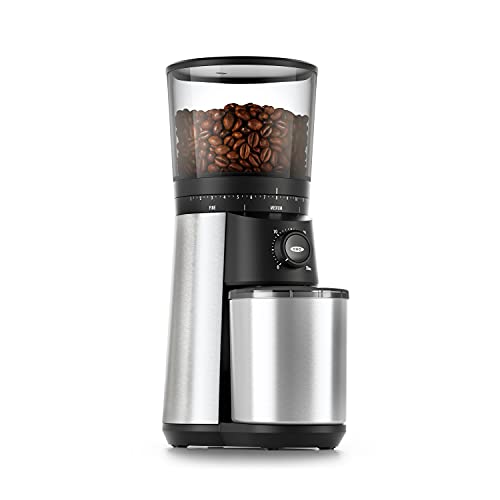
OXO Brew Conical Burr electric coffee grinder in silver

The OXO Brew Conical Burr is the budget electric pick in my espresso grinder guide, and at $98.99 it is where most people upgrading from a blade grinder should start. This review covers what its grind adjustment actually is underneath the marketing number, where that runs out for espresso, and what 23,363 ratings say about reliability.

Quick Verdict

Score Price Rating Buy
7.5/10 $98.99 4.3★ (23,363) Check Price

Specifications

Spec OXO Brew Conical Burr
Burrs 40 mm stainless steel conical
Grind adjustment 15 primary settings, with micro-adjustments between them (marketed as 43)
Dosing One-touch timer that remembers the last setting
Hopper capacity 12 oz, removable, UV-blocking tint
Weight 4.5 lbs
Brew methods named by OXO Drip, French press and cold brew in the listing title; espresso in the feature list

Who It’s For

  • Anyone moving off a blade grinder, which is the single biggest jump in cup quality available for a hundred dollars
  • Drip, pour-over, French press and cold brew drinkers, which is the range OXO leads with (for the makers themselves, see my best cold brew coffee maker guide)
  • Households where one person sets a grind and everyone else just presses the button
  • Anyone who wants a burr grinder proven at scale rather than a boutique one

Who Should Look Elsewhere

  • Anyone whose main brew is espresso and who is already weighing shots. The fine end is where 15 primary steps runs thin
  • Anyone wanting dose by weight rather than by time
  • Anyone grinding for a crowd continuously — this is a domestic grinder working in short bursts

Performance

What “43 settings” actually means

This is the number worth understanding before buying. OXO’s listing headlines 43 grind settings, and its own feature text is more precise: 15 grind settings, plus micro-adjustments between them. Those are not the same claim.

In practice you set one of 15 primary positions and then fine-tune within it. For drip, press and cold brew that is more resolution than the brew method can even use. For espresso it is the crux of the machine, because espresso is dialled in changes small enough to land between primary steps.

Where it runs out for espresso

The guide’s caveat holds up and this is the mechanical reason for it: at the fine end, adjacent settings make a surprisingly large difference to the shot, and the sweet spot can sit between two of them. The usual workaround is adjusting dose or tamp rather than grind.

That is a real limitation and not a disqualifying one at this price. A stepped burr grinder still beats any blade grinder by a wide margin, and if shots are running fast or gushing the guide to an espresso machine not building pressure covers grind, dose and tamp in the order worth checking.

The timer, and what it is good at

Dosing is a one-touch timer that remembers the last setting, so the second morning is a single button press. Like every timed grinder it measures seconds rather than grams, which means the dose drifts as beans age and as the burrs wear, and anyone weighing shots should expect to retune it periodically.

For filter brewing that drift is invisible. It only becomes a nuisance at the espresso end, where a gram either way changes the shot.

Design and Build

A 12 oz removable hopper with a UV-blocking tint, which is a genuinely thoughtful detail for beans left on a sunny counter, and 40 mm stainless conical burrs doing the actual work. At 4.5 lbs it is light enough to move and stable enough not to walk on the counter.

One inconsistency worth flagging rather than glossing: Amazon’s product attributes list the material as stainless steel, while the grinder is commonly described as having a plastic-bodied build with a tinted plastic hopper. Anyone for whom that matters should check the current listing rather than take either description on trust.

Cleaning and Maintenance

The upper burr lifts out and the grounds container removes for brushing. As with every burr grinder, the job that matters is frequency rather than thoroughness, because coffee oils go stale in the chute and taint the next brew before they ever cause a mechanical problem. OXO’s manual is specific about the burr: run the grinder for 10 seconds empty, unplug it, lift out the upper burr and use a small bristle brush with no water. The full steps, and how other makers’ advice differs, are in how to clean a coffee grinder.

If the motor runs and nothing comes out, the cause is usually a jam or caked burrs rather than a failure — the guide to a grinder that hums but does not grind separates the three cases.

Value

At $98.99 this is the most-rated burr grinder in its price bracket by a wide margin, and the upgrade from a blade grinder is the largest single improvement most people can make to their coffee for the money. Nothing at this price grinds more evenly in a way you would notice through a paper filter.

The comparison worth making is upward rather than sideways. The Breville Smart Grinder Pro at roughly double the price buys a wider stepped range and portafilter cradles, which matters if espresso is the point. If it is not, the extra ninety dollars buys very little.

Durability

The distribution across 23,363 ratings runs 72% five-star, 10% four, 4% three, 4% two and 10% one-star. That one-star share is the highest of any grinder in the guide, and on a sample this size it represents a substantial absolute number of unhappy owners rather than statistical noise.

Read alongside the 72% five-star share, the shape says the same thing as the average does not: most people are very happy, and a real minority have a hard failure. On a $99 grinder that is a risk many will accept knowingly, which is different from being surprised by it.

Alternatives to Consider

  • Breville Smart Grinder Pro — roughly double the price, wider stepped range, and portafilter cradles for grinding straight into the basket
  • The full grinder guide — including the manual option, which grinds finer for less money if you will accept 45 seconds of cranking
  • French press guide — the brew method this grinder suits best, and the cheapest good coffee there is

Verdict

The OXO Brew Conical Burr is the right first burr grinder and an honest budget entry, provided you buy it for what OXO leads with rather than for what a feature bullet claims. For drip, pour-over, French press and cold brew it is more grinder than those methods can use.

For espresso it is a compromise you should make knowingly: 15 primary steps with micro-adjustment is not the same as a dedicated espresso grinder, and the sweet spot can fall between settings. At $99 that is a fair trade. At $200 the Breville buys the range that removes the problem.

Check Price on Amazon ↗

How This Review Was Put Together

Plainly: this is research-based, not a hands-on test. I have not owned or used this grinder, and nothing here should be read as a report from my own kitchen.

What it rests on: OXO’s published specification — burr size and type, the 15-settings-plus-micro-adjustment mechanism behind the headline number, hopper capacity, weight and the one-touch timer — plus the rating distribution across 23,363 Amazon ratings rather than the 4.3 average it produces.

What I could not establish: grind consistency, which is the specification that would genuinely separate burr grinders and which no manufacturer publishes comparably. Nothing here claims a particle-size measurement. The body-material discrepancy noted above is also unresolved. Price and stock were read from Amazon’s US marketplace on 6 September 2026 and will move.

Frequently Asked Questions

Does the OXO Brew Conical Burr have 15 settings or 43?

Both figures describe the same mechanism. There are 15 primary grind settings, with micro-adjustments between them that OXO totals as 43. For drip and press brewing the distinction does not matter; for espresso it does, because the useful resolution at the fine end is closer to the smaller number.

Is it good enough for espresso?

It will make espresso and it will beat any blade grinder doing it, but it is not a dedicated espresso grinder. At the fine end adjacent settings change the shot noticeably and the ideal point can sit between two of them, so dialling in takes patience and sometimes means adjusting dose instead.

How much coffee does the hopper hold?

12 ounces, in a removable hopper with a UV-blocking tint that shields beans from light on a sunny counter. That is roughly a week of daily brewing for most households, and beans are still better stored sealed and ground fresh.

Is the OXO or the Breville the better buy?

It depends entirely on whether espresso is the point. For filter, press and cold brew the OXO does everything needed at half the price. For espresso, the Breville’s wider stepped range and its portafilter cradles are what the extra money actually buys.

Filed Under: Product Reviews

Ooni Koda 12 Review: The Pizza Oven Most People Should Buy

Last Updated November 3, 2026

I earn a commission if you buy through the Amazon links below, at no extra cost to you.

Ooni Koda 12 propane gas pizza oven in foundry black

The Ooni Koda 12 is the Best Overall pick in my pizza oven buying guide, and at $298.95 it is still the oven most people should buy. The links here go to the oven-only listing, which comes without a peel. This review covers why the 12-inch limit is a feature rather than a compromise, what the single rear burner asks of you at the peel, and the one thing its rating distribution is worth reading for.

Availability, 3 November 2026: Amazon.com shows the Koda 12 as currently unavailable, so the price and rating on this page are the last ones read. Ooni’s second-generation Koda 2 takes its place: Ooni lists a 14-inch stone, two side burners in place of the single rear one, a 20-minute heat-up and 35.3 lbs, and Amazon had it at $498.95 with 4.7 stars across 46 ratings. The best pizza oven guide now picks the Koda 2.

Quick Verdict

Score Price Rating Buy
9.0/10 $298.95 4.4★ (1,137) Check Price

Specifications

Spec Ooni Koda 12
Pizza size 12 inches
Cooking surface 13.2 x 13.2 inches
Max temperature 950°F (Ooni’s figure)
Burner Single, across the back of the chamber
Ready to cook ~15 minutes
Fuel Propane only — the listing states it is not natural-gas compatible
Weight 20.4 lbs (9.25 kg)
Shell Powder-coated carbon steel
In the box Oven, stone baking board, 28 mBar regulator and gas hose
Warranty 1 year, extended to 5 if registered within 60 days

Who It’s For

  • Couples and small households, where a 12-inch pizza is one person’s dinner and two of them is the meal
  • Anyone who actually wants to move the oven — at 20.4 lbs this is the one in the range you can carry one-handed
  • First-time pizza oven buyers, because there is nothing to learn beyond launching and turning
  • Anyone who wants the 950°F, 60-second result for the least money in the gas Ooni line

Who Should Look Elsewhere

  • Households regularly feeding four or more. You will cook in sequence and the first pizza will be cold before the last is served — the Koda 16 exists for this
  • Anyone with an exposed, windy garden. No door means wind takes temperature straight out of the chamber
  • Anyone who wants wood smoke in the crust, which no gas oven produces
  • Anyone expecting to run it off a domestic natural gas line as supplied

Performance

The 12-inch limit is the point, not the compromise

A 12-inch stone makes a personal pizza, and for one or two people that is exactly the right unit. Each pizza takes 60 seconds, so two people eat within three minutes of the first launch, and nobody waits.

The constraint only bites in one direction: numbers. Four people means four bakes plus the stone recovering between them, and that is the entire argument for the larger oven rather than any difference in how the pizza turns out. On quality, the two Kodas are the same oven.

The single rear burner, and turning

The Koda 12 runs one burner across the back of the chamber. That creates a hot zone at the rear of the stone, which is why the pizza needs turning every 20 to 30 seconds with a small turning peel rather than being launched and forgotten.

This is technique rather than a defect, and it is the single most common first-night complaint. A launching peel and a separate turning peel is the setup that makes it easy. The oven-only listing does not mention a peel, so budget for a launching peel and a turning peel.

Heat-up and the honest limit of 950°F

Ooni quotes about 15 minutes to cooking temperature, five faster than the Koda 16 simply because there is less steel and stone to heat. That figure assumes still air and a full preheat.

Peak stone temperature is Ooni’s own claim, and independent measurement of these ovens varies considerably with wind, ambient temperature and how patient you were. Where a pizza comes out pale underneath, a short preheat is nearly always the cause — the guide to a pizza oven not getting hot enough works through the rest in order.

Design and Build

Powder-coated carbon steel over folding legs, with the regulator and hose already attached. Setup is genuinely a matter of unfolding the legs, dropping in the stone and connecting a propane tank, and the instant ignition means no lighting ritual.

At 20.4 lbs this is the only oven in the Ooni gas line that is portable in the ordinary sense of the word. That matters more than it sounds: an oven that can be carried to the end of the garden, or to someone else’s, gets used more than one that lives where it was first put down.

Cleaning and Maintenance

The stone cleans itself by burning residue off at temperature, so it wants brushing rather than washing and should never meet detergent. The shell wipes down once cool.

Turning the stone over occasionally lets both faces burn clean, and lifting it out to sweep ash and semolina from underneath prevents the smoking that gets mistaken for a fault. Neither job takes more than a minute.

Value

At $298.95 the Koda 12 is the oven-only price, and a peel is extra. The Karu 12 is about $50 cheaper when Amazon has it in stock, but asks you to tend a fire. The Roccbox, which comes with a peel, is better built and better in wind for about $100 more, so if the oven will never leave one patio, that gap is worth a hard look.

What makes this the default recommendation is that the money buys the result rather than the capacity. Nothing above it in the range makes a better 12-inch pizza — they make more of them, or make them in worse weather.

Durability

The rating distribution is worth reading rather than averaging. On the oven-only listing, 1,137 ratings run 75% five-star, 12% four, 5% three, 1% two and 7% one-star. A one-star share seven times the two-star share is a failure tail, not gradual disappointment: the great majority are delighted and a small minority have something go properly wrong.

Register the oven within 60 days, which converts the standard one-year warranty into five. It is two minutes of admin against a fivefold difference in cover, and the distribution above is the reason to bother.

Alternatives to Consider

  • Ooni Koda 16 — the same oven at 16 inches with an L-shaped burner, for $199 more and double the weight. Buy it for capacity, not for quality
  • Koda 12 vs Koda 16 — the two set against each other, if the size question is the one holding you up
  • Gozney Roccbox — insulated, which makes it the better choice for an exposed garden

Verdict

The Koda 12 is the pizza oven to buy unless you have a specific reason not to. It makes the same pizza as the oven above it in the range, it costs $199 less, and it is light enough that it actually gets used rather than stored.

Its limits are honest and small: one burner means turning the pizza, no door means wind matters, and 12 inches means cooking in sequence for a crowd. None of those is a reason for most households to spend more, and all three are worth knowing before the first Friday night rather than during it.

Check Price on Amazon ↗

How This Review Was Put Together

Plainly: this is research-based, not a hands-on test. I have not owned or used this oven, and nothing here should be read as a report from my own kitchen.

What it rests on: the published specification — cooking surface, burner layout, stated peak temperature, heat-up time, weight, fuel type and warranty terms — read against the Koda 16 it is most often compared with; plus the shape of the rating distribution across 1,137 Amazon ratings on the oven-only listing rather than the 4.4 average it produced.

What I could not establish: actual stone temperature. The 950°F figure is Ooni’s own and varies widely in independent measurement with wind, ambient temperature and preheat length. Price and stock were read from Amazon’s US marketplace on 14 September 2026 and will move.

Frequently Asked Questions

Is the Ooni Koda 12 big enough for a family?

For two people comfortably, and for four with patience. Each 12-inch pizza takes about 60 seconds plus stone recovery, so feeding four means cooking in sequence while the earlier pizzas cool. Households that regularly feed four or more are the case the 16-inch model exists for.

Why does my pizza burn at the back?

Because the single burner sits across the back of the chamber, so the rear of the stone runs hotter than the front. Turning the pizza every 20 to 30 seconds with a small turning peel evens it out completely. This is normal operation rather than a fault.

Does the Koda 12 come with everything needed to cook?

Almost. The listing includes the oven, the stone baking board, a 28 mBar regulator and a gas hose. You supply the propane tank and the peels: a launching peel and a small turning peel.

Can the Ooni Koda 12 be left outside?

It is built for outdoor use but not for permanent exposure. The powder-coated carbon steel shell resists weather better than bare steel, and a cover plus indoor storage of the stone is what keeps the oven looking and working as new over years rather than seasons.

Filed Under: Product Reviews

Breville Smart Grinder Pro Review: 60 Settings, One Catch

Last Updated November 8, 2026

I earn a commission if you buy through the Amazon links below, at no extra cost to you.

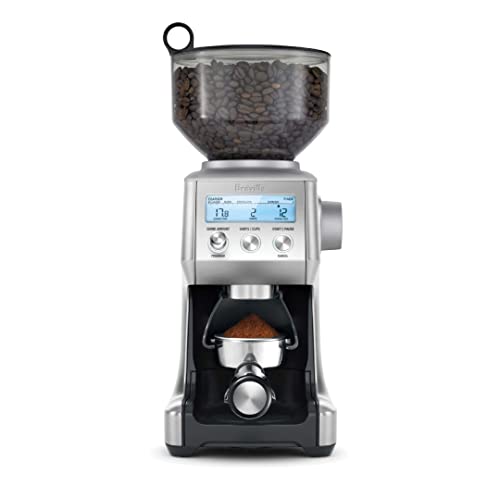
Breville Smart Grinder Pro BCG820BSS conical burr coffee grinder in brushed stainless steel

The Breville Smart Grinder Pro is the mid-range pick in my espresso grinder guide, and at $199.95 it is the machine most people land on when they accept that the grinder matters more than the machine. This Breville Smart Grinder Pro review covers what its 60 settings map to on Breville’s own chart, what the adjustable upper burr is for, why timed dosing is the real limitation, and the unusual shape of its rating distribution.

Quick Verdict

Score Price Rating Buy
8.0/10 $199.95 4.5★ (7,064) Check Price

Specifications

Spec Breville BCG820BSS
Burr type Conical burr, stainless steel
Grind settings 60, stepped
Dosing By time, programmable in 0.2 second increments
Motor 165 watts, 110-120 volts
Hopper capacity 18 oz on Breville’s US product page; the instruction book says 1 lb
Grinds into Portafilter, the supplied container, a gold tone basket or a paper filter
Portafilter cradles 50-54 mm and 58 mm, both included
Display LCD showing grind setting, grind time and shot or cup count
Weight 6.4 lbs
Warranty 1 year limited on Breville’s US product page; the Amazon description says 2 years

Who It’s For

  • Anyone pairing a grinder with an entry or mid-range espresso machine, where the grinder is the component actually limiting the shot
  • Households brewing more than one way — the 60-step range covers espresso through French press from the same machine
  • Anyone who wants to grind straight into the portafilter, since both common basket sizes are catered for in the box
  • People who value a repeatable button press over a ritual, which is what programmable timed dosing buys

Who Should Look Elsewhere

  • Anyone chasing the finest espresso adjustment. Sixty steps is a lot for a domestic grinder and still not stepless, and at the espresso end the gaps between steps are where dialling in gets frustrating
  • Anyone who wants dose by weight. This grinder measures time, not grams, and those are not the same thing
  • Single-method brewers on a budget. If you only make French press, a far cheaper grinder covers coarse grinding perfectly well
  • Anyone unwilling to run a machine with a known failure tail — see the rating distribution below

Grind Settings by Brew Method: Breville’s Chart

Breville’s instruction book splits the 60 settings into four bands, and it gives espresso half the dial. The table below is the coffee chart from the current US instruction book, including how much the SHOTS|CUPS button will dose for each method.

Settings Grind size Use the setting for Amount
1-30 Fine Espresso machines; stovetop percolator and moka machines 1 up to 5 shots
31-45 Medium Percolators with a coarse screen filter; drip coffee with a gold tone filter 1 up to 12 cups
46-54 Medium coarse Percolators with a fine screen filter; drip coffee with a paper filter; non-pump steam espresso 1 up to 12 cups
55-60 Coarse French press 1 up to 12 cups

Two of Breville’s groupings are worth noticing: moka pots sit in the espresso band, and paper-filter drip sits coarser than gold-tone drip. With a portafilter cradle fitted, the instruction book caps the dose at 2 shots.

For espresso, Breville recommends setting 12 as a starting point, moving the dial coarser or finer to adjust the flow alongside the grind amount. Its flow target is the traditional one: a single shot of 1 oz in 30 seconds and a double of 2 oz in 30 seconds. With dual-wall (pressurised) filter baskets it recommends starting at setting 30 and moving finer if needed, and with single-wall baskets and fresh beans it points to the finer 1–30 settings.

For French press, Breville’s tip is setting 58, water at 200°F and a 4-minute steep. Hands-on reviewers land nearby: Coffeeness found 9 to 11 ideal for espresso with its beans, around 30 for pour-over, 35 for a Hario V60 and around 37 for Chemex, while The Coffee Locator suggests starting around 34 for a V60.

Performance

Sixty settings, and where they run out

The adjustment range is genuinely wide: coarse enough for French press at one end, fine enough for espresso at the other, from a single machine. For most households that breadth is the reason to buy it rather than a cheaper single-purpose grinder.

The catch is that the settings are stepped rather than continuous. Breville’s chart gives settings 1-30 to espresso and moka, and spreads percolator, drip and French press across 31-60, where filter and press brewing tolerate a wider grind window. At the espresso end the steps matter more, because the right grind can fall between two of them. Breville’s answer is the adjustable upper burr below; the third-party workaround, which The Coffee Locator suggests when two settings straddle the ideal, is to nudge the dose or tamp pressure instead.

The adjustable upper burr: Breville’s fix for running out of range

The burrs are hardened stainless steel conical burrs (how conical burrs compare with flat ones is in the guide to coffee grinder types), and the upper one is removable and adjustable. Breville says some coffees need a wider grind range for an ideal extraction, and that the adjustable upper burr is how this grinder extends it. The default upper-burr setting is 6; Breville’s diagram says to move it one number coarser or finer, and recommends making only one adjustment at a time.

The procedure in the instruction book runs in this order:

  1. Unlock the hopper, release the beans into an airtight container, and set the hopper back in position.
  2. Run the grinder until it is empty, then remove the hopper.
  3. Remove the upper burr and take the wire handle off both sides of it.
  4. Move the burr one number coarser or finer, align the number with the handle opening, and refit the wire handle on both sides.
  5. Push the upper burr firmly into position, lock it, refit and lock the hopper, and check your extraction.

The hopper must be locked before the grinder will run: if it is not, the LCD shows “PLEASE LOCK HOPPER” and grinding is disabled. Breville’s diagram shows the default and single-step moves, but not how many upper-burr positions exist or where the range ends. Home Coffee Expert’s “600 possible grind settings” and Bean Poet’s “10 micro-adjustments” are those reviewers’ arithmetic, not Breville specifications.

The upper burr is also a spare part: Breville US lists a “Burr Assembly Upper (Pre 1926 PDC)” that works with the Smart Grinder Pro BCG820 and with the Barista Express BES870, Barista Pro BES878, Barista Touch BES880 and Barista Express Impress BES876. Breville does not explain the “Pre 1926 PDC” label, which looks like a production-date cut-off, so check the date code on your grinder before ordering. Its stock status changes, so check the part page on Breville’s site before relying on it.

Timed dosing is the real limitation

Dosing is by time, programmable in 0.2 second increments, with the count shown on the LCD. It is repeatable and it is convenient, and it is not the same as dosing by weight.

The reason matters: a given number of seconds does not always deliver the same mass of coffee, and The Coffee Locator attributes the drift to bean density and humidity. Anyone weighing shots should expect to retune the timer against the scale now and then, which is not a defect so much as the boundary of what timed grinders can do. If your shots are running inconsistently, the guide to an espresso machine not building pressure works through grind, dose and tamp in the order worth checking.

How the controls work, and the 2-minute limit

Every brew method is dosed by the digital timer. Press SHOTS|CUPS for the number of shots or cups, then turn the Grind Amount dial, where each click adds or removes 0.2 of a second. Press and hold PROGRAM and the grinder beeps twice to save that time to the count on the display, leaving the other counts unchanged. To return to Breville’s defaults, hold SHOTS|CUPS until a long beep.

Pushing the portafilter against the activation switch once starts an automatic dose, and holding it there grinds manually until you let go. Pressing START|PAUSE|CANCEL during grinding pauses it for 10 seconds so you can settle the coffee in the portafilter, and a second press resumes. Breville also says a correct dose looks overfilled in the basket, because untamped coffee is about three times the volume of tamped coffee.

The duty limit is specific. Breville says not to run the grinder for longer than 2 minutes at a time, to let it cool for at least 2 minutes after each use, and to allow 10-15 minutes after long operation. An automatic thermal safety shut-off protects the motor, and the grinder drops to standby after 5 minutes of non-use.

The troubleshooting table and notes in the instruction book cover the faults most likely to look like a breakdown:

Symptom Cause in the instruction book What the instruction book says to do
Will not start Overheated, or the hopper is not locked (“PLEASE LOCK HOPPER” on the LCD) Unplug it and leave it 20 minutes to cool; lock the hopper into position
Loud “racket” noise while the motor runs A foreign item or a blocked chute, or moisture clogging the grinder Remove the hopper, take out any foreign body, clean the burrs and chute, and let them dry fully; a hair dryer blowing into the lower-burr inlet is allowed
Hopper will not lock Beans obstructing the locking device Remove the hopper, clear the beans from the top of the burrs and relock
Grind size dial feels tight Grounds caught between the burrs Run the grinder while turning the dial

Breville also warns against grinding green or under-roasted beans, which it says are dense enough to damage or break the burrs.

Grinding into the portafilter

Both a 50-54 mm and a 58 mm cradle come in the box, which covers both common portafilter sizes. The 58 mm cradle takes the commercial-size baskets on machines like the Gaggia Classic Pro, and The Coffee Locator notes that the 54 mm size suits Breville’s own espresso machines. Grinding straight into the basket avoids a transfer step, and a transfer step is where dose gets lost.

What independent testing found

No measurement here is mine; the figures in this section are from TechGearLab. In its 2019 test it ground 21 g at a pour-over setting and sieved the result: about 83% of the grounds landed in the target size range, and it scored the Smart Grinder Pro 7.8 out of 10 for grind consistency, the highest grind-consistency score in its grinder ratings (the average was 5.7).

The weak spot it found is the coarse end, where the grinder produces more fine dust than other models; opening the machine and adjusting the burrs cut those fines by about half. For noise it gave 8.0 out of 10 against a 5.6 average, calling the sound relatively high-pitched but steady rather than whiny, though not the quietest. Two limits apply: the sieve test was at a pour-over grind, not an espresso grind, and the test dates from 2019, so read the numbers as a snapshot rather than a guarantee for a unit bought today.

Retention, Static and Purging

Breville’s answer to stale grounds in the chute is a purge: run the grinder for 2 seconds before each use. It also says not to store beans in the hopper but to put them back in an airtight container, and to run the grinder empty before storing it. The instruction book credits the grinding chamber with minimising static before the coffee is dispensed.

Breville gives no retention figure, and none of the reviews I read publishes one in grams. They also disagree. TechGearLab found minimal static, so the grinds container does not hang on to many grinds; its one cleanliness complaint was the container lid, whose opening is small enough to spit grounds onto the counter, which mostly stops with the lid off. Coffeeness says the grinder is known for chute retention issues, saw no problems in its own use, and still recommends purging for a second or two.

The Coffee Locator, which describes its review as based on manufacturer specifications and published owner feedback, calls retention moderate for a hopper-fed grinder, calls static a common complaint, and suggests misting the beans (RDT). Bean Poet lists the grinder among low-retention models, and Home Coffee Expert says it does not generate much static. The general fixes for clinging grounds are in the guide to coffee grinder static.

Design and Build

Breville lists a stainless steel housing and a weight of 6.39 lbs. Its US product page gives the hopper as 18 oz, while the instruction book calls it a 1lb bean hopper and Amazon’s details table says 1.1 pounds. The LCD is the practical part of the design rather than a flourish: seeing grind setting, time and count at once is what makes a change reproducible the next morning.

The 165 watt motor works to the 2-minute limit described above, so this is a grinder for doses rather than for bulk batches.

Cleaning and Maintenance

A cleaning brush is supplied and the upper burr lifts out for access. The job that actually matters is doing it regularly rather than thoroughly, because coffee oils build up and go stale in the chute and the grinds container. Breville’s own instruction book gives the burr-cleaning order and says no grinder part goes in the dishwasher; how it compares with other makers, including how often to clean, is in how to clean a coffee grinder.

Stale residue is also the usual explanation when a grinder seems to slow or clog rather than fail. The guide to a grinder that hums but does not grind covers the difference between a jam, an oil-caked burr and a genuinely dead motor.

Value

At $199.95 this sits above the entry-level burr grinders and well below the stepless espresso-focused machines that start around double. What the money buys is range plus repeatability, and for someone brewing espresso on a machine in the $300 to $600 bracket that is a sensible match rather than an overspend.

The judgement in my espresso grinder guide holds here: a capable grinder in front of a modest machine beats an expensive machine fed by a poor one. This is the grinder that makes that trade concrete at a mid-range budget.

Durability

The rating distribution is unusual and worth reading rather than averaging. Amazon shows 4.5 stars from 7,064 ratings, with 81% five-star, 8% four, 2% three, 2% two and 7% one-star. A one-star share more than three times the two-star share is a failure tail, not gradual dissatisfaction: most owners are very happy and a minority have something go properly wrong.

That shape argues for two things. Register it and keep the warranty paperwork, checking the term as you do: Breville’s US product page says 1 year, while the Amazon description says 2 years. Then exercise the machine properly in the first weeks rather than discovering a fault after the return window has closed.

Alternatives to Consider

  • The full grinder guide — where the cheaper and the stepless options sit, and what each price step actually changes
  • Espresso machines under $500 — the bracket this grinder is best matched to
  • The coffee section — French press, moka pot and the rest, if espresso is not settled yet
  • Manual vs electric grinder — what you give up and what you gain going hand-powered
  • Baratza Encore ESP — a direct rival at $199.95, the Breville’s usual price (checked 5 October 2026; the Breville itself was on sale at $159.95 that day). Its dial gives 20 fine steps for espresso and 20 wider steps for filter brewing, and the listing describes a pulse button and an on/off switch rather than timed dosing. Amazon shows it at 4.0 stars from 1,407 ratings, against 4.5 from 6,990 for the Breville on the same day.

Verdict

The Smart Grinder Pro is the sensible middle of the domestic grinder market, and it earns that position on range and repeatability rather than on any single specification. For a household brewing espresso and something else from the same beans, it is the machine that stops the grinder being the weakest part of the setup.

Its limits are honest ones: stepped adjustment, where the right espresso grind can fall between two settings, and dosing by time rather than weight. Neither matters much for filter and press brewing. Both matter if espresso is the whole point and you are already weighing shots, in which case the money is better spent further up the range.

Check Price on Amazon ↗

How This Breville Smart Grinder Pro Review Was Put Together

Plainly: this is research-based, not a hands-on test. I do not own this grinder, and nothing here should be read as a report from my own kitchen.

What it rests on: Breville’s current US instruction book, which supplies the grind chart, the upper-burr procedure, the duty limit and the troubleshooting table, and Breville’s US product page for the specification. Beyond those, it draws on TechGearLab’s 2019 test of this grinder, the hands-on review at Coffeeness, the research-based review at The Coffee Locator, and the rating distribution across 7,064 Amazon ratings, which is a stronger signal than the 4.5 average it produces.

What I could not establish: grind consistency at an espresso setting, which is the specification that would actually separate this grinder from its rivals. No manufacturer publishes it, and TechGearLab’s sieve test used a pour-over grind; its review does report consistent, close-to-ideal espresso extraction times, and Coffeeness found settings 9 to 11 suited its espresso, but neither is a particle-size measurement. Nothing here is a particle-size measurement of my own. Price and stock were read from Amazon.com on 6 September 2026 and will move.

Three conflicts are left on the page rather than resolved. The warranty is 1 year on Breville’s US product page, 2 years in the Amazon description and 1 year in Amazon’s own details table. The hopper is 18 oz on Breville’s US page, 1 lb in the instruction book and 1.1 pounds in Amazon’s details. TechGearLab’s review puts about 83% of its sieve sample in the desired range, while its best-grinders page says 43% in the ideal range with 14% in the extremes, and I could not establish why the two figures differ.

Frequently Asked Questions

Is the Breville Smart Grinder Pro good enough for espresso?

Yes for most domestic setups, with one caveat. Breville gives settings 1-30, half the dial, to espresso, but the adjustment is stepped rather than stepless. When the right grind falls between two steps, Breville’s answer is the adjustable upper burr; The Coffee Locator suggests adjusting dose or tamp.

What grind setting should I start on for espresso?

Breville recommends setting 12 as the starting point, then moving coarser or finer to reach about 1 oz in 30 seconds for a single shot or 2 oz for a double. With dual-wall pressurised baskets it recommends starting at setting 30 and moving finer if needed.

Does it grind directly into a portafilter?

Yes. Cradles for both 50-54 mm and 58 mm portafilters are included in the box, which covers both common portafilter sizes, including the 58 mm commercial basket size. Grinding straight into the basket avoids a transfer step where dose is easily lost, and a correct dose looks overfilled before tamping.

Does it dose by weight or by time?

By time, programmable in 0.2 second increments. That is repeatable but not the same as weighing: the same number of seconds can deliver a different mass of coffee, which The Coffee Locator puts down to bean density and humidity, so anyone weighing shots should retune the timer periodically.

What does the rating distribution say about reliability?

That opinion is polarised rather than lukewarm. Across 7,064 ratings, 81% are five-star and 7% are one-star, against only 2% two-star. That shape points to a minority experiencing outright failure rather than widespread mild disappointment, which is a reason to keep the warranty details to hand.

How long is the Breville Smart Grinder Pro warranty?

Breville’s US product page gives a 1 year limited warranty. The Amazon listing contradicts itself: its description says 2 years, while its details table says 1 year from the manufacturer. The instruction book points to breville.com for the length, so confirm the term when you register the grinder.

Is the Breville Smart Grinder Pro loud?

TechGearLab’s 2019 test scored it 8.0 out of 10 for noise, against a 5.6 average, and described the sound as relatively high-pitched but steady rather than whiny. Coffeeness reported 70-80 dB in its own review. TechGearLab says it is not the quietest, so expect to hear it.

If $200 is more than this job is worth to you, the OXO Brew Conical Burr review covers the half-price alternative and exactly what you give up.

Filed Under: Product Reviews

  • « Go to Previous Page
  • Page 1
  • Interim pages omitted …
  • Page 45
  • Page 46
  • Page 47
  • Page 48
  • Page 49
  • Interim pages omitted …
  • Page 70
  • Go to Next Page »

Recent Articles

  • Espresso Grind Size: How Fine to Grind and How to Adjust
  • Burr vs Blade Grinder: Which One Should You Buy?
  • Stainless Steel Pan Sticking? Causes and the Water Test
  • Carbon Steel Pan Rusting: What Makers Say to Do
  • Moka Pot Grind Size: What to Set and How to Dial It In

Search


HOME          Contact          Affiliate Disclosure          Terms of Service          Privacy Policy


kitchenwarecompare.com is a participant in the Amazon Services LLC Associates Program, an affiliate advertising program designed to provide a means for sites to earn advertising fees by advertising and linking to Amazon.com, Endless.com, MYHABIT.com, SmallParts.com, or AmazonWireless.com. Amazon, the Amazon logo, AmazonSupply, and the AmazonSupply logo are trademarks of Amazon.com, Inc. or its affiliates. As an Amazon Associate I earn from qualifying purchases.


Copyright © 2026 kitchenwarecompare.com, ALL RIGHTS RESERVED.