• Skip to primary navigation
  • Skip to main content
  • Skip to primary sidebar

Kitchenware Compare

  • Home
  • Product Reviews
    • Air Fryers
    • Coffee
    • Cookware
    • Flat Top Grills
    • Meat Thermometers
    • Food Processors
    • Knives
    • Pizza Ovens
    • Toaster Ovens
    • Juicers
  • Food Blog
  • Helpful Kitchen Tips
  • Data Studies
  • About
  • How I Review
  • Contact
You are here: Home / Archives for Product Reviews

BESWOOD 250 Review: Is the 10-Inch Slicer Worth the Price?

Last Updated October 8, 2026

Some links here go to Amazon. If you buy through one, I earn a commission at no extra cost to you.
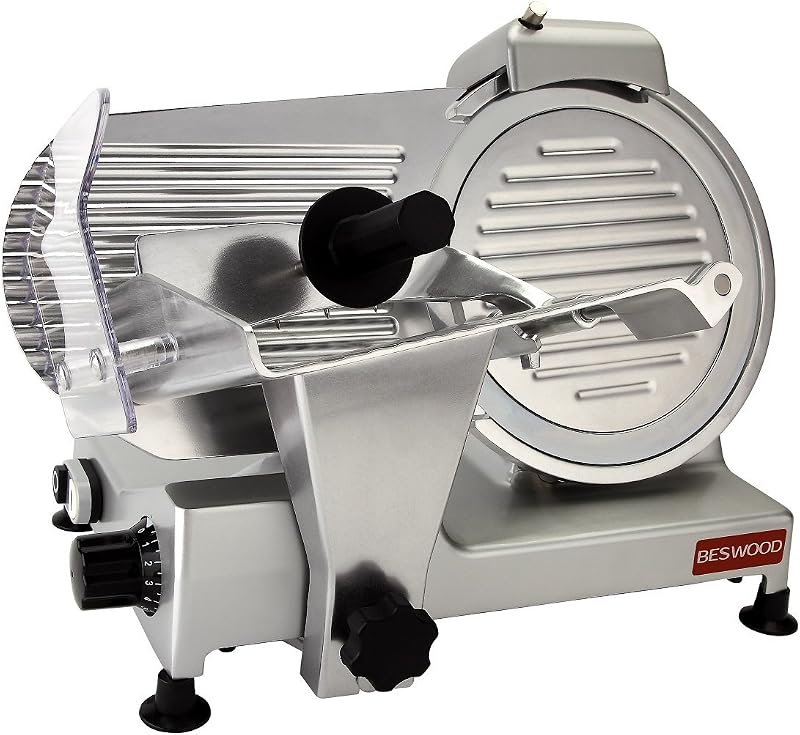
BESWOOD250 10-inch electric deli meat slicer with chromium-plated steel blade and aluminium body

Short version. The BESWOOD250 is a $358 machine that does one thing the $70–150 home slicers cannot: it keeps going. A 10″ chromium-plated blade turning at 282 rpm off a 240W, 1/3 HP motor will work through a whole brisket or a case of cheese without heating up or bogging down, and the top-mounted twin sharpening stones mean the edge is maintained on the machine rather than sent away.

It is also 33 pounds and takes up 20 inches of counter by 17 inches deep. If you slice deli meat twice a month, this is the wrong purchase and the CUSIMAX at around $110 does the same job for a third of the money. Buy the BESWOOD when volume, not capability, is what your current slicer is failing at.

Price and availability verified 2 September 2026: $358.00, in stock, sold on Amazon by BESWOOD directly rather than a reseller. Rating 4.6 out of 5 from 3,368 ratings.

Check Price on Amazon ↗

BESWOOD250 specifications

Blade 10″ high-carbon steel, chromium-plated
Motor 240W / 1⁄3 HP, 110–120V
Blade speed 282 revolutions per minute
Slice thickness 1–12 mm (about 0 to 1⁄2″)
Max cutting length 210 mm (8-1⁄4″)
Max cutting height 170 mm (6-7⁄10″)
Sharpener Built in, twin stones, top mounted
Weight 33 lb
Footprint 20″L × 17″W × 14.75″H
Certification ETL listed (see the certification section below)
In the box Machine, manual, cleaning brush, food-grade machine oil
Warranty 12 months from purchase

What the $358 actually buys

Almost every slicer sold for home use runs a direct-drive motor between 130W and 200W behind a 7.5″ blade. Those machines are sized for a task measured in minutes: a pound of turkey, a block of cheese, a few servings of prosciutto. The BESWOOD is sized for a task measured in pounds.

Three specifications carry that difference. The motor is 240W rated at 1/3 horsepower, which is roughly a fifth more power than the strongest of the home machines. The blade is 10 inches rather than 7.5, so a single pass covers 8-1/4 inches of cutting length instead of about 6. And the blade turns at a stated 282 revolutions per minute, which is deliberately unhurried — slicer blades are not meant to spin fast, they are meant to keep turning at a constant rate under load.

The body is aluminium rather than moulded plastic, which is most of the 33 pounds. Weight on a slicer is a feature and not a penalty: a machine that stays still while a blade turns against resistance produces more even slices than one that walks across the counter. It is the same reason a heavy stand mixer outperforms a light one.

The built-in sharpener is the part that matters most

The BESWOOD250 carries two sharpening stones mounted on top of the machine. You engage them against the blade and run it briefly, and the edge is restored in place.

This is easy to skim past on a spec sheet and it is the single biggest ownership difference between this machine and a $100 one. A slicer blade dulls. When a cheap slicer’s blade dulls, the realistic options are to buy a replacement blade or to live with a machine that tears rather than cuts, because sending a 7.5″ slicer blade out for sharpening costs a meaningful fraction of what the whole slicer cost. Neither option is good, and it is the reason a lot of budget slicers end up in a cupboard within two years.

A chromium-plated high-carbon blade with stones on the machine changes the arithmetic. The plating resists corrosion, so the edge does not pit between uses, and the stones mean maintenance is a two-minute job rather than a purchase.

Here is the number that makes the point. BESWOOD sells the original replacement blade for this machine directly, at $120.00 — a third of what the whole slicer costs, and more than the price of an entire budget slicer. It was also showing as sold out on their site when I checked on 2 September 2026, which sharpens the argument rather than softening it.

On a machine where a new blade costs $120 and may not be in stock when you want one, keeping the existing blade sharp is not a convenience feature. It is the difference between a long-term tool and a disposable one.

What it will and will not cut

The published capacity is 210 mm of cutting length by 170 mm of height, which in practical terms is a cut face of roughly 8-1/4 by 6-7/10 inches. That takes a whole turkey breast, a standing rib roast, a full deli-sized block of cheese, or a large salami along its length rather than at an angle.

Thickness runs from 1 mm to 12 mm. The bottom of that range is genuine deli-paper territory, and the top is a half-inch steak-cut. Most home slicers stop at 15 mm but cannot hold a setting at the thin end under load, which is the specification that actually matters: a slicer’s job is repeatability, and a dial that drifts by a millimetre between slices is what separates a machine from a toy.

What it will not do is cut bone, and no belt-driven slicer will. It is also not designed for hard-frozen meat. Semi-frozen — firmed in the freezer for 30 to 45 minutes so the fibres stiffen — is the standard technique for getting clean thin slices from raw meat, and a 240W motor is comfortable there in a way a 130W one is not. Solid-frozen is how blades get damaged, on this machine as on any other.

BESWOOD250 slicer showing the adjustable thickness dial and food carriage

The certification question, and why it is worth checking

This is the part of the listing I would treat carefully, and no other review of this machine seems to raise it.

The Amazon listing states one certification: USA standard approved: ETL Listed & Certified. ETL is an electrical safety mark, equivalent in function to a UL listing, and it is the certification that matters for plugging the machine in at home. On that point the sources agree and there is no ambiguity.

NSF is a different thing entirely. It certifies that equipment can be cleaned and sanitised to a standard health inspectors accept, and it is what a commercial kitchen is often required to have. BESWOOD’s own website is inconsistent here: one line of marketing copy on the product page lists the approvals as ETL and NSF, while the specification block further down the same page gives the certifications as ETL, GS, CE and ROHS, with no NSF among them. The Amazon listing does not mention NSF at all.

For a home kitchen this changes nothing; ETL is the relevant mark and it is confirmed. But this machine is sold as “for Commercial and for Home Use,” and if you are buying it for a business that gets inspected, do not take NSF certification from the product description. Ask BESWOOD to confirm it in writing before you order. If NSF is a hard requirement, the KWS MS-10NT at $394 states it explicitly on its listing, and my KWS MS-10NT review covers that machine in full, with the two set against each other in my BESWOOD vs KWS comparison.

Is it too much machine for a home kitchen?

For most people, yes. That is not a criticism of the machine, it is a description of who it is for.

The honest comparison is against the CUSIMAX, which is the Best Overall pick in my meat slicer buying guide at $109.78 with 8.7″ dual blades and a 200W motor. The BESWOOD costs $248.22 more. For that you get an inch and a bit more blade, about 20% more motor, an aluminium body instead of plastic, and the on-board sharpener.

Whether that is worth $248 depends entirely on one question: how much do you slice at a time? Below roughly a pound or two per session the CUSIMAX will not be the limiting factor in your kitchen and the extra money buys capability you never reach. Above that — a hunter processing a season, a household that buys whole roasts and portions them, anyone slicing for a market stall or a small deli counter — the cheaper machine starts overheating and the dial starts drifting, and the BESWOOD simply does not.

The specification that decides it

Duty cycle is the useful frame, even though no manufacturer in this category publishes one. A 130W to 200W direct-drive motor is designed for short runs with cooling gaps. A 1/3 HP motor in an aluminium housing is designed to run continuously. If you have ever stopped slicing because the machine got hot rather than because you were finished, that is the specification you are buying.

The same-price sibling almost nobody mentions

BESWOOD sells a second version of this machine on Amazon: the same 10″ 240W slicer in a red finish, listed at $358.00 — identical to the standard model — but with a removable serving plate included that the standard listing does not ship with.

It rates 4.6 out of 5, the same as the original, though from 219 ratings rather than 3,368. That is the trade: the same machine and the same price with an extra accessory, against a review base that is fifteen times smaller and a much shorter sales history. There is also a third variant, the BESWOOD250RX, which was showing as unavailable when I checked on 2 September 2026.

If the serving plate is useful to you, the red model is a free upgrade. If you would rather buy the version that thousands of people have already reported back on, the standard listing is the safer pick. Both are sold by BESWOOD rather than a third party.

Watch the blade size if you buy direct

BESWOOD’s own site sells this machine in both 9″ and 10″ blade sizes on a single product page, with 9″ selected by default and its specifications displayed until you switch. The 10″ is $358.00 there, the same as Amazon, so there is no saving in buying direct — but there is a way to accidentally order a smaller machine than you meant to.

What 3,368 ratings actually say

A star average on its own is close to useless, because a 4.6 from two hundred people and a 4.6 from three thousand are different claims about the world. Here is how the BESWOOD250’s rating breaks down, read off the listing on 2 September 2026.

Rating Share Approx. ratings
5 star 83% ~2,795
4 star 10% ~337
3 star 2% ~67
2 star 1% ~34
1 star 4% ~135

Ninety-three percent of buyers rated it four or five stars, which is a strong result on a sample this size. The interesting part is the shape at the bottom. The one-star share is larger than the two- and three-star shares combined, which means the negative feedback is not a gentle slope of mild disappointment — it is a large group who are very happy and a small group who are not happy at all, with very little in between.

I am not going to tell you why those roughly 135 people rated it one star, because Amazon now requires a sign-in to read filtered reviews and I have not read them. Anyone who tells you the cause without having read them is guessing. What the distribution supports is a narrower and more useful conclusion: whatever goes wrong for a small minority of buyers goes wrong badly rather than gradually.

The practical response is the same one that applies to any 33-pound appliance shipped by carrier. Unbox it, run it, and check the blade and the carriage properly within the return window rather than leaving the box in the garage for three weeks. That is cheap insurance on a purchase where the failure mode, whatever it is, appears to be binary.

It is also the reason to prefer this listing over the red variant if you are undecided. Both average 4.6, but 3,368 ratings resolve a distribution that 219 ratings cannot.

Setup, counter space and running costs

There is no assembly. The machine arrives built, with a manual, a cleaning brush and a bottle of food-grade machine oil, and the oil is a hint about the maintenance the manufacturer expects: the slide rod that the carriage travels on wants lubricating periodically so the stroke stays smooth.

Plan the counter space before it arrives rather than after. The footprint is 20 inches wide and 17 inches deep, which fits a standard 24- to 25-inch counter depth with room behind, but the number that catches people out is the clearance at the carriage end. The food carriage travels its full stroke out to one side, so the machine needs room beside it as well as under it, and a slicer wedged into a corner cannot use its own capacity.

At 33 pounds, this is not an appliance that gets lifted in and out of a cupboard between uses. Decide now whether you have somewhere it can live permanently, because a slicer that has to be hauled out is a slicer that stops being used — and that failure is much more common than any mechanical one.

Ongoing costs are otherwise close to nothing. The consumables are the oil and, eventually, a blade at $120.00, which the on-board stones exist to postpone.

Cleaning and maintenance

The slicer strips down without tools: the blade, the food carriage and the pusher all come off for washing. A cleaning brush and a bottle of food-grade machine oil are supplied, which tells you what the routine is meant to be — brush the seams, wash the removable parts, and oil the slide rod so the carriage keeps moving smoothly.

My guide to how to clean a meat slicer covers the full routine, including the step almost everyone skips. It is hand wash only. That is standard for slicers and it is not a shortcut the manufacturer is taking: dishwasher detergent is hard on a plated blade edge, and the plating is what stops the high-carbon steel underneath from corroding.

The thing to be disciplined about is the seams. Across verified-purchase reviews of slicers generally, trapped residue in places the machine does not open up is one of the two recurring complaints, alongside blades loosening over time. A machine that comes apart properly is easier to keep hygienic than one that does not, and that is worth more on a slicer than on most appliances. My guide to choosing a cutting board covers the same principle for the surface the sliced food lands on.

Who should skip it

  • Occasional slicers. If a slicer comes out once or twice a month for sandwich meat, this is roughly $250 of capability you will not use.
  • Small kitchens. 20 inches by 17 inches of counter, and 33 pounds. This is not a machine that gets lifted into a cupboard after each use, and a slicer that lives in a cupboard stops being used.
  • Anyone who needs NSF certification on paper. Confirm it directly with BESWOOD first, or buy a machine that states it.
  • Anyone hoping to cut frozen blocks or bone. Neither is what a belt-driven slicer does, at any price.

BESWOOD250 vs the alternatives

Slicer Best For Blade Price Rating
BESWOOD250 Volume slicing at home 10″ / 240W $358.00 4.6★ (3,368)
KWS MS-10NT When NSF is required 10″ / 320W $394.00 4.5★ (1,959)
CUSIMAX dual blade Most home kitchens 8.7″ / 200W $109.78 4.3★ (5,038)

The KWS is the closest thing to a direct competitor: a 10″ machine with a stronger 320W motor and a 304 stainless blade, $36 dearer and three pounds heavier. Its advantage is the explicit NSF statement and the extra motor; the BESWOOD’s advantage is a review base almost twice the size and a chromium-plated blade with the stones to maintain it.

The CUSIMAX is in the table because it is the machine most people buying a slicer should actually buy, and a review that does not say so is not being useful. Full comparisons for the home-priced machines are in my best meat slicers guide, and if slicing is only part of the prep problem, my food processors hub covers the chopping and shredding side.

How this review was researched

Plainly: I have not run this machine. This is a research-based review, not a firsthand account, and nothing in it is written as one.

What it rests on: the manufacturer’s published specification for the 10″ variant, cross-checked against the Amazon listing and against the figures third-party reviews report; live price, stock and seller status pulled on 2 September 2026; the pattern of complaints across the verified-purchase review base; and the certification claims read directly off both BESWOOD’s site and the Amazon listing, which is how the ETL and NSF discrepancy above surfaced.

What I could not establish: slice consistency under sustained load, which is the whole job of a slicer. Measuring it means slicing the same chilled product at one setting repeatedly and measuring every slice, and no independent test does that for this machine. Motor rating, blade diameter and body mass are used here as proxies for it, and a proxy is not a measurement.

Frequently Asked Questions

Is the BESWOOD250 worth it for home use?

Only if you slice in volume. The capability it adds over a $110 machine is sustained running and on-board sharpening, and both only pay back if you regularly slice more than a pound or two at a session. For occasional deli meat, a 7.5″ or 8.7″ home slicer does the same job for a third of the price.

Does the BESWOOD250 have a built-in sharpener?

Yes. Two sharpening stones are mounted on top of the machine and engage against the blade in place, so the edge is maintained without removing the blade or sending it out. Combined with the chromium plating on the high-carbon blade, that is the main reason this machine stays usable for longer than cheaper slicers.

Can the BESWOOD250 slice frozen meat?

Semi-frozen, yes; solid-frozen, no. Firming meat in the freezer for 30 to 45 minutes before slicing is the standard way to get clean thin cuts, and the 240W motor handles that comfortably. Cutting meat frozen through is how slicer blades get chipped, regardless of the machine.

Is the BESWOOD250 NSF certified?

The Amazon listing states ETL only. BESWOOD’s own site is inconsistent, with one marketing line claiming ETL and NSF while the specification block on the same page lists ETL, GS, CE and ROHS. If NSF matters for your kitchen, confirm it with BESWOOD before buying rather than relying on the listing.

How thin will it slice?

The thickness range is 1 mm to 12 mm, so from deli-paper at the bottom to roughly a half-inch cut at the top. The more useful question is whether a slicer holds its setting between slices under load, which is where heavier machines with stronger motors separate from budget ones.

What is the difference between the BESWOOD250 and the red BESWOOD model?

Mechanically nothing, as far as the listings show: both are the 10″, 240W machine at $358.00. The red version includes a removable serving plate the standard one does not. The standard model has 3,368 ratings against the red model’s 219, so you are choosing between an extra accessory and a much larger body of buyer feedback.

The bottom line

The BESWOOD250 is a genuinely capable machine at a fair price for what it is, and the specification that justifies the money is the on-board sharpener rather than anything about the motor. A slicer you can keep sharp is a slicer you still own in five years.

Buy it if volume is the thing your current slicer fails at, if you have the counter space to leave 33 pounds standing out, and if ETL rather than NSF is all the certification you need. If you are buying your first slicer and you are not sure how much you will use it, buy the CUSIMAX instead and spend the $248 you save on the meat.

See Today’s Price on Amazon →

Prices, ratings and stock verified 2 September 2026. Amazon pricing moves; check the current figure before buying.


If the BESWOOD is more machine than the job needs, the CUSIMAX review covers the home-duty alternative in full, including where its 200W motor stops.

Filed Under: Product Reviews

Typhur Sync Gold Review: The Only One That States Its Accuracy

Last Updated October 8, 2026

I earn a commission if you buy through the Amazon links below, at no extra cost to you.

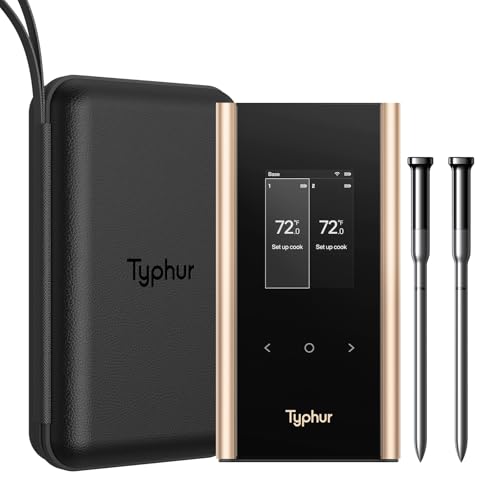
Typhur Sync Gold dual wireless WiFi meat thermometer with two probes, smart base and carrying case

The Typhur Sync Gold is the top pick in my brisket thermometer guide and the most expensive thermometer on this site at $145.34. It is the only one here that publishes the number that actually matters: ±0.5℉ accuracy with a half-second response, backed by NIST-traceable calibration.

That is the headline argument. The more interesting one turned out to be the radio. This is not a WiFi thermometer in the way most people mean it, and the difference explains both why owners rate its signal so highly and the one situation in which it reliably fails.

Quick Verdict

Score Price Rating Buy
8.5/10 $145.34 4.5★ (562) Check Price on Amazon

What Comes in the Box

Typhur Sync Gold contents: hard carrying case, smart base with display, and two probes

What you actually get: the hard case, the base, and two probes. The case is not an afterthought here.

Two probes, the smart base, a hard carrying case and a charging cable. The case matters more than it sounds. Probes are the part that gets bent, lost in a drawer or thrown out with the foil, and a moulded case is the difference between owning two working probes in a year and owning one.

Two probes is also the ceiling. There is no four-probe version of this model, so if you want to track three cuts and the chamber at once, this is the wrong tool regardless of how good it is.

Specifications

Model Typhur Sync Gold (dual probe)
Probes Two, each with 5 internal sensors plus 1 ambient tip sensor
Stated accuracy ±0.5℉, 0.5-second response, triple-calibrated
Probe → base link Sub-1 GHz radio, up to 3,000 ft unobstructed
Base → phone link WiFi, via the Typhur app
Standalone use Yes — the base displays readings and sets targets with no phone
Heat rating Up to 932℉
Water rating IPX8; Typhur states the probes are dishwasher safe
Materials Stainless steel and ceramic
In the box Base, 2 probes, hard carrying case, charging cable
Certification CE, FCC, NIST, RoHS

Why a Stated Accuracy Figure Is Worth Paying For

Diagram showing five internal sensors and one ambient sensor reading different points in a steak

Typhur’s own diagram: five sensors down the shaft read the meat at different depths, a sixth reads the air. The lowest of the five is the number that matters.

Almost no wireless meat thermometer publishes an accuracy tolerance. TempPro does not. Weber does not. They publish range, probe count and battery life, because those are easy to market and impossible to dispute.

Typhur states ±0.5℉ and backs it with NIST certification. That matters more than it sounds: NIST is traceable calibration, which is a different class of claim from the NSF mark on cheaper thermometers. NSF says the probe is safe to put in food; NIST says the reading has been checked against a standard.

Whether you need it is a fair question. For a steak, no — two degrees either way is invisible. For a brisket held at 203℉ through a twelve-hour cook, or for anyone cooking to a food-safety threshold rather than to taste, a known tolerance is worth real money. I go into how far to trust these readings in are wireless meat thermometers accurate.

One caveat before the marketing carries you away: among the Amazon reviews, one owner reports noticeable variance between the two probes when placed inches apart in the same cut. A stated tolerance is a manufacturing claim, not a guarantee about your particular unit.

Who It’s For

  • Long cooks where a couple of degrees compounds — brisket, pork shoulder, overnight smokes
  • Anyone who wants a stated, certified accuracy figure rather than a marketing range
  • Cooks with a ceramic kamado or a thick metal smoker, where Bluetooth thermometers routinely drop out
  • Anyone who wants readings without reaching for a phone — the base displays them on its own
  • Cooks who want to leave the property entirely while something is on the smoker

Who Should Look Elsewhere

  • Anyone tracking more than two things at once — two probes is the hard limit here
  • Anyone who wraps in foil mid-cook and needs the signal to survive it — see the range section below
  • Cooks working with thin cuts — fish, cutlets, thin chicken — where the probe cannot be buried deep enough
  • Buyers who want a large body of owner feedback; 562 ratings is the thinnest sample of the three thermometers here
  • Anyone on a budget — this is three and a half times the price of the four-probe TempPro

Performance

Six sensors per probe, and what they are for

Each probe carries five internal sensors along its length plus one ambient sensor at the tip. The internal sensors read the meat at different depths, which is how the app can report the coolest point rather than whatever the tip happens to be touching.

The ambient sensor is the one that earns its keep on a smoker. Chamber temperature and meat temperature from the same probe means you are not spending a second probe just to watch the pit, which partly offsets having only two to begin with.

Partly, not entirely. Several owners point out that the ambient tip sits exposed above the meat, and in a hot smoker that exposed section runs close to its own limit. The workarounds owners describe — a silicone sleeve, or burying the tip in a potato — are not supplied in the box.

It is not really a WiFi thermometer, and that matters

Diagram showing probes connecting to the smart base over Sub-1GHz and the base connecting to the Typhur app over WiFi

The actual architecture. The probes never speak WiFi — they reach the base over a Sub-1 GHz radio, and only the base talks to your phone.

This is worth being precise about, because the category is loose with the word. The probes do not connect to your home network. They reach the base over a Sub-1 GHz radio, and the base is what connects to WiFi and pushes readings to the app.

The first consequence is the good part. Sub-1 GHz generally penetrates dense material further than the 2.4 GHz that Bluetooth thermometers use, which is why this model gets recommended for ceramic kamados and thick steel smokers where a MEATER or an iGrill loses the plot. Owners say exactly that, unprompted and repeatedly.

The second is that the WiFi half is what lets you leave the house, and it depends on your home network. A router reboot mid-cook takes your remote monitoring with it, though the base keeps reading and logging regardless. The general trade-off is in Bluetooth vs WiFi meat thermometers.

Range, and the one thing that reliably breaks it

Typhur image showing the smart base reading a cook inside a ceramic kamado grill at up to 3,000 feet

Typhur claims up to 3,000 ft unobstructed. Owners broadly back the signal — with one specific exception.

Typhur claims up to 3,000 ft unobstructed. Treat that as the usual line-of-sight number, but the weight of owner feedback here is unusually consistent: people who had given up on Bluetooth units say this one holds a connection from a smoker at the far side of the house.

Then there is the exception, and it is a real one. More than one owner reports losing both probes at the moment they wrapped the meat in foil to push through the stall. Foil is a metal skin around the transmitter, and no radio gets a free pass through it.

That deserves stating plainly rather than burying, because wrapping is standard practice on exactly the long brisket cooks this thermometer is sold for. It is physics rather than a defect, and it applies to every wireless probe on the market. But if your method involves foil, know it before spending $145.34 on range.

The base is a real control unit, not a charger

Typhur Sync Gold smart base held in a hand showing live temperature readings beside a roast joint

The base sets targets and shows live readings on its own. No phone in the loop.

The standalone base shows live readings and lets you set target temperatures without a phone, which is genuinely uncommon at any price. Most rivals are phone-only, and a phone-only thermometer is one dead battery away from being a paperweight.

Owner opinion on the software splits harder than on anything else. Some call the app among the best cooking apps they have used; others say it is a thermometer and a timer with a software package bolted on, and complain specifically about weak audible alerting. If app polish is part of what you are buying, that split is worth weighing.

Design and Build

Typhur Sync Gold base and hard carrying case beside a portable charcoal grill on a mountainside

The hard case is the reason the probes survive being carried anywhere.

A gold-finished base with two probes and a hard carrying case. Probes are rated to 932℉ and IPX8, in stainless and ceramic, and Typhur states they are dishwasher safe — which the Weber iGrill 3, for comparison, explicitly is not.

Finish is the thing owners mention first and most consistently: it reads as expensive, and at $145.34 it ought to. Whether that matters to you is a separate question from whether the sensor package does.

What Owners Report

I have not cooked with this thermometer. What I can do is read what several hundred people who own one say about it, and the themes that recur are more useful than any single verdict. Here is what comes up repeatedly on both sides, as of 7 September 2026.

What recurs in the positive reviews

  • Signal, overwhelmingly. Owners who had abandoned MEATER and other Bluetooth units describe this one holding a connection through ceramic kamados, cast-iron Dutch ovens and across a house. It is the single most repeated point.
  • Build and finish. Described as solid and well made, with the case singled out.
  • Customer support. Several owners whose first unit failed report a fast, no-argument replacement. That matters when weighing the reliability complaints below.
  • Accuracy in practice. Owners replacing the wired probes bundled with their smoker consistently say the readings are closer to what they expect.

What recurs in the critical reviews

  • Foil kills the signal. Reported independently by owners wrapping brisket and chuck roast, and by one using a lidded Dutch oven.
  • Probe hardware failures. Separate reports of a probe physically detaching after a few uses, and of probes losing pairing with the base and never recovering — including on a replacement unit.
  • Ambient measurement is fiddly in a smoker. The exposed section needs a cover or a clip that Typhur does not supply.
  • Wrong tool for thin food. Fish, thin chicken and small cuts do not let you bury the probe past its heat limit.
  • Battery mismatch between probes. At least one owner reports one probe draining in about four hours while the other stays near full.
  • Charging fragility. One owner describes a unit going into overcharge protection and not recovering after being charged from a USB-C power bank.

Read together, the pattern is a product whose radio and finish are genuinely strong and whose probe hardware is the weak link, sold by a company that replaces failures quickly. That is a different proposition from “it is accurate”, and it is not something a specification sheet will ever tell you.

Value

$145.34 buys two probes. The TempPro TempSync 650ft buys four for $39.99. On probe count alone this looks indefensible, and if probe count is your constraint it is.

What the money actually buys is a stated and certified accuracy figure, a Sub-1 GHz radio that gets through material 2.4 GHz does not, six sensors per probe rather than one, a base that works without a phone, and a 932℉/IPX8 build. None of those appear on the cheaper machines at any price. It is a specialist purchase, not a better version of the same thing.

Durability

On 7 September 2026, across 539 ratings, the distribution ran 82% five-star, 7% four, 4% three, 1% two and 6% one-star. That 82% five-star share was the highest of any thermometer in my guide then; the average has since slipped to 4.5, level with the TempSync and iGrill 3.

The sample is the problem. 562 ratings against the TempPro’s 10,333 is an eighteen-fold difference, and a thin sample cannot show the failure that arrives in year two. The 6% one-star tail is also the highest of the three, and reading those reviews it is mostly probe hardware rather than electronics — consistent with the themes above, but on too small a sample to call a pattern.

Alternatives to Consider

  • TempPro TempSync 650ft — $39.99. Four probes, 650ft Bluetooth and 10,333 ratings. The better buy for most people, and the one to get if probe count matters more than precision.
  • Weber iGrill 3 — $40.00. Bluetooth, two probes, a 250-hour battery, and built to dock into Genesis II and Spirit II grills. Now priced like the TempSync but with a 38% critical share, so it is most useful if you own one.
  • See the full ranking in my wireless meat thermometer guide.

Verdict

The Typhur Sync Gold is the thermometer to buy if you care about being right rather than being covered. A stated ±0.5℉ with NIST behind it, six sensors per probe, a Sub-1 GHz radio that gets out of a ceramic kamado, and a build rated to 932℉ is a genuinely different product from the $40 four-probe alternative.

It is also three and a half times the price for half the probes, resting on about an eighteenth of the evidence, and owner reports put the probe hardware ahead of the electronics as the thing most likely to fail. If you smoke seriously, cook on something Bluetooth cannot escape, and do not wrap in foil, it earns the money. If you want to watch four things at once on a Sunday, buy the TempPro and keep the hundred and five dollars.

Check Price on Amazon

How This Review Was Put Together

Plainly: this is research-based, not a hands-on test. I have not owned or used this thermometer, and nothing here should be read as a report from my own kitchen.

What it rests on: the published specification — probe count and sensor layout, stated accuracy and response time, the radio architecture, heat and water ratings, and certification marks — read against the other thermometers in my brisket thermometer guide; the shape of the rating distribution across 562 Amazon ratings rather than the 4.5 average it produces; and the text of the positive and critical reviews, read for themes that recur across independent owners.

Why owner reviews are treated as evidence here: one reviewer cooking on one unit for a fortnight cannot show a probe detaching after five uses, or a signal dropping the moment foil goes on. Several hundred owners over months can. A theme is only reported above where more than one unconnected owner raised it.

What I could not establish: whether the ±0.5℉ figure holds on a given unit, since one owner reports probe-to-probe variance; long-term reliability, which 562 ratings cannot yet show; whether the 6% one-star share reflects early production or a persistent fault; and real WiFi behaviour on a weak home network, which no manufacturer publishes.

Price, stock and rating counts were read from Amazon’s US marketplace on 7 October 2026 and will move. The star-share breakdown and review themes above are from 7 September.

Frequently Asked Questions

Is the Typhur Sync Gold WiFi or Bluetooth?

Neither, exactly. The probes reach the base over a Sub-1 GHz radio, and the base connects to your home WiFi to reach the app. That two-hop design is why it holds a signal through a ceramic kamado where Bluetooth thermometers drop out, and it is also why the remote monitoring depends on your router.

Does the signal work if I wrap the meat in foil?

Often not. Several owners report losing both probes at the moment they wrapped to push through the stall, and one reports the same inside a lidded Dutch oven. Foil is a metal skin around the transmitter. This applies to every wireless probe, not just this one, but it matters here because wrapping is standard on the long cooks this thermometer is sold for.

How accurate is the Typhur Sync Gold?

Typhur states plus or minus 0.5 degrees Fahrenheit with a half-second response, and the unit carries NIST certification. It is the only thermometer in my guide that publishes an accuracy tolerance at all. One owner does report noticeable variance between the two probes placed inches apart, so treat the figure as a manufacturing claim rather than a guarantee about your unit.

How far does it actually reach?

Typhur claims up to 3,000 feet unobstructed. That is a line-of-sight number, but owner feedback on range is unusually consistent and positive: people who had given up on Bluetooth units report holding a connection from a smoker at the far side of a house.

How many probes does it come with?

Two, and two is the limit on this model. Each carries five internal sensors plus an ambient sensor at the tip, so a single probe reads both the meat and the chamber. The $39.99 TempPro ships four probes if raw count is what you need.

Can the probes go in the dishwasher?

Typhur states they are dishwasher safe, and rates them IPX8 in stainless steel and ceramic. The Weber iGrill 3, by contrast, explicitly must not be submerged.

Can I use it for fish or thin chicken?

It is a poor fit. Owners report that the probe has to be buried past a certain depth to keep its upper section below its heat limit, and thin cuts do not allow that. This is a tool for roasts, briskets, pork shoulders and whole birds.

Is it worth three and a half times the price of the TempPro?

Only for the precision and the radio. You are paying for a stated and certified accuracy figure, a Sub-1 GHz link that gets through dense material, six sensors per probe, a standalone base and a 932-degree IPX8 build. On probe count and on weight of buyer evidence the cheaper TempPro wins comfortably.

Filed Under: Product Reviews

TempPro 500FT Wireless Meat Thermometer Review

Last Updated October 8, 2026

This post contains affiliate links. If you buy through my links, I may earn a commission at no extra cost to you. Read the full disclosure.

Updated 7 October 2026. An earlier version of this page said the 500FT was discontinued. That was wrong — it is still on sale at $33.99, rated 4.5 stars across 14,322 ratings. If you want double the range, the TempSync 1000FT is $44.99.
Part of my meat thermometer guide — all reviews, comparisons, and buying advice in one place.

With the TempPro 500FT Wireless Meat Thermometer, you can have the freedom to move around and enjoy your grilling or smoking experience without being tied down by wires. In this article, I’ll delve into the features and benefits of this Bluetooth thermometer.

You’ll learn about its impressive range of up to 500 ft, the convenience of its dual temperature sensors, and how it can be controlled through an app. Plus, I’ll talk about its intelligent cooking system that helps you achieve perfect results every time. Say goodbye to overcooked meat and hello to stress-free cooking with the TempPro 500FT Wireless Meat Thermometer!

TempPro 500FT Wireless Meat Thermometer for Grilling and Smoking, Bluetooth Meat Thermometer Wireless with Dual Temperature Alert, Digital Food Cooking BBQ Thermometer for Smoker, Oven Rotisserie

Check out the TempPro 500FT Wireless Meat Thermometer for Grilling and Smoking, Bluetooth Meat Thermometer Wireless with Dual Temperature Alert, Digital Food Cooking BBQ Thermometer for Smoker, Oven Rotisserie here.

I earn a commission if you buy through the Amazon links in this review, at no extra cost to you.

Check Price on Amazon →

Features and Benefits

The TempPro 500FT Wireless Meat Thermometer for Grilling and Smoking is built around one standout feature: a 500-foot Bluetooth range. Here’s a closer look at what it offers:

Wireless Range

The built-in Advanced 5.2 Bluetooth Technology allows you to receive signals from up to 500 ft away. No additional setup or pairing is needed, ensuring a hassle-free experience. This wide range provides you with the freedom to move around without worrying about losing the signal.

Cordless Operation

Say goodbye to tangled wires and messy setups. The TempPro 500FT operates independently once inserted, freeing you from the hassle of dealing with cables. It works across ovens, grills, smokers, and rotisseries, and the app connection holds through all of them.

Dual Temperature Sensors

Equipped with two temperature sensors, the wireless meat thermometer can simultaneously monitor internal meat temperatures up to 212°F and ambient temperatures up to 572°F with an accuracy of ±1.8°F. This allows for precise and reliable temperature readings, giving you full control over your cooking.

App Remote Control

The TempPro 500FT comes with a dedicated app that acts as your personal sous-chef. With this app, you can monitor real-time temperatures, customize cook alerts, and receive notifications when your meat is ready. This intuitive interface allows you to easily cook anything you desire and achieve perfect results every time.

Intelligent Cooking System

The built-in real-time temperature chart and time estimate algorithm make cooking a breeze. With the TempPro 500FT, you can make quick adjustments to the heat and manage your time efficiently. It removes the guesswork of judging doneness by touch or time alone.

Ways to Use It

The TempPro 500FT Wireless Meat Thermometer offers a wide range of uses that can enhance your cooking experience. Here are a few examples:

  1. Grilling: Monitor the internal temperature of your steak or burger to achieve the desired level of doneness without any guesswork.
  2. Smoking: Keep track of the temperature inside your smoker and ensure that your meat is cooked to perfection.
  3. Oven Cooking: With the TempPro 500FT, you can monitor the temperature of your roasts, casseroles, and baked goods without opening the oven door.
  4. BBQ: Achieve consistent results by monitoring the temperature of your BBQ ribs, chicken, or brisket throughout the cooking process.

TempPro 500FT Wireless Meat Thermometer for Grilling and Smoking, Bluetooth Meat Thermometer Wireless with Dual Temperature Alert, Digital Food Cooking BBQ Thermometer for Smoker, Oven Rotisserie

Learn more about the TempPro 500FT Wireless Meat Thermometer for Grilling and Smoking, Bluetooth Meat Thermometer Wireless with Dual Temperature Alert, Digital Food Cooking BBQ Thermometer for Smoker, Oven Rotisserie here.

Product Specifications

To help visualize the specifications of the TempPro 500FT Wireless Meat Thermometer, here is a handy table:

Specification Details
Bluetooth Technology Advanced 5.2
Wireless Range Up to 500 ft
Temperature Range Internal: Up to 212°F
Ambient: Up to 572°F
Temperature Accuracy ±1.8°F
Battery Life 36 hours or more
Compatibility App available for iOS and Android devices
Probe 1 probe included

Who Is It For

The TempPro 500FT works best for anyone doing longer cooks (smoked briskets, whole roasts) where checking the oven or grill directly means losing heat. It’s built for anyone who wants a second set of eyes on the grill while they step away. It is particularly useful for those who enjoy grilling, smoking, and oven cooking. The setup takes a few minutes and doesn’t require any prior experience with smart kitchen gear.

TempPro 500FT Wireless Meat Thermometer for Grilling and Smoking, Bluetooth Meat Thermometer Wireless with Dual Temperature Alert, Digital Food Cooking BBQ Thermometer for Smoker, Oven Rotisserie

Pros and Cons

  • Pros:
    • Wide wireless range of up to 500 ft for convenient monitoring.
    • Cordless operation eliminates the hassle of tangled wires.
    • Dual temperature sensors provide accurate readings for both internal and ambient temperatures.
    • App remote control offers real-time temperature monitoring, customizable alerts, and notifications.
    • Intelligent cooking system with a real-time temperature chart and time estimate algorithm.
    • Use for grilling, smoking, oven cooking, and BBQ.
  • Cons:
    • Requires a compatible smartphone or tablet for app control.
    • Ships with two probes, but spares are sold separately and are not cheap.

FAQ’s

  1. How does the TempPro 500FT connect to my smartphone?
    • The TempPro 500FT uses Bluetooth 5.2 technology to establish a wireless connection with your smartphone or tablet. Simply download the app, follow the instructions for pairing, and you’re ready to go!
  2. Can the probe be washed in a dishwasher?
    • Yes, the probe of the TempPro 500FT is dishwasher-safe.
  3. Does the thermometer have an alarm feature?
    • Yes, the app allows you to set custom cook alerts and receive notifications when your meat reaches the desired temperature, eliminating the risk of overcooking.
  4. Can the TempPro 500FT be used with other cooking appliances like an air fryer?
    • Absolutely! The TempPro 500FT is suitable for use with various cooking appliances including air fryers, so it works across several appliances.

TempPro 500FT Wireless Meat Thermometer for Grilling and Smoking, Bluetooth Meat Thermometer Wireless with Dual Temperature Alert, Digital Food Cooking BBQ Thermometer for Smoker, Oven Rotisserie

What Customers Are Saying

Customers who have used the TempPro 500FT Wireless Meat Thermometer are highly satisfied with its performance. They appreciate the convenience of the wireless range, the accuracy of temperature readings, and the user-friendly app control.

Many users have praised how the thermometer has helped them achieve perfectly cooked meat without any guesswork. The intuitive interface and intelligent cooking system have also received positive feedback for simplifying the cooking process. Overall, the reviews that mention the TempPro 500FT most often cite the long range and the simple setup.

Overall Value

The TempPro 500FT Wireless Meat Thermometer is a valuable addition to any kitchen. With its advanced features, accurate readings, and user-friendly design, it offers great value for its price. The convenience of wireless monitoring, along with the app control and intelligent cooking system, sets this thermometer apart from its competitors. It’s a straightforward tool: pair it once, then check the app instead of opening the oven or grill lid.

TempPro 500FT Wireless Meat Thermometer for Grilling and Smoking, Bluetooth Meat Thermometer Wireless with Dual Temperature Alert, Digital Food Cooking BBQ Thermometer for Smoker, Oven Rotisserie

Tips and Tricks For Best Results

To get the best results with the TempPro 500FT Wireless Meat Thermometer, here are a few tips and tricks:

  1. Ensure the probe is properly inserted into the meat for accurate temperature readings.
  2. Clean the probe thoroughly after each use to maintain hygiene and prolong its lifespan.
  3. Experiment with different temperature settings and cooking times to discover your preferred level of doneness.
  4. Use the real-time temperature chart and time estimate algorithm to optimize your cooking process and achieve consistent results.

How This Review Was Put Together

Plainly: this is research-based, not a hands-on test. I have not owned or used this, and nothing here should be read as a report from my own kitchen.

What it rests on: the published specification – probe count, the 500ft range claim and how it is achieved, maximum probe and ambient ratings, battery arrangement and app features; plus the pattern across verified-purchase reviews, where the recurring theme for range-claiming thermometers is the gap between the number on the box and what happens through a wall.

What I could not establish: the range, which is the entire product claim. 500ft is a line-of-sight figure and no independent measurement covers it. Treat it as a class indicator, not a distance you can rely on from a kitchen.

Conclusion

In conclusion, the TempPro 500FT Wireless Meat Thermometer covers the core job: reading temperature remotely without opening the lid. With its advanced features, wide wireless range, accurate temperature readings, and user-friendly app control, it simplifies the cooking process and ensures delicious results. The 500ft range covers most backyard setups, including smokers parked well away from the house. Invest in the TempPro 500FT and take your cooking to new heights!

Get your own TempPro 500FT Wireless Meat Thermometer for Grilling and Smoking, Bluetooth Meat Thermometer Wireless with Dual Temperature Alert, Digital Food Cooking BBQ Thermometer for Smoker, Oven Rotisserie today.

If you still aren’t sure if this is the device for you, please check out my roundup of Best Bluetooth Meat Thermometers. For more wireless-specific options, my Best Wireless Meat Thermometers guide covers the category in full, and my guide to wireless thermometer accuracy covers how reliable this kind of remote reading really is.

Filed Under: Product Reviews Tagged With: Review, TempPro, Wireless Meat Thermometer

MEATER+ vs MEATER Pro Duo: Which Wireless Meat Thermometer Should You Buy?

Last Updated October 12, 2026

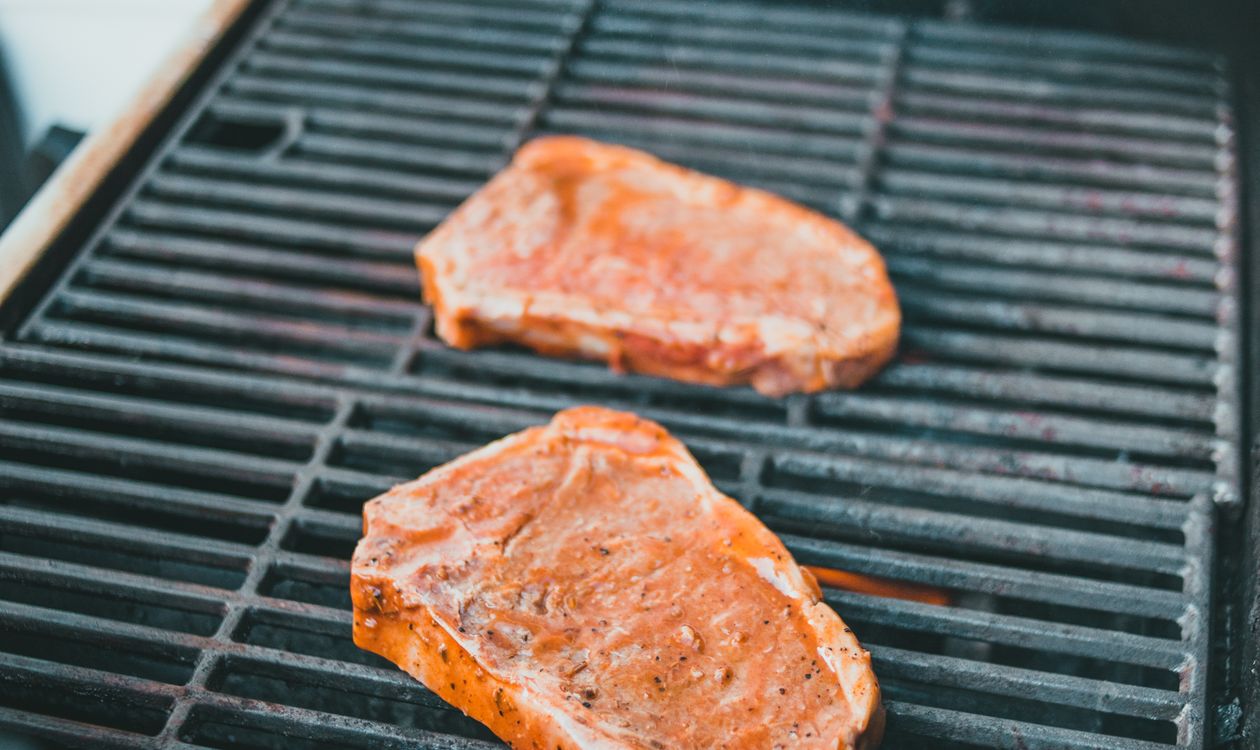
Two steaks grilling outdoors, comparing wireless meat thermometers

This post contains affiliate links. If you buy through my links, I may earn a commission at no extra cost to you. Read the full disclosure.

The quick answer

The MEATER+ is the right choice for most home cooks — it does everything you need for a single protein and has a 165-foot wireless range. The MEATER Pro Duo is genuinely worth the upgrade if you regularly cook two proteins simultaneously, or if you want the extended range and dual-zone precision. Most people should start with the MEATER+.

MEATER+ Wireless Smart Meat Thermometer
MEATER Pro Duo Wireless Meat Thermometer

A wireless meat thermometer changes how you cook. Without one, the alternatives are cutting into roasts to check doneness and losing juice every time, or relying on timing charts that never quite match your own oven. With one, the probe goes in, the target temperature goes into the app, and an alert tells you when it is time. Better results, less standing over the oven.

The question is whether you need one probe or two, and whether the Pro Duo’s extra features justify its higher price. Here is how the two compare.

ProductBest ForPriceRatingBuy
MEATER PlusBest for Most Cooks$79.994.3★ (48,552)Check Price
MEATER Pro DuoBest for Two Proteins$179.993.7★ (1,351)Check Price
Feature MEATER+ MEATER Pro Duo
Number of probes 1 2
Wireless range 165 ft (50m) 1,600 ft (490m) with WiFi
Connectivity Bluetooth Bluetooth + WiFi
Internal temp range Up to 212°F (100°C) Up to 212°F (100°C)
Ambient temp range Up to 527°F (275°C) Up to 527°F (275°C)
App guided cooking Yes Yes
Charger/storage Bamboo block Compact charging dock
Typical price ~$80 ~$180

One probe vs two: when it actually matters

One probe handles the vast majority of cooking scenarios: a whole chicken, a leg of lamb, a beef tenderloin, a thick pork chop. One protein, one probe, done. The MEATER+ handles all of this perfectly.

Two probes become genuinely useful when you’re cooking two proteins at the same time — a chicken and a leg of lamb, or two different cuts of beef at different target temperatures. They’re also useful for large birds where you want to monitor both the breast and the thigh independently, since they finish at different temperatures.

The honest question is: how often do you actually cook two proteins simultaneously? For most home cooks, the answer is rarely. For those who do Sunday meal preps or regularly host dinner parties, the Pro Duo earns its cost.

Wireless range: does it matter?

The MEATER+ has a 165-foot Bluetooth range, which is enough to monitor your grill from inside the house in most situations. The Pro Duo has WiFi connectivity, extending its range to 1,600 feet — effectively anywhere you have a phone signal.

The WiFi range matters if your grill is at the far end of a large garden, or if you cook low-and-slow for hours and want to monitor from the sofa without staying near a window. For a typical backyard or kitchen oven cook, the MEATER+ range is more than adequate.

The app experience

Both use the same MEATER app, which is genuinely good. The guided cook feature walks you through resting time and estimated finish times. It is one of the better-regarded cooking apps in the category — enough information without overwhelming you, and well-timed notifications.

Probe durability

Both probes use the same stainless steel construction and the same dual-sensor design (one sensor for internal meat temperature, one for ambient temperature). Both are dishwasher-safe. I haven’t seen meaningful durability differences between the two lines over long-term use.

Buy the MEATER+ if…

  • You cook one protein at a time (which most people do)
  • Your grill or oven is within 50 metres of where you’ll be monitoring
  • You want the most cost-effective wireless thermometer available
  • You’re new to probe thermometers

Buy the MEATER Pro Duo if… See my full meat thermometer buying guide for how this compares across the whole category.

  • You regularly cook two proteins at different target temperatures
  • You want WiFi range for monitoring from anywhere
  • You do long low-and-slow cooks (briskets, pulled pork) and want remote monitoring
  • You host regularly and cook for larger groups

The verdict

The MEATER+ is the right starting point for almost everyone. Buy the Pro Duo if you’re certain you need two probes or the extended WiFi range. If you’re not certain, start with the MEATER+ — it will change how you cook.

See MEATER Plus Price →
See MEATER Pro Duo Price →
Related: Best Bluetooth Meat Thermometer 2026: Full Buying Guide
Related: MEATER Plus Wireless Thermometer Review
Related: Guide to Buying Outdoor Cooking Equipment

How This Comparison Was Put Together

Plainly: this is a research-based comparison, not a hands-on test. I have not run these two side by side.

What it rests on: the published specification for both – probe count, stated wireless range and whether it is direct or via a repeater block, maximum ambient and internal temperature ratings, battery life and charging method; and the pattern across verified-purchase reviews for each, where the recurring themes are range falling short indoors and probes failing to charge after a season of use.

What I could not establish: real range for either, which is the whole basis of the comparison. Both figures are line-of-sight manufacturer claims and the distance that matters is through a wall to a kitchen. No independent measurement covers either model, so the range numbers here mark a class of device rather than what you will get.

Frequently Asked Questions

Can you buy additional MEATER probes separately?
Yes. MEATER sells individual replacement probes, and if you have a MEATER Block (the 4-probe charger), you can add probes up to its capacity. However, if you want to move from one probe to two probes, upgrading to the MEATER Pro Duo is often more cost-effective than buying a second standalone probe, which also requires its own charging block.

Does the MEATER Pro Duo need a separate WiFi hub?
No. The MEATER Pro Duo connects to your home WiFi directly through the charging dock, which acts as the bridge. You don’t need a separate hub or base station. The MEATER+ uses Bluetooth only and connects directly to your phone; WiFi is not required.

How accurate is the MEATER compared to an instant-read thermometer?
Very accurate: MEATER probes are calibrated to within +/- 1 degree Celsius. For the practical purpose of hitting a target internal temperature (135F for medium-rare beef, 165F for chicken), this accuracy is more than sufficient. The dual-sensor design (measuring both internal meat temp and ambient temp simultaneously) is a meaningful advantage over single-sensor thermometers.

Can you use a MEATER probe in a kitchen oven, not just a BBQ?
Yes, MEATER probes are designed for both indoor oven cooking and outdoor grilling or smoking. The ambient temperature sensor handles oven temperatures safely. Many people use MEATER probes for roasting chicken, beef tenderloin, and pork in a standard kitchen oven — the guided cook feature works exactly the same way indoors as it does outdoors.


Filed Under: Product Reviews

MEATER vs TempPro TempSync: Which Wireless Meat Thermometer Should You Buy?

Last Updated October 12, 2026

Steaks grilling on a smoky barbecue

This post contains affiliate links. If you buy through my links, I may earn a commission at no extra cost to you. Read the full disclosure.

The quick answer

These are fundamentally different thermometers that suit different cooks. The MEATER Plus is a true wireless probe — no wires at all, goes inside the meat, stays there throughout the cook.

The TempPro TempSync gives you four probes at a lower price, but with traditional wires into the meat. If you hate managing cables and cook one protein at a time, buy MEATER. If you regularly monitor multiple proteins or smoke large quantities, the TP25’s four probes make more sense.

This comparison gets asked a lot — and it’s a fair question, because both are popular Bluetooth meat thermometers about $30 apart in price. But once you understand how differently they work, the right choice becomes obvious for most people. Both also feature in my broader best Bluetooth meat thermometer guide, where they are compared alongside three other top picks.


ProductBest ForPriceRatingBuy
MEATER PlusBest Wireless Probe$79.994.3★ (48,552)Check Price
TempPro TempSyncBest Multi-Probe Value$49.994.5★ (10,333)Check Price

Head-to-head specs

Feature MEATER Plus TempPro TempSync
Number of probes 1 (true wireless) 4 (wired probes)
Wireless type Bluetooth Bluetooth
Range 165 ft (50m) 650 ft (200m)
Probe design Wireless — no cable Traditional wired probes
Simultaneous monitoring 1 protein Up to 4 proteins / zones
Ambient temp sensor Yes — built-in Yes — clip-on ambient probe
App guided cooking Yes (MEATER app) Yes (TempPro app)
Charging Bamboo block (AA batteries) USB rechargeable base
Water resistance IP67 IP65
Typical price ~$79.99 ~$49.99

The real difference: wires vs no wires

The MEATER probe is entirely wireless. It goes inside the meat — fully submerged — and transmits temperature data via Bluetooth from inside the cooking chamber. There is no cable running from the meat to a receiver. You close the oven or grill lid and walk away.

The TempPro TempSync uses traditional wired probes: thin stainless steel probes attached to heat-resistant cables that run from the meat to a receiver unit outside the oven or grill. You need to route the cables through a gap in your oven door or grill lid. It works well — millions of people cook with wired probes — but it is less elegant and requires a bit more setup.

For most cooks, the difference matters more than it sounds. Wires require planning: where does the cable exit? Is the gap large enough?

Will the cable get pinched? A wireless probe eliminates this entirely. You insert it, close everything up, and the signal goes through the lid.


When the TempPro TempSync wins

Four probes is a genuine advantage for certain cooks. If you’re running a large smoker with chicken, ribs, and a pork shoulder all going at once, the TP25 lets you monitor every protein simultaneously. The MEATER Plus can only do one.

The 650-foot Bluetooth range is also about four times MEATER’s stated 165 feet. If your smoker is far from your house, or you’re regularly losing Bluetooth connection with MEATER, the TP25’s range is a meaningful advantage.


When the MEATER Plus wins

For the most common cooking scenario — a single roast, whole chicken, or thick steak — MEATER’s no-wire design is genuinely superior. There’s nothing to route, nothing to kink, nothing to get pinched in the oven door. The ambient temperature sensor is built into the probe itself, not a clip-on attachment. The guided cook feature in the MEATER app (which calculates rest time and estimated finish time based on live temperature data) is best-in-class.

MEATER is also the better choice for charcoal grills and kamado-style cookers where routing a wire out of a sealed lid is awkward. The probe sits inside the cook chamber without any external cables.

Buy the MEATER Plus if…

  • You cook one protein at a time
  • You want a completely cable-free experience
  • You use a sealed oven, kamado, or kettle grill
  • You value the MEATER app’s guided cook feature
  • Wireless convenience matters more than probe count

Buy the TempPro TempSync if…

  • You regularly cook multiple proteins simultaneously
  • You need longer Bluetooth range
  • You want four probes at a lower price
  • You’re running a large smoker with multiple zones
  • You don’t mind managing cables


How they compare in real cooking scenarios

Oven roasting (Sunday roast, whole chicken, lamb leg)

MEATER Plus is the better tool here. You insert the probe, put the joint in the oven, close the door, and monitor from your phone. No cable to route through the door seal, no risk of the cable getting pinched. The MEATER app’s guided cook calculates estimated finish time based on the live internal temperature — genuinely useful when you’re timing a roast around other dishes.

TempPro TempSync works fine in the oven but requires routing a cable through the door gap, which can let out heat over a long cook. For a single roast, this inconvenience is unnecessary when MEATER eliminates it entirely.

Charcoal grilling and kamado cookers

MEATER wins again. Kamado cookers (Big Green Egg, Kamado Joe) seal tightly — routing a cable out of the lid degrades the seal and can cause heat loss. MEATER’s probe sits inside the cooking chamber with no cable exiting. The same applies to kettle grills where you’re cooking indirect with the vents nearly closed: MEATER doesn’t interfere with airflow management.

The TempPro TempSync’s 650-foot range does give it an advantage once you have the cable sorted: you can monitor from across the garden without losing signal, which matters more on a long charcoal cook where you’re not constantly watching the grill.

Overnight low-and-slow smoking

This is where TempPro TempSync’s four probes earn their place. A pork shoulder and a brisket going simultaneously for 12 hours demands multi-protein monitoring — MEATER Plus can’t do that with a single probe. The TP25 also has a 40-hour battery life, meaning it outlasts any overnight cook without needing a recharge mid-session.

If you’re smoking one protein at a time, MEATER Plus handles it — but if your smoker regularly runs multiple racks or proteins simultaneously, TempPro TempSync’s four probes are the decisive advantage.


App comparison

The MEATER app (iOS and Android) is the standout in this comparison. The guided cook feature uses your target doneness, the current internal temperature, and the ambient cook temperature to calculate an estimated finish time — and updates it in real time as conditions change.

The rest timer kicks in automatically when you pull the meat. For cooks who want hand-holding through the process, it’s genuinely excellent. The app interface is clean and well-designed.

The TempPro app is functional rather than guided. You set high and low temperature alarms for each probe, monitor the four readings simultaneously, and view a temperature history graph.

There’s no guided cook mode or rest timer. For experienced cooks who just need the numbers, this is all you need. For less confident cooks, MEATER’s guided approach is more supportive.

Neither app requires a subscription. Both are free to use with the hardware. TempPro TempSync also has a physical display unit with a backlit screen showing all four probe temperatures — useful if you want to monitor without your phone, or if your phone battery is running low during a long cook. See my full meat thermometer buying guide for how this compares across the whole category.

The verdict

For most home cooks, the MEATER Plus is the better thermometer. The no-wire design removes friction from every cook, and monitoring a single protein covers 90% of everyday cooking. The TempPro TempSync is the right call if probe count genuinely matters to you — four simultaneous readings at this price is hard to beat. Neither is a wrong choice; they solve the same problem differently.

See MEATER Plus Price →
See TempPro TempSync Price →

Related guides

Related: Best Bluetooth Meat Thermometer 2026
Related: MEATER Plus vs MEATER Pro Duo
Related: Bluetooth vs Wi-Fi Meat Thermometers
Related: Are Wireless Meat Thermometers Accurate?

How This Comparison Was Put Together

Plainly: this is a research-based comparison, not a hands-on test. I have not run these side by side.

What it rests on: the published specification for both lines – truly wireless probe versus a wired probe and transmitter, probe count, maximum ambient and internal ratings, stated range and how it is achieved, and app design; plus the pattern across verified-purchase reviews for each, where the MEATER theme is range and charging and the ThermoPro theme is cables failing at the strain relief.

What I could not establish: range or accuracy for either. Both sets of figures are manufacturer claims measured line-of-sight and under undisclosed conditions. This comparison is about the trade-off in design – no cable versus no charging – which is a real and checkable difference, rather than about which is more accurate, which it cannot establish.

Frequently Asked Questions

Is MEATER better than TempPro TempSync?
It depends on your cooking style. MEATER Plus is better if you want a completely wireless probe with no cables and cook one protein at a time.

TempPro TempSync is better if you need four simultaneous probes, longer Bluetooth range, or prefer a lower entry price. Both are accurate to +/-1C and produce reliable results.

Does the TempPro TempSync have an app?
Yes. The TempPro TempSync has a companion app (TempPro) that lets you monitor all four probes from your phone, set temperature alarms, and track cook history. The app works alongside the physical display unit, which shows all four probe temperatures simultaneously without needing your phone.

Can MEATER Plus monitor multiple probes?
The standard MEATER Plus is a single-probe system. To monitor two probes simultaneously, you need the MEATER Pro Duo. To monitor four probes, you need the MEATER Block (which holds and charges four probes and extends range via Wi-Fi).

What is the battery life of the TempPro TempSync?
The TempPro TempSync receiver is USB rechargeable and lasts approximately 40 hours per charge. The probes themselves don’t require separate batteries — they connect via cable to the receiver.

Which is easier to set up, MEATER Plus or TempPro TempSync?
MEATER Plus is simpler to set up: charge the bamboo block, pair with the app via Bluetooth, and it’s ready.

TempPro TempSync requires connecting each probe cable to the receiver, pairing the receiver with the app, and routing cables appropriately for your cooking setup. Once set up, both work reliably. MEATER is meaningfully easier for first-time users.

Can I use MEATER Plus in a gas grill?
Yes, MEATER Plus works in gas grills, charcoal grills, kamado cookers, and kitchen ovens. The probe is rated for ambient temperatures up to 527F, which covers all standard grill environments. The wireless design is particularly well-suited to gas grills where you want to monitor temperature without a cable trailing from the grill lid.


Filed Under: Product Reviews

  • « Go to Previous Page
  • Page 1
  • Interim pages omitted …
  • Page 21
  • Page 22
  • Page 23
  • Page 24
  • Page 25
  • Interim pages omitted …
  • Page 41
  • Go to Next Page »

Recent Articles

  • Coffee Grinder Static: Why It Happens and How to Fix It
  • How to Descale an Electric Kettle
  • Saucepan vs Saucier: Which Pan Do You Need?
  • Espresso Shot Troubleshooting: Fast, Slow, Sour or Bitter
  • How to Clean a Coffee Grinder: What Makers Say

Search


HOME          Contact          Affiliate Disclosure          Terms of Service          Privacy Policy


kitchenwarecompare.com is a participant in the Amazon Services LLC Associates Program, an affiliate advertising program designed to provide a means for sites to earn advertising fees by advertising and linking to Amazon.com, Endless.com, MYHABIT.com, SmallParts.com, or AmazonWireless.com. Amazon, the Amazon logo, AmazonSupply, and the AmazonSupply logo are trademarks of Amazon.com, Inc. or its affiliates. As an Amazon Associate I earn from qualifying purchases.


Copyright © 2026 kitchenwarecompare.com, ALL RIGHTS RESERVED.