• Skip to primary navigation
  • Skip to main content
  • Skip to primary sidebar

Kitchenware Compare

  • Home
  • Product Reviews
    • Air Fryers
    • Coffee
    • Cookware
    • Flat Top Grills
    • Meat Thermometers
    • Food Processors
    • Knives
    • Pizza Ovens
    • Toaster Ovens
    • Juicers
  • Food Blog
  • Helpful Kitchen Tips
  • Data Studies
  • About
  • How I Review
  • Contact
You are here: Home / Archives for Product Reviews

OXO Brew Conical Burr Review: The Right First Grinder

Last Updated September 6, 2026

I earn a commission if you buy through the Amazon links below, at no extra cost to you.
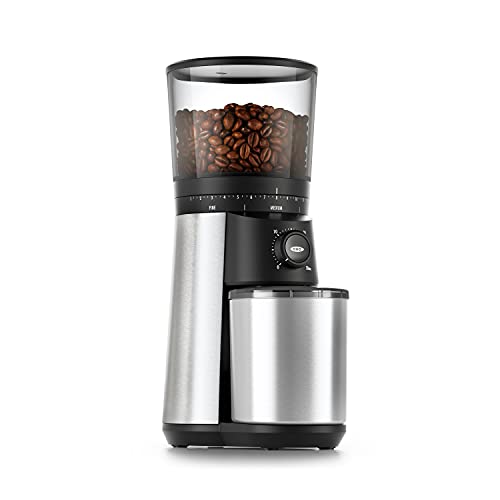
OXO Brew Conical Burr electric coffee grinder in silver

The OXO Brew Conical Burr is the budget electric pick in my espresso grinder guide, and at $109.95 it is where most people upgrading from a blade grinder should start. This review covers what its grind adjustment actually is underneath the marketing number, where that runs out for espresso, and what 23,330 ratings say about reliability.

Quick Verdict

Score Price Rating Buy
7.5/10 $109.95 4.3★ (23,330) Check Price

Specifications

Spec OXO Brew Conical Burr
Burrs 40 mm stainless steel conical
Grind adjustment 15 primary settings, with micro-adjustments between them (marketed as 43)
Dosing One-touch timer that remembers the last setting
Hopper capacity 12 oz, removable, UV-blocking tint
Weight 4.5 lbs
Brew methods named by OXO Drip, French press and cold brew in the listing title; espresso in the feature list

Who It’s For

  • Anyone moving off a blade grinder, which is the single biggest jump in cup quality available for a hundred dollars
  • Drip, pour-over, French press and cold brew drinkers, which is the range OXO leads with
  • Households where one person sets a grind and everyone else just presses the button
  • Anyone who wants a burr grinder proven at scale rather than a boutique one

Who Should Look Elsewhere

  • Anyone whose main brew is espresso and who is already weighing shots. The fine end is where 15 primary steps runs thin
  • Anyone wanting dose by weight rather than by time
  • Anyone grinding for a crowd continuously — this is a domestic grinder working in short bursts

Performance

What “43 settings” actually means

This is the number worth understanding before buying. OXO’s listing headlines 43 grind settings, and its own feature text is more precise: 15 grind settings, plus micro-adjustments between them. Those are not the same claim.

In practice you set one of 15 primary positions and then fine-tune within it. For drip, press and cold brew that is more resolution than the brew method can even use. For espresso it is the crux of the machine, because espresso is dialled in changes small enough to land between primary steps.

Where it runs out for espresso

The guide’s caveat holds up and this is the mechanical reason for it: at the fine end, adjacent settings make a surprisingly large difference to the shot, and the sweet spot can sit between two of them. The usual workaround is adjusting dose or tamp rather than grind.

That is a real limitation and not a disqualifying one at this price. A stepped burr grinder still beats any blade grinder by a wide margin, and if shots are running fast or gushing the guide to an espresso machine not building pressure covers grind, dose and tamp in the order worth checking.

The timer, and what it is good at

Dosing is a one-touch timer that remembers the last setting, so the second morning is a single button press. Like every timed grinder it measures seconds rather than grams, which means the dose drifts as beans age and as the burrs wear, and anyone weighing shots should expect to retune it periodically.

For filter brewing that drift is invisible. It only becomes a nuisance at the espresso end, where a gram either way changes the shot.

Design and Build

A 12 oz removable hopper with a UV-blocking tint, which is a genuinely thoughtful detail for beans left on a sunny counter, and 40 mm stainless conical burrs doing the actual work. At 4.5 lbs it is light enough to move and stable enough not to walk on the counter.

One inconsistency worth flagging rather than glossing: Amazon’s product attributes list the material as stainless steel, while the grinder is commonly described as having a plastic-bodied build with a tinted plastic hopper. Anyone for whom that matters should check the current listing rather than take either description on trust.

Cleaning and Maintenance

The upper burr lifts out and the grounds container removes for brushing. As with every burr grinder, the job that matters is frequency rather than thoroughness, because coffee oils go stale in the chute and taint the next brew before they ever cause a mechanical problem.

If the motor runs and nothing comes out, the cause is usually a jam or caked burrs rather than a failure — the guide to a grinder that hums but does not grind separates the three cases.

Value

At $109.95 this is the most-rated burr grinder in its price bracket by a wide margin, and the upgrade from a blade grinder is the largest single improvement most people can make to their coffee for the money. Nothing at this price grinds more evenly in a way you would notice through a paper filter.

The comparison worth making is upward rather than sideways. The Breville Smart Grinder Pro at roughly double the price buys a wider stepped range and portafilter cradles, which matters if espresso is the point. If it is not, the extra ninety dollars buys very little.

Durability

The distribution across 23,330 ratings runs 72% five-star, 10% four, 4% three, 4% two and 10% one-star. That one-star share is the highest of any grinder in the guide, and on a sample this size it represents a substantial absolute number of unhappy owners rather than statistical noise.

Read alongside the 72% five-star share, the shape says the same thing as the average does not: most people are very happy, and a real minority have a hard failure. On a $110 grinder that is a risk many will accept knowingly, which is different from being surprised by it.

Alternatives to Consider

  • Breville Smart Grinder Pro — roughly double the price, wider stepped range, and portafilter cradles for grinding straight into the basket
  • The full grinder guide — including the manual option, which grinds finer for less money if you will accept 45 seconds of cranking
  • French press guide — the brew method this grinder suits best, and the cheapest good coffee there is

Verdict

The OXO Brew Conical Burr is the right first burr grinder and an honest budget entry, provided you buy it for what OXO leads with rather than for what a feature bullet claims. For drip, pour-over, French press and cold brew it is more grinder than those methods can use.

For espresso it is a compromise you should make knowingly: 15 primary steps with micro-adjustment is not the same as a dedicated espresso grinder, and the sweet spot can fall between settings. At $110 that is a fair trade. At $200 the Breville buys the range that removes the problem.

Check Price on Amazon ↗

How This Review Was Put Together

Plainly: this is research-based, not a hands-on test. I have not owned or used this grinder, and nothing here should be read as a report from my own kitchen.

What it rests on: OXO’s published specification — burr size and type, the 15-settings-plus-micro-adjustment mechanism behind the headline number, hopper capacity, weight and the one-touch timer — plus the rating distribution across 23,330 Amazon ratings rather than the 4.3 average it produces.

What I could not establish: grind consistency, which is the specification that would genuinely separate burr grinders and which no manufacturer publishes comparably. Nothing here claims a particle-size measurement. The body-material discrepancy noted above is also unresolved. Price and stock were read from Amazon’s US marketplace on 6 September 2026 and will move.

Frequently Asked Questions

Does the OXO Brew Conical Burr have 15 settings or 43?

Both figures describe the same mechanism. There are 15 primary grind settings, with micro-adjustments between them that OXO totals as 43. For drip and press brewing the distinction does not matter; for espresso it does, because the useful resolution at the fine end is closer to the smaller number.

Is it good enough for espresso?

It will make espresso and it will beat any blade grinder doing it, but it is not a dedicated espresso grinder. At the fine end adjacent settings change the shot noticeably and the ideal point can sit between two of them, so dialling in takes patience and sometimes means adjusting dose instead.

How much coffee does the hopper hold?

12 ounces, in a removable hopper with a UV-blocking tint that shields beans from light on a sunny counter. That is roughly a week of daily brewing for most households, and beans are still better stored sealed and ground fresh.

Is the OXO or the Breville the better buy?

It depends entirely on whether espresso is the point. For filter, press and cold brew the OXO does everything needed at half the price. For espresso, the Breville’s wider stepped range and its portafilter cradles are what the extra money actually buys.

Filed Under: Product Reviews

Ooni Koda 12 Review: The Pizza Oven Most People Should Buy

Last Updated September 6, 2026

I earn a commission if you buy through the Amazon links below, at no extra cost to you.

Ooni Koda 12 propane gas pizza oven in foundry black

The Ooni Koda 12 is the Best Overall pick in my pizza oven buying guide, and at $379.99 it is still the oven most people should buy. The oven-only listing is no longer available on Amazon, so the links here go to Ooni’s bundle of the same Gen 1 oven with a 12-inch aluminium peel, which was low on stock when I checked. This review covers why the 12-inch limit is a feature rather than a compromise, what the single rear burner asks of you at the peel, and the one thing its rating distribution is worth reading for.

Quick Verdict

Score Price Rating Buy
9.0/10 $379.99 4.2★ (10) Check Price

Specifications

Spec Ooni Koda 12
Pizza size 12 inches
Cooking surface 13.2 x 13.2 inches
Max temperature 950°F (Ooni’s figure)
Burner Single, across the back of the chamber
Ready to cook ~15 minutes
Fuel Propane only — the listing states it is not natural-gas compatible
Weight 20.4 lbs (9.25 kg)
Shell Powder-coated carbon steel
In the box Oven, stone baking board, 28 mBar regulator, gas hose and a 12-inch aluminium peel (bundle)
Warranty 1 year, extended to 5 if registered within 60 days

Who It’s For

  • Couples and small households, where a 12-inch pizza is one person’s dinner and two of them is the meal
  • Anyone who actually wants to move the oven — at 20.4 lbs this is the one in the range you can carry one-handed
  • First-time pizza oven buyers, because there is nothing to learn beyond launching and turning
  • Anyone who wants the 950°F, 60-second result for the least money in the gas Ooni line

Who Should Look Elsewhere

  • Households regularly feeding four or more. You will cook in sequence and the first pizza will be cold before the last is served — the Koda 16 exists for this
  • Anyone with an exposed, windy garden. No door means wind takes temperature straight out of the chamber
  • Anyone who wants wood smoke in the crust, which no gas oven produces
  • Anyone expecting to run it off a domestic natural gas line as supplied

Performance

The 12-inch limit is the point, not the compromise

A 12-inch stone makes a personal pizza, and for one or two people that is exactly the right unit. Each pizza takes 60 seconds, so two people eat within three minutes of the first launch, and nobody waits.

The constraint only bites in one direction: numbers. Four people means four bakes plus the stone recovering between them, and that is the entire argument for the larger oven rather than any difference in how the pizza turns out. On quality, the two Kodas are the same oven.

The single rear burner, and turning

The Koda 12 runs one burner across the back of the chamber. That creates a hot zone at the rear of the stone, which is why the pizza needs turning every 20 to 30 seconds with a small turning peel rather than being launched and forgotten.

This is technique rather than a defect, and it is the single most common first-night complaint. A launching peel and a separate turning peel is the setup that makes it easy. The bundle includes the launching peel, so the small turning peel is the one to add.

Heat-up and the honest limit of 950°F

Ooni quotes about 15 minutes to cooking temperature, five faster than the Koda 16 simply because there is less steel and stone to heat. That figure assumes still air and a full preheat.

Peak stone temperature is Ooni’s own claim, and independent measurement of these ovens varies considerably with wind, ambient temperature and how patient you were. Where a pizza comes out pale underneath, a short preheat is nearly always the cause — the guide to a pizza oven not getting hot enough works through the rest in order.

Design and Build

Powder-coated carbon steel over folding legs, with the regulator and hose already attached. Setup is genuinely a matter of unfolding the legs, dropping in the stone and connecting a propane tank, and the instant ignition means no lighting ritual.

At 20.4 lbs this is the only oven in the Ooni gas line that is portable in the ordinary sense of the word. That matters more than it sounds: an oven that can be carried to the end of the garden, or to someone else’s, gets used more than one that lives where it was first put down.

Cleaning and Maintenance

The stone cleans itself by burning residue off at temperature, so it wants brushing rather than washing and should never meet detergent. The shell wipes down once cool.

Turning the stone over occasionally lets both faces burn clean, and lifting it out to sweep ash and semolina from underneath prevents the smoking that gets mistaken for a fault. Neither job takes more than a minute.

Value

At $379.99 the bundle costs about $81 more than the oven-only listing did, though that includes the 12-inch launching peel. The Karu 12 is $131 cheaper but asks you to tend a fire. The Roccbox, which also comes with a peel, is better built and better in wind for only about $19 more, so if the oven will never leave one patio, that gap is worth a hard look.

What makes this the default recommendation is that the money buys the result rather than the capacity. Nothing above it in the range makes a better 12-inch pizza — they make more of them, or make them in worse weather.

Durability

The rating distribution is worth reading rather than averaging. On the original oven-only listing, now unavailable, 1,134 ratings ran 74% five-star, 13% four, 5% three, 1% two and 7% one-star. A one-star share seven times the two-star share is a failure tail, not gradual disappointment: the great majority are delighted and a small minority have something go properly wrong. The bundle listing has only 10 ratings so far, at 4.2 stars.

Register the oven within 60 days, which converts the standard one-year warranty into five. It is two minutes of admin against a fivefold difference in cover, and the distribution above is the reason to bother.

Alternatives to Consider

  • Ooni Koda 16 — the same oven at 16 inches with an L-shaped burner, for $118 more and double the weight. Buy it for capacity, not for quality
  • Koda 12 vs Koda 16 — the two set against each other, if the size question is the one holding you up
  • Gozney Roccbox — insulated, which makes it the better choice for an exposed garden

Verdict

The Koda 12 is the pizza oven to buy unless you have a specific reason not to. It makes the same pizza as the oven above it in the range, it costs $118 less, and it is light enough that it actually gets used rather than stored.

Its limits are honest and small: one burner means turning the pizza, no door means wind matters, and 12 inches means cooking in sequence for a crowd. None of those is a reason for most households to spend more, and all three are worth knowing before the first Friday night rather than during it.

Check Price on Amazon ↗

How This Review Was Put Together

Plainly: this is research-based, not a hands-on test. I have not owned or used this oven, and nothing here should be read as a report from my own kitchen.

What it rests on: the published specification — cooking surface, burner layout, stated peak temperature, heat-up time, weight, fuel type and warranty terms — read against the Koda 16 it is most often compared with; plus the shape of the rating distribution across 1,134 Amazon ratings on the original listing rather than the 4.4 average it produced.

What I could not establish: actual stone temperature. The 950°F figure is Ooni’s own and varies widely in independent measurement with wind, ambient temperature and preheat length. Price and stock were read from Amazon’s US marketplace on 14 September 2026 and will move.

Frequently Asked Questions

Is the Ooni Koda 12 big enough for a family?

For two people comfortably, and for four with patience. Each 12-inch pizza takes about 60 seconds plus stone recovery, so feeding four means cooking in sequence while the earlier pizzas cool. Households that regularly feed four or more are the case the 16-inch model exists for.

Why does my pizza burn at the back?

Because the single burner sits across the back of the chamber, so the rear of the stone runs hotter than the front. Turning the pizza every 20 to 30 seconds with a small turning peel evens it out completely. This is normal operation rather than a fault.

Does the Koda 12 come with everything needed to cook?

Almost. The bundle includes the oven, stone baking board, 28 mBar regulator, gas hose and a 12-inch aluminium launching peel. You supply the propane tank and a small turning peel.

Can the Ooni Koda 12 be left outside?

It is built for outdoor use but not for permanent exposure. The powder-coated carbon steel shell resists weather better than bare steel, and a cover plus indoor storage of the stone is what keeps the oven looking and working as new over years rather than seasons.

Filed Under: Product Reviews

Breville Smart Grinder Pro Review: 60 Settings, One Catch

Last Updated September 6, 2026

I earn a commission if you buy through the Amazon links below, at no extra cost to you.

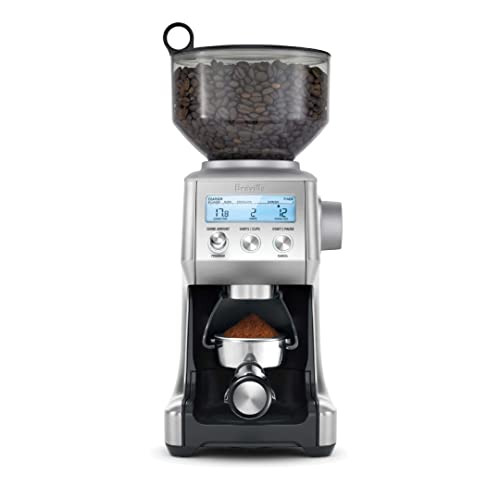
Breville Smart Grinder Pro BCG820BSS conical burr coffee grinder in brushed stainless steel

The Breville Smart Grinder Pro is the mid-range pick in my espresso grinder guide, and at $199.95 it is the machine most people land on when they accept that the grinder matters more than the machine. This review covers what its 60 settings actually give you, why timed dosing is the real limitation, and the unusual shape of its rating distribution.

Quick Verdict

Score Price Rating Buy
8.0/10 $199.95 4.5★ (6,990) Check Price

Specifications

Spec Breville BCG820BSS
Burr type Conical burr, stainless steel
Grind settings 60, stepped
Dosing By time, programmable in 0.2 second increments
Motor 165 watts, 110-120 volts
Hopper capacity 18 oz
Grinds into Portafilter, the supplied container, a gold tone basket or a paper filter
Portafilter cradles 50-54 mm and 58 mm, both included
Display LCD showing grind setting, grind time and shot or cup count
Weight 6.4 lbs
Warranty 2 year limited

Who It’s For

  • Anyone pairing a grinder with an entry or mid-range espresso machine, where the grinder is the component actually limiting the shot
  • Households brewing more than one way — the 60-step range covers espresso through French press from the same machine
  • Anyone who wants to grind straight into the portafilter, since both common basket sizes are catered for in the box
  • People who value a repeatable button press over a ritual, which is what programmable timed dosing buys

Who Should Look Elsewhere

  • Anyone chasing the finest espresso adjustment. Sixty steps is a lot for a domestic grinder and still not stepless, and at the espresso end the gaps between steps are where dialling in gets frustrating
  • Anyone who wants dose by weight. This grinder measures time, not grams, and those are not the same thing
  • Single-method brewers on a budget. If you only make French press, a far cheaper grinder covers coarse grinding perfectly well
  • Anyone unwilling to run a machine with a known failure tail — see the rating distribution below

Performance

Sixty settings, and where they run out

The adjustment range is genuinely wide: coarse enough for French press at one end, fine enough for espresso at the other, from a single machine. For most households that breadth is the reason to buy it rather than a cheaper single-purpose grinder.

The catch is that the settings are stepped rather than continuous. Across the coarse two-thirds of the range that makes no practical difference, because filter and press brewing tolerate a wide grind window. At the espresso end it does, because espresso is dialled in changes small enough to fall between steps, and the usual workaround is adjusting dose or tamp instead of grind.

Timed dosing is the real limitation

Dosing is by time, programmable in 0.2 second increments, with the count shown on the LCD. It is repeatable and it is convenient, and it is not the same as dosing by weight.

The reason matters: a given number of seconds delivers a different mass of coffee as beans age, as the roast changes, and as the burrs wear. Anyone weighing shots will find the timer drifting against the scale over weeks, which is not a defect so much as the boundary of what timed grinders can do. If your shots are running inconsistently, the guide to an espresso machine not building pressure works through grind, dose and tamp in the order worth checking.

Grinding into the portafilter

Both a 50-54 mm and a 58 mm cradle come in the box, which covers the great majority of domestic machines including the 58 mm commercial-size baskets on machines like the Gaggia Classic Pro. Grinding straight into the basket avoids a transfer step, and a transfer step is where dose gets lost.

Design and Build

Brushed stainless steel over a 6.4 lb body, with an 18 oz hopper that is generous for a domestic grinder. The LCD is the practical part of the design rather than a flourish: seeing grind setting, time and count at once is what makes a change reproducible the next morning.

The 165 watt motor is modest on paper. For a conical burr grinder working in short domestic bursts that is adequate rather than marginal, but it is not a machine built for grinding continuously, and treating it as one is the fastest route to trouble.

Cleaning and Maintenance

A cleaning brush is supplied and the upper burr lifts out for access. The job that actually matters is doing it regularly rather than thoroughly, because coffee oils build up and go stale in the chute and the grinds container.

Stale residue is also the usual explanation when a grinder seems to slow or clog rather than fail. The guide to a grinder that hums but does not grind covers the difference between a jam, an oil-caked burr and a genuinely dead motor.

Value

At $199.95 this sits above the entry-level burr grinders and well below the stepless espresso-focused machines that start around double. What the money buys is range plus repeatability, and for someone brewing espresso on a machine in the $300 to $600 bracket that is a sensible match rather than an overspend.

The judgement in my espresso grinder guide holds here: a capable grinder in front of a modest machine beats an expensive machine fed by a poor one. This is the grinder that makes that trade concrete at a mid-range budget.

Durability

The rating distribution is unusual and worth reading rather than averaging. Across 6,990 ratings it runs 80% five-star, 8% four, 3% three, 2% two and 7% one-star. A one-star share more than three times the two-star share is a failure tail, not gradual dissatisfaction: most owners are very happy and a minority have something go properly wrong.

That shape argues for two things. Register and keep the two-year limited warranty paperwork, and exercise the machine properly in the first weeks rather than discovering a fault after the return window has closed.

Alternatives to Consider

  • The full grinder guide — where the cheaper and the stepless options sit, and what each price step actually changes
  • Espresso machines under $500 — the bracket this grinder is best matched to
  • The coffee section — French press, moka pot and the rest, if espresso is not settled yet

Verdict

The Smart Grinder Pro is the sensible middle of the domestic grinder market, and it earns that position on range and repeatability rather than on any single specification. For a household brewing espresso and something else from the same beans, it is the machine that stops the grinder being the weakest part of the setup.

Its limits are honest ones: stepped adjustment that thins out at the espresso end, and dosing by time rather than weight. Neither matters much for filter and press brewing. Both matter if espresso is the whole point and you are already weighing shots, in which case the money is better spent further up the range.

Check Price on Amazon ↗

How This Review Was Put Together

Plainly: this is research-based, not a hands-on test. I have not owned or used this grinder, and nothing here should be read as a report from my own kitchen.

What it rests on: the published specification — burr type, the stepped 60-setting range, timed dosing in 0.2 second increments, motor wattage, hopper size, the two included portafilter cradles and the warranty term — plus the rating distribution across 6,990 Amazon ratings, which is a stronger signal than the 4.5 average it produces.

What I could not establish: grind consistency, which is the specification that would actually separate this grinder from its rivals and which no manufacturer publishes in comparable form. Nothing here claims a particle-size measurement. Price and stock were read from Amazon’s US marketplace on 6 September 2026 and will move.

Frequently Asked Questions

Is the Breville Smart Grinder Pro good enough for espresso?

Yes for most domestic setups, with one caveat. The fine end of its range reaches espresso comfortably, but the adjustment is stepped rather than stepless, so dialling in sometimes means adjusting dose or tamp rather than grind. On an entry or mid-range machine that is rarely the limiting factor.

Does it grind directly into a portafilter?

Yes. Cradles for both 50-54 mm and 58 mm portafilters are included in the box, which covers most domestic machines including those using the 58 mm commercial basket size. Grinding straight into the basket avoids a transfer step where dose is easily lost.

Does it dose by weight or by time?

By time, programmable in 0.2 second increments. That is repeatable but not the same as weighing: the same number of seconds delivers a different mass as beans age and as burrs wear, so anyone weighing shots should expect to retune the timer periodically.

What does the rating distribution say about reliability?

That opinion is polarised rather than lukewarm. Across 6,990 ratings, 80% are five-star and 7% are one-star, against only 2% two-star. That shape points to a minority experiencing outright failure rather than to widespread mild disappointment, which is a reason to keep the two-year warranty details to hand.

If $200 is more than this job is worth to you, the OXO Brew Conical Burr review covers the half-price alternative and exactly what you give up.

Filed Under: Product Reviews

Ooni Koda 16 Review: The 16-Inch Family Pizza Oven

Last Updated September 6, 2026

I earn a commission if you buy through the Amazon links below, at no extra cost to you.

Ooni Koda 16 propane gas pizza oven in foundry black

The Ooni Koda 16 is the family-sized pick in my pizza oven buying guide, and at $498 it costs $118 more than the Koda 12 bundle that sits above it in that lineup. This review covers what the extra 4 inches of stone actually buys, why the burner design matters more than the size on paper, and who should ignore it and save the money.

Quick Verdict

Score Price Rating Buy
8.5/10 $498.00 4.6★ (1,257) Check Price

Specifications

Spec Ooni Koda 16
Pizza size 16 inches
Cooking surface 17.7 x 17.7 inches
Max temperature 950°F (Ooni’s figure)
Burner L-shaped, wrapping the back and one side
Ready to cook ~20 minutes
Fuel Propane only — the listing states it is not natural-gas compatible
Weight 40.9 lbs (18.5 kg)
Shell Powder-coated carbon steel
In the box Oven, stone baking board, 28 mBar regulator and gas hose
Warranty 1 year, extended to 5 if registered within 60 days

Who It’s For

  • Anyone regularly feeding four or more people, where a 12-inch oven means cooking in sequence while the first pizzas go cold
  • Cooks who want a genuinely restaurant-sized 16-inch pie rather than a personal one
  • People who will leave the oven in one place — a patio, a fixed outdoor kitchen — rather than carrying it anywhere
  • Anyone who found turning a pizza every 20 seconds on a smaller oven more stressful than fun

Who Should Look Elsewhere

  • Anyone cooking mostly for one or two. The extra stone is dead weight and $118 that buys nothing you will use
  • Anyone who wants to take the oven to other people’s houses. At 40.9 lbs this is portable in the sense that a car boot is involved
  • Anyone hoping to run it off a natural gas line as supplied — the listing is explicit that this model is propane only
  • Anyone who wants wood-fired flavour, which no gas oven produces. The Ooni Karu 12 is the answer there

Performance

The burner is the real upgrade, not the stone

The headline difference is 16 inches against 12, but the change that matters more is the burner. The Koda 16 runs an L-shaped burner that wraps around the back and along one side of the chamber, where the Koda 12 has a single burner across the back only. That geometry is what makes a 16-inch stone usable at all.

A single rear burner on a large stone would leave the front corners cold, and the pizza would need constant turning to compensate. Wrapping the flame along a side spreads heat across a much wider arc, which is why owner reports on the Koda 16 mention less frantic turning rather than more, despite the larger pie.

Heat-up and bake time

Ooni quotes roughly 20 minutes to reach cooking temperature and a 60-second bake at 950°F, against about 15 minutes for the smaller Koda 12. The extra five minutes is simply more steel and more stone to bring up to heat, and it is a fair trade for the capacity.

Those figures assume still air and a full preheat. Peak stone temperature is Ooni’s own claim and varies considerably in independent measurement with wind, ambient temperature and how long you actually wait. If yours is not reaching temperature, the guide to a pizza oven not getting hot enough covers the usual causes in order.

The open mouth, and what it costs

Like the rest of the Koda range, this oven has no door. That keeps operation simple and makes launching and turning easier, and it means an exposed patio will cost you real temperature on a windy evening. It is the clearest structural advantage the insulated, door-fitted Gozney Roccbox holds over the Koda line, and it is worth weighing if your garden is open.

Design and Build

The shell is powder-coated carbon steel, which holds heat well and is the same construction that has kept the Koda range at a 4.5-plus star average across thousands of ratings. Setup is genuinely as described: unfold the legs, drop in the stone, connect the supplied hose and regulator to a propane tank.

The weight is the honest reservation. At 40.9 lbs against the Koda 12’s 20.4, this is double the machine, and the difference shows up the moment you try to move it alone. Ooni markets the Koda line on portability and that framing stretches thin at this size.

Cleaning and Maintenance

There is very little to it. The stone self-cleans by burning off residue at temperature, so it needs brushing rather than washing, and it should never be scrubbed with detergent. The shell wipes down once cool.

The one job people skip is turning the stone over periodically so both faces get burned clean, and lifting it out to sweep ash and semolina from underneath. Neither takes long and both prevent the smoking that gets misread as a fault.

Value

At $498 the Koda 16 sits $118 above the Koda 12 bundle and $99 above the Gozney Roccbox. The question is not whether it is better than the Koda 12 — it plainly is, on capacity and heat distribution — but whether the household will use the difference.

For a family of four or more, or anyone who entertains, the maths works quickly: cooking four 12-inch pizzas in sequence means the first is cold before the last is served. For a couple, the same $118 buys a great deal of very good flour, and the Koda 12 makes the same 60-second pizza.

Durability

Ooni ships a one-year warranty as standard and extends it to five years if you register the product within 60 days of purchase. That registration step is easy to miss and worth doing on the day the oven arrives, because it is a fivefold difference in cover for two minutes of admin.

The 4.6-star average across 1,257 ratings is high for outdoor cooking equipment, and the complaints that do recur are about the stone cracking under thermal shock rather than about the oven itself — which is a handling issue, and the reason the stone should never be doused or washed while hot.

Alternatives to Consider

  • Ooni Koda 12 — the same oven logic at 12 inches and 20.4 lbs, for $118 less, now sold as a bundle with a peel. The right choice for most couples, and the full size comparison is here
  • Gozney Roccbox — 12 inches, but insulated with a retained-heat jacket and a door, which makes it the better oven in wind
  • Ooni Karu 12 — wood and charcoal rather than gas, for anyone who wants smoke flavour and does not mind tending a fire

Verdict

The Koda 16 is the right pizza oven for a household that cooks for a table, and the wrong one for almost everybody else. The L-shaped burner earns the size rather than merely permitting it, and a 16-inch pie in 60 seconds is a genuinely different evening from four 12-inch ones in sequence.

What it is not is portable, whatever the marketing implies at 40.9 lbs, and it is not the oven to buy if your garden is exposed and you have not considered a door. Buy it for capacity. If capacity is not the problem you have, buy the Koda 12 and spend the difference on better flour.

Check Price on Amazon ↗

How This Review Was Put Together

Plainly: this is research-based, not a hands-on test. I have not owned or used this oven, and nothing here should be read as a report from my own kitchen.

What it rests on: the published specification — cooking surface, burner geometry, stated peak temperature, weight, fuel type and warranty terms — read against the Koda 12 it is most often compared with; plus the pattern across 1,257 Amazon ratings, where the recurring Koda 16 themes are the weight and the cracked-stone-through-thermal-shock complaint rather than anything about how it bakes.

What I could not establish: actual stone temperature. The 950°F figure is Ooni’s own, and independent measurement of these ovens varies widely with wind, ambient temperature and preheat length. The current price and stock were read from Amazon’s US marketplace on 6 September 2026 and will move.

Frequently Asked Questions

Does the Ooni Koda 16 need a separate regulator and hose?

No. A 28 mBar regulator and gas hose are attached in the box, so the only thing you supply is the propane tank itself. The tank is not included and is the one purchase people are surprised by.

Can the Koda 16 run on natural gas?

Not as supplied. The Amazon listing states explicitly that this model is suitable for propane only and is not compatible with natural gas, so anyone planning to plumb it into a house line should confirm the conversion options for their region before buying.

Is the Koda 16 actually portable?

Only in the sense that it has folding legs and no fixed installation. At 40.9 lbs it is twice the weight of the Koda 12, and moving it is a two-handed, plan-your-route job rather than something you carry to a friend’s house casually.

How long does the Ooni Koda 16 take to heat up?

About 20 minutes to reach cooking temperature, which is roughly five minutes longer than the Koda 12 because there is more steel and more stone to bring up to heat. Cutting the preheat short is the most common reason a pizza comes out pale underneath.

Filed Under: Product Reviews

BESWOOD 250 vs KWS MS-10NT: Which 10-Inch Slicer?

Last Updated September 2, 2026

Some links here go to Amazon. If you buy through one, I earn a commission at no extra cost to you.

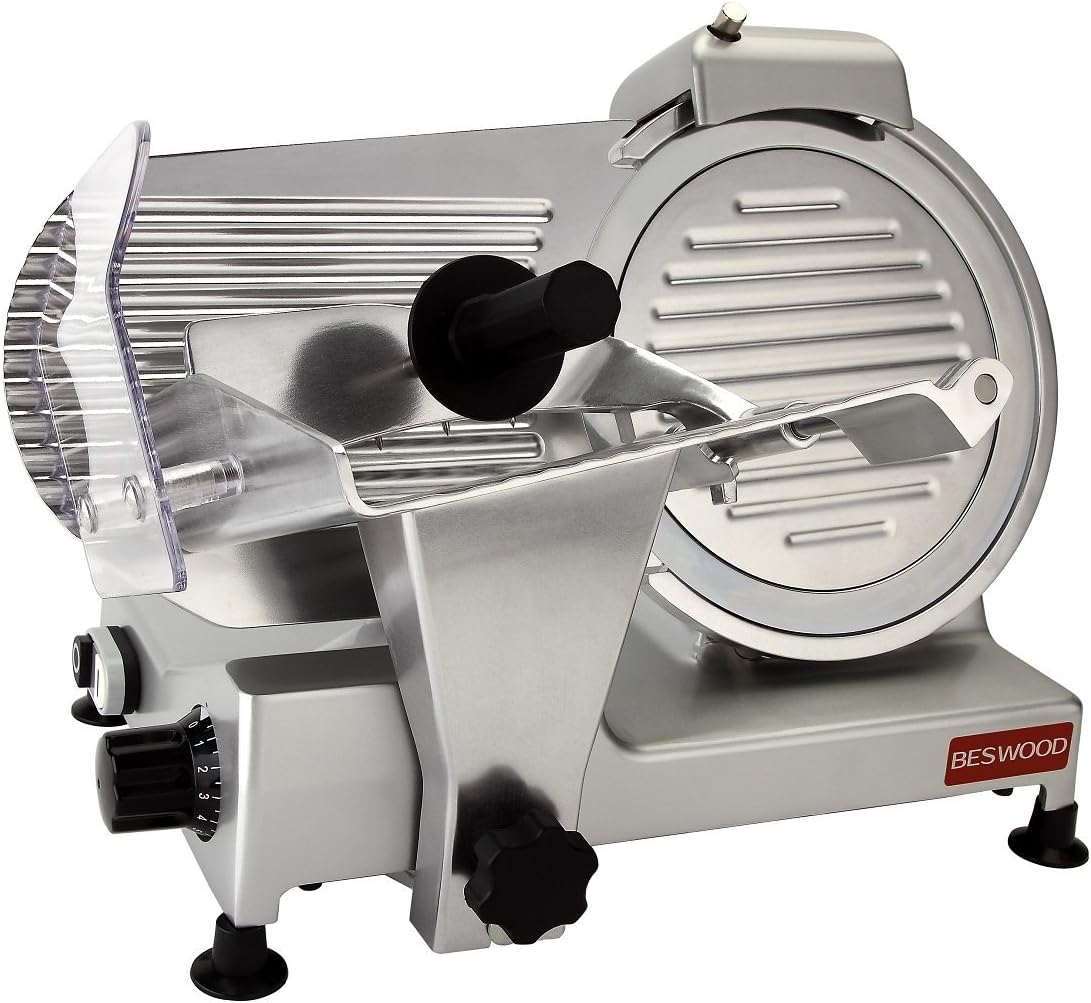
BESWOOD250 10-inch electric meat slicer with chromium-plated steel blade

BESWOOD250 — $358.00

KWS MS-10NT 10-inch electric meat slicer with Teflon-coated stainless blade

KWS MS-10NT — $394.00

Which one do I buy? Buy the KWS MS-10NT if the machine has to satisfy a health inspector, or if you intend to still be using it in ten years. It is the only one of the two with unambiguous NSF certification and a published, priced spare-parts list that includes a $159.99 replacement motor.

Buy the BESWOOD250 for everything else. It is $36 cheaper, better rated across a review base nearly twice the size, sells roughly twice as fast, and has the better-finished body. For a home kitchen that is the safer purchase.

Prices and stock verified 2 September 2026. BESWOOD250 $358.00, in stock, 4.6 out of 5 from 3,368 ratings. KWS MS-10NT $394.00, in stock, 4.5 out of 5 from 1,959 ratings. Both are sold on Amazon by the manufacturer rather than a reseller, and both cost exactly the same buying direct from the maker, so there is no saving either way.

The difference is $36

That is the whole financial question, and it is small enough that specification arguments matter more than price. These are not machines from different tiers. They are two 10-inch, metal-bodied, belt-driven slicers with on-board sharpening stones, aimed at the same buyer, separated by about ten percent.

So the useful comparison is not “which is better value.” It is which of two genuine differences you actually need: certification, or validation.

Head to head

  BESWOOD250 KWS MS-10NT
Price $358.00 $394.00
Rating 4.6★ (3,368) 4.5★ (1,959)
Motor 240W / 1⁄3 HP 320W / 0.4 HP
Blade speed 282 rpm 525 rpm
Blade 10″ high-carbon, chromium plated 10″ 304 stainless, Teflon coated
Slice thickness 1–12 mm 0–10 mm
Certification ETL. NSF inconsistent on its own site ETL, NSF and FDA, stated throughout
Spare parts Blade only, $120.00, was out of stock ~20 parts priced, motor $159.99
Weight 33 lb 36 lb
Footprint 20″ × 17″ × 14.75″ 20.5″ × 18.5″ × 15.5″
In the box Cleaning brush, machine oil Spare whetstone, spare drive belt
Warranty 12 months 1 year factory limited

The certification claim to be careful about

If you research this comparison elsewhere you will find the BESWOOD described as ETL and NSF certified. That claim needs checking, because it is not what the BESWOOD’s own materials consistently say.

The Amazon listing for the BESWOOD250 states one certification: ETL listed and certified. On BESWOOD’s own website, a line of marketing copy lists the approvals as ETL and NSF, while the specification block further down the same page gives ETL, GS, CE and ROHS — with no NSF among them. Those cannot both be right.

The KWS has no such ambiguity. NSF and ETL appear in the Amazon listing title, in a dedicated bullet naming Intertek as the certifying body, and on the manufacturer’s product page, which also claims FDA approval.

What this means in practice. For a home kitchen it changes nothing: ETL is the electrical safety mark that matters for plugging a machine in, and both have it. For a business that gets inspected, NSF is often a requirement, and the difference between “stated everywhere” and “stated in one place and contradicted in another” is the difference between a machine you can rely on and a phone call you have to make. If you need NSF on paper, that alone settles this comparison.

Repairability: the argument that gets ignored

Both machines have on-board sharpening stones, so neither has the disposable-blade problem that ends most cheap slicers. Beyond the blade, though, they are not comparable at all.

KWS publishes a public, priced parts catalogue for the MS-10 series — around twenty items. BESWOOD lists one part, a blade at $120.00, and it was showing as sold out when I checked on the same day.

KWS MS-10 part Price
Teflon blade $204.99
Product tray assembly $199.99
320W motor $159.99
Support arm $59.99
Relay $38.00
Power cord $32.99
Sharpening stone set $29.99
Bearing set $28.49

A machine with a published motor price can outlive its motor. That is a different ownership proposition from one where a failed component means the machine is finished, and it is why the KWS earns its $36 for anyone thinking in decades rather than seasons.

The honest counterweight: the KWS blade costs $204.99 against the BESWOOD’s $120.00, so the part you are most likely to replace is $85 dearer. If you expect to wear out blades rather than motors, that runs the other way.

Motor and blade speed

The KWS has a third more motor, 320W against 240W, and turns its blade at a stated 525 rpm against 282. Nearly double the blade speed is a striking difference on paper.

It is worth resisting the obvious conclusion. Faster is not automatically better on a slicer: a slower blade backed by enough torque can give cleaner results on soft product, and blade speed is not the specification that separates a good slicer from a bad one. What matters is whether the machine holds its speed under load, and both of these do, which is most of what the extra money over a $110 home slicer buys in either case.

Where the KWS motor genuinely helps is sustained running and dense product — long sessions, semi-frozen meat, hard cheese. If your slicing is measured in hours rather than minutes, it is the stronger machine.

Thickness: they are good at opposite ends

This is the most practical difference between them and it is easy to miss, because the two ranges look similar until you notice which end each one covers.

  • BESWOOD250: 1–12 mm. Reaches thicker cuts — a half-inch steak cut is within range.
  • KWS MS-10NT: 0–10 mm. Starts at zero, which is the end that matters for prosciutto, bresaola and anything meant to be translucent.

Most people buying a 10-inch slicer care more about the thin end than the thick one, which is a quiet point for the KWS. If you are portioning roasts rather than making charcuterie, it runs the other way.

One caution: the KWS Amazon listing states a range of “0 to 14 mm depending on models.” That is generic copy written for the whole KWS range. The manufacturer’s page for this specific model gives 0 to 0.4 inches, about 0 to 10 mm. Plan around 10.

What the ratings say about each

Both machines are well rated, and the distributions are more informative than the averages. Read on the listings on 2 September 2026:

Rating BESWOOD250 KWS MS-10NT
5 star 83% 76%
4 star 10% 13%
3 star 2% 5%
2 star 1% 2%
1 star 4% 4%

The one-star rate is identical. What differs is the middle: the KWS collects more three- and four-star reviews, so its negative feedback is graduated where the BESWOOD’s is closer to all-or-nothing.

The recurring KWS complaint across the sources that discuss it is fit and finish rather than function — rough castings, machining marks, labels attached with gaps. That is a real difference and it favours the BESWOOD if you care how the machine looks and feels.

The market agrees, for what that is worth. The BESWOOD sits at an Amazon sales rank around 20,300 against the KWS at roughly 42,900, and its listing shows 500+ bought in the past month. Sales rank is a demand signal, not a quality one, but a review base of 3,368 resolves a machine’s real-world behaviour better than 1,959 does.

What each one costs over ten years

The $36 gap is the number everyone compares. It is also the least important one, because on machines built to run for a decade the purchase price is not the whole cost. Using each maker’s own published parts pricing, here is what the two look like over a long life.

  BESWOOD250 KWS MS-10NT
Machine $358.00 $394.00
One replacement blade $120.00 $204.99
Machine + one blade $478.00 $598.99
If the motor dies No part listed — replace the machine $159.99
Motor failure, total $836.00 (buy a second machine) $758.98

The arithmetic flips depending on what fails first. If you wear out blades, the BESWOOD is cheaper to keep running by $85 a blade. If anything else fails, the BESWOOD has no listed part and the realistic answer is a new machine, at which point the KWS is the cheaper machine to have owned.

This is a projection from list prices, not a prediction. Neither machine is likely to need a motor in a home kitchen, and BESWOOD may sell parts on request that they do not publish. But the published position is the only one a buyer can actually check, and on the published position the KWS is the machine with a floor under it.

Frozen and semi-frozen meat

Both listings advertise frozen slicing, and the KWS puts it in the product title. Neither will cut meat frozen solid, and attempting it is how slicer blades get chipped on any machine at any price.

What both do well is semi-frozen — meat firmed in the freezer for 30 to 45 minutes so the fibres stiffen, which is the standard technique for getting clean thin slices from raw meat. This is the one everyday task where the KWS’s extra motor is doing something you can feel, because dense chilled product is exactly the load that makes a weaker slicer slow down.

If semi-frozen slicing is the reason you are buying — portioning bulk meat, making jerky, cutting your own hotpot slices — that is a real argument for the KWS beyond the certification question.

Cleaning

Neither is difficult to take apart, and both come apart far enough to clean properly, which is the hygiene point that matters on a slicer. The KWS has a removable product tray and carriage; the BESWOOD ships with a cleaning brush and food-grade oil for the slide rod.

The practical advice from owners applies to both, and it is worth repeating: wear cut-proof gloves when you strip either machine down. The full routine for either machine is in my guide to how to clean a meat slicer. The parts come off easily; what takes the time is handling them safely next to a very sharp 10-inch blade.

The KWS Teflon coating is a small genuine advantage here, since less residue clings to the blade in the first place. That is also why it is the better pick if you slice a lot of cheese.

What else each maker sells

Neither machine exists alone, and in one case the alternatives change the decision.

BESWOOD sells the same 10-inch machine in a red finish at the same $358.00, with a removable serving plate the standard model does not include — a free accessory, though on 219 ratings rather than 3,368. Its own site also sells the Classic Line in 9-inch and 10-inch with 9-inch preselected, so it is possible to order a smaller machine than you intended.

KWS sells a ladder: the MS-10NT at $394.00 is the cheapest 10-inch it makes, with the MS-10ES at $419.00, the MS-10ET at $449.00, the MS-10DS at $502.00, and a 12-inch range from $639.00 to $1,299.00 at 60 to 84 pounds. If you were considering a KWS at all, the MS-10NT is the value entry point rather than a compromise.

Choose the BESWOOD250 if

  • You are buying for a home kitchen, where ETL is the certification that matters.
  • You want the better-validated machine — higher rating, nearly twice the reviews, roughly twice the sales rate.
  • Fit and finish matter to you.
  • You cut thick more often than paper-thin.
  • You want to save $36 without giving up anything you will notice.

Choose the KWS MS-10NT if

  • You need NSF certification stated without ambiguity.
  • You are thinking in decades and want a machine whose motor, bearings, relay and tray you can buy.
  • You slice for hours rather than minutes, or work with dense and semi-frozen product.
  • You slice a lot of cheese, where the Teflon coating earns its place.
  • You want the thin end of the thickness range more than the thick end.

Or buy neither

Both of these are commercial machines, and most people asking this question do not need one. The Best Overall pick in my meat slicer buying guide is the CUSIMAX at $109.78, and below roughly two pounds of slicing a session it will not be the limiting factor in your kitchen.

The honest test is whether your current slicer fails on capability or on volume. If you have never owned one, it is volume you cannot yet judge, and $250 is a lot to spend on a guess.

How this comparison was researched

Plainly: I have not run either machine. This is a research-based comparison, not a firsthand account, and nothing in it is written as one.

What it rests on: each manufacturer’s own published specification for the exact model, read from their sites rather than taken from a listing; live Amazon price, stock, seller and rating data pulled on 2 September 2026; the published spare-parts pricing from KWS and BESWOOD; the rating distributions as shown; and owner discussion for the cleaning and finish observations. The certification discrepancy was found by reading BESWOOD’s marketing copy and specification block against each other on the same page.

What I could not establish: slice consistency under sustained load, and the low-noise claims both makers make, which nobody measures. Motor rating, blade speed and mass stand in for the first, and a proxy is not a measurement. Full detail on each machine is in my BESWOOD 250 review and my KWS MS-10NT review.

Frequently Asked Questions

Is the BESWOOD or the KWS better?

For a home kitchen the BESWOOD250 is the safer buy: $36 cheaper, rated 4.6 against 4.5, and across nearly twice as many reviews. The KWS MS-10NT is the better choice in two specific cases — when NSF certification is required, and when you want a machine you can rebuild from published parts.

Is the BESWOOD250 NSF certified?

Its own materials do not agree. The Amazon listing states ETL only, and while one marketing line on BESWOOD’s site claims ETL and NSF, the specification block on the same page lists ETL, GS, CE and ROHS with no NSF. Confirm directly with BESWOOD before relying on it. The KWS states NSF unambiguously.

Which slicer has the more powerful motor?

The KWS, at 320W and 0.4 HP against the BESWOOD’s 240W and 1/3 HP, and it turns its blade at 525 rpm against 282. The extra power matters for long sessions and dense or semi-frozen product rather than for ordinary deli slicing, where both are comfortable.

Which one slices thinner?

The KWS, whose range starts at 0 mm against the BESWOOD’s 1 mm. The BESWOOD reaches thicker, to 12 mm against the KWS’s 10 mm. Note that the KWS Amazon listing quotes “0 to 14 mm depending on models,” which is generic range copy rather than this model’s figure.

Can you get spare parts for either?

For the KWS, yes and extensively — around twenty priced parts including a $159.99 motor, a $28.49 bearing set and a $29.99 stone set. BESWOOD lists a single part, a blade at $120.00, which was showing as sold out when checked on 2 September 2026.

Are they worth it over a $110 home slicer?

Only for volume or longevity. Below roughly two pounds of slicing per session a $110 machine will not be your limiting factor, and the extra $250 buys headroom you never reach. Both of these earn their money when a cheaper slicer would be overheating or losing its thickness setting.

The bottom line

These two machines are closer than the $36 between them suggests, and both are good. The decision is not really about price at all.

If a health inspector will look at it, or you want to still be running it in 2036, buy the KWS MS-10NT — unambiguous NSF, and a parts list that means a dead motor is a $159.99 problem rather than a new machine. Otherwise buy the BESWOOD250, which is cheaper, better finished, and validated by nearly twice as many buyers.

BESWOOD250 Price ↗KWS MS-10NT Price ↗

Everything else on slicers is in my meat slicer hub. If neither is right, the home-priced picks cover the $66 to $153 range, and my food processors hub covers the chopping and shredding side of prep.

Prices, ratings and stock verified 2 September 2026. Both Amazon and manufacturer pricing move; check the current figures before buying.

Filed Under: Product Reviews

  • « Go to Previous Page
  • Page 1
  • Interim pages omitted …
  • Page 7
  • Page 8
  • Page 9
  • Page 10
  • Page 11
  • Interim pages omitted …
  • Page 35
  • Go to Next Page »

Recent Articles

  • Cuisinart DLC-10SYP1 Review: Durable, But a Newer Bowl
  • COSORI Pro Gen 2 Review: Big Basket, Fragile Handle
  • Dash Tasti-Crisp Review: Cheap, but the Coating Wears Fast
  • Chefman TurboFry Touch Review: Cheap, but the Coating Wears
  • Chef’sChoice 15XV Review: Very Sharp, With Scratch Reports

Search


HOME          Contact          Affiliate Disclosure          Terms of Service          Privacy Policy


kitchenwarecompare.com is a participant in the Amazon Services LLC Associates Program, an affiliate advertising program designed to provide a means for sites to earn advertising fees by advertising and linking to Amazon.com, Endless.com, MYHABIT.com, SmallParts.com, or AmazonWireless.com. Amazon, the Amazon logo, AmazonSupply, and the AmazonSupply logo are trademarks of Amazon.com, Inc. or its affiliates. As an Amazon Associate I earn from qualifying purchases.


Copyright © 2026 kitchenwarecompare.com, ALL RIGHTS RESERVED.