• Skip to primary navigation
  • Skip to main content
  • Skip to primary sidebar

Kitchenware Compare

  • Home
  • Product Reviews
    • Air Fryers
    • Coffee
    • Cookware
    • Flat Top Grills
    • Meat Thermometers
    • Food Processors
    • Knives
    • Pizza Ovens
    • Toaster Ovens
    • Juicers
  • Food Blog
  • Helpful Kitchen Tips
  • Data Studies
  • About
  • How I Review
  • Contact
You are here: Home / Archives for Product Reviews

KWS MS-10NT Review: The $394 NSF-Certified 10-Inch Slicer

Last Updated September 2, 2026

Some links here go to Amazon. If you buy through one, I earn a commission at no extra cost to you.

KWS MS-10NT 10-inch electric meat slicer with Teflon-coated 304 stainless steel blade

Short version. The MS-10NT is a $394 slicer whose real argument is not its 320W motor or its Teflon blade. It is that KWS publishes a priced spare-parts list for it — motor $159.99, blade $204.99, bearings $28.49, relay $38.00, product tray $199.99 — which means this is a machine you can rebuild rather than replace.

It is also 36 pounds, ETL and NSF certified, and the cheapest 10-inch machine KWS makes. If you are buying your first slicer and are not sure how much you will use it, this is far too much machine and the CUSIMAX at around $110 is the honest answer.

Price and availability verified 2 September 2026: $394.00, in stock, sold on Amazon by KitchenWare Station directly. Rating 4.5 out of 5 from 1,959 ratings.

Check Price on Amazon ↗

KWS MS-10NT specifications

Blade 10″ 304 stainless steel, Teflon coated
Motor 320W / 0.4 HP, 110V 60Hz
Blade speed 525 revolutions per minute
Slice thickness 0 to 0.4″ (about 0–10 mm)
Product tray 7″L × 7.5″W × 5.5″H, removable
Sharpener Built in, dual whetstone, with ring guard
Weight 36 lb
Footprint 20.5″L × 18.5″W × 15.5″H
Certification ETL, NSF and FDA, stated by the manufacturer
In the box Machine, plus a spare whetstone and a spare drive belt
Warranty 1-year factory limited

The part of this machine nobody reviews

Search for a review of this slicer and you will find the manufacturer’s own product pages, a handful of retailer listings, one forum thread and one aggregator page. There is almost no independent editorial coverage of the MS-10NT at all, which means the most useful thing about it has gone unreported.

KWS publishes a public, priced spare-parts catalogue for the MS-10 series. Not a contact form — an actual list with part numbers and prices you can read before you buy.

Part (fits KWS MS-10 models) Price
Teflon blade $204.99
Stainless steel blade $189.99
Product tray assembly $199.99
320W motor $159.99
Tow bracket $67.31
Support arm $59.99
All-metal handle $56.99
Relay $38.00
On/off button $37.00
Power cord $32.99
Sharpening stone set $29.99
Bearing set $28.49

Prices read from the manufacturer’s site on 2 September 2026. There are roughly twenty parts listed in total, down to a $5.49 slice-guard screw.

This is what “buy once” actually looks like, and it is rare at this price. A slicer with a published motor price is a slicer that can outlive its motor. Compare that with the usual position at the budget end, where a failed component means the machine is finished, and with the BESWOOD250, whose maker lists one part — a blade — and had it showing as out of stock when I checked the same day.

What the $394 buys against a $110 machine

The comparison that actually matters for most readers is not against another commercial slicer. It is against the machine most people should buy, which is the CUSIMAX at $109.78 — the Best Overall pick in my meat slicer buying guide.

The MS-10NT costs $284.22 more. For that you get a 320W motor instead of 200W, a 10-inch blade instead of 8.7, a 36-pound metal machine instead of a plastic-bodied one, dual whetstones on board, NSF certification, and the parts catalogue above.

What you do not get is a better machine for slicing a pound of turkey on a Sunday. Below about two pounds a session the CUSIMAX is not the limiting factor in your kitchen, and every dollar of the difference buys headroom you never reach. The case for the KWS is volume and longevity, and if neither of those describes you, the case does not apply.

The specification that decides it

At 525 revolutions per minute the MS-10NT turns its blade nearly twice as fast as the BESWOOD250’s stated 282 rpm. Faster is not automatically better on a slicer — a slower blade under a strong motor can produce cleaner cuts on soft product — but combined with 0.4 HP it means this machine keeps its blade speed under load rather than bogging down, which is the failure mode that ends a budget slicer’s session.

KWS MS-10NT slicer showing the removable product tray and thickness adjustment

Check the thickness range before you buy

The Amazon listing says the thickness control has “a range of 0 to 14 mm depending on models.” That phrase is doing a lot of work, because it is generic copy written for the whole KWS range rather than for this machine.

The manufacturer’s own product page for the MS-10NT gives its cutting thickness as 0 to 0.4 inches, which is about 0 to 10 mm. If you are buying specifically because you want thick cuts, that is the number to plan around, and it is 2 mm less than the BESWOOD250’s stated 12 mm maximum.

In the other direction the KWS has the advantage. Its range starts at 0 rather than 1 mm, which is the end that matters for prosciutto, bresaola and anything else meant to be translucent. Most people buying a 10-inch slicer care far more about the thin end than the thick one.

The Teflon blade, and the strange thing about its price

The MS-10NT’s blade is 304 stainless with a non-stick Teflon coating. The stated purpose is to reduce friction and stop food residue clinging to the blade face, and the manufacturer specifically recommends it for cheese, which is the product most likely to weld itself to bare steel.

Here is the oddity. KWS sells the same machine with an uncoated 304 stainless blade as the MS-10ES, and that model costs more — $419.00 against the MS-10NT’s $394.00. The coated version is the cheaper one.

The two blades are priced the other way round as spare parts, where the Teflon blade is $204.99 against $189.99 for the plain stainless. So if you slice a lot of cheese, the coating is worth having and you are getting it at a discount on the machine. If you expect to be replacing blades regularly, the plain stainless is the cheaper long-run consumable.

Where this sits in the KWS range

Reviews of individual slicers tend to treat them as if they exist alone. This one does not: KWS sells a ladder of machines, and knowing where the MS-10NT sits on it is most of the buying decision.

Model Blade / motor Price Notes
MS-6RS 7.67″ / 200W $329.00 Compact. Costs nearly as much as the 10-inch.
MS-10NT 10″ / 320W $394.00 Teflon blade. Cheapest 10-inch KWS sells.
MS-10ES 10″ / 320W $419.00 Bare stainless blade, extended back space.
MS-10ET 10″ / 320W $449.00 Stock was down to one unit when checked.
MS-10DS 10″ / 320W $502.00 Anodised aluminium base, blade removal tool.
MS-12 range 12″ / 420–450W $639–$1,299 60–84 lb. A different category of machine.

Two things fall out of that table. The MS-10NT is the cheapest way into a 10-inch KWS, undercutting the next model up by $25 and the top 10-inch by $108. And the compact 7.67-inch MS-6RS costs only $65 less than the MS-10NT, which makes it very hard to recommend — you would be paying nearly the same money for meaningfully less machine.

All prices above were read on 2 September 2026 and will move.

Cleaning: what the aggregators get wrong

The one aggregator review of this machine lists cleaning as a major drawback, reporting that users find it hard and time-consuming. Owners discussing the same slicer on a smoking forum say the opposite — that it comes apart easily for cleaning, with quick-detach parts and a removable carriage.

Both are describing something real, and the reconciliation is worth knowing before you buy. The disassembly itself is straightforward. What makes it slow is doing it safely, because the parts you are handling sit next to a very sharp 10-inch blade.

The specific advice from an owner is the most practical thing in that entire thread: wear cut-proof gloves when you strip it down. My guide to how to clean a meat slicer covers the full routine, step by step. He did not the first time and did the second. That is not a criticism of the machine so much as a description of what cleaning any commercial slicer involves, and it applies equally to the BESWOOD.

The Teflon coating genuinely helps here, since less residue on the blade means less contact time with it. The removable tray and carriage reduce the seams where residue can sit, which is the hygiene issue that matters most on a slicer. My guide to choosing a cutting board covers the same seams-and-surfaces problem for the board the sliced food lands on.

What 1,959 ratings say

The MS-10NT averages 4.5 out of 5. The distribution, read from the listing on 2 September 2026, is more informative than the average:

Rating KWS MS-10NT BESWOOD250
5 star 76% 83%
4 star 13% 10%
3 star 5% 2%
2 star 2% 1%
1 star 4% 4%

The two machines have an identical one-star rate. Where they differ is the middle: the KWS collects more three- and four-star reviews, so its negative feedback is graduated rather than binary. In plain terms, more KWS buyers came away with something specific to grumble about, and fewer came away furious.

What the grumbles are about is consistent across the sources that discuss it: cosmetic and finishing quality rather than function. Rough castings, machining marks, and labels attached with gaps that food can get into. That is a fit-and-finish complaint on a machine built to a commercial spec, and it is worth knowing that this is not a beautifully finished object.

I have not read the one-star reviews themselves, because Amazon now requires a sign-in to read filtered reviews, and I am not going to characterise reviews I have not read.

Who should skip it

  • Anyone buying a first slicer on a maybe. At $394 this is a commitment. The home-priced machines answer the question of whether you will actually use one.
  • Anyone who wants an appliance that looks good on a counter. The recurring complaint is finish quality, and 36 pounds of commercial slicer is not a decorative object.
  • Anyone who needs cuts thicker than 10 mm. Check the manufacturer’s figure, not the Amazon listing’s generic range.
  • Small kitchens. 20.5 by 18.5 inches of permanent counter space, plus clearance for the carriage stroke.

MS-10NT vs BESWOOD250

  KWS MS-10NT BESWOOD250
Price $394.00 $358.00
Motor 320W / 0.4 HP 240W / 1⁄3 HP
Blade speed 525 rpm 282 rpm
Thickness 0–10 mm 1–12 mm
NSF Stated, with FDA and ETL Inconsistent on its own site
Spare parts ~20 published with prices Blade only, was out of stock
Ratings 4.5★ (1,959) 4.6★ (3,368)

The BESWOOD is $36 cheaper, better rated by a tenth of a star across a review base almost twice the size, and cuts 2 mm thicker. The KWS has a third more motor, nearly double the blade speed, unambiguous NSF certification, and a parts catalogue that makes it genuinely repairable.

The full head-to-head is in my BESWOOD vs KWS comparison. The short answer: if the machine has to satisfy a health inspector, or you intend to still be using it in ten years, the KWS earns its extra $36. If neither applies, the BESWOOD is the better-validated buy.

Accessories worth knowing about

The machine ships with a spare whetstone and a spare drive belt in the box, which is unusual and tells you something about how KWS expects the machine to be used. Belts are a wear item on a belt-driven slicer, and supplying a second one is a small signal of a long-service mindset.

The one accessory worth considering separately is the PerfectCut bread guide attachment at $39.99, which fits the MS-6 and MS-10 series. A meat slicer will cut bread, but a soft loaf tends to compress against a flat carriage; a bread guide is the fix if that is a use you care about.

How this review was researched

Plainly: I have not run this machine. This is a research-based review, not a firsthand account, and nothing in it is written as one.

What it rests on: the manufacturer’s own published specification and spare-parts pricing for this exact model, read directly rather than taken from a listing; the Amazon listing and its live price, stock and seller status on 2 September 2026; the full KWS 10-inch and 12-inch range priced on the same day for context; the rating distribution as published; and owner discussion of cleaning and finish quality from a smoking forum, which is where the cut-proof gloves advice comes from.

What I could not establish: slice consistency under sustained load, and the “low noise” claim, which appears in the marketing for every slicer in this class and is measured by nobody. Motor rating, blade speed and mass are used here as proxies for the first, and a proxy is not a measurement.

Frequently Asked Questions

Is the KWS MS-10NT NSF certified?

Yes. KWS states ETL, NSF and FDA approval on its own product page for this model, and the NSF and ETL marks also appear in the Amazon listing title. That matters if the machine is going into a kitchen subject to health inspection, and it is the clearest difference between this slicer and the BESWOOD250, whose own site is inconsistent about NSF.

How thick will the MS-10NT slice?

The manufacturer gives the range as 0 to 0.4 inches, roughly 0 to 10 mm. The Amazon listing quotes “0 to 14 mm depending on models,” which is generic copy for the whole KWS range rather than a figure for this machine. Plan around 10 mm.

Can you get spare parts for the KWS MS-10NT?

Yes, and this is its strongest argument. KWS publishes around twenty priced parts for the MS-10 series, including the 320W motor at $159.99, the Teflon blade at $204.99, a bearing set at $28.49 and a sharpening stone set at $29.99. Very few slicers at this price can be rebuilt rather than replaced.

What is the difference between the MS-10NT and the MS-10ES?

The blade. The NT has a Teflon-coated 304 stainless blade, the ES has a bare stainless one and extended back space. Counter-intuitively the coated NT is the cheaper machine at $394.00 against $419.00, so the coating is not a premium you pay for on purchase.

Is the MS-10NT hard to clean?

The parts come off easily, with a removable carriage and product tray. What slows it down is doing it safely next to a very sharp 10-inch blade, and owners recommend cut-proof gloves for disassembly. The Teflon coating reduces how much residue ends up on the blade in the first place.

Is the KWS MS-10NT worth it over a $110 home slicer?

Only for volume or longevity. It costs $284.22 more than the CUSIMAX, and below roughly two pounds of slicing a session that money buys headroom you will not reach. Where it pays back is sustained running and the ability to replace a motor rather than a machine.

The bottom line

The MS-10NT is the cheapest way into KWS’s 10-inch range and, on the evidence, the most sensible machine in it. The Teflon blade costs less on purchase than the bare stainless equivalent, the certification is unambiguous, and the published parts list is the strongest longevity argument of any slicer covered on this site.

Set against that: the finish is rough, the thickness range is narrower than the listing implies, and it is rated slightly below the BESWOOD250 across a smaller review base. Buy it for NSF certification or for a decade of ownership. For anything less demanding, the home-priced picks remain the better value, and if slicing is only part of the prep problem, my food processors hub covers the rest.

See Today’s Price on Amazon →

Prices, ratings and stock verified 2 September 2026. Amazon and manufacturer pricing both move; check the current figures before buying.


Filed Under: Product Reviews

BESWOOD 250 Review: Is the 10-Inch Slicer Worth $358?

Last Updated September 2, 2026

Some links here go to Amazon. If you buy through one, I earn a commission at no extra cost to you.

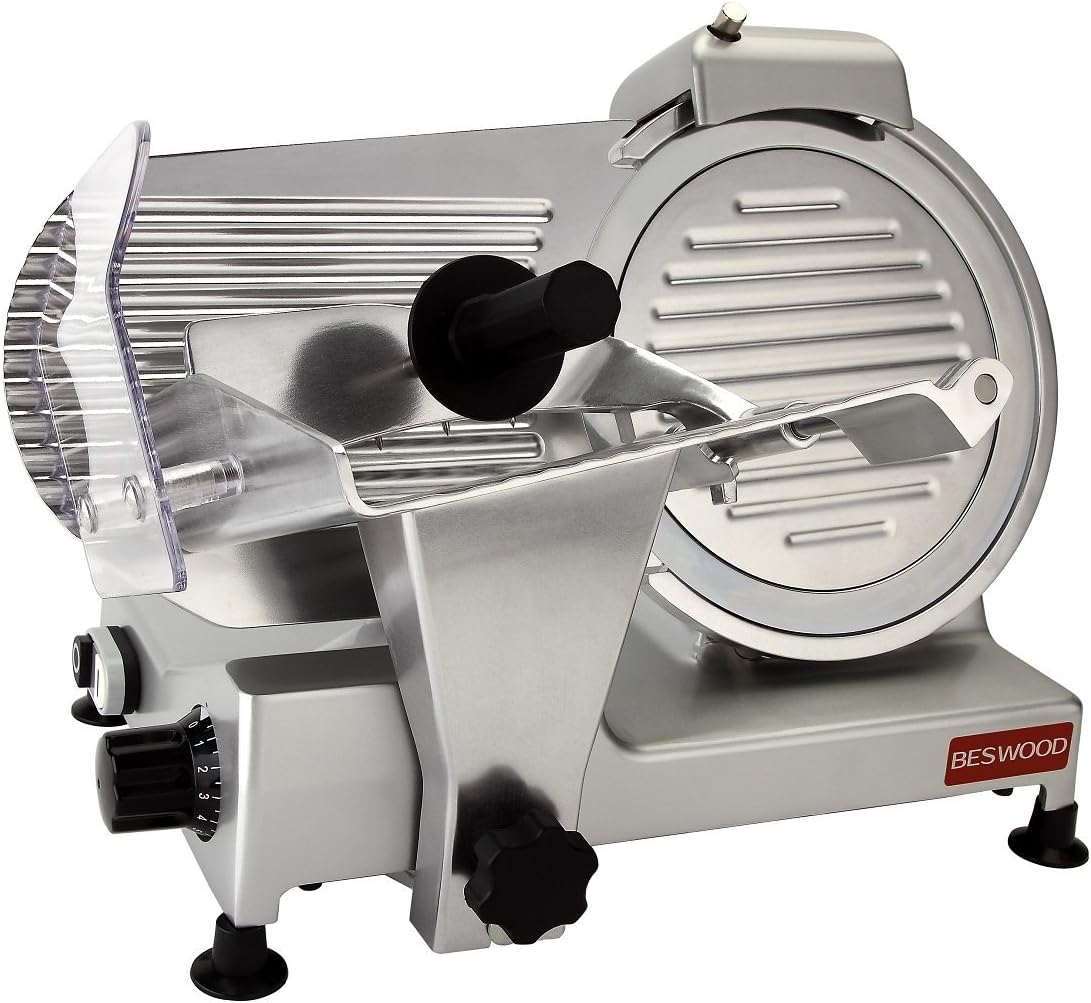
BESWOOD250 10-inch electric deli meat slicer with chromium-plated steel blade and aluminium body

Short version. The BESWOOD250 is a $358 machine that does one thing the $70–150 home slicers cannot: it keeps going. A 10″ chromium-plated blade turning at 282 rpm off a 240W, 1/3 HP motor will work through a whole brisket or a case of cheese without heating up or bogging down, and the top-mounted twin sharpening stones mean the edge is maintained on the machine rather than sent away.

It is also 33 pounds and takes up 20 inches of counter by 17 inches deep. If you slice deli meat twice a month, this is the wrong purchase and the CUSIMAX at around $110 does the same job for a third of the money. Buy the BESWOOD when volume, not capability, is what your current slicer is failing at.

Price and availability verified 2 September 2026: $358.00, in stock, sold on Amazon by BESWOOD directly rather than a reseller. Rating 4.6 out of 5 from 3,368 ratings.

Check Price on Amazon ↗

BESWOOD250 specifications

Blade 10″ high-carbon steel, chromium-plated
Motor 240W / 1⁄3 HP, 110–120V
Blade speed 282 revolutions per minute
Slice thickness 1–12 mm (about 0 to 1⁄2″)
Max cutting length 210 mm (8-1⁄4″)
Max cutting height 170 mm (6-7⁄10″)
Sharpener Built in, twin stones, top mounted
Weight 33 lb
Footprint 20″L × 17″W × 14.75″H
Certification ETL listed (see the certification section below)
In the box Machine, manual, cleaning brush, food-grade machine oil
Warranty 12 months from purchase

What the $358 actually buys

Almost every slicer sold for home use runs a direct-drive motor between 130W and 200W behind a 7.5″ blade. Those machines are sized for a task measured in minutes: a pound of turkey, a block of cheese, a few servings of prosciutto. The BESWOOD is sized for a task measured in pounds.

Three specifications carry that difference. The motor is 240W rated at 1/3 horsepower, which is roughly a fifth more power than the strongest of the home machines. The blade is 10 inches rather than 7.5, so a single pass covers 8-1/4 inches of cutting length instead of about 6. And the blade turns at a stated 282 revolutions per minute, which is deliberately unhurried — slicer blades are not meant to spin fast, they are meant to keep turning at a constant rate under load.

The body is aluminium rather than moulded plastic, which is most of the 33 pounds. Weight on a slicer is a feature and not a penalty: a machine that stays still while a blade turns against resistance produces more even slices than one that walks across the counter. It is the same reason a heavy stand mixer outperforms a light one.

The built-in sharpener is the part that matters most

The BESWOOD250 carries two sharpening stones mounted on top of the machine. You engage them against the blade and run it briefly, and the edge is restored in place.

This is easy to skim past on a spec sheet and it is the single biggest ownership difference between this machine and a $100 one. A slicer blade dulls. When a cheap slicer’s blade dulls, the realistic options are to buy a replacement blade or to live with a machine that tears rather than cuts, because sending a 7.5″ slicer blade out for sharpening costs a meaningful fraction of what the whole slicer cost. Neither option is good, and it is the reason a lot of budget slicers end up in a cupboard within two years.

A chromium-plated high-carbon blade with stones on the machine changes the arithmetic. The plating resists corrosion, so the edge does not pit between uses, and the stones mean maintenance is a two-minute job rather than a purchase.

Here is the number that makes the point. BESWOOD sells the original replacement blade for this machine directly, at $120.00 — a third of what the whole slicer costs, and more than the price of an entire budget slicer. It was also showing as sold out on their site when I checked on 2 September 2026, which sharpens the argument rather than softening it.

On a machine where a new blade costs $120 and may not be in stock when you want one, keeping the existing blade sharp is not a convenience feature. It is the difference between a long-term tool and a disposable one.

What it will and will not cut

The published capacity is 210 mm of cutting length by 170 mm of height, which in practical terms is a cut face of roughly 8-1/4 by 6-7/10 inches. That takes a whole turkey breast, a standing rib roast, a full deli-sized block of cheese, or a large salami along its length rather than at an angle.

Thickness runs from 1 mm to 12 mm. The bottom of that range is genuine deli-paper territory, and the top is a half-inch steak-cut. Most home slicers stop at 15 mm but cannot hold a setting at the thin end under load, which is the specification that actually matters: a slicer’s job is repeatability, and a dial that drifts by a millimetre between slices is what separates a machine from a toy.

What it will not do is cut bone, and no belt-driven slicer will. It is also not designed for hard-frozen meat. Semi-frozen — firmed in the freezer for 30 to 45 minutes so the fibres stiffen — is the standard technique for getting clean thin slices from raw meat, and a 240W motor is comfortable there in a way a 130W one is not. Solid-frozen is how blades get damaged, on this machine as on any other.

BESWOOD250 slicer showing the adjustable thickness dial and food carriage

The certification question, and why it is worth checking

This is the part of the listing I would treat carefully, and no other review of this machine seems to raise it.

The Amazon listing states one certification: USA standard approved: ETL Listed & Certified. ETL is an electrical safety mark, equivalent in function to a UL listing, and it is the certification that matters for plugging the machine in at home. On that point the sources agree and there is no ambiguity.

NSF is a different thing entirely. It certifies that equipment can be cleaned and sanitised to a standard health inspectors accept, and it is what a commercial kitchen is often required to have. BESWOOD’s own website is inconsistent here: one line of marketing copy on the product page lists the approvals as ETL and NSF, while the specification block further down the same page gives the certifications as ETL, GS, CE and ROHS, with no NSF among them. The Amazon listing does not mention NSF at all.

For a home kitchen this changes nothing; ETL is the relevant mark and it is confirmed. But this machine is sold as “for Commercial and for Home Use,” and if you are buying it for a business that gets inspected, do not take NSF certification from the product description. Ask BESWOOD to confirm it in writing before you order. If NSF is a hard requirement, the KWS MS-10NT at $394 states it explicitly on its listing, and my KWS MS-10NT review covers that machine in full, with the two set against each other in my BESWOOD vs KWS comparison.

Is it too much machine for a home kitchen?

For most people, yes. That is not a criticism of the machine, it is a description of who it is for.

The honest comparison is against the CUSIMAX, which is the Best Overall pick in my meat slicer buying guide at $109.78 with 8.7″ dual blades and a 200W motor. The BESWOOD costs $248.22 more. For that you get an inch and a bit more blade, about 20% more motor, an aluminium body instead of plastic, and the on-board sharpener.

Whether that is worth $248 depends entirely on one question: how much do you slice at a time? Below roughly a pound or two per session the CUSIMAX will not be the limiting factor in your kitchen and the extra money buys capability you never reach. Above that — a hunter processing a season, a household that buys whole roasts and portions them, anyone slicing for a market stall or a small deli counter — the cheaper machine starts overheating and the dial starts drifting, and the BESWOOD simply does not.

The specification that decides it

Duty cycle is the useful frame, even though no manufacturer in this category publishes one. A 130W to 200W direct-drive motor is designed for short runs with cooling gaps. A 1/3 HP motor in an aluminium housing is designed to run continuously. If you have ever stopped slicing because the machine got hot rather than because you were finished, that is the specification you are buying.

The same-price sibling almost nobody mentions

BESWOOD sells a second version of this machine on Amazon: the same 10″ 240W slicer in a red finish, listed at $358.00 — identical to the standard model — but with a removable serving plate included that the standard listing does not ship with.

It rates 4.6 out of 5, the same as the original, though from 219 ratings rather than 3,368. That is the trade: the same machine and the same price with an extra accessory, against a review base that is fifteen times smaller and a much shorter sales history. There is also a third variant, the BESWOOD250RX, which was showing as unavailable when I checked on 2 September 2026.

If the serving plate is useful to you, the red model is a free upgrade. If you would rather buy the version that thousands of people have already reported back on, the standard listing is the safer pick. Both are sold by BESWOOD rather than a third party.

Watch the blade size if you buy direct

BESWOOD’s own site sells this machine in both 9″ and 10″ blade sizes on a single product page, with 9″ selected by default and its specifications displayed until you switch. The 10″ is $358.00 there, the same as Amazon, so there is no saving in buying direct — but there is a way to accidentally order a smaller machine than you meant to.

What 3,368 ratings actually say

A star average on its own is close to useless, because a 4.6 from two hundred people and a 4.6 from three thousand are different claims about the world. Here is how the BESWOOD250’s rating breaks down, read off the listing on 2 September 2026.

Rating Share Approx. ratings
5 star 83% ~2,795
4 star 10% ~337
3 star 2% ~67
2 star 1% ~34
1 star 4% ~135

Ninety-three percent of buyers rated it four or five stars, which is a strong result on a sample this size. The interesting part is the shape at the bottom. The one-star share is larger than the two- and three-star shares combined, which means the negative feedback is not a gentle slope of mild disappointment — it is a large group who are very happy and a small group who are not happy at all, with very little in between.

I am not going to tell you why those roughly 135 people rated it one star, because Amazon now requires a sign-in to read filtered reviews and I have not read them. Anyone who tells you the cause without having read them is guessing. What the distribution supports is a narrower and more useful conclusion: whatever goes wrong for a small minority of buyers goes wrong badly rather than gradually.

The practical response is the same one that applies to any 33-pound appliance shipped by carrier. Unbox it, run it, and check the blade and the carriage properly within the return window rather than leaving the box in the garage for three weeks. That is cheap insurance on a purchase where the failure mode, whatever it is, appears to be binary.

It is also the reason to prefer this listing over the red variant if you are undecided. Both average 4.6, but 3,368 ratings resolve a distribution that 219 ratings cannot.

Setup, counter space and running costs

There is no assembly. The machine arrives built, with a manual, a cleaning brush and a bottle of food-grade machine oil, and the oil is a hint about the maintenance the manufacturer expects: the slide rod that the carriage travels on wants lubricating periodically so the stroke stays smooth.

Plan the counter space before it arrives rather than after. The footprint is 20 inches wide and 17 inches deep, which fits a standard 24- to 25-inch counter depth with room behind, but the number that catches people out is the clearance at the carriage end. The food carriage travels its full stroke out to one side, so the machine needs room beside it as well as under it, and a slicer wedged into a corner cannot use its own capacity.

At 33 pounds, this is not an appliance that gets lifted in and out of a cupboard between uses. Decide now whether you have somewhere it can live permanently, because a slicer that has to be hauled out is a slicer that stops being used — and that failure is much more common than any mechanical one.

Ongoing costs are otherwise close to nothing. The consumables are the oil and, eventually, a blade at $120.00, which the on-board stones exist to postpone.

Cleaning and maintenance

The slicer strips down without tools: the blade, the food carriage and the pusher all come off for washing. A cleaning brush and a bottle of food-grade machine oil are supplied, which tells you what the routine is meant to be — brush the seams, wash the removable parts, and oil the slide rod so the carriage keeps moving smoothly.

My guide to how to clean a meat slicer covers the full routine, including the step almost everyone skips. It is hand wash only. That is standard for slicers and it is not a shortcut the manufacturer is taking: dishwasher detergent is hard on a plated blade edge, and the plating is what stops the high-carbon steel underneath from corroding.

The thing to be disciplined about is the seams. Across verified-purchase reviews of slicers generally, trapped residue in places the machine does not open up is one of the two recurring complaints, alongside blades loosening over time. A machine that comes apart properly is easier to keep hygienic than one that does not, and that is worth more on a slicer than on most appliances. My guide to choosing a cutting board covers the same principle for the surface the sliced food lands on.

Who should skip it

  • Occasional slicers. If a slicer comes out once or twice a month for sandwich meat, this is roughly $250 of capability you will not use.
  • Small kitchens. 20 inches by 17 inches of counter, and 33 pounds. This is not a machine that gets lifted into a cupboard after each use, and a slicer that lives in a cupboard stops being used.
  • Anyone who needs NSF certification on paper. Confirm it directly with BESWOOD first, or buy a machine that states it.
  • Anyone hoping to cut frozen blocks or bone. Neither is what a belt-driven slicer does, at any price.

BESWOOD250 vs the alternatives

Slicer Best For Blade Price Rating
BESWOOD250 Volume slicing at home 10″ / 240W $358.00 4.6★ (3,368)
KWS MS-10NT When NSF is required 10″ / 320W $394.00 4.5★ (1,959)
CUSIMAX dual blade Most home kitchens 8.7″ / 200W $109.78 4.3★ (5,038)

The KWS is the closest thing to a direct competitor: a 10″ machine with a stronger 320W motor and a 304 stainless blade, $36 dearer and three pounds heavier. Its advantage is the explicit NSF statement and the extra motor; the BESWOOD’s advantage is a review base almost twice the size and a chromium-plated blade with the stones to maintain it.

The CUSIMAX is in the table because it is the machine most people buying a slicer should actually buy, and a review that does not say so is not being useful. Full comparisons for the home-priced machines are in my best meat slicers guide, and if slicing is only part of the prep problem, my food processors hub covers the chopping and shredding side.

How this review was researched

Plainly: I have not run this machine. This is a research-based review, not a firsthand account, and nothing in it is written as one.

What it rests on: the manufacturer’s published specification for the 10″ variant, cross-checked against the Amazon listing and against the figures third-party reviews report; live price, stock and seller status pulled on 2 September 2026; the pattern of complaints across the verified-purchase review base; and the certification claims read directly off both BESWOOD’s site and the Amazon listing, which is how the ETL and NSF discrepancy above surfaced.

What I could not establish: slice consistency under sustained load, which is the whole job of a slicer. Measuring it means slicing the same chilled product at one setting repeatedly and measuring every slice, and no independent test does that for this machine. Motor rating, blade diameter and body mass are used here as proxies for it, and a proxy is not a measurement.

Frequently Asked Questions

Is the BESWOOD250 worth it for home use?

Only if you slice in volume. The capability it adds over a $110 machine is sustained running and on-board sharpening, and both only pay back if you regularly slice more than a pound or two at a session. For occasional deli meat, a 7.5″ or 8.7″ home slicer does the same job for a third of the price.

Does the BESWOOD250 have a built-in sharpener?

Yes. Two sharpening stones are mounted on top of the machine and engage against the blade in place, so the edge is maintained without removing the blade or sending it out. Combined with the chromium plating on the high-carbon blade, that is the main reason this machine stays usable for longer than cheaper slicers.

Can the BESWOOD250 slice frozen meat?

Semi-frozen, yes; solid-frozen, no. Firming meat in the freezer for 30 to 45 minutes before slicing is the standard way to get clean thin cuts, and the 240W motor handles that comfortably. Cutting meat frozen through is how slicer blades get chipped, regardless of the machine.

Is the BESWOOD250 NSF certified?

The Amazon listing states ETL only. BESWOOD’s own site is inconsistent, with one marketing line claiming ETL and NSF while the specification block on the same page lists ETL, GS, CE and ROHS. If NSF matters for your kitchen, confirm it with BESWOOD before buying rather than relying on the listing.

How thin will it slice?

The thickness range is 1 mm to 12 mm, so from deli-paper at the bottom to roughly a half-inch cut at the top. The more useful question is whether a slicer holds its setting between slices under load, which is where heavier machines with stronger motors separate from budget ones.

What is the difference between the BESWOOD250 and the red BESWOOD model?

Mechanically nothing, as far as the listings show: both are the 10″, 240W machine at $358.00. The red version includes a removable serving plate the standard one does not. The standard model has 3,368 ratings against the red model’s 219, so you are choosing between an extra accessory and a much larger body of buyer feedback.

The bottom line

The BESWOOD250 is a genuinely capable machine at a fair price for what it is, and the specification that justifies the money is the on-board sharpener rather than anything about the motor. A slicer you can keep sharp is a slicer you still own in five years.

Buy it if volume is the thing your current slicer fails at, if you have the counter space to leave 33 pounds standing out, and if ETL rather than NSF is all the certification you need. If you are buying your first slicer and you are not sure how much you will use it, buy the CUSIMAX instead and spend the $248 you save on the meat.

See Today’s Price on Amazon →

Prices, ratings and stock verified 2 September 2026. Amazon pricing moves; check the current figure before buying.


If the BESWOOD is more machine than the job needs, the CUSIMAX review covers the home-duty alternative in full, including where its 200W motor stops.

Filed Under: Product Reviews

Best Pellet Tube Smoker: Use It Instead of Your Chip Tray, Not As Well

Last Updated September 2, 2026

Smoke rising over racks of meat on a barbecue grate

This post contains affiliate links. If you buy through my links, I may earn a commission at no extra cost to you. Read the full disclosure.

A pellet tube is a ten-dollar fix for a specific problem, and buying one to get “more smoke” in general is how food ends up tasting bitter. The A-MAZE-N AMNTS12 is the one to buy, at $13.49, because it comes from the company that invented the format and its own instructions tell you what the thing is actually for.

The quick answer

Buy a 12-inch tube with a flat side — oval or hexagonal, so it does not roll off the grate. The A-MAZE-N at $13.49 or the LIZZQ at $13.93 both qualify and there is very little between them. Use it instead of a loaded chip tray, not as well as one. If you need to cover a full overnight cook, the Kaduf maze tray is the only format here that will.

What a smoke tube actually fixes

It is worth being precise about the problem, because it decides whether you need one at all.

An electric smoker holds its temperature by switching the element on and off. On most cabinets the chip tray sits on or beside that element, so the chips only smoulder while the element is drawing power. Once the box reaches 225°F the element spends most of each cycle off, and the smoke arrives in bursts with long gaps between them. That is normal behaviour rather than a fault, and it is set out in full in the guide to an electric smoker not producing smoke.

A tube sidesteps that entirely. It is a perforated metal tube filled with pellets, lit at one end, smouldering on its own. Nothing about it is connected to the thermostat, so it keeps producing smoke whether the element is running or not.

That is the whole mechanism, and it explains who should buy one: anyone whose smoke output tracks the element cycle rather than the cook. It also explains who should not. If the cabinet is not reaching temperature at all, or the chip tray is packed solid, or the vent is shut, a tube is treating a symptom.

The part the category does not tell you

Every guide to these things sells more smoke as an unqualified good. It is not.

Weber’s own smoking guidance is to start with a small amount of wood and add more only if you want a stronger flavour, because too much wood smoke over long periods can make food taste bitter. A tube runs continuously for hours by design. Add one to a chip tray that is already working and you have roughly doubled the smoke on a twelve-hour cook.

So the rule is substitution rather than addition. Run the tube or the chip tray. On a long cook, many people light the tube for the first few hours only and leave it out after that, which is closer to how the smoke would behave on a fire anyway.

How to choose one

Shape, for an unglamorous reason

Round tubes roll. A cylinder on a grate of parallel bars will find a gap, tip, and empty burning pellets into the bottom of the cooker. Hexagonal and oval sections sit still, which is why every serious version of this product has flat sides. It is the single most practical difference between two tubes that otherwise look identical.

Burn time, and how much to trust it

Claimed burn times run from about three hours to twelve, and none of them has been independently verified. Worth noticing: the most established brand claims the least. A-MAZE-N, which built this category, says up to four hours; the marketplace brands mostly say five for the same twelve-inch tube.

Treat the numbers as an ordering rather than a promise, and read them as a maximum in still air with dry pellets. Wind, damp pellets and a packed tube all shorten it.

Length and format

Twelve inches is the default and is right for most cooks. Six-inch tubes exist for small kettles and short sessions. An expandable tube covers both, which is genuinely useful if your cooks vary, since lighting five hours of pellets for a two-hour cook simply wastes them.

Above that sits the maze tray, a flat 5″ × 8″ grid rather than a tube, which trades footprint for burn time and is the only format that covers an overnight cook without a refill.

Pellets or dust

Tubes take standard barbecue pellets, which is what makes them convenient. Maze trays take pellets too, and some also take the finer sawdust used for cold smoking, which burns slower and cooler. If cold-smoking cheese is the goal rather than adding smoke to a hot cook, that distinction matters more than any other on this page.

My picks at a glance

Product Best For Price Rating Buy
A-MAZE-N AMNTS12 12″ oval Most people $13.49 4.6★ (1,570) Check Price
LIZZQ Premium 12″ The safest default $13.93 4.7★ (14,948) Check Price
LOVEERCT 12″ hexagon Spending as little as sensible $9.99 4.7★ (1,378) Check Price
Kaduf 5″×8″ maze tray Long cooks and cold smoking $29.99 4.5★ (744) Check Price
Pit Boss Expandable 7–12″ Matching burn time to the cook $14.99 No ratings yet Check Price

Prices and ratings were checked on 2 September 2026 and will move.

A-MAZE-N AMNTS12 — the one most people should buy

A-MAZE-N made this product category exist, and the reason to start here is not nostalgia. Its listing is the only one of the five that says what a tube is for rather than what it can do: designed to supplement smoke in an electric smoker. That is the actual use case, stated by the maker, and it is the sentence the rest of the category leaves out.

The oval section is the practical advantage. It cannot roll, which matters more than it sounds like it should when the alternative is burning pellets in the bottom of a cabinet.

It also claims less than its rivals — four hours against their five, for the same twelve inches. Read that as the difference between a figure someone has to stand behind and a figure written for a listing.

A-MAZE-N AMNTS12 oval stainless steel pellet tube smoker
BEST OVERALL

A-MAZE-N AMNTS12 12″ oval

  • 12 inches, stainless steel, oval section
  • Up to 4 hours of smoke, the maker’s own figure
  • Designed to supplement smoke in an electric smoker
  • Hot and cold smoking

Pros: The brand that established this category, and the only one whose own listing states what a tube is actually for — supplementing an electric smoker. The oval section will not roll off a grate. Cheapest of the five.

Cons: Claims four hours where the marketplace brands claim five, which reads as conservative rather than worse but does mean less unattended time. Ships in one to two days rather than from stock. No lid, so pellets can spill if it is knocked while loaded.

See Today’s Price on Amazon →

LIZZQ Premium 12″ — the safest default

If the A-MAZE-N is out of stock, this is the one to buy, and on the numbers alone it has a fair claim to being first.

Nearly fifteen thousand ratings at 4.7 stars is an evidence base nothing else in the category comes close to, and hexagonal sides solve the rolling problem the same way the oval does. It costs forty-four cents more than the A-MAZE-N.

What it does not have is a manufacturer with a history behind it. That is worth something on a piece of stainless steel that lives in a fire, and it is the only reason it is second here rather than first.

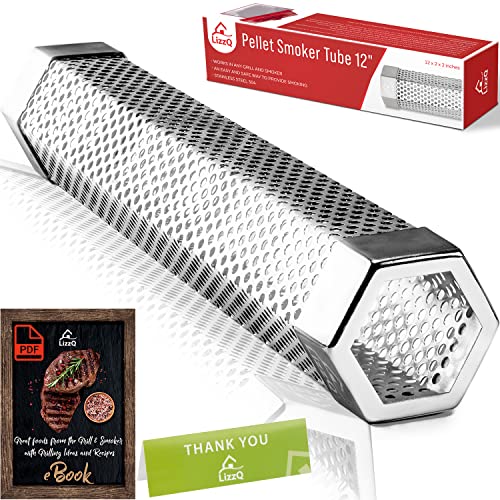
LIZZQ Premium 12 inch stainless steel pellet smoker tube
MOST REVIEWED

LIZZQ Premium 12″

  • 12 inches, stainless steel, hexagonal
  • Up to 5 hours claimed
  • Works in any grill or smoker
  • Nearly 15,000 ratings

Pros: By far the largest review base in the category, at 4.7 stars. Hexagonal, so it stays where you put it. Same money as the A-MAZE-N.

Cons: The five-hour figure is the maker’s and nobody independent has published a burn test. A house brand rather than a manufacturer with a history, so there is less to fall back on if it warps.

See Today’s Price on Amazon →

LOVEERCT 12″ hexagon — the cheapest one worth buying

Ten dollars buys the same format in 304 stainless, with over a thousand ratings behind it and a cleaning brush in the box.

This is also where the category floor sits. Below this price there are dozens of near-identical tubes with no reviews at all, often from sellers who will not exist next season. The difference between a $7 tube and a $10 tube is not the steel; it is whether anyone has used it.

LOVEERCT 12 inch hexagon stainless steel smoke tube with brush
CHEAPEST CREDIBLE

LOVEERCT 12″ hexagon

  • 12 inches, 304 stainless steel, hexagonal
  • Up to 5 hours claimed
  • Cleaning brush included
  • Hot and cold smoking

Pros: Ten dollars for the same format as the picks above, in 304 stainless rather than unspecified steel, with over a thousand ratings at 4.7. The brush is a genuine convenience.

Cons: A marketplace brand with no track record beyond this listing, so long-term durability is unknown. Below this price the category is full of near-identical tubes with no reviews at all, and that is where the risk starts.

See Today’s Price on Amazon →

Kaduf 5″ × 8″ maze tray — for overnight cooks and cold smoking

This is the only pick that is not a tube, and the only one that will run a brisket through the night without a refill.

A maze tray is a flat grid: the pellets burn along a folded path rather than down a cylinder, which is what buys the longer time. It sits flat, so nothing rolls, and the low profile makes it the easier choice for cold smoking, where the point is smoke without heat.

The trade is footprint and price. It needs a clear patch of grate that a twelve-inch tube does not, and it costs three times as much. On a small kettle it is the wrong shape.

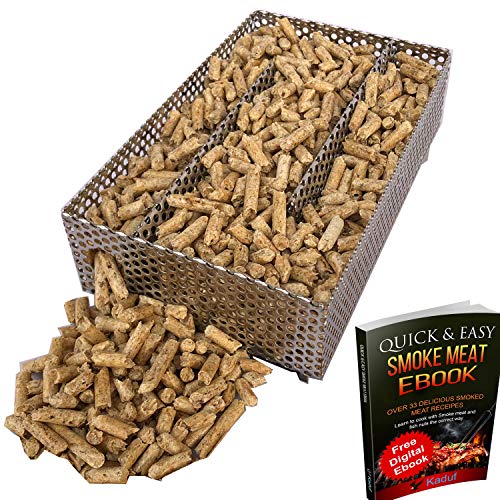
Kaduf 5 by 8 inch stainless steel pellet smoker maze tray
LONGEST BURN

Kaduf 5″×8″ maze tray

  • 5″ × 8″ maze tray rather than a tube
  • Up to 12 hours claimed — the longest here
  • Sits flat; no rolling to worry about
  • Hot and cold smoking

Pros: The only format here that covers a full overnight cook without a refill, which is the whole point on a brisket. Flat, so placement is easy. Genuinely different from the four tubes rather than another version of them.

Cons: Three times the price of the tubes. The footprint is large for a small kettle or a crowded cabinet, and it needs a clear patch of grate. Fewer ratings than the leading tubes.

See Today’s Price on Amazon →

Pit Boss Expandable 7–12″ — when the cook is short

Every other tube here commits you to its full length. Light a twelve-inch tube for a two-hour cook and three hours of pellets burn away after the food comes off.

This one collapses to seven inches, so the burn matches the session. It also comes from a company that makes the cookers rather than only the accessory, which is worth something on fit and finish.

The caveat is unusual enough to state plainly: it has no customer ratings at all. That is a genuine unknown rather than a bad sign, but on a fifteen-dollar accessory with four proven alternatives on this page, it is a reason to buy it for the adjustability rather than by default.

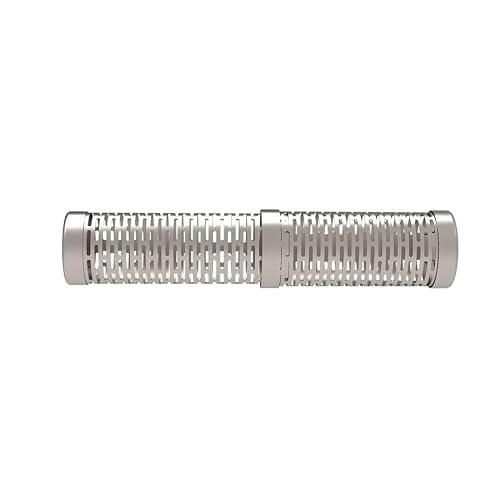
Pit Boss expandable pellet smoker tube extending from 7 to 12 inches
ADJUSTABLE

Pit Boss Expandable 7–12″

  • Expands from 7 to 12 inches
  • Approximately 3 hours of smoke
  • Stainless steel; Pit Boss part 41075
  • Hot and cold smoking

Pros: The only pick that lets you shorten the burn to match a two-hour cook rather than lighting five hours of pellets and wasting three. From a manufacturer that makes the grills rather than only the accessory.

Cons: No customer ratings at all yet, which is a real gap on a product this cheap to get wrong. Stock has been thin. Three hours at full extension is the shortest burn here, so it is the wrong choice for an overnight cook.

See Today’s Price on Amazon →

Which pellets to put in it

The tube is the cheap part of this decision. What goes in it matters more, and there is one distinction that is worth getting right before any question of flavour.

Barbecue pellets and heating pellets are not the same product. Pellets sold for pellet stoves are made to burn in an appliance, not to season food, and they can contain binders and material you would not choose to put smoke from into your dinner. Traeger describes its own barbecue pellets as free from additives and binders, which is the standard to buy to. Cooking pellets cost a little more per bag and the bag says what they are for.

Beyond that, wood choice is preference rather than rule. The conventional groupings are useful as a starting point: fruit woods such as apple and cherry are mild and suit poultry and pork; hickory and mesquite are assertive and suit beef; oak sits between them and is hard to get wrong. Weber publishes a chart pairing woods with foods, and it is worth a look before buying a large bag of anything.

Two practical points. Buy small bags until you know what you like, because a tube uses very little and a large bag will outlast your patience with the flavour. And blends are not a compromise so much as a hedge, which is why they are the safest first purchase.

Looking after it

The one thing owners get wrong is pellet storage rather than tube maintenance, and it is the cause of most tubes that will not stay lit.

Pellets are compressed sawdust and they absorb moisture from the air, after which they swell, crumble and refuse to hold an ember. A bag folded over in a damp shed is enough to ruin them over a winter. Keep them in a sealed container indoors, and check before lighting: good pellets have a sheen and snap cleanly, while damp ones look dull and crumble.

The tube itself needs very little. Tip the ash out while it is cool, and run a brush through it if one came in the box. Stainless steel discolours to a permanent brown and that is cosmetic rather than a fault. What does matter is storing it dry and empty — pellets left in a tube between cooks are the ones that will not light next time.

What was left out, and why

Round tubes. Plenty are sold and some are cheap, but a cylinder rolls on a grate and can tip burning pellets into the bottom of the cooker. Every pick here has flat sides for that reason.

Sub-$8 no-name tubes. The category has a long tail of identical-looking tubes with no reviews and sellers with no history. The saving is two or three dollars on a product that sits inside a fire, which is the wrong place to economise.

Dedicated cold smoke generators. Devices that pump smoke into a chamber with a small pump, at forty dollars and up, are a different product for a different job. If cold-smoking cheese and fish is the main use rather than an occasional one, look at those rather than at a tube.

Tubes bundled with pellets. The bundle is usually the same tube plus a small bag at a markup, and it locks you into one wood. Pellets are cheap and better bought separately in the flavour you want.

Getting it lit, which is where people struggle

The commonest complaint about these things is not that they burn out too soon but that they go out.

Fill the tube no more than about three-quarters full, so air can move through the pellets. Stand it upright, light the top end with a blowtorch or a chimney lighter, and keep the flame on it for a good half a minute or more — considerably longer than feels necessary. Let it burn with a live flame for a couple of minutes, then blow it out. What should be left is a glowing ember and a thin stream of smoke.

A tube that keeps dying is usually one of three things: pellets that have taken on moisture, a tube packed too tight for air to pass, or not enough initial flame to establish the ember. Damp pellets are the most common by a distance, and the test is the same one the pellet-grill makers give — good pellets have a sheen and snap cleanly rather than crumbling, which is set out with the sources in pellet grill temperature swings.

Lay it on the grate away from the food and away from direct flame, at the end where air enters if the cooker has an obvious flow. And leave the vent open. Smouldering wood needs air, and a closed vent starves the tube and deposits stale smoke on the food at the same time.

How These Picks Were Chosen

Plainly: this is a research-based guide, not a hands-on test. I do not own a smoker or a pellet tube, none of these has been through my hands, and no burn was timed to produce anything here.

What the selection rests on is what can be established without testing: the physical format and what it implies, the maker’s own stated figures, whether there is a manufacturer behind the product or only a listing, and the size and score of the review base. Flat-sided tubes were preferred over round ones for a mechanical reason rather than a taste one. Products with no review history were included only where they cover a need nothing else on the page does, and said so.

Prices, availability and product images come from the Amazon Product Advertising API, which is the licensed route for images. Star ratings and review counts were read from each product page on 2 September 2026, and every listing was confirmed live the same day.

Also not established: how long any of these actually burns. Every burn-time figure on this page is the manufacturer’s own claim, none of them is independently verified, and they are not measured on a common basis — a “five hour” tube and a “four hour” tube may well behave identically. Nobody publishes comparative burn tests for this category. The figures are quoted as an ordering, not as a specification, and the A-MAZE-N is recommended despite claiming the shortest of the twelve-inch times rather than because of it.

Frequently Asked Questions

Do pellet tube smokers actually work?

Yes, for what they are for. A tube burns independently of the cooker’s thermostat, so it produces smoke steadily while an electric smoker’s chip tray only smoulders when the element is running. It will not fix a cabinet that is not reaching temperature, and it is not a substitute for a working chip tray on a machine that has one.

How long does a 12-inch pellet tube burn?

Makers claim four to five hours, and none of those figures is independently verified. A-MAZE-N says up to four; most marketplace brands say five for the same length. Treat them as an ordering rather than a promise: wind, damp pellets and overfilling all shorten the burn.

Can I use a smoke tube and wood chips at the same time?

Better not to. Weber warns that too much smoke over long periods makes food taste bitter, and a tube plus a full chip tray roughly doubles the smoke on a long cook. Run one or the other. Many people light the tube for the first few hours of a cook and leave it out afterwards.

Why does my smoke tube keep going out?

Usually damp pellets, a tube packed too tightly for air to pass, or not enough flame at the start. Fill to about three-quarters, hold a torch on the lit end for well over thirty seconds, let it flame for a minute or two, then blow it out so an ember is left. Keep the cooker vent open.

What is the difference between a tube and a maze tray?

Burn time and footprint. A maze tray is a flat grid where pellets burn along a folded path, which is what lets it claim up to twelve hours against a tube’s four or five. It needs a clear patch of grate, costs more, and is the easier choice for cold smoking. A tube is smaller, cheaper and enough for most cooks.

Can I use a pellet tube for cold smoking cheese?

Yes, and it is one of the main reasons to own one, since the tube produces smoke without heating the chamber. Put the cheese as far from the tube as the cooker allows, work on a cool day, and expect to experiment. A maze tray is the better tool if cold smoking is the main use rather than an occasional one.

The verdict

The A-MAZE-N AMNTS12 at $13.49 is the one to buy for most people: the format’s originator, an oval section that will not roll, and a maker honest enough to claim four hours where its rivals claim five. If it is out of stock, the LIZZQ Premium is forty-four cents more and has fifteen thousand ratings behind it.

Spend more only for a reason. The Kaduf maze tray is the pick if a cook runs overnight or cold smoking is the point. The Pit Boss expandable earns its place only if your cooks are short and vary in length.

If the smoker is plugged into an extension lead, that is the other cheap thing worth getting right, and the specification is stricter than most people expect — see the best extension cord for an electric smoker.

And whichever you buy, use it instead of a loaded chip tray rather than alongside one. If the underlying problem is that the smoker is not making smoke at all, start with an electric smoker not producing smoke before buying anything. The rest of the outdoor cooking guides are collected on the outdoor cooking hub.


Filed Under: Product Reviews

Best Extension Cord for an Electric Smoker: What the Makers Require

Last Updated September 2, 2026

Orange outdoor extension cord coiled loosely on a sunlit wooden deck

This post contains affiliate links. If you buy through my links, I may earn a commission at no extra cost to you. Read the full disclosure.

Two smoker manufacturers publish exactly what an extension cord has to be, and almost nothing sold as a “smoker extension cord” meets it. The Southwire 25ft SJTW 14/3 does, and at $19.30 it is also the cheapest option here that does. Most cords fail on one specification: gauge.

The quick answer

Buy an outdoor-rated SJTW cord, with a three-prong grounded plug, heavier than 16 gauge, and as short as it will reach. The Southwire 25ft 14/3 covers all four for under $20. If your smoker is a Bradley, the 15-foot Iron Forge is the one to buy, because Bradley specifies under 20 feet.

What the smoker makers actually require

This is the part every competing guide leaves out, and it turns the question from a matter of opinion into a specification check.

Masterbuilt states that an outdoor extension cord used with its smokers must be marked with the suffix letters “W-A” and tagged “Suitable for Use with Outdoor Appliances”, must have grounding terminals in working condition, should be heavier than 16AWG, and should be no longer than 25 feet. Bradley Smoker’s guidance is shorter and stricter on length: if an extension cord is needed, it should be heavy-duty and under 20 feet.

Read together, that is four requirements and a ceiling.

1. Outdoor-rated jacket

The marking to look for on the cord itself is SJTW. The W is the part that matters: it means the jacket is rated for outdoor use, wet conditions and sunlight. An SJT cord without the W is an indoor cord, and it will go brittle in a season of weather. The “W-A” suffix Masterbuilt names is the older form of the same designation.

2. A working three-prong ground

The earth pin is not optional on an appliance that lives outdoors. A smoker trips its socket because current is finding a path to earth, and the grounding conductor is what makes that path safe and detectable. Two-prong cords and adapters that defeat the earth pin have no place here at all — the full argument is in the guide to an electric smoker that keeps tripping the breaker.

3. Heavier than 16 gauge, which rules out most of the category

Wire gauge runs backwards: the smaller the number, the thicker the copper. Masterbuilt’s “heavier than 16AWG” therefore means 14, 12 or 10 gauge, and it disqualifies the 16/3 cords that make up a large share of what is sold for this job.

The reason is voltage drop. Thin wire over distance loses voltage, the element receives less than it should, and the cord itself warms up. On a machine that draws continuously for twelve hours rather than in short bursts, that matters more than it would on a drill.

4. Short

Length is the specification people ignore, and it is the one both makers put a number on. Twenty-five feet is Masterbuilt’s ceiling. Twenty is Bradley’s. Nothing in this guide is longer than 25 feet, and the shortest cord that reaches is always the better cord, because voltage drop scales with length.

My picks at a glance

Product Best For Price Rating Buy
Southwire 25ft SJTW 14/3 Most electric smokers $19.30 4.8★ (248) Check Price
Iron Forge Cable 15ft 12/3 Bradley owners and short runs $25.99 4.8★ (6,954) Check Price
GoGreen Power GG-14025 12-gauge headroom at 25 feet $21.49 4.8★ (1,425) Check Price
GoGreen Power GG-15125 A smoker plus a light or probe $20.80 4.4★ (50) Check Price
EP 25ft 10/3 SJTW Maximum headroom and cold $39.99 4.8★ (1,429) Check Price

Prices and ratings were checked on 2 September 2026 and will move.

Southwire 25ft SJTW 14/3 — best for most electric smokers

Southwire is a wire manufacturer that supplies the trade rather than a brand that appeared on a marketplace last year, and on a product whose whole job is the quality of the copper inside it, that is worth more than any feature list.

The specification does everything Masterbuilt asks. It is SJTW, so the jacket is rated for weather and sunlight; it is 14 gauge, which clears the 16-gauge line; and it is 25 feet, which is the stated ceiling rather than a number pulled out of the air.

The plug is three-prong with reinforced blades, and the lighted end tells you at a glance that the socket is actually live — genuinely useful on a smoker plugged into a GFCI that may have tripped without anyone noticing.

The temperature rating is −40°C to 60°C, which is the difference between a cord that stays flexible on a cold morning and one that fights you.

Southwire 25ft SJTW 14/3 outdoor extension cord with lighted end
BEST OVERALL

Southwire 25ft SJTW 14/3

  • 14/3 SJTW, outdoor-rated jacket, three-prong grounded
  • 25 feet — Masterbuilt’s stated maximum
  • 15 amps, 125 volts; UL and cUL listed
  • Lighted end; reinforced blades; −40°C to 60°C

Pros: An established wire manufacturer rather than a marketplace brand. Meets every published Masterbuilt requirement. Cheapest cord here that does.

Cons: 14 gauge is the minimum that qualifies rather than generous headroom, so it is the wrong pick if you also want to run a griddle from it. Only 248 ratings, far fewer than the marketplace brands. Red is conspicuous in a garden.

See Today’s Price on Amazon →

Iron Forge Cable 15ft 12/3 — best for Bradley owners and short runs

Bradley specifies under 20 feet, and this is the only cord here that satisfies it. It is also 12 gauge rather than 14, so it is thicker copper over a shorter distance — which is the combination that loses the least voltage of anything in this guide.

The practical case for it is broader than Bradley ownership. If the socket is genuinely fifteen feet away, buying twenty-five feet of cord and coiling the slack is worse than buying fifteen, for reasons covered further down. Iron Forge is an American veteran-owned business, the cord is UL certified, and the listing makes a point of it staying flexible in an unheated garage, which is relevant given that Bradley also warns about cold slowing a smoker down.

Iron Forge Cable 15 foot 12/3 SJTW lighted outdoor extension cord
BEST SHORT CORD

Iron Forge Cable 15ft 12/3

  • 12/3 SJTW, outdoor-rated, three-prong grounded
  • 15 feet — the only pick under Bradley’s 20-foot limit
  • 15 amps, 125 volts, 1,875 watts; UL certified
  • Lighted end; reinforced blades; stays flexible in the cold

Pros: Thicker copper over a shorter run, which is the best electrical combination here. Satisfies both makers’ length rules at once. Nearly 7,000 ratings at 4.8 stars.

Cons: Fifteen feet is genuinely short, and there is no way to extend it safely — joining two cords is exactly what you should not do. Costs more than the 25-foot Southwire despite being shorter, because of the heavier gauge.

See Today’s Price on Amazon →

GoGreen GG-14025 25ft 12/3 — best 12-gauge at full length

If the socket is a full twenty-five feet away and you want more headroom than 14 gauge gives, this is the cheapest sensible way to get it. Contractor grade, cETL listed, molded plugs, lighted end.

It is worth reading the manufacturer’s own warning on this one rather than discovering it later: GoGreen states plainly that the cord should not be used with an EV charger. That has nothing to do with smokers, but it is a useful signal about where the maker draws its own line on sustained high-current loads, and it belongs in front of a reader rather than buried.

GoGreen Power GG-14025 12/3 SJTW outdoor extension cord with lighted end
BEST 12-GAUGE

GoGreen Power GG-14025

  • 12/3 SJTW, contractor grade, three-prong grounded
  • 25 feet, at Masterbuilt’s ceiling
  • cETL listed; molded plugs; lighted end
  • Moisture and abrasion resistant jacket

Pros: Heavier copper than the Southwire for about two dollars more. Molded plugs resist the flexing that kills cheap cords at the neck. 1,425 ratings at 4.8 stars.

Cons: The maker explicitly excludes EV charging, which is a fair signal of its limits under long high-current loads. Twelve-gauge cable is stiff and heavy to coil, and at 25 feet you are carrying that weight for no benefit if the socket is closer.

See Today’s Price on Amazon →

GoGreen GG-15125 25ft 14/3 three-outlet — only if you genuinely need two things powered

This is the compromise pick, and it comes with a warning attached rather than a recommendation.

The case for it is real enough: a smoker and a work light, or a smoker and a mains-powered thermometer receiver, from one cord. Same 14/3 SJTW construction as the Southwire, contractor grade, lighted end, and it costs about the same.

The case against it is that three sockets on one 14-gauge cord invite precisely the behaviour the troubleshooting guides warn about. A smoker and an LED lamp is fine. A smoker and a second heating appliance is how a 15-amp circuit ends up tripping, and the cord will not stop you. It also has by far the thinnest review history here — 50 ratings at 4.4 stars, against four figures for everything else.

GoGreen Power GG-15125 14/3 three-outlet SJTW outdoor extension cord in orange
THREE OUTLETS

GoGreen Power GG-15125

  • 14/3 SJTW, three outlets, three-prong grounded
  • 25 feet; contractor grade; cETL listed
  • Lighted end; molded plugs; high-visibility orange

Pros: Powers a smoker and a light or receiver without a second cord. Same jacket and gauge as the top pick, at a similar price.

Cons: Three sockets on 14-gauge cable make overloading easy, which is the opposite of what a smoker owner with a tripping breaker needs. Only 50 ratings and 4.4 stars — the weakest evidence base of the five. Do not buy it as a general-purpose splitter.

See Today’s Price on Amazon →

EP 25ft 10/3 SJTW — more cord than a smoker needs

Ten-gauge is overkill for an electric smoker and it is worth saying so before the price. A cabinet drawing a few hundred watts will never notice the difference between this and the Southwire.

It earns a place for two reasons. The first is if one cord has to serve the whole patio — a smoker today, a griddle or a pressure washer next weekend — because 10 gauge has headroom the others do not. The second is cold: the jacket is rated from −40°F to 140°F and the cable stays workable at the bottom of that range, which is where thin cords turn into hosepipe.

EP 25 foot 10/3 SJTW lighted outdoor extension cord in yellow
MOST HEADROOM

EP 25ft 10/3 SJTW

  • 10/3 SJTW, pure copper, three-prong grounded
  • 25 feet; 15 amps, 125 volts, 1,875 watts; ETL listed
  • −40°F to 140°F; lighted end; reinforced blades

Pros: The most headroom here by a wide margin, so one cord covers a smoker, a griddle and power tools. Best cold-weather rating of the five. 1,429 ratings at 4.8 stars.

Cons: Twice the price of the top pick for capacity a smoker cannot use. Ten-gauge cable is heavy and stiff, which makes it awkward to store and slow to lay out. The plug is bulky in a weatherproof socket cover.

See Today’s Price on Amazon →

What was left out, and why

The manufacturer standard does most of the excluding, and it is worth naming what it removes rather than quietly omitting it. Four whole categories that dominate this search do not qualify.

16-gauge cords. These are the single most common thing sold and recommended for smokers, and Masterbuilt’s “heavier than 16AWG” excludes them by definition. They are not merely a weaker choice; they sit on the wrong side of a line the maker drew. Several of them are perfectly good cords for a lamp or a hedge trimmer.

Short indoor appliance cords. The three-foot and six-foot cords that appear in this category are indoor-rated, and no length of an indoor cord makes it suitable for a machine standing in the weather. The jacket is the problem, not the distance.

Fifty-foot and hundred-foot cords. Both makers stop at or before 25 feet. A 50-foot cord in a smoker guide is a recommendation to exceed a published limit, whatever its gauge, and a heavier gauge does not buy permission to run further than the manufacturer allows.

Cord reels. A reel is a coil that cannot be uncoiled without unwinding all of it, which is the opposite of what a long low-temperature cook needs. If a reel is what you have, run it out completely rather than drawing off the length you want.

One thing was deliberately not used as a criterion: appearance. Orange, yellow and red are conventional for outdoor cords because they are meant to be seen and not tripped over, and choosing a black cord because it disappears against a patio is choosing against the point of the colour.

How to choose for your own smoker

Measure before you buy, then buy shorter

Run a tape from the socket to where the smoker will actually stand, then add a little for the route rather than the straight line. Buy the shortest cord that covers it. Every extra foot loses a little more voltage and gives you slack you will end up coiling, and coiled cord is a problem in its own right.

If the answer comes out over 25 feet, the cord is not the fix. That is the point at which the honest advice is to move the smoker or have a socket installed, because both makers stop at or before 25 feet and there is no cord that makes 40 feet acceptable.

Match the gauge to what you will plug in, not to the smoker alone

Fourteen gauge clears the manufacturer requirement for a smoker and is enough on its own. Choose 12 if the same cord will occasionally run something heavier, or if the run is at the long end. Choose 10 only if it is genuinely the patio’s only cord and a griddle or pressure washer is in its future.

The rating plate on the back of the smoker gives the wattage, and it is the number to use rather than any figure quoted on a review site. Divide watts by 120 for a rough amp draw. A cabinet in the hundreds of watts is a light load for any of these cords; the reason to go heavier is future-proofing, not present need.

Read the cord, not the listing

Marketplace listings use “heavy duty” and “waterproof” freely, and neither is a specification. The jacket itself is printed with what it actually is. Look for SJTW and the gauge, in the form 14/3 or 12/3 — the first number is the gauge, the second is the number of conductors, and three is what gives you an earth.

“Waterproof” on a cord listing generally means the jacket resists water, not that the connection does. A plug and socket joined in the open will still let water in, and that is exactly the leakage path that trips a GFCI. If the join has to sit outside, it needs a cover.

What is not worth paying for

A lighted end is genuinely useful on a smoker, because it distinguishes a tripped socket from a failed appliance at a glance. Beyond that, most of the differentiation in this category is colour and marketing. Braided sleeves, “military grade” claims and 20,000-bend test figures do not appear in any manufacturer requirement, and none of them changes the four things that do.

The other accessory an electric smoker owner tends to want is a pellet tube, for smoke that arrives in bursts rather than steadily — the formats are compared in the best pellet tube smoker.

The mistake that damages cords

Do not run the cord coiled. Several manufacturers print this on the listing and it is easy to skip past: a coiled cable under sustained load builds heat in the middle of the coil instead of shedding it, and the cord runs warmer than its rating assumes. On a twelve-hour cook, that matters.

Lay it out fully, even if that means the slack loops across a lawn. If there is a lot of slack, the honest conclusion is that the cord is longer than it needed to be.

Storage is the other half. Bring it in, or at least keep the connection off the ground and under cover. A cord left plugged in and lying in a puddle between cooks is a moisture leakage path waiting to be discovered, and moisture is the most common cause of an electric smoker tripping its socket in the first place.

How These Picks Were Chosen

Plainly: this is a research-based guide, not a hands-on test. I do not own an electric smoker, none of these cords has been through my hands, and no cord was put on a meter to produce anything here.

What the selection rests on is a published standard rather than an opinion. Masterbuilt and Bradley Smoker both state in their own documentation what an extension cord for their smokers must be, and those requirements — outdoor-rated jacket, working ground, heavier than 16AWG, 25 feet or less — are objective and printed on the product. Candidates were screened against them, and everything that failed on gauge, length or jacket rating was excluded regardless of price or rating. That is the whole reason this category can be assessed honestly without testing: the specification is the product.

Prices, availability and product images come from the Amazon Product Advertising API, which is the licensed route for images. Star ratings and review counts were read from each product page on 2 September 2026, and every listing was confirmed live on the same day.

Also not established: how these five compare on durability over years of outdoor use. That would need cords left outside for seasons and inspected, nobody publishes that data for consumer extension cords, and review counts are a measure of popularity rather than longevity. Where a cord here has a large review base, that is stated as what it is — evidence that many people bought it, not evidence that it lasts.

Frequently Asked Questions

What gauge extension cord do I need for an electric smoker?

Heavier than 16 gauge, which means 14, 12 or 10. Masterbuilt states that requirement directly. Gauge numbers run backwards, so a smaller number is thicker copper. Fourteen gauge is enough for a smoker on its own; go to 12 if the run is long or the cord will sometimes power something heavier.

Can I use a regular indoor extension cord with a smoker?

No. Masterbuilt requires a cord marked for outdoor use and tagged as suitable for outdoor appliances, with working grounding terminals. An indoor cord has a jacket that is not rated for weather or sunlight, and it will harden and crack. It is also the most common cause of an outdoor socket tripping.

How long can an extension cord for a smoker be?

Masterbuilt sets a ceiling of 25 feet and Bradley Smoker says under 20. Shorter is always electrically better, because voltage drop increases with length. If the socket is more than 25 feet from where the smoker needs to stand, the answer is to move the smoker or add a socket, not to buy a longer cord.

What does SJTW mean on an extension cord?

It is the jacket rating printed on the cable. The W is the important letter: it certifies the cord for outdoor use in wet conditions and sunlight. An SJT cord without the W is indoor only. The W-A suffix that Masterbuilt names in its own guidance is the older form of the same designation.

Will a better extension cord stop my smoker tripping the breaker?

Sometimes, but do not assume it. A thin or damaged cord is a common cause, and swapping it is worth trying. If the smoker still trips with no extension at all, the fault is elsewhere, usually moisture reaching the element terminals or the control housing. The diagnostic order is set out in the guide to a smoker that keeps tripping the breaker.

Is it safe to plug one extension cord into another?

No. Joining cords creates an unprotected connection that is usually left lying on the ground, and it compounds the voltage drop of both. Neither manufacturer allows it, and it defeats the length limits they set. Buy one cord of the right length instead.

The verdict

For most people the Southwire 25ft SJTW 14/3 is the right buy. It satisfies every requirement Masterbuilt publishes, it comes from a company that makes wire for a living, and at $19.30 it costs less than the cords that do not qualify.

Two exceptions are worth knowing. If your smoker is a Bradley, the Iron Forge 15ft 12/3 is the one to get, because Bradley draws its line at 20 feet and this is the only pick under it. And if one cord has to serve the whole patio for years, the EP 10/3 buys headroom a smoker will never use but a griddle might.

Whichever you choose, the cord is only one of the causes. If the machine is still tripping, still refusing to reach temperature, or still not making smoke, those are separate faults with separate diagnoses — see tripping the breaker, not getting hot enough and not producing smoke. The rest of the outdoor cooking guides are collected on the outdoor cooking hub.


Filed Under: Product Reviews

Best Meat Thermometer for Smoking 2026: Picks for Every Budget

Last Updated August 30, 2026

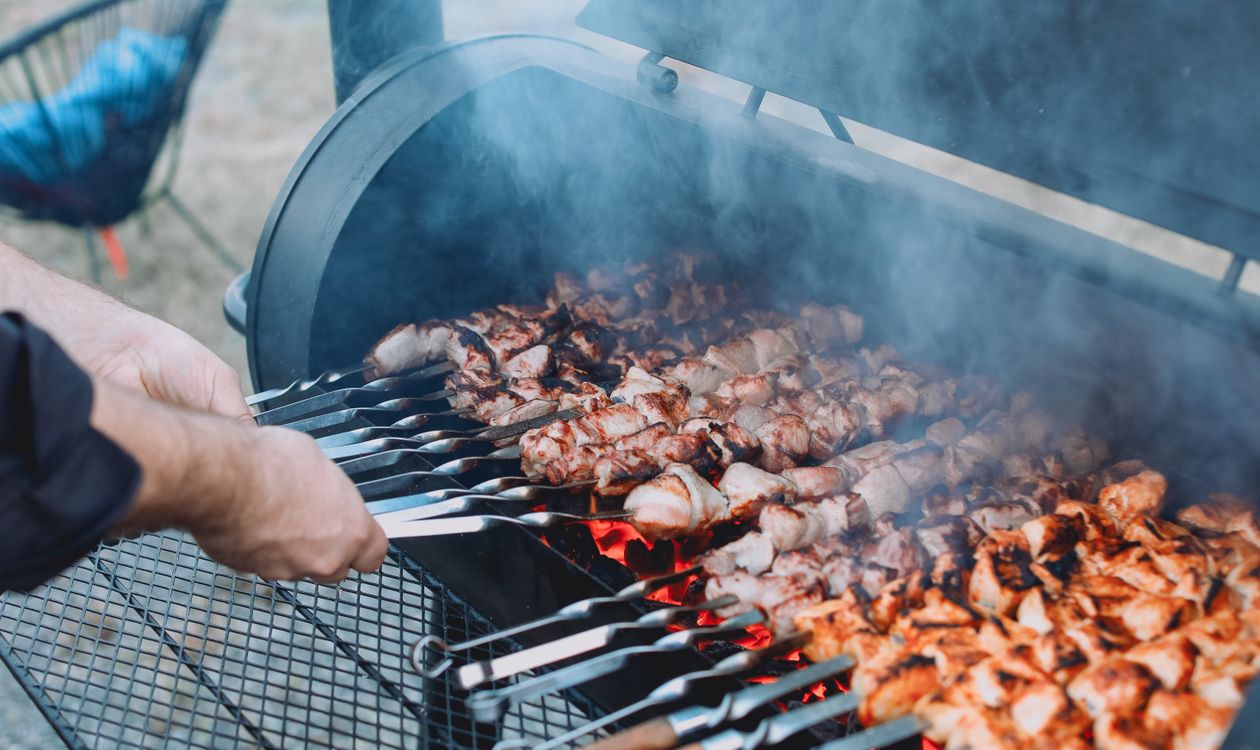
Meat skewers smoking over a charcoal grill

This post contains affiliate links. If you buy through my links, I may earn a commission at no extra cost to you. Read the full disclosure.

The quick answer

The TempPro TempSync is my top pick for smoking: four probes, 650-foot range, rechargeable, and priced at $42.98. For those who want a completely wireless probe without cables, the Typhur Sync Gold ($152.99) offers two probes and Wi-Fi range for monitoring overnight cooks from anywhere. The Inkbird IBT-4XS is the alternative pick at $49.99.

Smoking demands more from a thermometer than any other cooking method. You’re monitoring internal temperature over 10–18 hours, often overnight, with the meat in a sealed chamber. Range, battery life, and probe count all matter in a way that doesn’t apply to a 25-minute oven roast.

These are the thermometers that actually hold up to a long smoke. Each also features in my best Bluetooth meat thermometer guide, where I compare them for everyday cooking as well as long smokes.


My top picks at a glance

ProductBest ForPriceRatingBuy
TempPro TempSyncBest Overall for Smoking$42.984.5★ (10,332)Check Price
Typhur Sync GoldBest for Overnight Monitoring$152.994.6★ (539)Check Price
Inkbird IBT-4XSAlternative Pick$49.994.5★ (10,856)Check Price
Weber iGrill 3Best App Experience$109.994.5★ (5,552)Check Price
MEATER PlusBest Single-Probe$59.984.3★ (48,491)Check Price

TempPro TempSync — best overall for smoking

TempPro TempSync 4-Probe Bluetooth Meat Thermometer
BEST OVERALL

TempPro TempSync

  • 4 probes — monitor 4 cuts or zones simultaneously
  • 650-foot Bluetooth range — furthest of any consumer wireless thermometer
  • USB rechargeable base, 40-hour battery life
  • Backlit LCD shows all 4 probes at once
  • 2 stainless grate clips supplied for chamber readings
  • Companion app with temperature alerts

The TP25 wins for smoking because the 650-foot Bluetooth range keeps you connected even if your smoker is at the far end of the yard. Four probes mean you can run a brisket, rack of ribs, and chicken simultaneously. The rechargeable base handles a full overnight cook on a single charge. At $49.99, this is the single best value in dedicated smoking thermometers.

Current price: $42.98

See Today’s Price on Amazon →

Typhur Sync Gold — best for overnight and remote monitoring

Typhur Sync Gold Wireless Meat Thermometer
BEST FOR OVERNIGHT COOKS

Typhur Sync Gold

  • 2 true wireless probes — no cables into the meat
  • Wi-Fi plus a Sub-1 GHz radio — monitor from anywhere with phone signal
  • Each probe reads internal meat and ambient chamber temperature
  • Standalone base shows readings without a phone
  • 6 sensors per probe: 5 internal plus 1 ambient tip

The Sync Gold’s advantage for long smokes is the Wi-Fi connectivity. A brisket that runs from midnight to noon is a 12-hour cook. With Wi-Fi, you can check the temperature from bed, from the grocery store, or from anywhere with a phone signal. The two-probe setup covers most smoking scenarios — one for the meat, one for the ambient zone.

Current price: $152.99

See Today’s Price on Amazon →

Inkbird IBT-4XS — alternative pick

Inkbird IBT-4XS Bluetooth BBQ Thermometer
BEST BUDGET

Inkbird IBT-4XS

  • 4 probes included
  • Bluetooth range ~150 ft
  • USB rechargeable via magnetic cable
  • 150-hour battery life
  • iOS and Android app with temperature alerts

The Inkbird now costs about $7 more than the TempPro TempSync, which undercuts its case as the budget pick, though it does deliver four probes with solid app support. The Bluetooth range (150 feet vs 650 feet) is the meaningful trade-off — if your smoker is close to your house, this limitation won’t matter. At $49.99 it’s a reasonable starting point, though it is no longer the cheaper of the two.

Current price: $49.99

See Today’s Price on Amazon →

Weber iGrill 3 — best for Weber kettle owners

Weber iGrill 3 Bluetooth Meat Thermometer
BEST FOR WEBER USERS

Weber iGrill 3

  • 4 probe ports (2 probes included)
  • Bluetooth (Weber publishes no range figure)
  • Mounts directly to Weber grill side table
  • Weber iGrill app
  • LED temperature indicator on device
  • LP tank scale sensor included, so the app also reports propane level

The iGrill 3 is designed to integrate with Weber grills — mounts to the side table and connects to the Weber iGrill app. For Weber Kettle, Spirit, and Genesis owners, the integration is a genuine advantage. For everyone else, the TempPro TempSync offers better value with a much longer Bluetooth range.

Current price: $109.99

See Today’s Price on Amazon →

MEATER Plus — best single-probe wireless option

MEATER Plus Wireless Smart Meat Thermometer
BEST WIRELESS PROBE

MEATER Plus

  • 1 probe, completely wireless — no cables
  • 165-foot Bluetooth range
  • Dual sensor: internal meat temp + ambient cook temp
  • MEATER app with guided cook and rest time estimation
  • Bamboo charging block

If you primarily smoke single proteins and want zero cable management, the MEATER Plus is the cleanest option. Insert the probe, close the lid, monitor from the app. For multi-protein or long-range needs, the Sync Gold is the upgrade path.

Current price: $59.98

See Today’s Price on Amazon →

One failure a thermometer cannot warn you about is the smoker losing power partway through a cook. It is the most common way an overnight smoke ends badly on an electric cabinet, and it is usually moisture leaking current to earth rather than an overloaded circuit — the causes, and the order worth checking them in, are in the guide to an electric smoker that keeps tripping the breaker.


Grate temperature also governs how much smoke a cabinet makes, because on most electric smokers the chip tray is heated by the element and the element only runs when the thermostat calls for it — which is why smoke arrives in bursts. That is worked through in an electric smoker not producing smoke.

How These Picks Were Chosen

Plainly: this is a research-based guide, not a hands-on test. I have not run these through a cook, and nothing here should be read as a report from my own kitchen.

What the picks rest on: maximum probe temperature, which is the specification that matters most for smoking and the one cheap thermometers most often fail on; whether an ambient probe is included for grate temperature; stated battery life against the length of a real smoke; and the complaint patterns in verified-purchase reviews, where probe failure after repeated high-heat exposure is the theme that recurs.

What I could not establish: how these hold up across a full 12 to 16 hour cook, which is exactly the condition that matters for brisket. Manufacturer battery figures assume moderate conditions and continuous Bluetooth streaming in cold weather is harder on a battery than the specification suggests. Take the quoted runtimes as optimistic.

Frequently Asked Questions

What probe thermometer is best for a smoker?
The TempPro TempSync is the best all-round probe thermometer for smoking: four probes, 650-foot Bluetooth range, rechargeable, and priced around $42.98. For overnight cooks where you want to monitor from anywhere, the Typhur Sync Gold sends its probe readings to a base over a Sub-1 GHz radio, and that base is what connects to Wi-Fi. The Inkbird IBT-4XS is the alternative pick with four probes around $49.99.

How many probes do I need for smoking?
Two probes cover most smoking scenarios: one in the meat, one monitoring ambient temperature near the grill grate. Four probes become useful when running multiple proteins simultaneously. If you only ever smoke one protein at a time, a single-probe thermometer like the MEATER Plus (with its built-in ambient sensor) is sufficient.

Can you leave a meat thermometer in the smoker for the whole cook?
Yes — that’s exactly what probe thermometers are designed for. All the thermometers in this guide are rated for sustained use in smoker environments.

Wired probes should have cables routed away from direct flame. MEATER probes sit inside the meat throughout the entire cook without any external cable concern.

What temperature do you smoke a brisket to?
195-205F (91-96C) internal temperature. Many pitmasters target 203F specifically. At this temperature, collagen has fully converted to gelatin, giving you the tender, pull-apart texture that defines a properly cooked brisket.

Does smoke affect thermometer accuracy?
No. Smoke itself doesn’t interfere with probe temperature readings — the probe measures internal meat temperature directly via a metal sensor, not through the smoke-filled air. What smoke does affect is Bluetooth signal slightly, which is why range matters more for smoking than for a quick indoor cook.

What’s the difference between smoking and grilling for thermometer needs?
Smoking runs much longer (10-18 hours vs 10-30 minutes for grilling) and often overnight, so battery life, Bluetooth/Wi-Fi range, and the ability to leave the probe in for the entire cook matter far more than they do for a quick grilled steak.

Related guides

Related: Best Bluetooth Meat Thermometer 2026
Related: Best Thermometer for Brisket
Related: Meat Temperature Guide
Related: Bluetooth vs Wi-Fi Meat Thermometers


Filed Under: Product Reviews

  • « Go to Previous Page
  • Page 1
  • Interim pages omitted …
  • Page 8
  • Page 9
  • Page 10
  • Page 11
  • Page 12
  • Interim pages omitted …
  • Page 35
  • Go to Next Page »

Recent Articles

  • Cuisinart DLC-10SYP1 Review: Durable, But a Newer Bowl
  • COSORI Pro Gen 2 Review: Big Basket, Fragile Handle
  • Dash Tasti-Crisp Review: Cheap, but the Coating Wears Fast
  • Chefman TurboFry Touch Review: Cheap, but the Coating Wears
  • Chef’sChoice 15XV Review: Very Sharp, With Scratch Reports

Search


HOME          Contact          Affiliate Disclosure          Terms of Service          Privacy Policy


kitchenwarecompare.com is a participant in the Amazon Services LLC Associates Program, an affiliate advertising program designed to provide a means for sites to earn advertising fees by advertising and linking to Amazon.com, Endless.com, MYHABIT.com, SmallParts.com, or AmazonWireless.com. Amazon, the Amazon logo, AmazonSupply, and the AmazonSupply logo are trademarks of Amazon.com, Inc. or its affiliates. As an Amazon Associate I earn from qualifying purchases.


Copyright © 2026 kitchenwarecompare.com, ALL RIGHTS RESERVED.