• Skip to primary navigation
  • Skip to main content
  • Skip to primary sidebar

Kitchenware Compare

  • Home
  • Product Reviews
    • Air Fryers
    • Coffee
    • Cookware
    • Flat Top Grills
    • Meat Thermometers
    • Food Processors
    • Knives
    • Pizza Ovens
    • Toaster Ovens
    • Juicers
  • Food Blog
  • Helpful Kitchen Tips
  • Data Studies
  • About
  • How I Review
  • Contact
You are here: Home / Archives for Product Reviews

Broan-NuTone 413004 vs. BCDF130SS: Which Range Hood Should You Buy?

Last Updated October 22, 2026

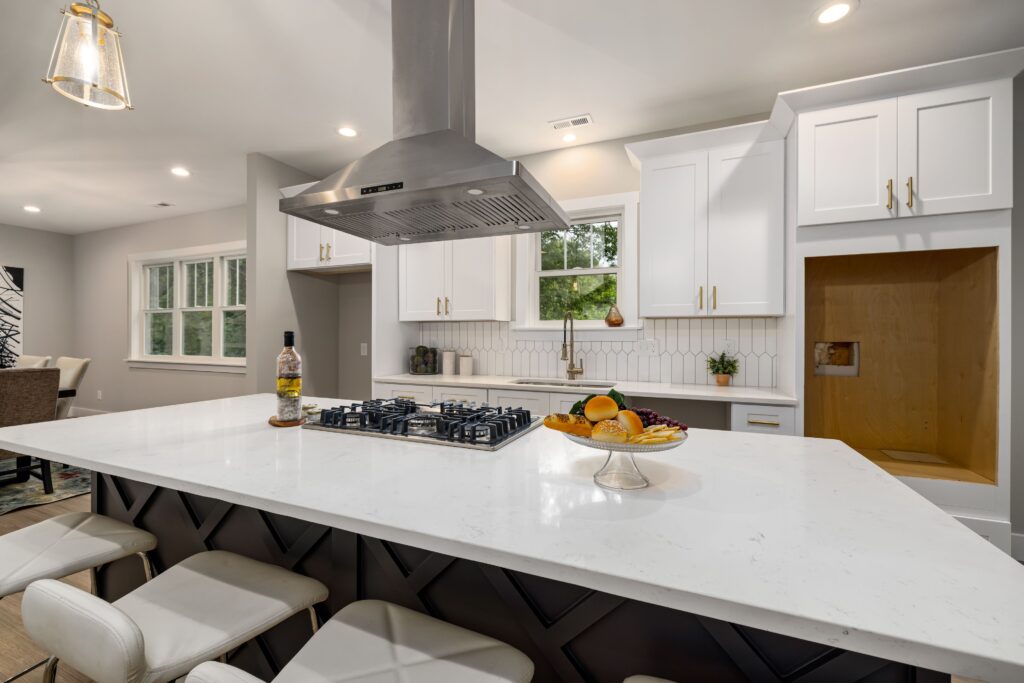
Kitchen with a stainless steel range hood installed above the cooktop

Last Updated July 21, 2026

Quick verdict: these two solve different ventilation problems, not the same one at different prices. The Broan-NuTone 413004 (currently $109) is a ductless-only insert — it recirculates filtered air back into the kitchen and nothing else.

The BCDF130SS ($129) is a 4-way convertible unit that can actually vent outside through three different ducting configurations, or run ductless if you don’t have ducting. If you have or can install ducting, the BCDF130SS is the only one of the two that actually removes heat and humidity rather than just filtering smoke. If ducting isn’t an option, the 413004 does the ductless job for a third of the price.

I earn a commission if you buy through the Amazon links below, at no extra cost to you. Every range hood page on the site is collected on the range hoods hub.

Broan-NuTone 413004 vs. BCDF130SS: Specs Side by Side

Product Best For Price Rating Buy
Broan-NuTone 413004 Ductless-only, budget $109.00 4.6★ (20,490) Check Price
Broan-NuTone BCDF130SS Convertible ducted/ductless $128.98 4.5★ (4,752) Check Price

Availability note: on 22 October 2026 the BCDF130SS had no single Amazon offer, only several third-party sellers at $129.00, so Check Price opens a listing with See All Buying Options and no Add to Cart button. The price and rating in the table were read earlier and may have moved.

Full spec comparison:

Spec Broan-NuTone 413004 Broan-NuTone BCDF130SS
Venting options Non-ducted (recirculating) only 4-way convertible: 2 ducted configurations, 7″ round ducted, or non-ducted
Blower performance 2 speeds, CFM not published 375 max CFM, 5.5 Sones
Lighting Up to 75W bulb (not included) Integrated 2-level LED modules (included)
Filter Charcoal (replaceable) Dual dishwasher-safe micro-mesh filters, plus charcoal for ductless mode
Controls 2 rocker switches (fan, light) Tap-touch capacitive controls
Price at review time $109.00 $128.98
Rating 4.6★ (20,490 ratings) 4.5★ (4,752 ratings)

The Core Difference: Ducted Capability vs. Ductless Only

This comparison isn’t really about which one is “better” — it’s about which ventilation setup you actually have. The 413004 is a non-ducted insert, full stop: it filters smoke and grease through a charcoal filter and blows the same air back into the kitchen.

The BCDF130SS is a genuinely different category of product — it installs in one of three ducted configurations (rear or top 3.25″x10″ rectangular duct, or a 7″ round top vent) that actually vents smoke, heat, and humidity outside, and only falls back to non-ducted recirculation if you choose that installation instead. If your kitchen has existing ductwork, the BCDF130SS is the only one of these two that uses it. If it doesn’t, both machines end up doing the same basic job, just at very different price points.

Power and Airflow

The BCDF130SS publishes real performance numbers — 375 max CFM and 5.5 Sones — while Broan doesn’t publish a CFM rating for the 413004 at all, consistent with it being positioned as a basic economy insert rather than a performance-rated one. Owner reviews for both describe adequate airflow for normal cooking; nobody describes either as struggling with everyday smoke and steam. The real airflow advantage of the BCDF130SS only shows up if you install it ducted, since venting outside moves heat and humidity in a way no recirculating hood can match, regardless of CFM rating.

Lighting

This is a genuine, concrete difference: the BCDF130SS ships with integrated 2-level LED lighting built in and ready to use. The 413004 accepts up to a 75W bulb, but doesn’t include one — you’re buying a bulb separately before it’s usable out of the box. If out-of-box readiness matters to you, that’s a real point in the BCDF130SS’s favor.

Noise Level

Owner reports on both are similar in shape: quiet at low and medium fan speeds, noticeably louder at the highest setting. BCDF130SS owners specifically flag high-speed noise as the one place the “quiet” marketing claim doesn’t fully hold up, though several also note it’s still quieter than the units they replaced. Neither product’s owners describe it as a dealbreaker at any speed below maximum.

What Owners Report

The 413004’s aggregated review themes center on installation, appearance, and value for money, with a specific, recurring installation quirk: the stock mounting screws assume a flush cabinet bottom, which most real cabinets don’t have. The BCDF130SS’s aggregated themes cover installation, brightness, appearance, and noise level, with detailed owner reports describing the ducted installation as more involved than a simple swap — getting the rear duct opening to align within a quarter inch of the existing wall duct, sealing joints with foil tape, and sourcing a wire bushing not included in the box. Both are real, specific complaints rather than vague dissatisfaction, and both are solvable with a bit of extra effort during install.

Value for Money

At $109, the 413004 is the clear value pick if ductless recirculation is all you need — you’re not paying for ducted capability you won’t use. The BCDF130SS’s value case depends entirely on whether you’ll actually duct it: done that way, it’s the only one of the two that meaningfully improves kitchen air quality by venting outside, which can be worth the premium. At $129 it is also no longer the expensive option it briefly appeared to be: an earlier low-stock third-party offer had pushed the listing to $349.99, and that has since resolved.

Buy the 413004 If…

You don’t have kitchen ductwork and aren’t planning to add it, you want the cheapest way to cut down smoke and odor, and you’re comfortable buying a light bulb separately.

Buy the BCDF130SS If…

You have or can install ducting and want a hood that actually vents outside, you want integrated lighting with nothing extra to buy, and you’re willing to take on a somewhat more involved installation for real ventilation performance.

The Verdict

These two aren’t competing for the same buyer. The 413004 is the pick for a straightforward, cheap ductless replacement. The BCDF130SS is the pick if you have ducting and want a hood that uses it — its integrated lighting and published CFM rating reflect a more complete product, and that’s what the higher price is paying for, not just a nicer badge on the same basic insert.

How This Comparison Was Put Together

Plainly: this is a research-based comparison, not a hands-on test. I have not run these side by side.

What it rests on: the published specification for both – airflow in CFM, whether each is ducted or ductless in the configuration compared, filter type and replacement cost, noise in sones where published, and physical dimensions against a standard cabinet opening; plus the pattern across verified-purchase reviews for each.

What I could not establish: real odour and grease removal, which no manufacturer measures publicly and which CFM alone does not describe – particularly for a recirculating configuration, where air passes a filter rather than leaving the room.

Frequently Asked Questions

Can the 413004 be ducted to the outside?

No. It’s a non-ducted (ductless) unit only. If you want ducted capability, the BCDF130SS is the one of these two that provides it.

Does the BCDF130SS include a light bulb?

Yes — it has integrated 2-level LED lighting built in. The 413004 requires you to buy your own bulb separately.

Which is quieter?

Both are quiet at low and medium fan speeds; both get noticeably louder on their highest setting, per each product’s own owner reviews. Neither pattern is unique to one product.

Is the BCDF130SS installation harder than the 413004’s?

Generally yes, if installed ducted — owners describe needing to align duct openings precisely and seal joints with foil tape. The 413004’s install challenge is different: its stock mounting screws don’t reach solid wood on cabinets with a recessed lip.

How much does the BCDF130SS cost?

It currently sells for $129. An earlier low-stock third-party offer had it listed at $349.99, well above its normal price, but that has resolved — the hood is back on a standard listing at a price close to the 413004.

Which one actually improves air quality more?

The BCDF130SS, but only if installed in a ducted configuration — venting outside removes heat and humidity that a recirculating hood can’t touch. Installed ductless, the two perform a similar basic job.

Which is the better budget pick?

The 413004, for anyone without ducting. See my full 413004 review for the complete breakdown of what owners report.

For the full lineup of ductless range hoods across every budget, see my best ductless range hood buying guide. If you’re still deciding whether a ducted or ductless setup makes more sense for your kitchen, my ductless range hood guide covers that decision in more depth, and my charcoal filter replacement guide is worth bookmarking once either hood’s filter starts to wear.
Filed Under: Product Reviews

Best Non-Stick Pan Without Teflon: 5 PFAS-Free Picks That Actually Work

Last Updated October 20, 2026

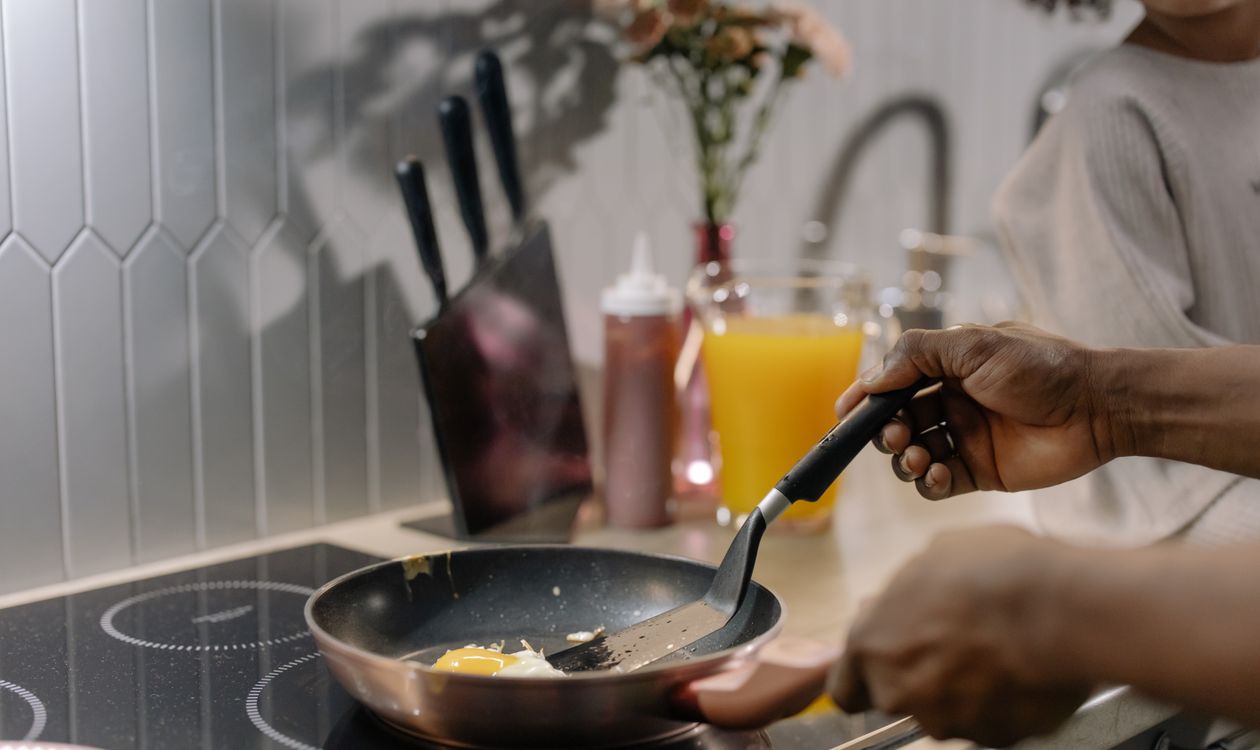
Cooking eggs in a nonstick frying pan on an induction stovetop

“Teflon-free” gets used as a catch-all for two different things: pans coated in PTFE that just don’t carry the Teflon brand name, and pans coated in something else entirely, usually a ceramic (sol-gel) coating. “Stone” and “granite” describe how a coating looks, not what it is made of, and pans sold under those names turn up in both groups. If you’re avoiding Teflon specifically because of PTFE, only pans whose listings actually say PTFE-free or PFAS-free qualify. After checking coating chemistry, current pricing, and real owner feedback across dozens of listings, the Blue Diamond 12″ Nonstick Frying Pan is the one to buy first — a PFAS-free diamond-ceramic coating with 7,678 ratings averaging 4.3 stars and a $32.99 price that doesn’t ask you to gamble on an unproven brand.

I earn a commission if you buy through the Amazon links below, at no extra cost to you.

Quick Comparison

Product Best For Price Rating Buy
Blue Diamond 12″ Best Overall $32.99 4.3★ (7,679) Check Price
Blue Diamond 8″ Best Budget $15.92 4.3★ (15,468) Check Price
GreenPan Rio 12″ Best Established Brand $27.99 4.2★ (2,274) Check Price
Caraway 10.5″ + Lid Best Premium $185.00 4.6★ (531) Check Price
SENSARTE 9.5″ Best for Eggs $23.50 4.4★ (35,186) Check Price

How I Picked These

Every pan here is coated in ceramic (a silica-based sol-gel coating baked onto the metal) rather than PTFE, and every listing verified explicitly states PFOA-free or PFAS-free manufacturing — not just “non-toxic,” which is a marketing word with no fixed meaning. Beyond coating chemistry, three things separated the pans worth buying from the ones to skip: review volume, base heat retention, and honest handle design. Ceramic coatings wear out faster than PTFE under real use, so a pan with 30,000+ ratings sustained at 4.5 stars has survived enough kitchens long enough to trust; a coating that failed fast would show up in the rating within a year.

Many pans written off as worn are actually carrying a layer of polymerised residue that cleans off. Base thickness matters more here than on a PTFE pan because ceramic doesn’t forgive hot spots — thin bases scorch eggs in the center while the edges stay raw. And stay-cool handles aren’t a luxury on an all-metal-body pan that goes from stovetop to oven.

Price range on this list runs from $15.92 to $185 for a reason: at the low end you’re paying for the ceramic coating and not much else, which is fine for a pan you’ll replace in a year or two. At the high end (Caraway) you’re paying for a heavier cast-aluminum body, a glass lid, and a coating rated for slightly higher heat tolerance — not a fundamentally different chemistry.

The 5 Best Non-Stick Pans Without Teflon

1. Blue Diamond 12″ Nonstick Frying Pan — Best Overall


Blue Diamond 12 inch nonstick frying pan with diamond-infused ceramic coating

Best for: Anyone who wants one full-size pan that covers most stovetop cooking without a lot of research.

Blue Diamond mixes actual crushed diamonds into its ceramic coating, which sounds like marketing until you look at the review pattern: 7,678 ratings holding at 4.3 stars is a solid, stable sample for a $33 pan. That’s the real signal — a cheap ceramic pan that degraded fast would have dragged this rating down by now. The 12″ size handles a full four-egg scramble or a family-size stir-fry, the stay-cool handle survives medium stovetop heat without a towel, and it’s rated safe for the oven up to 600°F and for the dishwasher, though hand-washing extends coating life on any ceramic pan regardless of what the label says.

Key specs:

  • 12″ diameter, diamond-infused ceramic coating
  • PFAS-free, PFOA-free
  • Oven safe to 600°F, dishwasher safe
  • Compatible with gas and electric stovetops — not induction

Pros:

  • Stable 4.3-star rating across 7,678 ratings
  • Full 12″ cooking surface for family-size meals
  • Price stays under $35 even with the size

Cons:

  • Coating shows the same wear-over-time pattern as every ceramic pan — don’t expect PTFE-level lifespan
  • Single-handle design means it’s awkward one-handed once it’s fully loaded and heavy

Verdict: Buy this if you want one pan that does most jobs well and you’re comfortable replacing ceramic cookware every couple of years. Skip it if you specifically want a smaller everyday egg pan — go to the SENSARTE or the Blue Diamond 8″ pick instead.

Check Price on Amazon ↗

2. Blue Diamond 8″ Ceramic Frying Pan — Best Budget


Blue Diamond 8 inch diamond-infused ceramic nonstick frying pan in blue

Best for: One or two eggs, a grilled cheese or a single portion, for the least money a pan labelled PFAS-free costs on this list.

Why this pick changed: this slot previously went to the CAROTE 8″ granite pan. CAROTE labels that pan PFOA-free and nothing more, keeps “PFAS free” and “ceramic” for a separate range, and several owners report the granite coating is PTFE. A pan whose maker will not call it Teflon-free does not belong on a Teflon-free list, and my CAROTE 8-inch review sets out the evidence.

The Blue Diamond 8″ is the smaller sibling of the best overall pick, and at $15.92 it was the cheapest 8″ pan I found whose listing puts the claim in writing: a diamond-infused ceramic coating described as free of PFAS, PFOA, lead and cadmium. It holds 4.3 stars across 15,459 ratings, about twice the sample of the 12″ version. Buying the same brand for two slots is a fair criticism of this list, but the two cheaper best-sellers checked, CAROTE’s and SENSARTE’s granite pans, both stop short of a PTFE-free claim. For how ceramic and PTFE coatings compare on safety and lifespan, see ceramic vs Teflon pans.

Key specs:

  • 8″ diameter, diamond-infused ceramic coating
  • Listing states free of PFAS, PFOA, lead and cadmium
  • Oven and broiler safe to 600°F; dishwasher safe
  • Riveted stainless steel handle
  • Gas and electric stovetops — not induction

Pros:

  • The cheapest pan on this list, with the PFAS-free claim on the listing
  • Oven and broiler safe to 600°F, so a frittata can finish under the grill
  • Riveted handle rather than a screw-fitted one

Cons:

  • Does not work on induction
  • 8″ is too small for anything beyond single servings
  • Ceramic coatings lose their release sooner than PTFE, so expect to replace it sooner too

Verdict: Buy this as a cheap second pan for eggs and single portions if you want the PFAS-free claim in writing. Skip it if you cook on induction — the SENSARTE is the induction-compatible egg pan on this list.

Check Price on Amazon ↗

3. GreenPan Rio 12″ — Best Established Ceramic Brand


GreenPan Rio 12 inch ceramic nonstick frying pan

Best for: Buyers who specifically want the brand that pioneered ceramic nonstick, not a newer imitator.

GreenPan invented Thermolon, the sol-gel ceramic coating that most of the industry (including several other pans on this list) has since copied in some form. The Rio line is their entry-level tier — same PFAS-free coating chemistry as their $150+ cookware, in a simpler aluminum body. At $27.99 with 2,273 ratings averaging 4.2 stars, the sample size is smaller than either Blue Diamond pan or the SENSARTE, which is worth knowing going in, but the brand has over a decade of ceramic-coating manufacturing behind it, which matters if you’re choosing based on who actually understands this coating type best.

Key specs:

  • 12″ diameter, Thermolon ceramic coating
  • PFAS-free, PFOA-free, cadmium-free, lead-free
  • Dishwasher safe
  • Hard-anodized aluminum body

Pros:

  • Original ceramic-coating manufacturer, not a copycat brand
  • Hard-anodized body resists warping better than thin stamped aluminum
  • Full 12″ surface at a similar price to smaller pans

Cons:

  • Fewer total ratings than the Blue Diamond or SENSARTE pans, so the track record is thinner
  • 4.2-star average is the lowest of the ceramic pans on this list, driven mostly by coating-longevity complaints after 12+ months

Verdict: Buy this if brand pedigree in ceramic coating matters to you specifically. If you just want the longer track record at this price, the Blue Diamond 12″ has more than three times as many ratings.

Check Price on Amazon ↗

4. Caraway Ceramic Frying Pan (10.5″, Glass Lid) — Best Premium


Caraway 10.5 inch ceramic nonstick frying pan with glass lid

Best for: Buyers who want a heavier pan, a lid included, and don’t mind paying 4-5x more for it.

Caraway built its whole business around ceramic cookware sold as a design-forward alternative to Teflon, and the $185 price for a single 10.5″ pan reflects that positioning — you’re paying for a heavier cast-aluminum body, a glass lid (most pans on this list don’t include one), and a coating Caraway rates as more scratch-resistant than typical drugstore ceramic. The 531 ratings at 4.6 stars is a smaller sample than the budget pans, but it’s consistent with the pattern across their product line. This is not a pan to buy if the goal is avoiding Teflon as cheaply as possible; it’s a pan to buy if you want the included lid, the heavier feel, and don’t mind the DTC price.

Independent testing backs the coating. Consumer Reports recommends Caraway’s ceramic-coated non-stick pan: in its tests eggs fried without oil slid out one after another, and the coating stood up well in its durability test. Two cautions from the same source: it tested a Caraway frying pan from the brand’s cookware set rather than this exact 10.5″ pan with a lid, and it lists the pan as not dishwasher safe.

Key specs:

  • 10.5″ diameter, 2.7-quart capacity, includes glass lid
  • PTFE-free, PFOA-free
  • Compatible with gas, electric, and induction
  • Oven safe (check current spec sheet for temperature limit before broiling)

Pros:

  • Only pan on this list that includes a matching lid
  • Noticeably heavier cast body than the budget pans, which helps with even heating
  • Widest color selection if kitchen aesthetics matter to you

Cons:

  • $185 for one pan is 5-12x the price of the other options here for the same underlying coating chemistry
  • Smaller review sample than the budget picks

Verdict: Buy this if a matching lid and heavier build are worth the premium to you. Skip it if you just want the coating chemistry without the design markup — the Blue Diamond gets you 90% of the practical benefit for a fifth of the price.

Check Price on Amazon ↗

5. SENSARTE 9.5″ Ceramic Frying Pan — Best for Eggs and Omelets


SENSARTE 9.5 inch ceramic nonstick omelette frying pan in cream white with a woodgrain handle

Best for: Eggs, omelets, and crepes specifically — anything where the coating needs to release a delicate, thin food cleanly.

SENSARTE markets this specifically as an omelet pan, and the shallower sloped sides back that up — you can slide an omelet out onto a plate without folding it against a straight wall the way you’d have to on a standard skillet.

Check which SENSARTE you are buying. The brand sells a near-identical 9.5″ pan with a “Swiss Granite” coating labelled PFOA-free only, and this list previously linked to that version by mistake. This is the ceramic one: its listing states the coating is free of PFOA, PTFE, PFAS, lead and cadmium.

It costs $23.50 and holds 4.4 stars across 35,186 ratings, but Amazon pools that count with SENSARTE’s granite pans, so treat it as a rating for the brand’s omelette pans rather than for this coating alone. The 9.5″ size sits between the 8″ budget pick and the full-size 12″ pans, which makes it a reasonable single everyday pan for one or two people who mostly cook eggs.

Key specs:

  • 9.5″ diameter, ceramic coating with sloped sides
  • Listing states free of PFOA, PTFE, PFAS, lead and cadmium
  • Cast aluminium body with an induction base
  • Removable woodgrain Bakelite handle; oven safe to 550°F with the handle removed

Pros:

  • Sloped sides genuinely help with omelets and crepes
  • The PTFE-free claim is on the listing, unlike SENSARTE’s granite version
  • Works on induction, unlike the Blue Diamond pans

Cons:

  • Its 4.4-star rating is pooled with the granite version, so it says less about this coating than it seems to
  • Still too small for a family-size meal
  • Same ceramic-coating lifespan trade-off as every pan on this list

Verdict: Buy this if eggs and omelets are most of what you cook and you want a dedicated PTFE-free pan. Skip it if you need one pan to do everything — go with the Blue Diamond 12″ instead. My full SENSARTE ceramic review covers the pooled rating and how long owners say the coating lasts.

Check Price on Amazon ↗

How to Choose a Non-Stick Pan Without Teflon

Size and capacity

An 8-9.5″ pan covers one to two servings — eggs, a single portion of stir-fry, grilled cheese. A 10.5-12″ pan is what you want if you’re regularly cooking for a household of three or more, or if you want a single do-everything pan instead of buying multiple sizes. If budget allows, most kitchens are better served by owning one small (8-9.5″) and one large (12″) pan than one mid-size pan trying to do both jobs.

Budget and what you actually get at each price

Under $20 buys you the ceramic coating and a basic aluminum body — functional, but expect to replace it within one to two years of regular use. $25-35 gets you a name-brand coating with a larger, more consistent review history, which is the sweet spot for most buyers.

Above $100, you’re paying for a heavier cast body, included accessories like a lid, and marginally better heat retention — not a fundamentally more durable coating. My comparison of ceramic vs. traditional nonstick cookware covers this tradeoff in more depth if you’re deciding between coating types generally.

What “PFOA-free” and “PFAS-free” actually mean

PFOA was a chemical used in manufacturing PTFE (Teflon) coatings that the EPA phased out of U.S. production by 2013 — every Teflon pan sold in the U.S. today, ceramic or not, is already PFOA-free. So “PFOA-free” on a ceramic pan’s packaging isn’t actually a distinguishing feature; it’s true of nearly everything on shelves now.

“PFAS-free” is the more meaningful claim, since PFAS is the broader chemical family PTFE belongs to. If avoiding that entire chemical family is the goal, confirm the listing specifically says PFAS-free, not just PFOA-free, before buying — all five pans on this list meet that bar.

Compatibility and care

Check the base for an induction symbol if you cook on an induction stovetop — not every ceramic pan includes the magnetic base layer induction requires. Both Blue Diamond pans and the GreenPan Rio are listed as dishwasher-safe. Caraway tells owners to hand-wash its pans, and Consumer Reports lists its pan as not dishwasher safe; I did not confirm a dishwasher rating for the SENSARTE, so treat it as hand-wash. Either way, ceramic coatings last measurably longer with hand-washing; the abrasion and heat cycling of a dishwasher is one of the more common reasons owners report early coating failure.

Avoid aerosol cooking sprays on any ceramic pan — the propellants leave a residue that bakes onto the coating and is genuinely difficult to remove, and it’s one of the most common self-inflicted causes of a ceramic pan “losing” its nonstick surface early. Use a small amount of oil or butter instead. For care of cookware more broadly, my guide to cookware materials on gas stoves covers how coating type interacts with different heat sources.

Heat is the other half of care. Caraway’s own care guide says ceramic holds heat more efficiently than traditional pans, so it recommends cooking on low to medium heat, preheating for no more than about 90 seconds, and never leaving an empty pan on a hot burner. I checked only Caraway’s guidance, but it is a sensible habit for every ceramic pan on this list.

Durability expectations

Set expectations correctly going in: ceramic coatings wear faster than a well-kept PTFE pan, and nobody publishes a precise figure. Consumer Reports says most nonstick pans have to be replaced every few years, and sooner if they are scratched. For ceramic specifically, the pattern in owner reviews is a year or two of regular use before a pan needs more oil to stop food sticking; that is a rule of thumb drawn from reviews, not a lab measurement, and a careful owner of a better pan can expect longer. This isn’t a defect specific to any pan on this list — it’s how sol-gel ceramic coatings behave as a category, and it’s the real tradeoff you’re making by choosing this coating type.

If coating lifespan matters more to you than avoiding PTFE specifically, it’s worth reading my breakdown of cast iron vs. ceramic cookware, since cast iron sidesteps the coating-wear problem entirely at the cost of more maintenance.

Teflon-Free Without a Coating: Carbon Steel and Cast Iron

Ceramic is not the only way to avoid PTFE. Carbon steel and cast iron carry no synthetic coating at all. Food releases from them only once they hold a seasoning layer, which is oil baked onto the metal, so they are stick-resistant rather than non-stick on day one, and they need a little upkeep to stay that way. They are also heavier than most ceramic pans, and acidic foods such as tomato sauce can damage the seasoning.

The trade is effort for lifespan: a seasoned pan does not wear out the way a ceramic coating does, which is the one weakness every pick above shares. Carbon steel is lighter and heats faster; cast iron holds heat longer.

Pure titanium pans are a newer uncoated option: nothing to wear off and no seasoning to keep up, but like bare steel they only release food once the pan is preheated with oil. ChopChic’s Plateful titanium pan review walks through that learning curve. My titanium cookware guide sets out what the label means and which titanium pans have a documented construction.

My carbon steel vs cast iron comparison works through which suits which cook, and the cast iron skillet buying guide has five verified picks. Ceramic still makes more sense if you cook eggs or delicate fish with very little oil and do not want to season anything. If a pan you already own has started to stick, my guide to why non-stick pans stick helps tell residue from coating wear.

The same coating question applies to rice cookers, where nearly every inner pot is nonstick. My best rice cooker for brown rice guide lists the ceramic and uncoated stainless options.

Frequently Asked Questions

What is the best non-stick pan without Teflon overall?

The Blue Diamond 12″ Nonstick Frying Pan. Its diamond-infused ceramic coating is PFAS-free, and with 7,678 ratings holding at 4.3 stars, it has a long and stable track record for a pan in this price range.

What is the best non-stick pan without Teflon for eggs?

The SENSARTE 9.5″ pan, purpose-built as an omelet pan with sloped sides that let a folded omelet slide out cleanly onto a plate rather than catching on a straight-walled skillet.

Is ceramic-coated cookware actually free of harmful chemicals?

Ceramic (sol-gel) coatings don’t contain PTFE or the PFAS chemical family PTFE belongs to, which is the specific concern most people mean when they say “Teflon-free.” They’re generally silica-based. All five pans on this list are verified PFOA-free and PFAS-free by their current listings.

What should I avoid when buying a Teflon-free nonstick pan?

Avoid pans that only advertise “non-toxic” without specifying PFOA-free or PFAS-free — that phrase has no regulated meaning. Also avoid using aerosol cooking sprays on any ceramic pan; the residue bakes on and is one of the most common causes of a coating failing early.

How long does a ceramic nonstick pan actually last?

Expect roughly a year or two of strong nonstick performance with regular use and hand-washing, and less than a well-kept PTFE pan. That figure is a rule of thumb from owner reviews, not a lab measurement; Consumer Reports says most nonstick pans have to be replaced every few years. This is a category-wide tradeoff of sol-gel ceramic coatings, not a flaw specific to any brand on this list.

Is Caraway better than GreenPan?

They use comparable ceramic coating chemistry. Caraway’s $185 pan includes a glass lid and a heavier cast body; GreenPan’s $27.99 Rio is the original ceramic-coating brand at a fraction of the price with a thinner aluminum body. Neither coating outlasts the other meaningfully — the difference is mostly build weight, accessories, and price.

Are “stone” or “granite” coated pans actually different from ceramic?

It depends on the pan. “Stone” and “granite” describe how a coating looks, not what it is made of. Some pans sold under those names use a ceramic (sol-gel) coating with mineral flecks; others carry no PTFE-free claim at all. The label is the only reliable guide: CAROTE and SENSARTE both sell granite pans labelled PFOA-free only, alongside separate ceramic ranges labelled PTFE-free and PFAS-free — which is why the SENSARTE on this list is the ceramic version.

Can you use metal utensils on a ceramic nonstick pan?

Most brands claim metal-utensil compatibility, but wood or silicone utensils genuinely extend coating life regardless of what the packaging says — ceramic coatings are more brittle than PTFE and small scratches accumulate faster than they do on a Teflon pan.

Are there non-stick pans without Teflon that are not ceramic?

Yes. Carbon steel and cast iron have no synthetic coating at all; they become stick-resistant once seasoned with baked-on oil. They are heavier than most ceramic pans, need more upkeep, and are not non-stick straight out of the box, but a seasoned pan does not wear out like a coating.

How These Picks Were Chosen

Plainly: this is a research-based guide, not a hands-on test. I have not run these side by side, and nothing here should be read as a report from my own kitchen.

What the picks rest on: what the alternative coating actually is – almost always a ceramic sol-gel layer, occasionally seasoned carbon steel or enamel – along with maximum safe temperature, induction compatibility, base construction and oven-safe rating; plus the complaint patterns across verified-purchase reviews, where the consistent finding for ceramic is that release is excellent at first and declines faster than PTFE does.

What I could not establish: how long each coating lasts, which is the trade-off at the centre of this category. There is no standardised abrasion test published for consumer ceramic pans. Anyone presenting a PTFE-free pan as equally durable is asserting something the available evidence does not support.

Bottom Line

If you want the safest choice, buy the Blue Diamond 12″ — a stable 4.3-star rating across 7,678 ratings at a price that doesn’t punish you if the coating wears out in two years. If you specifically cook a lot of eggs and want a dedicated pan for it, the SENSARTE 9.5″ is the better shape for the job.

Whichever you choose, remember that “Teflon-free” means a different coating with different tradeoffs, not a coating that lasts longer or performs better — it lasts measurably less time in exchange for sidestepping PTFE and PFAS entirely. For more on how these coatings compare to traditional nonstick and to uncoated cookware, see my ceramic vs. nonstick comparison or browse the full cookware reviews hub.

If you are also replacing bakeware, see my best non-toxic baking sheets guide.

Related reviews: Copper Chef Titan Pan · Best Non-Stick Copper Cookware · Best Omelette Pan

Filed Under: Product Reviews

Ceramic vs Nonstick Cookware: Which Should You Buy?

Last Updated October 18, 2026

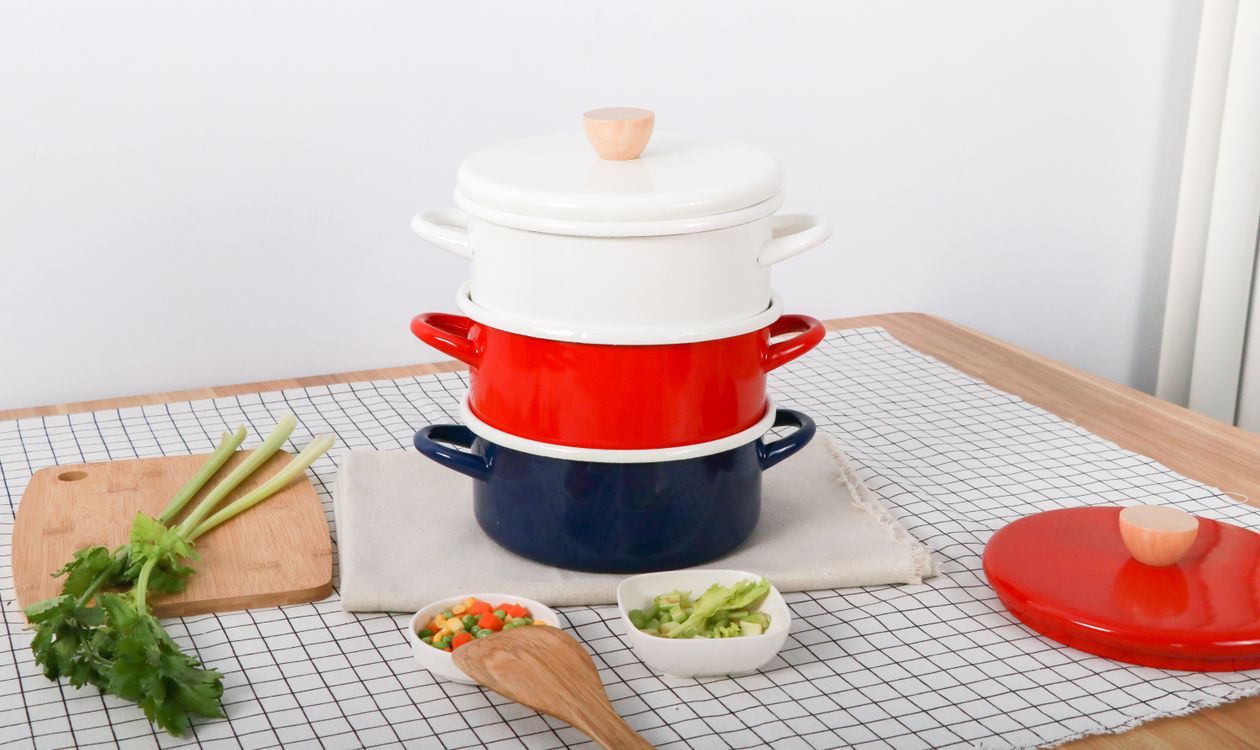
Stacked ceramic and enamel cookware on a kitchen table

Part of my cookware reviews hub — all reviews, comparisons, and buying advice in one place.

Ceramic coatings win if you want zero PTFE or PFAS in your cookware, even knowing you’ll likely replace the pans sooner. Traditional nonstick (PTFE) coatings win if you want the surface to still work well after three or four years of regular cooking.This post contains affiliate links.

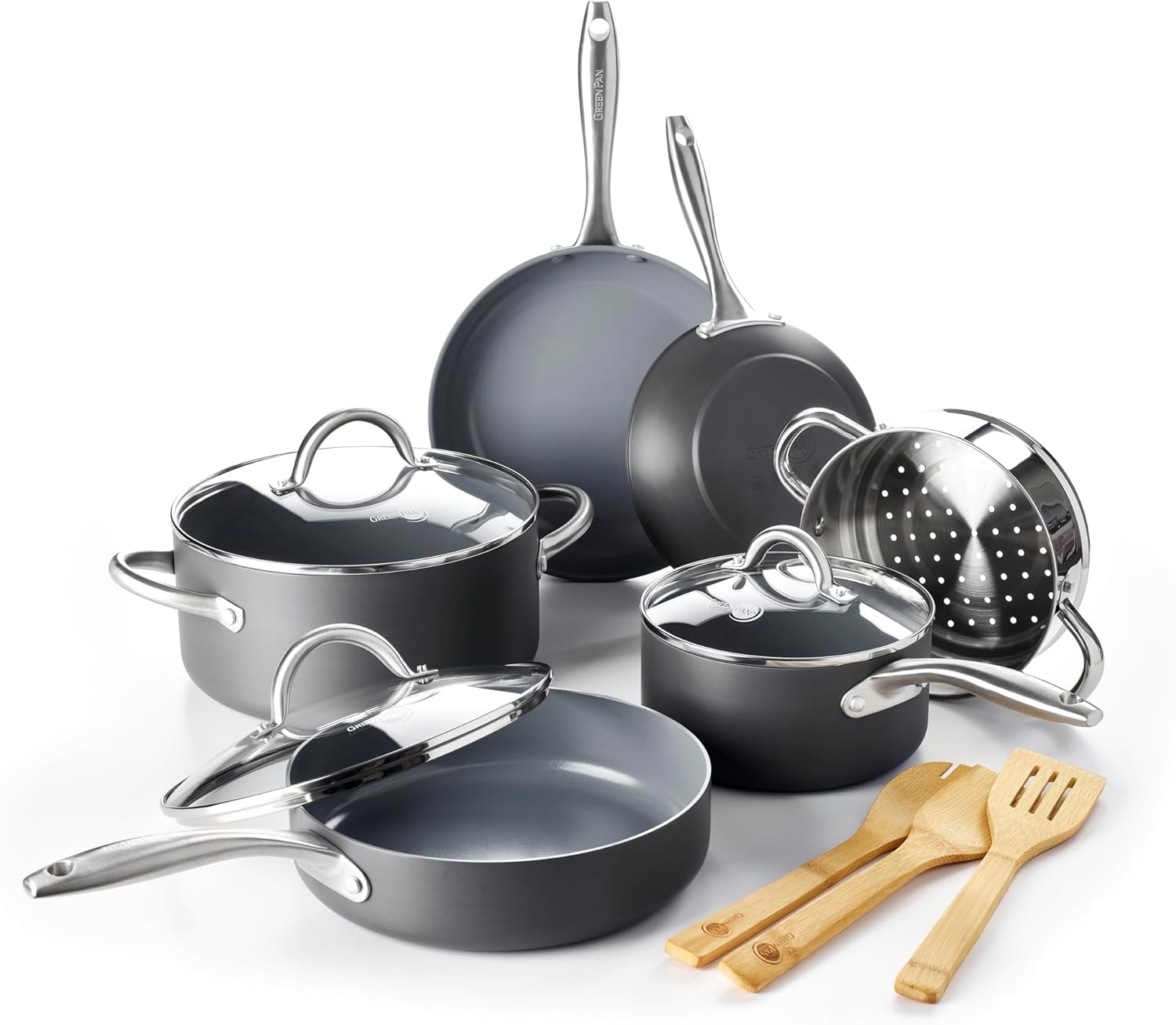
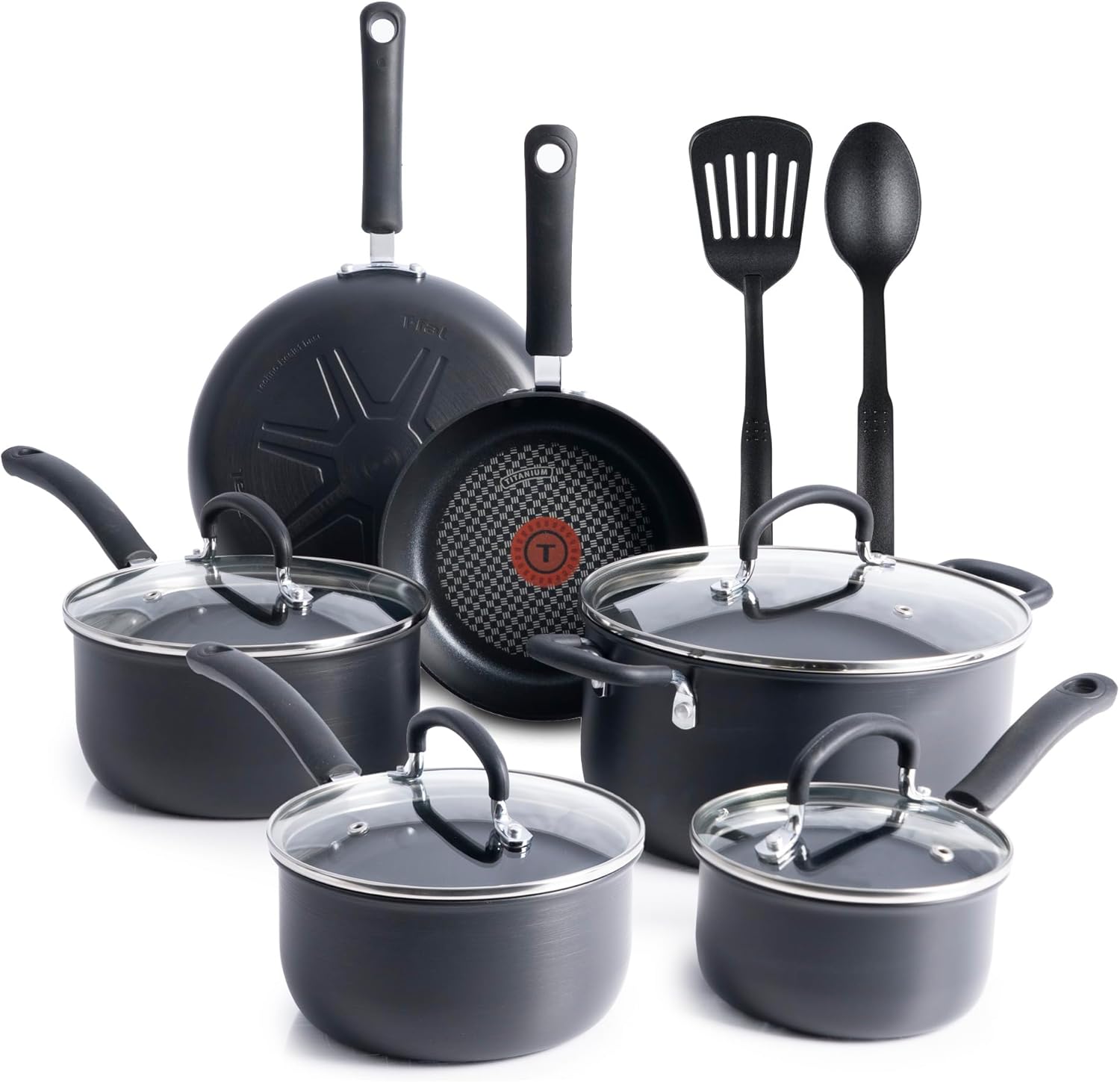
If you buy through my links, I may earn a commission at no extra cost to you. My pick for most people is traditional nonstick — it holds up more consistently over years of normal home use than ceramic does. Throughout this comparison I’m using the GreenPan Lima and T-fal Ultimate Hard Anodized as real, currently-available examples of each coating type, not as the only two sets worth considering.

Both are 12-piece hard-anodized aluminum sets in a similar price range ($150–$160), which makes this a genuinely useful comparison — the difference that matters here is the coating, not the price tier. The trade-off between the two coatings is simple: ceramic starts out with a slicker, “cleaner” feel and no chemical-coating concerns, but it degrades faster with everyday use. Traditional nonstick lasts longer if you treat it right, but it’s still PTFE.

Product Best For Price Rating Buy
GreenPan Lima 12-Piece Ceramic PTFE/PFAS-free cooking $149.99 4.4★ (1,614) Check Price
T-fal Ultimate Hard Anodized 12-Piece Long-term nonstick performance $159.99 4.7★ (8,678) Check Price

Spec Comparison

Spec GreenPan Lima (Ceramic) T-fal Ultimate (Traditional Nonstick)
Coating Ceramic (PTFE/PFAS-free) Traditional PTFE nonstick
Body material Hard-anodized aluminum Hard-anodized aluminum
Pieces 12 12
Oven safe Yes (check listing for max temp) 400°F (lids to 350°F)
Dishwasher safe Hand wash recommended Yes
Rating 4.4★ (1,609 reviews) 4.7★ (8,678 reviews)
Price $149.99 $159.99
GreenPan Lima 12-Piece Ceramic Nonstick Cookware Set

Nonstick Performance

Ceramic coatings, like the one on the GreenPan Lima, are excellent for the first several months — eggs and fish slide off with barely any oil, and there’s no PTFE smell if you accidentally overheat an empty pan. The problem is longevity. Ceramic coatings lose their slick surface faster than PTFE does, especially if you cook with any regularity at medium-high heat. Owners of ceramic pans commonly report needing extra oil for eggs within a year of near-daily use.

Traditional PTFE coatings, illustrated here by the T-fal Ultimate, start almost as slick and stays that way much longer. Two to three years of regular use is a realistic expectation before you notice real degradation, provided you’re not scraping it with metal utensils. For anyone who cooks eggs, fish, or pancakes several times a week, this is the practical difference that matters most.

Heat Distribution and Searing

Both sets use hard-anodized aluminum bodies, so heat distribution is essentially identical — no noticeable hot spots in either, and both preheat at the same rate on a gas or induction burner. Neither set is designed for aggressive searing; the nonstick coating on both limits how much of a crust you’ll get on a steak compared to stainless steel or cast iron. If searing is a priority, neither of these sets is the right tool regardless of coating type.

Response Time and Everyday Handling

Handle comfort and weight are nearly the same across both sets — both use stay-cool stainless handles and comparable pan weights for their sizes. The GreenPan lids run slightly lighter, which some people prefer when lifting a pot one-handed to check on food.

Design and Usability

Both sets come as full 12-piece kits with lids, so the count and coverage are identical — you’re choosing between coatings on otherwise comparable cookware. The GreenPan’s lighter overall build makes it marginally easier to handle for anyone with wrist or grip issues; the T-fal feels slightly more substantial but not in a way that changes daily use.

T-fal Ultimate Hard Anodized 12-Piece Nonstick Cookware Set
Check Price on Amazon ↗

Cleaning and Maintenance

T-fal’s set is dishwasher-safe according to the listing, though hand-washing extends nonstick life on any coating. GreenPan recommends hand washing — ceramic coatings are more sensitive to the heat and detergent cycles of a dishwasher, and skipping the dishwasher is one of the few things that meaningfully slows ceramic’s faster wear curve. Neither coating tolerates metal utensils or cooking spray with propellants (both build up a sticky residue over time) — use wood, silicone, or nylon tools on either set.

Value for Money

At $149.99 vs $159.99, the price difference is small enough that it shouldn’t be the deciding factor. The real cost question is replacement frequency: if ceramic needs replacing in 12–18 months of regular use and PTFE lasts 2–3 years, traditional nonstick works out cheaper over time despite the higher upfront price — the T-fal Ultimate is a good example of that — assuming you’re replacing the whole set rather than a single worn pan.

Who Should Buy Each

Buy ceramic (like the GreenPan Lima) if:

  • You specifically want to avoid PTFE and PFAS in cookware, even knowing the coating won’t last as long
  • You cook lighter-duty meals (a few times a week, not daily high-heat searing)
  • You’re comfortable hand-washing your cookware rather than using a dishwasher

Buy traditional nonstick (like the T-fal Ultimate Hard Anodized) if:

  • You cook daily or near-daily and want the nonstick surface to still work in three years
  • You want to use the dishwasher without worrying about coating wear
  • PTFE itself isn’t a concern for you (it’s not linked to health issues in cookware use — that concern is mainly about PFOA, which was phased out of nonstick manufacturing in the US years ago)

Long-Term Ownership

Neither set includes a meaningful long-term warranty against nonstick wear — that’s normal for cookware in this price range, and it’s true of nearly every set on the market. Realistically, plan to replace the frying pans in either set (not necessarily the pots) every 1–3 years depending on use, and expect ceramic to be on the shorter end of that range.

Verdict

For most people, traditional PTFE nonstick is the better choice of coating. It holds up longer under normal home cooking and tends to be dishwasher-safe. The T-fal Ultimate Hard Anodized used in this comparison is a good example of that category done well — its 4.7 rating across 8,678 reviews, well ahead of the GreenPan’s 4.4 across 1,609, is consistent with what you’d expect from the coating difference, though individual products vary within each category. For the safety evidence and a lab study on how long each coating lasts, see ceramic vs Teflon pans.

That said, if avoiding PTFE entirely is a genuine priority for you — not just a vague preference — go with ceramic. The GreenPan Lima is a legitimately good example, not a compromise pick. Just go in knowing you’ll likely be replacing the frying pans sooner regardless of which ceramic set you choose. For the full lineup of sets, see my Best Nonstick Cookware Sets guide, and if the health angle is what’s driving your decision, my piece on cast iron vs ceramic cookware covers that in more depth.

If you specifically want to avoid PTFE and PFAS entirely rather than choosing between coating types, see my guide to the best non-stick pans without Teflon.

Rice cookers pose the same coating choice for their inner pots. My best rice cooker for brown rice guide lists which pots are ceramic-coated or stainless steel, using the listings and four independent tests.

How This Comparison Was Put Together

Plainly: this is a research-based comparison, not a hands-on test. I have not run these two side by side.

What it rests on: what the two coatings actually are – a sol-gel silica layer versus PTFE – and how that difference shows up in maximum safe temperature, behaviour with metal utensils, and the mechanism by which each eventually stops releasing food; plus the pattern across verified-purchase reviews for pans of both types, where the ceramic complaint is a fast, early decline and the PTFE complaint is scratching.

What I could not establish: how long either lasts in a specific kitchen. There is no standardised abrasion test published across both coating types for consumer pans, and owner reports conflate careless heat and metal utensils with genuine coating failure. The direction of the difference is well documented; the timeline is not.

FAQs

Is ceramic cookware actually PFAS-free?

Reputable ceramic-coated cookware, including the GreenPan Lima, is genuinely PTFE- and PFAS-free — the coating is a mineral-based sol-gel finish, not a fluoropolymer. That’s different from “ceramic-look” coatings some budget brands use, which can still contain PTFE underneath a ceramic-style top layer.

Which lasts longer, ceramic or traditional nonstick?

Traditional PTFE nonstick, in almost every real-world case. Ceramic coatings typically show reduced slickness within 12–18 months of regular cooking; PTFE coatings commonly last 2–3 years or more with reasonable care.

Can I use metal utensils on either of these sets?

No. Metal utensils will scratch both coatings and accelerate wear. Use wood, silicone, or nylon utensils on either set.

Is ceramic cookware oven safe?

Yes, most ceramic cookware including the GreenPan Lima is oven safe, though always check the specific temperature limit on the listing — it’s usually lower than hard-anodized PTFE sets rated to 400°F+.

Which is easier to clean day to day?

They’re similar when the coating is new. T-fal’s set is dishwasher-safe, which makes it more convenient for daily cleanup; GreenPan recommends hand washing, which is one more step but extends the ceramic coating’s usable life.

Do either of these need to be seasoned like cast iron?

No. Both ceramic and PTFE nonstick coatings work straight out of the box — seasoning is a cast iron and carbon steel concept, not something either of these coatings needs or benefits from.

Looking for other options? My Best Non-Stick Copper Cookware guide covers copper-core sets, a third coating/construction approach not covered here.

Filed Under: Product Reviews

Best Stand Mixer: Reviews + Buying Guide

Last Updated October 28, 2026

Best stand mixer 2026

The right stand mixer depends entirely on how and how often you bake. A weekend cookie baker has completely different needs from someone turning out six loaves of sourdough a week, and the machine that suits one is an expensive irrelevance to the other. This guide is built on specifications, warranty terms and the pattern of what long-term owners report — not on spec-sheet comparison alone, and not on testing I have not done.

If you take one thing from this guide: don’t overthink the choice. The difference between a good stand mixer and a great one matters far less than you think. What matters most is getting one that matches your actual baking volume, fits on your counter, and feels comfortable to use. Read on and I’ll help you figure out exactly which one that is.

This post contains affiliate links. If you buy through my links, I may earn a commission at no extra cost to you. Both stand mixer pages on the site are collected on the stand mixers hub.

Best For My Pick Price Range
Best Overall KitchenAid Artisan 5-Qt From $379.99
Best Simple Option KitchenAid Classic 4.5-Qt $399
Best Budget Pick Cuisinart SM-50 5.5-Qt $275.37
Best for Small Kitchens Hamilton Beach 63326 $108
Best for Bread Bakers Bosch Universal Plus See listing

My Top Stand Mixer Picks for 2026

Each machine below is assessed against the same set of demands — stiff cookie dough, delicate chiffon batter, and bread dough heavy enough to strain any motor. Here’s where they differ.

Best Overall

KitchenAid Artisan 5-Quart Stand Mixer

From $379.99 on Amazon, depending on colour (pistachio, read 12 October 2026)

KitchenAid Artisan 5-Quart Stand Mixer
See Today’s Price on Amazon →

The KitchenAid Artisan is the stand mixer most people picture when they think of a stand mixer, and it’s earned that place through decades of consistent, reliable performance. The 325-watt motor is more than capable for anything a home baker throws at it — thick peanut butter cookie dough, royal icing that needs to be beaten stiff, whipped cream from scratch, egg whites for macarons. It handles all of it without complaint.

What sets the Artisan apart from cheaper alternatives isn’t just the motor — it’s the planetary mixing action. The beater orbits 67 points around the bowl, making contact with virtually every part of it. You don’t get pockets of unmixed flour hiding at the edges, which is a real problem with cheaper machines that simply spin in place.

The 5-quart bowl is the sweet spot for most home baking. It’s large enough for a double batch of cookies or a full loaf of bread dough, but not so enormous that half-batch recipes get lost. The tilt-head design makes swapping attachments and scraping the bowl quick and easy.

And then there’s the attachment hub — compatible with over 15 optional attachments, from pasta rollers to meat grinders. Once you own an Artisan, you can turn it into almost any kitchen tool you need.

The one consistent complaint: at 26 lbs, it doesn’t move easily. Once it’s on your counter, it tends to stay there. Make sure you have a dedicated spot for it before you buy.

Pros
  • Planetary mixing reaches every part of the bowl
  • 5-qt bowl handles most home baking tasks
  • Compatible with 15+ attachments (pasta, grinder, etc.)
  • Built to last 10–20+ years
  • 10 speeds with smooth transitions
  • Available in dozens of colors
Cons
  • Heavy at 26 lbs — not easy to move
  • More expensive than budget alternatives
  • No built-in timer or digital display

Verdict: The Artisan is the right choice for anyone who bakes regularly and wants one machine to do everything. It’s not cheap, but it’s a machine you’ll still be using in 15 years. If you prefer a simpler build, the Classic below gives you most of the same capability, though at the prices I read it was not cheaper.

Best Simple Option

KitchenAid Classic 4.5-Quart Stand Mixer

$399.00 on Amazon (white, read 12 October 2026)

KitchenAid Classic 4.5-Quart Stand Mixer
See Today’s Price on Amazon →

The KitchenAid Classic is essentially the Artisan with a slightly smaller bowl and a slightly less powerful motor. For casual to moderate bakers, that tradeoff is rarely a problem. You get the same planetary mixing action, the same attachment compatibility, the same iconic build. When I read the listings on 12 October 2026 the Classic in white was $399.00 and the Artisan in pistachio was $379.99, so the Classic was not the cheaper of the two.

The 4.5-quart bowl is the main practical difference. For a single batch of most recipes, it’s plenty. Where you start to feel the constraint is when you double a recipe or work with bulky doughs.

If you regularly bake in large quantities, choose the Artisan’s 5-quart. If you bake a batch of cookies on Sunday mornings, the Classic will never feel limiting.

The 275-watt motor (vs the Artisan’s 325W) is worth mentioning only for very stiff doughs — think bagel dough or dense whole-wheat bread. For cakes, cookies, muffins, meringues, and pasta dough, you’ll never know the difference. The motor runs just as smoothly through most everyday tasks.

The Classic also comes in fewer color options than the Artisan — if you’re particular about matching your kitchen aesthetic, that might matter. But if you just want a great mixer that works beautifully, the Classic is a sound choice, and its 4.8 stars across 12,266 ratings are the highest of the KitchenAid pair.

Pros
  • Same KitchenAid quality and attachment system
  • Rated 4.8 stars across 12,266 ratings
  • Lighter at 22 lbs
  • 10 speeds with planetary mixing
  • Well suited to everyday baking volumes
Cons
  • 4.5-qt bowl limits large batches
  • Fewer color options
  • 275W motor vs Artisan’s 325W
  • Slightly less bowl clearance

Verdict: For most home bakers, the Classic delivers everything that matters, though at the prices I read on 12 October 2026 it was $19 above the Artisan in pistachio. Unless you regularly bake double batches or very stiff bread doughs, you won’t miss the Artisan’s extra capacity or power. An exceptional choice for anyone entering the KitchenAid ecosystem.

Best Budget Pick

Cuisinart SM-50 5.5-Quart Stand Mixer

$275.37 on Amazon (read 12 October 2026)

Cuisinart SM-50 5.5-Quart Stand Mixer
See Today’s Price on Amazon →

Here’s the honest truth about the Cuisinart SM-50: it’s a genuinely capable machine that undercuts the KitchenAid Artisan. At about $275, you’re getting a 5.5-quart bowl (larger than the Artisan’s 5-quart), 12 speeds, a built-in splash guard, and performance that handles 90% of what most home bakers do every week.

The SM-50 mixes cakes, cookie doughs, whipped cream, and frosting without any issues. It’s smooth at low speeds for gentle folding and has plenty of power at higher speeds for beating egg whites stiff. Where it starts to show its limits is with very stiff doughs — dense bread dough or bagel dough will cause the motor to strain noticeably. It can get through it, but not gracefully.

The attachment ecosystem is the other area where you feel the price difference. Cuisinart attachments exist, but the selection is far more limited than KitchenAid’s, and aftermarket options are fewer. If you’re primarily interested in baking (as opposed to, say, grinding meat or making pasta), that’s less of a concern.

For a first stand mixer, for someone who bakes regularly but not obsessively, or for someone who wants to try stand mixing before committing to a KitchenAid price point — the SM-50 is a smart, practical choice.

Pros
  • 5.5-qt bowl — larger than the Artisan
  • 12 speeds for fine control
  • Splash guard included standard
  • Excellent value for the price
  • Handles everyday baking confidently
Cons
  • Strains with very stiff bread doughs
  • Limited attachment ecosystem
  • Motor quality not on par with KitchenAid longevity
  • Less refined low-speed performance

Verdict: The SM-50 is the best non-KitchenAid stand mixer for most home bakers. Don’t let the price tag fool you — it bakes cookies, cakes, and whipped cream beautifully. Just know its limits with heavy doughs, and you’ll get years of solid performance.

Best for Small Kitchens

Hamilton Beach 63326 3.5-Quart Stand Mixer

Availability, 28 October 2026: Amazon.com showed this listing with only a used offer and no new-item buy box, so I could not confirm that a new unit is available. Check the listing before relying on this pick.

Approx. $108 on Amazon

Hamilton Beach 63326 3.5-Quart Stand Mixer
See Today’s Price on Amazon →

At about $108, the Hamilton Beach 63326 occupies a different category than the rest of this list. It’s not trying to compete with KitchenAid — it’s for occasional bakers who need a reliable machine for basic tasks without spending several hundred dollars.

The 3.5-quart bowl is genuinely small. A standard batch of chocolate chip cookie dough (about 36 cookies) works fine. A double batch pushes the limit.

If you regularly bake in bulk, this will frustrate you. But for someone who makes a single batch of cupcakes a few times a month, or wants a machine to handle mashed potatoes and simple batters, it does the job without complaint.

The tilt-head design makes bowl access easy, and the 6-speed dial is simple and intuitive. Don’t expect silky smooth motor performance at low speeds — there’s a bit of shudder — but at this price, that’s an expected tradeoff. The machine is lightweight (about 6 lbs), which makes it easy to pull out and put away, important if you don’t have counter space to leave it out.

Think of this as a starter machine or a secondary machine for someone who already owns a full-size mixer but wants something compact for lighter tasks. It punches above its price point for what it’s designed to do.

Read the full Hamilton Beach 63326 review for the complete spec breakdown and what the review data says about its mixed power and sturdiness reports.

Pros
  • Compact and lightweight — easy to store
  • Very affordable
  • Simple controls — no learning curve
  • Handles basic batters and doughs
  • Tilt-head design for easy bowl access
Cons
  • 3.5-qt bowl limits batch sizes significantly
  • Only 6 speeds
  • Motor strains with anything dense
  • More plastic in the housing than premium models, which shows after years of heavy use

Verdict: The right machine for the right job — occasional baking, small batches, tight budgets, or limited counter space. Don’t expect it to compete with KitchenAid, and it won’t let you down.

Best for Bread Bakers

Bosch Universal Plus 6.5-Quart Stand Mixer

No price shown on this listing on 12 October 2026; the stainless-bowl version was $599.00

Bosch Universal Plus 6.5-Quart Stand Mixer
See Today’s Price on Amazon →

I want to be upfront about the Bosch Universal Plus: it’s a polarizing machine. People who make bread love it passionately. People who primarily bake cakes and cookies sometimes find it awkward. That’s because Bosch designed it specifically around high-volume, high-resistance tasks — bread dough being the primary one.

Read the full Bosch Universal Plus review for the complete spec breakdown and what the review data says about its power, durability, and mixing performance.

The 500-watt motor is the headline. That’s roughly 1.5x the Artisan’s 325W, and it shows. Stiff whole-wheat dough, dense rye, enriched brioche — none of it causes the Bosch to break a sweat.

Owners who bake heavy doughs regularly report it working through batches that leave the KitchenAid’s motor guard light blinking in alarm. If you bake bread three or more times a week, that power difference matters enormously.

The bottom-drive design (the motor sits beside the bowl and drives the beaters from below, rather than a tilting or lifting head) is extremely stable with heavy loads — there’s no wobble or walking across the counter that you sometimes see with tilt-heads under strain. The 6.5-quart bowl also handles very large batches, making it popular with families who bake in bulk.

The tradeoff: the Bosch’s dough hook and mixing geometry is optimized for dense doughs. For whipping cream or beating egg whites, it performs fine but doesn’t have the same touch as the KitchenAid. The attachment ecosystem, while it exists, isn’t as extensive or widely available. And the design takes some getting used to — it’s more utilitarian than iconic.

Pros
  • 500W motor handles any dough without strain
  • 6.5-qt bowl for large batches
  • Bottom-drive design is exceptionally stable
  • Built for heavy, frequent use
  • Excellent for bread baking specifically
Cons
  • Design takes getting used to
  • Smaller attachment ecosystem
  • Bulkier footprint
  • Overkill (and more expensive) if you don’t bake bread regularly

Verdict: If bread baking is your primary purpose, the Bosch is the better machine — full stop. The motor capacity and stability under load are genuinely superior. For a general baking machine, the KitchenAid Artisan handles a wider range of attachments and larger batches, which is what most people actually need.

Stand Mixer Buying Guide: What Actually Matters

Across the machines on this list, here’s what separates a good stand mixer from a frustrating one.

Bowl Size

The most practical spec to get right. A 4.5-quart bowl handles a standard batch of most recipes. A 5-quart gives you comfortable headroom for slight overfilling.

A 6+ quart is for people who regularly double or triple recipes, or who bake bread in large quantities. Don’t buy more capacity than you actually use — larger bowls don’t mix small batches as effectively because the beater can’t reach the contents properly.

Motor Wattage

For cakes, cookies, whipped cream, and frosting, 250–325W is plenty. For bread dough — especially stiff whole-wheat or dense enriched doughs — you want 500W or more. The Artisan at 325W handles most bread doughs at low speed and with restraint, but the Bosch Universal Plus, which Bosch and NutriMill rate for up to 15 lbs of dough on a 500 W motor, is built for it. Know what you’ll be mixing before deciding how much motor you need.

Planetary vs Standard Mixing

Planetary mixing means the attachment orbits the bowl while rotating on its own axis simultaneously — like a planet moving around the sun. This reaches virtually every part of the bowl’s interior. Standard mixing (the attachment just spins in the center) leaves unmixed pockets at the sides and bottom.

All the machines on this list use planetary mixing. Any mixer that doesn’t is not worth your time.

The Attachment Ecosystem

One of the most underrated reasons to buy a KitchenAid is the attachment hub. The same power outlet that drives the mixer can run a pasta roller, meat grinder, spiralizer, food grinder, ice cream maker, and more. If you cook broadly and want a single machine that does many things, KitchenAid’s ecosystem is unmatched. If you just want to bake, this matters less.

Model Bowl Size Motor Speeds Best For Price
KitchenAid Artisan 5 qt 325W 10 Most home bakers From $379.99
KitchenAid Classic 4.5 qt 275W 10 Simpler build $399
Cuisinart SM-50 5.5 qt 500W 12 Budget-conscious bakers $275.37
Hamilton Beach 63326 3.5 qt 300W 6 Occasional/light baking $108
Bosch Universal Plus 6.5 qt 500W 4 Bread bakers See listing

Frequently Asked Questions

Is a stand mixer worth it if I only bake occasionally?

For true occasional bakers — a few times a year — a hand mixer is probably sufficient and more practical to store. The stand mixer investment makes sense when you bake at least once a week. At that frequency, the hands-free operation and superior power start saving you significant time and effort, and the machine pays for itself in convenience. The tipping point for most people is bread dough — once you try kneading bread in a stand mixer, going back to hand-kneading becomes genuinely painful.

How long does a KitchenAid stand mixer last?

A properly maintained KitchenAid should last 10–20 years without major issues. Many people inherit their parents’ machines and they still run perfectly. The keys to longevity: never overload the motor on speed 10 with stiff dough (keep it at speed 2 for bread), clean the attachment hub regularly, and if you hear a grinding noise, stop immediately and investigate. KitchenAid’s customer service and replacement parts availability are excellent, which extends the practical lifespan even further.

Can a KitchenAid Artisan handle bread dough?

Yes, with some discipline. Use speed 2 only for bread dough — never higher. Mix in 2-minute intervals and let the motor rest for a minute in between. This prevents motor overheating.

For light bread doughs (enriched doughs like brioche, standard white sandwich bread), the Artisan handles it comfortably. For very stiff whole-wheat or high-hydration sourdough in large quantities, you’ll get better results with the Bosch or a dedicated bread machine.

What is the difference between a tilt-head and bowl-lift stand mixer?

Tilt-head mixers (KitchenAid Artisan, Classic) hinge the head back to give you access to the bowl and attachment. Bowl-lift mixers (KitchenAid Pro 600, Bosch) use a lever to raise the bowl to the attachment. Bowl-lift designs are more stable under heavy loads because the head is locked in place — you’ll see less wobble and walking with stiff doughs.

Tilt-heads are slightly more convenient for adding ingredients mid-mix. For most home bakers, tilt-head is perfectly adequate.

Do I need to buy the KitchenAid brand attachments, or do third-party ones work?

Third-party attachments generally work on KitchenAid machines because the power hub dimensions are standardized. Quality varies significantly — some aftermarket attachments are excellent, some are poor. For the pasta roller and other precision attachments, I’d recommend spending the extra money on genuine KitchenAid versions.

For simpler attachments like extra bowls or flex-edge beaters, third-party options are usually fine. Always check compatibility with your specific model.


How much should I spend on a stand mixer?

For occasional home baking, a budget model in the $150-250 range is enough. If you bake weekly or make bread dough regularly, the added torque and bowl capacity on a $350-450 machine like the KitchenAid Artisan pays off within a couple of years of use.

How These Picks Were Chosen

Plainly: this is a research-based guide, not a hands-on test. I have not run these through a cook, and nothing here should be read as a report from my own kitchen.

What the picks rest on: motor wattage set against gearing and whether the gears are metal or nylon, bowl capacity in real dough terms rather than nominal quarts, tilt-head versus bowl-lift geometry, and the breadth and cost of the attachment ecosystem; plus the complaint patterns across verified-purchase reviews, which for stand mixers are unusually clear — stripped gears under stiff dough, bowl-lift wobble, and heat build-up on long runs.

What I could not establish: how long each motor lasts, which is the single thing most buyers actually want to know and the hardest thing to find out. There is no independent longevity test across these machines. What this guide uses instead is warranty length and the frequency of failure reports among long-term owners — weaker evidence than a test, and it should be weighted as such. Anyone telling you confidently which of these will last twenty years is guessing.

Related Reading

Deciding between the KitchenAid models?

  • KitchenAid Classic vs Artisan – detailed comparison of specs, price difference, and which to buy
  • Best Stand Mixer for Bread Dough – maker flour limits and two dough tests, for bread-first bakers
  • KitchenAid Stand Mixer Problems – what KitchenAid’s own help pages say about oil leaks, wobble and shut-offs
  • Best Chef’s Knife 2026 – the natural companion to a stand mixer for a fully equipped kitchen
  • Basic Cooking Tools Every Chef Should Own – where a stand mixer fits in the bigger picture

The Bottom Line

For the vast majority of home bakers, the KitchenAid Artisan is the right choice. It is the model that has been in production longest, and the one owner reports most consistently describe still working after a decade or more. If you don’t need the extra capacity, the KitchenAid Classic gives you the same design, and the Cuisinart SM-50 is the cheaper route.

If you’re budget-constrained and want a capable machine right now, the Cuisinart SM-50 is an honest performer that won’t embarrass you. And if bread is your primary focus, do yourself a favour and look at the Bosch Universal Plus — nothing else handles heavy dough as effortlessly. Whichever you choose, a quality stand mixer is one of those kitchen investments that genuinely improves the experience of cooking, every single time you use it.


Filed Under: Product Reviews

KitchenAid Classic vs Artisan Stand Mixer: Is the Upgrade Worth It?

Last Updated October 20, 2026

Woman using a KitchenAid stand mixer to bake

This post contains affiliate links. If you buy through my links, I may earn a commission at no extra cost to you. Read the full disclosure. Both stand mixer pages on the site are collected on the stand mixers hub.

The quick answer

For most home bakers, the KitchenAid Artisan is the one to buy. The extra half-quart of bowl capacity and the slightly stronger motor make a real difference for bread doughs and large batches. The Classic is the right choice if budget is the deciding factor or if you bake in smaller quantities and want a smaller, simpler way into the KitchenAid ecosystem.

KitchenAid Classic K45SS Stand Mixer
KitchenAid Artisan KSM150 Stand Mixer

The KitchenAid Classic and the KitchenAid Artisan are, from the outside, almost identical. Same silhouette. Same tilt-head design.

Same attachment hub. Same satisfying thunk when you lock the head down. If you put them side by side without the labels, most people couldn’t tell them apart.

But the differences matter. Comparing the two on specification and owner feedback shows exactly what you give up by buying the Classic, and whether that trade-off makes sense for how you bake.

Feature KitchenAid Classic KitchenAid Artisan
Bowl capacity 4.5 quarts 5 quarts
Motor 275 watts 325 watts
Speeds 10 10
Attachments hub Yes (same hub) Yes (same hub)
Bowl type Flat-bottomed Flat-bottomed
Colour options Limited Over 20 colours
Head design Tilt-head Tilt-head
Typical price $399.00 (white) From $379.99, depending on colour

The bowl capacity difference: half a quart matters more than you think

Four and a half quarts vs five quarts. In absolute terms, it’s not much. In practice, it’s the difference between a comfortable double batch of cookie dough and a double batch that’s pushing the bowl’s limits. It’s the difference between kneading a standard 500g bread dough with room to spare, and a 700g dough that has the hook working hard.

If you bake in small quantities — a single loaf, a dozen cookies, one cake at a time — the Classic’s bowl is perfectly adequate. If you bake double batches, or if you ever want to make a large quantity of bread dough at once, the Artisan’s extra half-quart will be something you notice and appreciate regularly.

The motor: 275W vs 325W

The Classic’s 275-watt motor handles most tasks comfortably. Cakes, cookies, whipped cream, pasta dough — all fine. Where it starts to work harder is in stiff enriched doughs: brioche, bagels, anything with a high proportion of butter or a lot of gluten development required. You’ll notice the motor slow down under load in these situations.

The Artisan’s 325-watt motor handles these tasks with noticeably less effort. It doesn’t strain under a stiff brioche dough. This matters for the long-term health of the machine as much as the immediate cooking experience — a motor that’s regularly pushed to its limits wears faster than one operating comfortably within its range.

Attachments: the same, and that’s the point

Both the Classic and the Artisan use the same attachment hub. Every KitchenAid attachment — pasta roller, meat grinder, food processor, ice cream maker, grain mill — fits both machines identically. This is one of KitchenAid’s great strengths as a brand: the attachment ecosystem is enormous, and it doesn’t discriminate by model.

If you plan to build a collection of KitchenAid attachments over time, you don’t need to stretch to the Artisan for attachment compatibility. The Classic will accept them all.

Colour and aesthetics

The Artisan comes in over 20 colours. The Classic comes in a smaller selection. This sounds trivial, and for most people it is — but the KitchenAid is often a countertop centrepiece, and if you want it to match your kitchen exactly, the Artisan gives you that option.

The honest long-term view

Both machines are built to last decades. The die-cast metal construction is overbuilt in the best possible way. Whichever one you buy, you are very likely buying the last stand mixer you will ever need to buy. If one does develop a leak or a wobble, KitchenAid stand mixer problems sets out what KitchenAid’s own help pages say to check.

That durability changes the value calculation. Any extra cost for the Artisan, spread over 20 years of daily baking, is negligible, and on 12 October 2026 the gap ran from $19 in the Artisan’s favour (pistachio) to about $90 against it, depending on colour. The question is whether you’ll notice the differences in the first place.

Buy the KitchenAid Classic if…

  • You bake in smaller quantities and rarely push bowl capacity
  • Budget is a genuine constraint
  • You want a smaller, simpler entry into the KitchenAid attachment ecosystem
  • You mostly make cakes, cookies, and light doughs

Buy the KitchenAid Artisan if…

  • You bake double batches or large quantities regularly
  • You make enriched or stiff bread doughs (brioche, bagels, pizza)
  • You want the full colour range for your kitchen aesthetic
  • You want more motor headroom for long-term reliability

The verdict

If you bake regularly and seriously, buy the Artisan. The extra capacity and motor power are real advantages that you’ll feel every time you use it. If you’re an occasional baker or you’re buying it primarily for lighter tasks, the Classic is an excellent machine, and often the cheaper of the two. Either way, you’re buying one of the best stand mixers ever made.

Want a metal-bodied alternative at a lower price than either KitchenAid model? See my Cuisinart SM-50 review for a genuine mid-tier option with its own optional attachment line.

Want the Cuisinart and the Artisan compared head-to-head instead of each against the Classic? See my Cuisinart SM-50 vs KitchenAid Artisan comparison.

Weighing the Artisan against the true budget option instead? See my Hamilton Beach 63326 vs KitchenAid Artisan comparison.

Considering a mixer built for heavy bread dough instead? See Bosch Universal Plus vs KitchenAid Artisan: which wins.

See KitchenAid Classic Price →
See KitchenAid Artisan Price →
Related: Best Stand Mixer 2026: Full Buying Guide
Related: Basic Cooking Tools Every Chef Should Own

How This Comparison Was Put Together

Plainly: this is a research-based comparison, not a hands-on test. I have not run these side by side.

What it rests on: the published specification for both – bowl capacity, motor wattage, tilt-head geometry which the two share, bowl attachment style, and the colour and accessory range that accounts for much of the price difference; plus the pattern across verified-purchase reviews for each, where the recurring question is whether the Artisan premium buys anything mechanical.

What I could not establish: whether either motor lasts longer than the other. No independent longevity test compares them, and since the two share a great deal of their mechanism the honest answer is that the difference is mostly capacity and finish rather than durability.

Frequently Asked Questions

Is the KitchenAid Classic still worth buying in 2026?

Yes, for the right buyer. The Classic is an excellent entry point into the KitchenAid ecosystem at a lower price. If you bake smaller quantities and don’t need the extra bowl capacity or motor power of the Artisan, the Classic is a sound investment that will last decades. If your baking is growing in ambition or volume, the Artisan is the better long-term choice.

Do both the Classic and Artisan use the same attachments?

Yes. Both models share the same KitchenAid power hub, meaning every official KitchenAid attachment (pasta roller, meat grinder, food processor, ice cream maker, grain mill) fits both machines. Attachment compatibility is not a reason to choose one model over the other.

What is the warranty on KitchenAid stand mixers?

KitchenAid offers a 1-year full warranty on all stand mixers, covering parts and labor. Extended warranties are available through KitchenAid directly or via retailers. Given that these machines routinely last 20-30 years with normal use, the standard warranty period is rarely a concern.

Is a half-quart difference in bowl capacity really noticeable?

More than you’d expect. The difference becomes apparent when you’re making a double batch of cookies, a large bread dough, or any recipe that fills the bowl. A 4.5-quart bowl fills to capacity faster, which can cause ingredients to spill over the edge if you overfill. The 5-quart Artisan bowl gives you meaningful headroom for larger batches.


Filed Under: Product Reviews

  • « Go to Previous Page
  • Page 1
  • Interim pages omitted …
  • Page 35
  • Page 36
  • Page 37
  • Page 38
  • Page 39
  • Interim pages omitted …
  • Page 41
  • Go to Next Page »

Recent Articles

  • Coffee Grinder Static: Why It Happens and How to Fix It
  • How to Descale an Electric Kettle
  • Saucepan vs Saucier: Which Pan Do You Need?
  • Espresso Shot Troubleshooting: Fast, Slow, Sour or Bitter
  • How to Clean a Coffee Grinder: What Makers Say

Search


HOME          Contact          Affiliate Disclosure          Terms of Service          Privacy Policy


kitchenwarecompare.com is a participant in the Amazon Services LLC Associates Program, an affiliate advertising program designed to provide a means for sites to earn advertising fees by advertising and linking to Amazon.com, Endless.com, MYHABIT.com, SmallParts.com, or AmazonWireless.com. Amazon, the Amazon logo, AmazonSupply, and the AmazonSupply logo are trademarks of Amazon.com, Inc. or its affiliates. As an Amazon Associate I earn from qualifying purchases.


Copyright © 2026 kitchenwarecompare.com, ALL RIGHTS RESERVED.