• Skip to primary navigation
  • Skip to main content
  • Skip to primary sidebar

Kitchenware Compare

  • Home
  • Product Reviews
    • Air Fryers
    • Coffee
    • Cookware
    • Flat Top Grills
    • Meat Thermometers
    • Food Processors
    • Knives
    • Pizza Ovens
    • Toaster Ovens
    • Juicers
  • Food Blog
  • Helpful Kitchen Tips
  • Data Studies
  • About
  • How I Review
  • Contact
You are here: Home / Archives for Product Reviews

Best Pellet Tube Smoker: Use It Instead of Your Chip Tray, Not As Well

Last Updated October 28, 2026

Smoke rising over racks of meat on a barbecue grate

This post contains affiliate links. If you buy through my links, I may earn a commission at no extra cost to you. Read the full disclosure.

A pellet tube is a ten-dollar fix for a specific problem, and buying one to get “more smoke” in general is how food ends up tasting bitter. The A-MAZE-N AMNTS12 is the one to buy, at $13.49, because it comes from the company that invented the format and its own instructions tell you what the thing is actually for.

The quick answer

Buy a 12-inch tube with a flat side — oval or hexagonal, so it does not roll off the grate. The A-MAZE-N at $13.49 or the LIZZQ at $13.93 both qualify and there is very little between them. Use it instead of a loaded chip tray, not as well as one. If you need to cover a full overnight cook, the Kaduf maze tray is the only format here that will.

What a smoke tube actually fixes

It is worth being precise about the problem, because it decides whether you need one at all.

An electric smoker holds its temperature by switching the element on and off. On most cabinets the chip tray sits on or beside that element, so the chips only smoulder while the element is drawing power. Once the box reaches 225°F the element spends most of each cycle off, and the smoke arrives in bursts with long gaps between them. That is normal behaviour rather than a fault, and it is set out in full in the guide to an electric smoker not producing smoke.

A tube sidesteps that entirely. It is a perforated metal tube filled with pellets, lit at one end, smouldering on its own. Nothing about it is connected to the thermostat, so it keeps producing smoke whether the element is running or not.

That is the whole mechanism, and it explains who should buy one: anyone whose smoke output tracks the element cycle rather than the cook. It also explains who should not. If the cabinet is not reaching temperature at all, or the chip tray is packed solid, or the vent is shut, a tube is treating a symptom.

The part the category does not tell you

Every guide to these things sells more smoke as an unqualified good. It is not.

Weber’s own smoking guidance is to start with a small amount of wood and add more only if you want a stronger flavour, because too much wood smoke over long periods can make food taste bitter. A tube runs continuously for hours by design. Add one to a chip tray that is already working and you have roughly doubled the smoke on a twelve-hour cook.

So the rule is substitution rather than addition. Run the tube or the chip tray. On a long cook, many people light the tube for the first few hours only and leave it out after that, which is closer to how the smoke would behave on a fire anyway.

How to choose one

Shape, for an unglamorous reason

Round tubes roll. A cylinder on a grate of parallel bars will find a gap, tip, and empty burning pellets into the bottom of the cooker. Hexagonal and oval sections sit still, which is why every serious version of this product has flat sides. It is the single most practical difference between two tubes that otherwise look identical.

Burn time, and how much to trust it

Claimed burn times run from about three hours to twelve, and none of them has been independently verified. Worth noticing: the most established brand claims the least. A-MAZE-N, which built this category, says up to four hours; the marketplace brands mostly say five for the same twelve-inch tube.

Treat the numbers as an ordering rather than a promise, and read them as a maximum in still air with dry pellets. Wind, damp pellets and a packed tube all shorten it.

Length and format

Twelve inches is the default and is right for most cooks. Six-inch tubes exist for small kettles and short sessions. An expandable tube covers both, which is genuinely useful if your cooks vary, since lighting five hours of pellets for a two-hour cook simply wastes them.

Above that sits the maze tray, a flat 5″ × 8″ grid rather than a tube, which trades footprint for burn time and is the only format that covers an overnight cook without a refill.

Pellets or dust

Tubes take standard barbecue pellets, which is what makes them convenient. Maze trays take pellets too, and some also take the finer sawdust used for cold smoking, which burns slower and cooler. If cold-smoking cheese is the goal rather than adding smoke to a hot cook, that distinction matters more than any other on this page.

My picks at a glance

Product Best For Price Rating Buy
A-MAZE-N AMNTS12 12″ oval Most people $13.49 4.6★ (1,570) Check Price
LIZZQ Premium 12″ The safest default $13.93 4.7★ (14,948) Check Price
LOVEERCT 12″ hexagon Spending as little as sensible $9.99 4.7★ (1,378) Check Price
Kaduf 5″×8″ maze tray Long cooks and cold smoking $29.99 4.5★ (744) Check Price
Pit Boss Expandable 7–12″ Matching burn time to the cook $14.99 No ratings yet Check Price

Prices and ratings were checked on 2 September 2026 and will move.

A-MAZE-N AMNTS12 — the one most people should buy

Availability, 28 October 2026: Amazon.com showed this listing as currently unavailable, so I could not confirm that a new unit can be bought. Check the listing before relying on this pick.

A-MAZE-N made this product category exist, and the reason to start here is not nostalgia. Its listing is the only one of the five that says what a tube is for rather than what it can do: designed to supplement smoke in an electric smoker. That is the actual use case, stated by the maker, and it is the sentence the rest of the category leaves out.

The oval section is the practical advantage. It cannot roll, which matters more than it sounds like it should when the alternative is burning pellets in the bottom of a cabinet.

It also claims less than its rivals — four hours against their five, for the same twelve inches. Read that as the difference between a figure someone has to stand behind and a figure written for a listing.
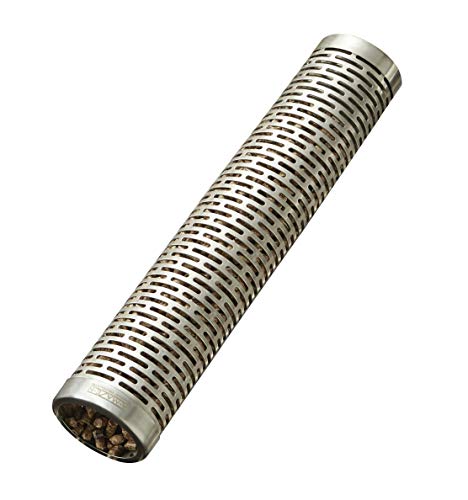
A-MAZE-N AMNTS12 oval stainless steel pellet tube smoker
BEST OVERALL

A-MAZE-N AMNTS12 12″ oval

  • 12 inches, stainless steel, oval section
  • Up to 4 hours of smoke, the maker’s own figure
  • Designed to supplement smoke in an electric smoker
  • Hot and cold smoking

Pros: The brand that established this category, and the only one whose own listing states what a tube is actually for — supplementing an electric smoker. The oval section will not roll off a grate. Cheapest of the five.

Cons: Claims four hours where the marketplace brands claim five, which reads as conservative rather than worse but does mean less unattended time. Ships in one to two days rather than from stock. No lid, so pellets can spill if it is knocked while loaded.

See Today’s Price on Amazon →

LIZZQ Premium 12″ — the safest default

If the A-MAZE-N is out of stock, this is the one to buy, and on the numbers alone it has a fair claim to being first.

Nearly fifteen thousand ratings at 4.7 stars is an evidence base nothing else in the category comes close to, and hexagonal sides solve the rolling problem the same way the oval does. It costs forty-four cents more than the A-MAZE-N.

What it does not have is a manufacturer with a history behind it. That is worth something on a piece of stainless steel that lives in a fire, and it is the only reason it is second here rather than first.
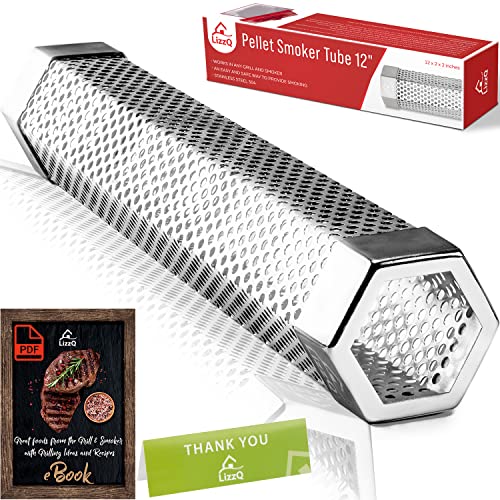
LIZZQ Premium 12 inch stainless steel pellet smoker tube
MOST REVIEWED

LIZZQ Premium 12″

  • 12 inches, stainless steel, hexagonal
  • Up to 5 hours claimed
  • Works in any grill or smoker
  • Nearly 15,000 ratings

Pros: By far the largest review base in the category, at 4.7 stars. Hexagonal, so it stays where you put it. Same money as the A-MAZE-N.

Cons: The five-hour figure is the maker’s and nobody independent has published a burn test. A house brand rather than a manufacturer with a history, so there is less to fall back on if it warps.

See Today’s Price on Amazon →

LOVEERCT 12″ hexagon — the cheapest one worth buying

Ten dollars buys the same format in 304 stainless, with over a thousand ratings behind it and a cleaning brush in the box.

This is also where the category floor sits. Below this price there are dozens of near-identical tubes with no reviews at all, often from sellers who will not exist next season. The difference between a $7 tube and a $10 tube is not the steel; it is whether anyone has used it.

LOVEERCT 12 inch hexagon stainless steel smoke tube with brush
CHEAPEST CREDIBLE

LOVEERCT 12″ hexagon

  • 12 inches, 304 stainless steel, hexagonal
  • Up to 5 hours claimed
  • Cleaning brush included
  • Hot and cold smoking

Pros: Ten dollars for the same format as the picks above, in 304 stainless rather than unspecified steel, with over a thousand ratings at 4.7. The brush is a genuine convenience.

Cons: A marketplace brand with no track record beyond this listing, so long-term durability is unknown. Below this price the category is full of near-identical tubes with no reviews at all, and that is where the risk starts.

See Today’s Price on Amazon →

Kaduf 5″ × 8″ maze tray — for overnight cooks and cold smoking

This is the only pick that is not a tube, and the only one that will run a brisket through the night without a refill.

A maze tray is a flat grid: the pellets burn along a folded path rather than down a cylinder, which is what buys the longer time. It sits flat, so nothing rolls, and the low profile makes it the easier choice for cold smoking, where the point is smoke without heat.

The trade is footprint and price. It needs a clear patch of grate that a twelve-inch tube does not, and it costs three times as much. On a small kettle it is the wrong shape.
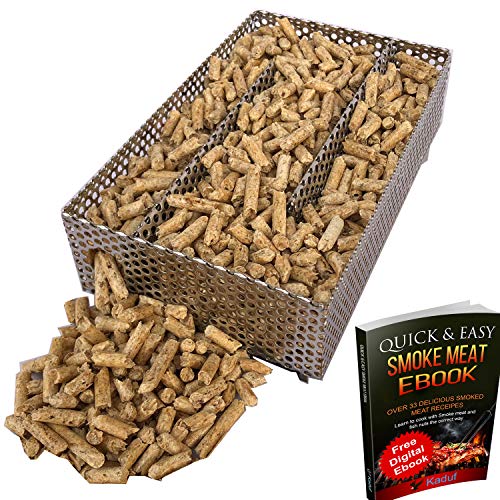
Kaduf 5 by 8 inch stainless steel pellet smoker maze tray
LONGEST BURN

Kaduf 5″×8″ maze tray

  • 5″ × 8″ maze tray rather than a tube
  • Up to 12 hours claimed — the longest here
  • Sits flat; no rolling to worry about
  • Hot and cold smoking

Pros: The only format here that covers a full overnight cook without a refill, which is the whole point on a brisket. Flat, so placement is easy. Genuinely different from the four tubes rather than another version of them.

Cons: Three times the price of the tubes. The footprint is large for a small kettle or a crowded cabinet, and it needs a clear patch of grate. Fewer ratings than the leading tubes.

See Today’s Price on Amazon →

Pit Boss Expandable 7–12″ — when the cook is short

Every other tube here commits you to its full length. Light a twelve-inch tube for a two-hour cook and three hours of pellets burn away after the food comes off.

This one collapses to seven inches, so the burn matches the session. It also comes from a company that makes the cookers rather than only the accessory, which is worth something on fit and finish.

The caveat is unusual enough to state plainly: it has no customer ratings at all. That is a genuine unknown rather than a bad sign, but on a fifteen-dollar accessory with four proven alternatives on this page, it is a reason to buy it for the adjustability rather than by default.
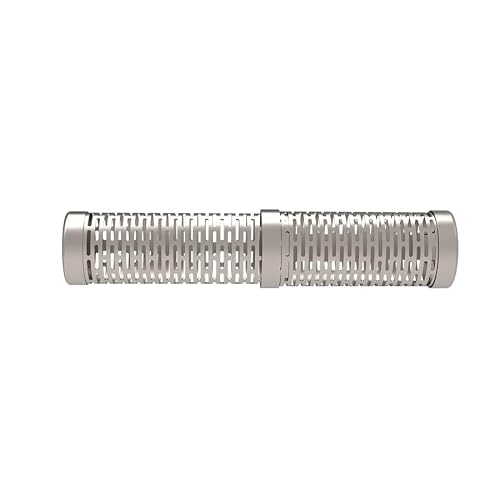
Pit Boss expandable pellet smoker tube extending from 7 to 12 inches
ADJUSTABLE

Pit Boss Expandable 7–12″

  • Expands from 7 to 12 inches
  • Approximately 3 hours of smoke
  • Stainless steel; Pit Boss part 41075
  • Hot and cold smoking

Pros: The only pick that lets you shorten the burn to match a two-hour cook rather than lighting five hours of pellets and wasting three. From a manufacturer that makes the grills rather than only the accessory.

Cons: No customer ratings at all yet, which is a real gap on a product this cheap to get wrong. Stock has been thin. Three hours at full extension is the shortest burn here, so it is the wrong choice for an overnight cook.

See Today’s Price on Amazon →

Which pellets to put in it

The tube is the cheap part of this decision. What goes in it matters more, and there is one distinction that is worth getting right before any question of flavour.

Barbecue pellets and heating pellets are not the same product. Pellets sold for pellet stoves are made to burn in an appliance, not to season food, and they can contain binders and material you would not choose to put smoke from into your dinner. Traeger describes its own barbecue pellets as free from additives and binders, which is the standard to buy to. Cooking pellets cost a little more per bag and the bag says what they are for.

Beyond that, wood choice is preference rather than rule. The conventional groupings are useful as a starting point: fruit woods such as apple and cherry are mild and suit poultry and pork; hickory and mesquite are assertive and suit beef; oak sits between them and is hard to get wrong. Weber publishes a chart pairing woods with foods, and it is worth a look before buying a large bag of anything.

Two practical points. Buy small bags until you know what you like, because a tube uses very little and a large bag will outlast your patience with the flavour. And blends are not a compromise so much as a hedge, which is why they are the safest first purchase.

Looking after it

The one thing owners get wrong is pellet storage rather than tube maintenance, and it is the cause of most tubes that will not stay lit.

Pellets are compressed sawdust and they absorb moisture from the air, after which they swell, crumble and refuse to hold an ember. A bag folded over in a damp shed is enough to ruin them over a winter. Keep them in a sealed container indoors, and check before lighting: good pellets have a sheen and snap cleanly, while damp ones look dull and crumble.

The tube itself needs very little. Tip the ash out while it is cool, and run a brush through it if one came in the box. Stainless steel discolours to a permanent brown and that is cosmetic rather than a fault. What does matter is storing it dry and empty — pellets left in a tube between cooks are the ones that will not light next time.

What was left out, and why

Round tubes. Plenty are sold and some are cheap, but a cylinder rolls on a grate and can tip burning pellets into the bottom of the cooker. Every pick here has flat sides for that reason.

Sub-$8 no-name tubes. The category has a long tail of identical-looking tubes with no reviews and sellers with no history. The saving is two or three dollars on a product that sits inside a fire, which is the wrong place to economise.

Dedicated cold smoke generators. Devices that pump smoke into a chamber with a small pump, at forty dollars and up, are a different product for a different job. If cold-smoking cheese and fish is the main use rather than an occasional one, look at those rather than at a tube.

Tubes bundled with pellets. The bundle is usually the same tube plus a small bag at a markup, and it locks you into one wood. Pellets are cheap and better bought separately in the flavour you want.

Getting it lit, which is where people struggle

The commonest complaint about these things is not that they burn out too soon but that they go out.

Fill the tube no more than about three-quarters full, so air can move through the pellets. Stand it upright, light the top end with a blowtorch or a chimney lighter, and keep the flame on it for a good half a minute or more — considerably longer than feels necessary. Let it burn with a live flame for a couple of minutes, then blow it out. What should be left is a glowing ember and a thin stream of smoke.

A tube that keeps dying is usually one of three things: pellets that have taken on moisture, a tube packed too tight for air to pass, or not enough initial flame to establish the ember. Damp pellets are the most common by a distance, and the test is the same one the pellet-grill makers give — good pellets have a sheen and snap cleanly rather than crumbling, which is set out with the sources in pellet grill temperature swings.

Lay it on the grate away from the food and away from direct flame, at the end where air enters if the cooker has an obvious flow. And leave the vent open. Smouldering wood needs air, and a closed vent starves the tube and deposits stale smoke on the food at the same time.

How These Picks Were Chosen

Plainly: this is a research-based guide, not a hands-on test. I do not own a smoker or a pellet tube, none of these has been through my hands, and no burn was timed to produce anything here.

What the selection rests on is what can be established without testing: the physical format and what it implies, the maker’s own stated figures, whether there is a manufacturer behind the product or only a listing, and the size and score of the review base. Flat-sided tubes were preferred over round ones for a mechanical reason rather than a taste one. Products with no review history were included only where they cover a need nothing else on the page does, and said so.

Prices, availability and product images come from the Amazon Product Advertising API, which is the licensed route for images. Star ratings and review counts were read from each product page on 2 September 2026, and every listing was confirmed live the same day.

Also not established: how long any of these actually burns. Every burn-time figure on this page is the manufacturer’s own claim, none of them is independently verified, and they are not measured on a common basis — a “five hour” tube and a “four hour” tube may well behave identically. Nobody publishes comparative burn tests for this category. The figures are quoted as an ordering, not as a specification, and the A-MAZE-N is recommended despite claiming the shortest of the twelve-inch times rather than because of it.

Frequently Asked Questions

Do pellet tube smokers actually work?

Yes, for what they are for. A tube burns independently of the cooker’s thermostat, so it produces smoke steadily while an electric smoker’s chip tray only smoulders when the element is running. It will not fix a cabinet that is not reaching temperature, and it is not a substitute for a working chip tray on a machine that has one.

How long does a 12-inch pellet tube burn?

Makers claim four to five hours, and none of those figures is independently verified. A-MAZE-N says up to four; most marketplace brands say five for the same length. Treat them as an ordering rather than a promise: wind, damp pellets and overfilling all shorten the burn.

Can I use a smoke tube and wood chips at the same time?

Better not to. Weber warns that too much smoke over long periods makes food taste bitter, and a tube plus a full chip tray roughly doubles the smoke on a long cook. Run one or the other. Many people light the tube for the first few hours of a cook and leave it out afterwards.

Why does my smoke tube keep going out?

Usually damp pellets, a tube packed too tightly for air to pass, or not enough flame at the start. Fill to about three-quarters, hold a torch on the lit end for well over thirty seconds, let it flame for a minute or two, then blow it out so an ember is left. Keep the cooker vent open.

What is the difference between a tube and a maze tray?

Burn time and footprint. A maze tray is a flat grid where pellets burn along a folded path, which is what lets it claim up to twelve hours against a tube’s four or five. It needs a clear patch of grate, costs more, and is the easier choice for cold smoking. A tube is smaller, cheaper and enough for most cooks.

Can I use a pellet tube for cold smoking cheese?

Yes, and it is one of the main reasons to own one, since the tube produces smoke without heating the chamber. Put the cheese as far from the tube as the cooker allows, work on a cool day, and expect to experiment. A maze tray is the better tool if cold smoking is the main use rather than an occasional one.

The verdict

The A-MAZE-N AMNTS12 at $13.49 is the one to buy for most people: the format’s originator, an oval section that will not roll, and a maker honest enough to claim four hours where its rivals claim five. If it is out of stock, the LIZZQ Premium is forty-four cents more and has fifteen thousand ratings behind it.

Spend more only for a reason. The Kaduf maze tray is the pick if a cook runs overnight or cold smoking is the point. The Pit Boss expandable earns its place only if your cooks are short and vary in length.

If the smoker is plugged into an extension lead, that is the other cheap thing worth getting right, and the specification is stricter than most people expect — see the best extension cord for an electric smoker.

And whichever you buy, use it instead of a loaded chip tray rather than alongside one. If the underlying problem is that the smoker is not making smoke at all, start with an electric smoker not producing smoke before buying anything. The rest of the outdoor cooking guides are collected on the outdoor cooking hub.


Filed Under: Product Reviews

Best Extension Cord for an Electric Smoker: What the Makers Require

Last Updated October 8, 2026

Orange outdoor extension cord coiled loosely on a sunlit wooden deck

This post contains affiliate links. If you buy through my links, I may earn a commission at no extra cost to you. Read the full disclosure.

Two smoker manufacturers publish exactly what an extension cord has to be, and almost nothing sold as a “smoker extension cord” meets it. The Southwire 25ft SJTW 14/3 does, and at $19.30 it is also the cheapest option here that does. Most cords fail on one specification: gauge.

The quick answer

Buy an outdoor-rated SJTW cord, with a three-prong grounded plug, heavier than 16 gauge, and as short as it will reach. The Southwire 25ft 14/3 covers all four for under $20. If your smoker is a Bradley, the 15-foot Iron Forge is the one to buy, because Bradley specifies under 20 feet.

What the smoker makers actually require

This is the part every competing guide leaves out, and it turns the question from a matter of opinion into a specification check.

Masterbuilt states that an outdoor extension cord used with its smokers must be marked with the suffix letters “W-A” and tagged “Suitable for Use with Outdoor Appliances”, must have grounding terminals in working condition, should be heavier than 16AWG, and should be no longer than 25 feet. Bradley Smoker’s guidance is shorter and stricter on length: if an extension cord is needed, it should be heavy-duty and under 20 feet.

Read together, that is four requirements and a ceiling.

1. Outdoor-rated jacket

The marking to look for on the cord itself is SJTW. The W is the part that matters: it means the jacket is rated for outdoor use, wet conditions and sunlight. An SJT cord without the W is an indoor cord, and it will go brittle in a season of weather. The “W-A” suffix Masterbuilt names is the older form of the same designation.

2. A working three-prong ground

The earth pin is not optional on an appliance that lives outdoors. A smoker trips its socket because current is finding a path to earth, and the grounding conductor is what makes that path safe and detectable. Two-prong cords and adapters that defeat the earth pin have no place here at all — the full argument is in the guide to an electric smoker that keeps tripping the breaker.

3. Heavier than 16 gauge, which rules out most of the category

Wire gauge runs backwards: the smaller the number, the thicker the copper. Masterbuilt’s “heavier than 16AWG” therefore means 14, 12 or 10 gauge, and it disqualifies the 16/3 cords that make up a large share of what is sold for this job.

The reason is voltage drop. Thin wire over distance loses voltage, the element receives less than it should, and the cord itself warms up. On a machine that draws continuously for twelve hours rather than in short bursts, that matters more than it would on a drill.

4. Short

Length is the specification people ignore, and it is the one both makers put a number on. Twenty-five feet is Masterbuilt’s ceiling. Twenty is Bradley’s. Nothing in this guide is longer than 25 feet, and the shortest cord that reaches is always the better cord, because voltage drop scales with length.

My picks at a glance

Product Best For Price Rating Buy
Southwire 25ft SJTW 14/3 Most electric smokers $19.30 4.8★ (250) Check Price
Iron Forge Cable 15ft 12/3 Bradley owners and short runs $25.99 4.8★ (8,257) Check Price
GoGreen Power GG-14025 12-gauge headroom at 25 feet $21.49 4.8★ (1,436) Check Price
GoGreen Power GG-15125 A smoker plus a light or probe $20.80 4.4★ (52) Check Price
EP 25ft 10/3 SJTW Maximum headroom and cold $41.99 4.7★ (1,535) Check Price

Prices and ratings were checked on 2 September 2026 and will move.

Southwire 25ft SJTW 14/3 — best for most electric smokers

Southwire is a wire manufacturer that supplies the trade rather than a brand that appeared on a marketplace last year, and on a product whose whole job is the quality of the copper inside it, that is worth more than any feature list.

The specification does everything Masterbuilt asks. It is SJTW, so the jacket is rated for weather and sunlight; it is 14 gauge, which clears the 16-gauge line; and it is 25 feet, which is the stated ceiling rather than a number pulled out of the air.

The plug is three-prong with reinforced blades, and the lighted end tells you at a glance that the socket is actually live — genuinely useful on a smoker plugged into a GFCI that may have tripped without anyone noticing.

The temperature rating is −40°C to 60°C, which is the difference between a cord that stays flexible on a cold morning and one that fights you.

Southwire 25ft SJTW 14/3 outdoor extension cord with lighted end
BEST OVERALL

Southwire 25ft SJTW 14/3

  • 14/3 SJTW, outdoor-rated jacket, three-prong grounded
  • 25 feet — Masterbuilt’s stated maximum
  • 15 amps, 125 volts; UL and cUL listed
  • Lighted end; reinforced blades; −40°C to 60°C

Pros: An established wire manufacturer rather than a marketplace brand. Meets every published Masterbuilt requirement. Cheapest cord here that does.

Cons: 14 gauge is the minimum that qualifies rather than generous headroom, so it is the wrong pick if you also want to run a griddle from it. Only 248 ratings, far fewer than the marketplace brands. Red is conspicuous in a garden.

See Today’s Price on Amazon →

Iron Forge Cable 15ft 12/3 — best for Bradley owners and short runs

Bradley specifies under 20 feet, and this is the only cord here that satisfies it. It is also 12 gauge rather than 14, so it is thicker copper over a shorter distance — which is the combination that loses the least voltage of anything in this guide.

The practical case for it is broader than Bradley ownership. If the socket is genuinely fifteen feet away, buying twenty-five feet of cord and coiling the slack is worse than buying fifteen, for reasons covered further down. Iron Forge is an American veteran-owned business, the cord is UL certified, and the listing makes a point of it staying flexible in an unheated garage, which is relevant given that Bradley also warns about cold slowing a smoker down.

Iron Forge Cable 15 foot 12/3 SJTW lighted outdoor extension cord
BEST SHORT CORD

Iron Forge Cable 15ft 12/3

  • 12/3 SJTW, outdoor-rated, three-prong grounded
  • 15 feet — the only pick under Bradley’s 20-foot limit
  • 15 amps, 125 volts, 1,875 watts; UL certified
  • Lighted end; reinforced blades; stays flexible in the cold

Pros: Thicker copper over a shorter run, which is the best electrical combination here. Satisfies both makers’ length rules at once. More than 8,000 ratings at 4.8 stars.

Cons: Fifteen feet is genuinely short, and there is no way to extend it safely — joining two cords is exactly what you should not do. Costs more than the 25-foot Southwire despite being shorter, because of the heavier gauge.

See Today’s Price on Amazon →

GoGreen GG-14025 25ft 12/3 — best 12-gauge at full length

If the socket is a full twenty-five feet away and you want more headroom than 14 gauge gives, this is the cheapest sensible way to get it. Contractor grade, cETL listed, molded plugs, lighted end.

It is worth reading the manufacturer’s own warning on this one rather than discovering it later: GoGreen states plainly that the cord should not be used with an EV charger. That has nothing to do with smokers, but it is a useful signal about where the maker draws its own line on sustained high-current loads, and it belongs in front of a reader rather than buried.

GoGreen Power GG-14025 12/3 SJTW outdoor extension cord with lighted end
BEST 12-GAUGE

GoGreen Power GG-14025

  • 12/3 SJTW, contractor grade, three-prong grounded
  • 25 feet, at Masterbuilt’s ceiling
  • cETL listed; molded plugs; lighted end
  • Moisture and abrasion resistant jacket

Pros: Heavier copper than the Southwire for about two dollars more. Molded plugs resist the flexing that kills cheap cords at the neck. 1,436 ratings at 4.8 stars.

Cons: The maker explicitly excludes EV charging, which is a fair signal of its limits under long high-current loads. Twelve-gauge cable is stiff and heavy to coil, and at 25 feet you are carrying that weight for no benefit if the socket is closer.

See Today’s Price on Amazon →

GoGreen GG-15125 25ft 14/3 three-outlet — only if you genuinely need two things powered

This is the compromise pick, and it comes with a warning attached rather than a recommendation.

The case for it is real enough: a smoker and a work light, or a smoker and a mains-powered thermometer receiver, from one cord. Same 14/3 SJTW construction as the Southwire, contractor grade, lighted end, and it costs about the same.

The case against it is that three sockets on one 14-gauge cord invite precisely the behaviour the troubleshooting guides warn about. A smoker and an LED lamp is fine. A smoker and a second heating appliance is how a 15-amp circuit ends up tripping, and the cord will not stop you. It also has by far the thinnest review history here — 50 ratings at 4.4 stars, against four figures for everything else.

GoGreen Power GG-15125 14/3 three-outlet SJTW outdoor extension cord in orange
THREE OUTLETS

GoGreen Power GG-15125

  • 14/3 SJTW, three outlets, three-prong grounded
  • 25 feet; contractor grade; cETL listed
  • Lighted end; molded plugs; high-visibility orange

Pros: Powers a smoker and a light or receiver without a second cord. Same jacket and gauge as the top pick, at a similar price.

Cons: Three sockets on 14-gauge cable make overloading easy, which is the opposite of what a smoker owner with a tripping breaker needs. Only 50 ratings and 4.4 stars — the weakest evidence base of the five. Do not buy it as a general-purpose splitter.

See Today’s Price on Amazon →

EP 25ft 10/3 SJTW — more cord than a smoker needs

Ten-gauge is overkill for an electric smoker and it is worth saying so before the price. A cabinet drawing a few hundred watts will never notice the difference between this and the Southwire.

It earns a place for two reasons. The first is if one cord has to serve the whole patio — a smoker today, a griddle or a pressure washer next weekend — because 10 gauge has headroom the others do not. The second is cold: the jacket is rated from −40°F to 140°F and the cable stays workable at the bottom of that range, which is where thin cords turn into hosepipe.

EP 25 foot 10/3 SJTW lighted outdoor extension cord in yellow
MOST HEADROOM

EP 25ft 10/3 SJTW

  • 10/3 SJTW, pure copper, three-prong grounded
  • 25 feet; 15 amps, 125 volts, 1,875 watts; ETL listed
  • −40°F to 140°F; lighted end; reinforced blades

Pros: The most headroom here by a wide margin, so one cord covers a smoker, a griddle and power tools. Best cold-weather rating of the five. 1,535 ratings at 4.7 stars.

Cons: Twice the price of the top pick for capacity a smoker cannot use. Ten-gauge cable is heavy and stiff, which makes it awkward to store and slow to lay out. The plug is bulky in a weatherproof socket cover.

See Today’s Price on Amazon →

What was left out, and why

The manufacturer standard does most of the excluding, and it is worth naming what it removes rather than quietly omitting it. Four whole categories that dominate this search do not qualify.

16-gauge cords. These are the single most common thing sold and recommended for smokers, and Masterbuilt’s “heavier than 16AWG” excludes them by definition. They are not merely a weaker choice; they sit on the wrong side of a line the maker drew. Several of them are perfectly good cords for a lamp or a hedge trimmer.

Short indoor appliance cords. The three-foot and six-foot cords that appear in this category are indoor-rated, and no length of an indoor cord makes it suitable for a machine standing in the weather. The jacket is the problem, not the distance.

Fifty-foot and hundred-foot cords. Both makers stop at or before 25 feet. A 50-foot cord in a smoker guide is a recommendation to exceed a published limit, whatever its gauge, and a heavier gauge does not buy permission to run further than the manufacturer allows.

Cord reels. A reel is a coil that cannot be uncoiled without unwinding all of it, which is the opposite of what a long low-temperature cook needs. If a reel is what you have, run it out completely rather than drawing off the length you want.

One thing was deliberately not used as a criterion: appearance. Orange, yellow and red are conventional for outdoor cords because they are meant to be seen and not tripped over, and choosing a black cord because it disappears against a patio is choosing against the point of the colour.

How to choose for your own smoker

Measure before you buy, then buy shorter

Run a tape from the socket to where the smoker will actually stand, then add a little for the route rather than the straight line. Buy the shortest cord that covers it. Every extra foot loses a little more voltage and gives you slack you will end up coiling, and coiled cord is a problem in its own right.

If the answer comes out over 25 feet, the cord is not the fix. That is the point at which the honest advice is to move the smoker or have a socket installed, because both makers stop at or before 25 feet and there is no cord that makes 40 feet acceptable.

Match the gauge to what you will plug in, not to the smoker alone

Fourteen gauge clears the manufacturer requirement for a smoker and is enough on its own. Choose 12 if the same cord will occasionally run something heavier, or if the run is at the long end. Choose 10 only if it is genuinely the patio’s only cord and a griddle or pressure washer is in its future.

The rating plate on the back of the smoker gives the wattage, and it is the number to use rather than any figure quoted on a review site. Divide watts by 120 for a rough amp draw. A cabinet in the hundreds of watts is a light load for any of these cords; the reason to go heavier is future-proofing, not present need.

Read the cord, not the listing

Marketplace listings use “heavy duty” and “waterproof” freely, and neither is a specification. The jacket itself is printed with what it actually is. Look for SJTW and the gauge, in the form 14/3 or 12/3 — the first number is the gauge, the second is the number of conductors, and three is what gives you an earth.

“Waterproof” on a cord listing generally means the jacket resists water, not that the connection does. A plug and socket joined in the open will still let water in, and that is exactly the leakage path that trips a GFCI. If the join has to sit outside, it needs a cover.

What is not worth paying for

A lighted end is genuinely useful on a smoker, because it distinguishes a tripped socket from a failed appliance at a glance. Beyond that, most of the differentiation in this category is colour and marketing. Braided sleeves, “military grade” claims and 20,000-bend test figures do not appear in any manufacturer requirement, and none of them changes the four things that do.

The other accessory an electric smoker owner tends to want is a pellet tube, for smoke that arrives in bursts rather than steadily — the formats are compared in the best pellet tube smoker.

The mistake that damages cords

Do not run the cord coiled. Several manufacturers print this on the listing and it is easy to skip past: a coiled cable under sustained load builds heat in the middle of the coil instead of shedding it, and the cord runs warmer than its rating assumes. On a twelve-hour cook, that matters.

Lay it out fully, even if that means the slack loops across a lawn. If there is a lot of slack, the honest conclusion is that the cord is longer than it needed to be.

Storage is the other half. Bring it in, or at least keep the connection off the ground and under cover. A cord left plugged in and lying in a puddle between cooks is a moisture leakage path waiting to be discovered, and moisture is the most common cause of an electric smoker tripping its socket in the first place.

How These Picks Were Chosen

Plainly: this is a research-based guide, not a hands-on test. I do not own an electric smoker, none of these cords has been through my hands, and no cord was put on a meter to produce anything here.

What the selection rests on is a published standard rather than an opinion. Masterbuilt and Bradley Smoker both state in their own documentation what an extension cord for their smokers must be, and those requirements — outdoor-rated jacket, working ground, heavier than 16AWG, 25 feet or less — are objective and printed on the product. Candidates were screened against them, and everything that failed on gauge, length or jacket rating was excluded regardless of price or rating. That is the whole reason this category can be assessed honestly without testing: the specification is the product.

Prices, availability and product images come from the Amazon Product Advertising API, which is the licensed route for images. Star ratings and review counts were read from each product page on 2 September 2026, and every listing was confirmed live on the same day.

Also not established: how these five compare on durability over years of outdoor use. That would need cords left outside for seasons and inspected, nobody publishes that data for consumer extension cords, and review counts are a measure of popularity rather than longevity. Where a cord here has a large review base, that is stated as what it is — evidence that many people bought it, not evidence that it lasts.

Frequently Asked Questions

What gauge extension cord do I need for an electric smoker?

Heavier than 16 gauge, which means 14, 12 or 10. Masterbuilt states that requirement directly. Gauge numbers run backwards, so a smaller number is thicker copper. Fourteen gauge is enough for a smoker on its own; go to 12 if the run is long or the cord will sometimes power something heavier.

Can I use a regular indoor extension cord with a smoker?

No. Masterbuilt requires a cord marked for outdoor use and tagged as suitable for outdoor appliances, with working grounding terminals. An indoor cord has a jacket that is not rated for weather or sunlight, and it will harden and crack. It is also the most common cause of an outdoor socket tripping.

How long can an extension cord for a smoker be?

Masterbuilt sets a ceiling of 25 feet and Bradley Smoker says under 20. Shorter is always electrically better, because voltage drop increases with length. If the socket is more than 25 feet from where the smoker needs to stand, the answer is to move the smoker or add a socket, not to buy a longer cord.

What does SJTW mean on an extension cord?

It is the jacket rating printed on the cable. The W is the important letter: it certifies the cord for outdoor use in wet conditions and sunlight. An SJT cord without the W is indoor only. The W-A suffix that Masterbuilt names in its own guidance is the older form of the same designation.

Will a better extension cord stop my smoker tripping the breaker?

Sometimes, but do not assume it. A thin or damaged cord is a common cause, and swapping it is worth trying. If the smoker still trips with no extension at all, the fault is elsewhere, usually moisture reaching the element terminals or the control housing. The diagnostic order is set out in the guide to a smoker that keeps tripping the breaker.

Is it safe to plug one extension cord into another?

No. Joining cords creates an unprotected connection that is usually left lying on the ground, and it compounds the voltage drop of both. Neither manufacturer allows it, and it defeats the length limits they set. Buy one cord of the right length instead.

The verdict

For most people the Southwire 25ft SJTW 14/3 is the right buy. It satisfies every requirement Masterbuilt publishes, it comes from a company that makes wire for a living, and at $19.30 it costs less than the cords that do not qualify.

Two exceptions are worth knowing. If your smoker is a Bradley, the Iron Forge 15ft 12/3 is the one to get, because Bradley draws its line at 20 feet and this is the only pick under it. And if one cord has to serve the whole patio for years, the EP 10/3 buys headroom a smoker will never use but a griddle might.

Whichever you choose, the cord is only one of the causes. If the machine is still tripping, still refusing to reach temperature, or still not making smoke, those are separate faults with separate diagnoses — see tripping the breaker, not getting hot enough and not producing smoke. The rest of the outdoor cooking guides are collected on the outdoor cooking hub.


Filed Under: Product Reviews

Best Countertop Dishwasher

Last Updated October 8, 2026

Woman Arranging Plates In Dishwasher

A countertop dishwasher is an excellent choice if you have limited space in your kitchen. They are more compact while promising to deliver the same cleaning power as traditional dishwashers. One thing that ruins either kind quickly: putting washing-up liquid in a dishwasher.

Although they can’t tackle heavy tasks like cleaning multiple dishes after a party, they are great for small families that need to reduce their chores. That said, here are five of the best countertop dishwashers available today. 

I earn a commission if you buy through the Amazon links below, at no extra cost to you.

Quick Comparison

Product Best For Price Rating Buy
COMFEE Portable Mini Best Overall $309.99 4.2★ (3,726) Check Price
AIRMSEN Portable Best No-Hookup Flexibility $339.99 4.6★ (1,631) Check Price
NOVETE Countertop Best for Larger Dishes $289.99 4.4★ (2,515) Check Price
EUHOMY Countertop Cheapest No-Hookup $249.00 4.5★ (1,007) Check Price
Hermitlux Countertop Most Polished Build $299.99 4.4★ (4,577) Check Price

Best Countertop Dishwasher Reviews

COMFEE Countertop Dishwasher

Uenxnudbl. Sl300

Check on Amazon

The COMFEE countertop dishwasher weighs 46 pounds and has a yearly energy consumption of 174 Kilowatt hours. It comes with a push-button control console and has eight cycle options. The dishwasher’s primary material consists of plastic and stainless steel. The package includes a dishwasher, a user manual, a drain hose, an inlet hose, and a power cord. 

Review

One of the first things you will notice about this dishwasher is its easy installation. You can quickly combine accessories and make simple connections like regular dishwashers. The only thing that might need to be added to the instruction manual is how to get rid of errors. Also, connecting it to some faucets might require an adapter. 

The dishwasher can go anywhere in your cupboard or the table. You can put up to about 70 tableware pieces inside. Plates also fit, as long as they are 10 inches in diameter or less.

The washing cycles include Normal, Heavy, ECO, Speed, Glass, and Baby-care. It also has an extra drying function which aids in delivering sparkly clean, dry dishes. The compact dishwasher also has Rinse, Mini-part, and Speed. 

The Baby-care wash cycle prevents bacteria growth and aims to keep children’s bottles and dinner sets clean. Speaking of children, you won’t have to worry much about accidents as the dishwasher has a child safety lock. 

One of the highlight features of this dishwasher is the heavy program. It cleans heavily soiled dishes courtesy of the 12 washing nozzles and the 360° spiral spray wash. The two allow for complete cleaning from all angles.

In addition to the 150°F water temperature and the high pressure, you won’t have to deal with tough stains anymore. An extra drying option allows extended drying time by increasing the final rinsing temperature.        

It takes about 45 minutes to clean the dishes. Lastly, the COMFEE compact dishwasher is certified by Energy Star as it consumes as little as 2.77 gallons of water. 

Pros

  • It fits a large number of utensils
  • Installation is easy
  • Several washing cycles
  • Convenient heavy program
  • Does the job fast and efficiently

Cons

  • The manual is not clear on how to remove errors 

AIRMSEN Portable Countertop Dishwasher

Qknlzgeyl. Sl300

Check on Amazon

This dishwasher from AIRMSEN is packed with unique features that make it not only efficiently functional but also convenient. It weighs around 26.4 pounds and has a 3-cup capacity. It comes in white, features a touch control console, and has five option cycles.

Review

From an aesthetic point of view, this dishwasher has built-in light functions which are pleasing to the eye. Since it’s a lightweight appliance with small dimensions (16 x 16 x 17.5 inches), you can easily carry it around. This makes it a convenient unit for a small apartment, a camper, a boat, or a dorm. Despite its small size, the dishwasher can easily fit different dishes as long as they are up to 12 inches in diameter. 

Some of the different multi-washing programs include Dry, Fruit, ECO, Strong, and Quick. You also enjoy deep cleaning without streaks, courtesy of the upper and lower spray arms. 

The panel is easy to use and the LED digital controls clearly display the wash controls. In addition, an automatic water level indicator alerts you when you have reached the ideal water level.  

The portable countertop dishwasher features two channel options for filling it out. A water hose or a tank option adds to the convenience of storage and portability.

You can use any detergent from powder, liquids, or pods with the dishwasher — if your home is on a septic tank, see my septic-safe dishwasher detergent guide. If you are running long cycles, manufacturers recommend using detergent tablets to ensure they get fully dissolved. 

There are a few downsides to having this dishwasher. For example, some of your pots may not fit inside the dishwasher. Some people also find the dishwasher to be noisy during operation. 

Pros

  • You can place it almost anywhere
  • The control panel is pretty easy to use
  • Offers several washing programs
  • Two channel filling up is convenient
  • Accepts most types of detergents

Cons

  • Noisy when in use
  • Big pans will not fit in the dishwasher

NOVETE Portable Countertop Dishwasher

Cyw8utfal. Sl300

Check on Amazon

If you were looking for a dishwasher with a stylish and compact design, this is the one to get. NOVETE is not only known for its unique and innovative products; they are also dependable, whether for customer support or any other inquiry.

The company is committed to making work in the kitchen much easier and more efficient with its products. NOVETE makes other products like stainless steel cookware and ceramic and non-stick tools. They bring innovation, value, design, and durability to the table.

Review

For this dishwasher, you don’t need a water hookup. That makes it the easiest unit here to move between kitchen, RV, and storage. It offers five washing programs, including Glass, Baby-care, Fruitwash, Rapid and Normal. For effective cleaning, you also get upper and lower spray arms. 

Using the Baby-care wash program generates steam, conveniently giving glassware a sparkling clean result. 

It is also relatively fast and you can clean your dirty dishes in 40 minutes. In addition, the air circulation is automatic, which helps to dry your dishes. 

The fruit wash feature is convenient for cleaning your vegetables and fruit and having them ready from the dishwasher. 

When you use the Baby-care program, you might notice that your baby bottles have a powdery residue. This usually means you use a lot of detergents and might have to reduce the quantity.

Plates and dishes 12″ in diameter can fit in this dishwasher; thus, you are covered for most dishes. The overall compact design makes it great for campers or small-sized apartments. 

It has a 5-liter tank and the package includes a water hose to connect to your kitchen faucet. If it doesn’t fit, you can buy an adapter. 

The constituted material also makes this dishwasher durable, meaning it will last a long time. When you initially receive the packaging, you might notice a bit of residual water inside, don’t worry; this is normal. Dishwashers are usually tested first in the factory before release. You can reach NOVETE by phone or email if you experience issues with your dishwasher. 

Overall this dishwasher is an aesthetically pleasing unit to add to your kitchen. In addition to the nice looks and finishes, it’s also functional and reliable. 

Pros

  • Compact and stylish design
  • It does not require hookups
  • It fits a variety of dishes
  • Convenient steam cycle for washing baby utensils
  • Numerous wash cycles

Cons

  • Your dishes might come out soapy at times

EUHOMY Countertop Dishwasher


EUHOMY portable countertop dishwasher

The EUHOMY replaces the discontinued hOmeLabs unit that used to hold this spot — hOmeLabs has left the countertop dishwasher category entirely. It is a strong swap: 6 programs, a 5-liter built-in tank for hookup-free use, and a 167°F high-temp cycle for sanitizing baby items, all at $249.00 — the cheapest pick on this list. The trade-off for the price is a smaller review base (1,007 ratings at 4.5 stars) than the longer-established brands here.

Pros:

  • Cheapest pick on the list, with the same no-hookup tank design as units costing $40 or more
  • 167°F high-temperature sanitize cycle
  • Compact footprint fits under most cabinets

Cons:

  • Smallest review base on this list
  • Air-dry only — no heated drying

Verdict: Buy this if you want the no-hookup convenience at the lowest price and don’t mind a newer brand. Skip it if a proven track record matters more than saving $40.

Check Price on Amazon →

Hermitlux Countertop Dishwasher


Hermitlux Countertop Dishwasher with glass door

The Hermitlux runs 7 washing programs from a 5-liter built-in tank, so like the AIRMSEN it needs no plumbing hookup at all. The glass door and interior LED are genuinely useful rather than decorative — you can see whether that baking dish actually came clean without opening the door mid-cycle. At $299.99 it costs less than the COMFEE ($309.99) and the AIRMSEN ($339.99), and its 4.4-star average across 4,577 ratings is the largest review base on this list.

Pros:

  • No water hookup needed — 5L built-in tank
  • Glass door with interior light to check cycle progress
  • 7 programs including high-temp 167°F sanitize

Cons:

  • Priciest option on this list
  • Tank filling adds a manual step every cycle if you skip the hookup

Verdict: Buy this if you want the no-hookup convenience with the most polished build. Skip it if you have a faucet connection available — the COMFEE does more programs for less.

Check Price on Amazon →

Conclusion

All the countertop dishwashers reviewed not only add to the functionality of your kitchen but are also designed to be aesthetically pleasing. The COMFEE Countertop Dishwasher is my top pick: Energy Star certified, eight wash programs, and the largest proven track record on this list (3,604 ratings). If you are looking for a dishwasher that you can fill up using your jug, get the AIRMSEN countertop dishwasher which offers two filling options. The NOVETE dishwasher is an excellent choice for those with dishes bigger than 10 inches but smaller than 12 inches. 

How These Picks Were Chosen

Plainly: this is a research-based guide, not a hands-on test. I have not run these side by side, and nothing here should be read as a report from my own kitchen.

What the picks rest on: place-setting capacity and what that means in real crockery, whether the unit needs a tap connection or fills from an internal reservoir, cycle length, stated water use per cycle, and whether there is a heated dry; plus the complaint patterns across verified-purchase reviews, which for countertop units concentrate on tap adapters leaking and on drying performance disappointing buyers used to a full-size machine.

What I could not establish: actual cleaning performance, which needs standardised soiled loads of the kind consumer test labs use. No independent test covers these models. Capacity, water use and cycle options are specifications you can act on; cleaning quality here rests on owner consensus.

Frequently Asked Questions

What is the best countertop dishwasher overall?

The COMFEE Portable Mini. It is Energy Star certified, runs eight wash programs, and its 3,604 ratings are the largest proven track record on this list — the surest bet in a category full of newer brands.

Do countertop dishwashers need a plumbing hookup?

Not all of them. The AIRMSEN, EUHOMY, and Hermitlux all have built-in water tanks you fill with a jug, needing no faucet connection at all. The COMFEE and NOVETE connect to a standard faucet with a quick-connect adapter — no permanent plumbing either way.

How many dishes fit in a countertop dishwasher?

Most handle 4-6 place settings — realistically, dinner dishes for two people or a day’s worth for one. Plates larger than about 10-12 inches will not fit in most units; the NOVETE handles up to 12-inch plates, the most of any pick here.

Do countertop dishwashers actually get dishes clean?

Yes — they use the same spray-arm and heated-water approach as full-size machines, just in a smaller chamber. The main compromises are capacity and cycle time, not cleaning quality. High-temp cycles on the EUHOMY and Hermitlux reach 167°F, hot enough to sanitize.

How much counter space does one need?

Plan for roughly 17-22 inches wide, 20 inches deep, and 17-18 inches tall — about the footprint of a large microwave. Check clearance under your cabinets before buying; most standard 18-inch cabinet gaps fit these units with little room to spare.

Planning a full countertop setup? A countertop ice maker has roughly half this footprint if you are budgeting space for both.

Are countertop dishwashers worth it compared to hand washing?

For one- and two-person households, usually yes — they use 2-5 gallons per cycle versus up to 20 gallons of running-tap hand washing, and the high-temperature wash is more hygienic than any sink scrub.

Filed Under: Product Reviews

Best Sous Vide Precision Cookers

Last Updated October 30, 2026

cooking food using sous vide technology

Sometimes it is nice to have restaurant-quality food in your home without paying too much money or exerting too much effort. You can only do that if you have a sous vide cooker at your disposal for a precision cooking option. Getting the target right matters more than the machine does — the meat temperature guide covers the safe and preferred finish temperatures.

In-home fine dining is now within your reach, with great options available on the marketplace at very affordable prices. This article looks at some popular and best sous vide cookers to help you make the best choice.

Here’s a closer look at what these sous vide cookers have to offer, so you can make the best purchasing decision for your needs and budget.

I earn a commission if you buy through the Amazon links below, at no extra cost to you.

Quick Comparison

Product Best For Price Rating Buy
Anova Nano 2.0 Best Overall $68.00 4.6★ (15,079) Check Price
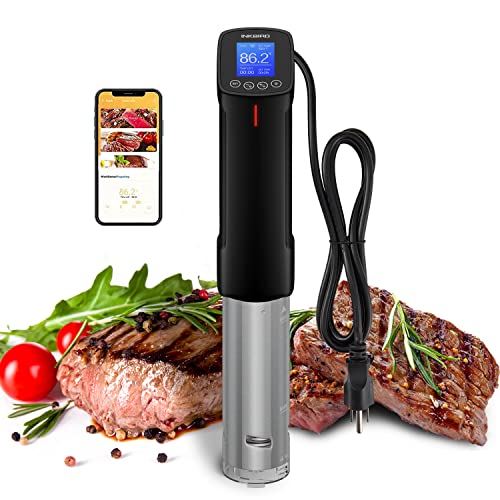
INKBIRD ISV-100W WiFi Best WiFi Features $95.99 4.5★ (5,362) Check Price
Breville Joule CS10001 Most Compact $274.95 4.5★ (3,516) Check Price
Greater Goods 1100W Quietest, No App Needed $89.99 4.6★ (1,901) Check Price
Wancle 1100W Best Budget $43.99 4.3★ (1,617) Check Price

Best Sous Vide Precision Cookers – Reviews

Anova Culinary AN400-US00 Nano Sous Vide Precision Cooker

+7znfdvdl. Sl300

Check on Amazon


This precision cooker from Anova Culinary will make it possible for everyone to have top-quality food in the safety of their home. That is because it comes loaded with features to make it easy to use by even the entry-level home cook without too much effort.

Review

This will be the only cooking appliance you will need when preparing and cooking food for dinner. It is so easy to operate; anyone can use it. It is a perfect option for entry-level cooks and those with experience.

It helps to keep the water circulating, thus maintaining a perfect cooking temperature for consistently good results. This will help to improve your overall cooking skills while at the same time boosting your confidence in the kitchen.

Even though this is an entry-level sous vide cooker, it can cook large quantities of food in one go. You can easily prepare dinner or any meal for up to four people, saving time and effort.

This appliance is the ideal choice for those who don’t want to be limited when it comes to preparing food. You can cook a wide range of food types with this cooker to increase the versatility of the meal.

Because it is made with durable but lightweight materials, this cooker will last many hours of happy cooking without fail.

With only a 110-volt power outlet connection, this device can not support any other configuration, which takes away some of the versatility. This also means that the device can’t be used outside the USA, thus keeping it away from the rest of the world.

The operating noise of the Anova precision cooker is a bit high, making it difficult to hear the other notifications. It will also be annoying if you prefer a quieter setup in your food preparation environment.

Pros

  • It has very accurate temperature control
  • Easy to store with a compact design
  • Cleaning this device is easy and quick
  • Access to the Anova app for easy operating

Cons

  • Cannot be used outside the USA
  • The operating noise level is a bit high

ISV-100W/1000W Sous Vide Precision Cooker From Inkbird

Rpzg8pcdl. Sl3500

Check on Amazon


If you are looking for a sous vide cooker that is easy and can be used by most people, this is a great option. It might be a mid-range precision cooker, but you can get top-notch results when using it to prepare your food.

Review

With very fast water circulation, the temperature will be evenly distributed in the container, ensuring much better results. This benefit also allows your cooker to be more accurate in getting the food cooked just the way you want it.

The Inkbird sous vide offers an accurate timer with various settings to get the food cooked in accordance with your schedule. You can conveniently set it and get on with your daily activities until you are notified by the cooker when the food is done.

An easy option to set the device up on your phone with the available app makes controlling it even simpler. With Wi-Fi connectivity, you can set it up for use without too much effort and control the device via the app to save time.

A clear and large display makes it easy to see the readouts on the precision cooker at a glance to keep easy track of progress. It also has an easy-to-select and intuitive feature option on the control panel to make the device user-friendly.

This is the ideal precision cooker for those who love to have everything close at hand while preparing food, and it operates very quietly.

Unfortunately, there are no sous vide cooking bags included with this precision cooker from Inkbird, which is a drawback. This means you will have to get the bags to cook your food separately and at an extra cost.

Also, the selector button on the control panel is a bit too sensitive and can accidentally be changed without you knowing. This means you must be very careful while using the cooker so you don’t accidentally bump against it and change your settings.

Pros

  • It has a quiet operating noise level
  • Strong and durable design
  • Easy to set it up and use
  • Strong and reliable clip to secure the cooker

Cons

  • You don’t get any sous vide bags included with the cooker
  • Selectors on the control panel are too sensitive

Breville CS10001 Joule Sous Vide Precision Cooker

Duys9o7ql. Sl300

Check on Amazon

With many years of experience in the cooking industry, Breville is sure to provide only the best appliances. This is also the case with this precision cooker, with many great options to make your kitchen life much easier.

Review

With a compact design, you can easily use this device on the counter without it taking up space. This feature also allows the cooker to be stored out of the way in a small space when it is not in use.

To further enhance the overall durability of the cooker from Breville, it is made from stainless steel to last much longer. This means that the device can easily resist corrosion, increasing the lifespan of the cooker.

This precision cooker from Breville comes ready with Wi-Fi and Bluetooth capabilities for easy connectivity options and app control. The Bluetooth connectivity option will keep the sous vide cooker connected all the time, even when the Wi-Fi is down.

With quick heating capability, it will be at the perfect temperature in a flash to save you time and effort. What is also great is that it comes with a maximum power output of around 1100 watts to heat a large quantity of water.

With the custom Joule Alexa feature, you can now control the cooker with voice commands. This is the ideal device for the perfectionist and those who love to have only the best gadgets available.

However, you pay the price for the best quality; this cooker comes with quite a high price tag. This cost will put the device out of reach of many people out there who are working with a tight budget.

It is great that you have an innovative app to control the cooker remotely, but that is also the only way to control it. There is no way you can operate and control the features on the cooker itself, which is a bit of a limitation.

Pros

  • A beautiful design to display well
  • Very quick to heat the water
  • You can control it remotely
  • It is made with a compact design to fit in a small space easily

Cons

  • It comes with a high price tag attached to it
  • This cooker can only be operated via the app

Greater Goods Sous Vide Cooker, 1100W

V36livvvl. Sl300

Check on Amazon

For restaurant-grade dishes, you can not go wrong with the great features of this sous vide precision cooker by Greater Goods. With this cooking appliance at your disposal, you will have much better cooking results and more kitchen fun.

Review

The fact that the motor of this sous vide cooker from Greater Goods operates at a low noise level is a good thing. It means you can hear all notifications from the device to keep you updated on the progress.

With a fast heating element, you don’t need to wait too long for the water to reach the desired temperature. This also gives you higher temperature control accuracy for more precise cooking of all your food.

Good circulation ensures that you have a more even heating of the food without hot and cold areas in the water. This translates to evenly cooked food to improve the quality of your dish and boost your cooking skills.

The durable clamp will always hold it in place, ensuring your device is constantly at the right spot in the water. It is also designed in such a way that you can easily attach the device to the container using only one hand.

The display on this precision cooker is very easy to read, with a large font for accurate reading at a glance. The unit is waterproof, so you can wipe down the exterior without worrying about water reaching the interior electronics.

There are no recipes included. This might not be that much of a problem with the availability of the internet, but it means that you need to take some time to find your own recipes, which may annoy those who don’t have time to waste.

There is no added feature that allows you to control your precision cooker from a distance. You will have to go to the device every time you want to know the progress of your food or set it.

Pros

  • Accurate temperature control for improved results
  • Large and clear display for easy reading
  • Strong and quiet motor 
  • It has a waterproof design for increased protection

Cons

  • There are no recipes included with this device
  • You can only control the features on the device manually

Wancle Sous Vide Cooker, 1100W

Dfrm+gbl. Sl500

Check on Amazon

This budget-friendly precision cooker doesn’t need to compete with any of the other devices when it comes to features. It is loaded with capabilities to make it a great sous vide cooker for every level of experience in the kitchen.

Review

With the easy clamp-on option, you can simply attach the precision cooker to the pot’s side to secure it. The clamp is also easy to operate and very durable to last for a long time.

The 1000-watt element will quickly get a large quantity of water to the desired temperature for much better cooking results. You also have up to 99 hours of programmable timing so the food can be ready when you want it to be.

A durable design and construction will make this precision cooker from Wancle last for a long time. This means that you will enjoy many hours of cooking your food without the device failing.

You can easily set the device up and operate it from a clear display panel with large readings for accurate control. Because the water is ready in only a few minutes, you will have a more evenly distributed heat for much better results.

You can easily read the device with a backlit touch screen, even in weak light conditions. This very affordable device is ideal for those who have just started out with this more advanced method of top-grade cooking.

To warn you when something goes wrong or a cooking cycle is done, there is no loud beep or indication to get your attention. This means that you will have to keep an eye on the device all the time in case something goes wrong.

The touchpad can get a bit difficult to control the features after some time of use, which might be bothersome. This simply means that the quality of the touchpad and the selections are not the best and might not last long.

Pros

  • A very affordable price tag is attached to this cooker
  • High-accuracy temperature control
  • Easy clamp option for attachment
  • Long hours programmable options

Cons

  • You don’t have a loud beeping to warn you
  • The touchpad is a bit difficult to use

Conclusion

The sous vide I consider to be the number one is the precision cooker from Breville with all the great features included, making your life easier. For those with a small budget, the very affordable sous vide cooker from Wancle is a great option.

How These Picks Were Chosen

Plainly: this is a research-based guide, not a hands-on test. I have not run these side by side, and nothing here should be read as a report from my own kitchen.

What the picks rest on: stated temperature accuracy and stability, wattage against the water volume each unit is rated for, circulation design and the minimum water depth required, clamp design and whether it fits a stockpot as well as a container, and connectivity where fitted; plus the complaint patterns across verified-purchase reviews, which for circulators concentrate on units failing after a year and on apps being abandoned by the manufacturer.

What I could not establish: actual temperature accuracy, which is the entire specification of a sous vide device. Every figure quoted is a manufacturer tolerance and none is independently verified for these models. A calibrated thermometer in the bath is the only way to know, and it is worth doing on arrival.

Frequently Asked Questions

What is the best sous vide precision cooker overall?

The Anova Nano 2.0. At $68.00 with 15,027 ratings averaging 4.6 stars, it is the cheapest pick on this list and still delivers the accurate temperature control that matters most — the extra wattage on pricier models mainly speeds up preheating, not cooking quality.

Do I need WiFi on a sous vide cooker?

Only if you run long cooks away from home — WiFi lets you monitor a 24-hour brisket from work. For steaks, fish, and anything under a few hours, Bluetooth range (or no app at all) is fine.

Does higher wattage make sous vide food better?

No — wattage affects how fast the water bath reaches temperature, not the cooking result. An 800W unit and an 1100W unit hold the same 135°F bath equally well; the 1100W just gets there a few minutes sooner.

Do I need a vacuum sealer for sous vide?

No. A freezer-grade zip bag with the water-displacement method works for most cooks. A vacuum sealer helps for long cooks (12+ hours) where bag seams are stressed, and for batch meal prep.

What container should I use with an immersion circulator?

Any heat-safe vessel deep enough for the circulator’s minimum water line — a large stockpot works fine. Polycarbonate containers with lids reduce evaporation on long cooks, which stops the circulator’s low-water shutoff from triggering overnight.

How long do sous vide precision cookers last?

Typically 3-6 years of regular use. The most common failure points are the pump motor and mineral scale buildup from hard water — descaling every few months with a citric-acid solution meaningfully extends the working life.


Filed Under: Product Reviews

Best Gooseneck Kettle: 5 Picks Compared

Last Updated October 29, 2026

Barista pouring hot water from a white gooseneck kettle into a pour-over coffee dripper

This post contains affiliate links. If you buy through my links, I may earn a commission at no extra cost to you.

A gooseneck kettle exists for one reason: flow control. Pour-over coffee lives or dies by how evenly water hits the grounds, and a standard kettle dumps and sloshes where a gooseneck spout draws slow, precise spirals. The COSORI Electric Gooseneck is the pick for most people — five temperature presets, a precise spout, and a 4.6-star average across 19,500+ reviews for $69.99. Below it: the Fellow Stagg EKG Pro for those who want the best, the stovetop Hario classic, a full pour-over starter set, and a $28 budget option with a built-in thermometer.

Best Gooseneck Kettles — Quick Comparison

Product Best For Price Rating Buy
COSORI Electric Gooseneck (5 presets) Best Overall $69.99 4.6★ (19,562) Check Price
Fellow Stagg EKG Pro Best Premium $179.95 4.4★ (295) Check Price
Hario V60 Buono 1.2L Best Stovetop $59.50 4.5★ (10,287) Check Price
Bonavita 1L Digital Variable Best Temperature Precision $99.99 4.4★ (7,195) Check Price
Coffee Gator Gooseneck 40oz Best Budget $28.04 4.5★ (6,828) Check Price

How I Picked

Every pick was verified live on Amazon on 29 August 2026 — price, rating, availability. Three picks from the previous version of this guide were cut because their Amazon listings had gone dead: the original Fellow Stagg EKG, a Mueller starter set and a budget stovetop kettle. Selection weighed spout flow control, temperature capability (the category’s real differentiator), build quality, and owner reports at scale — the five picks here carry over 37,000 reviews combined. Research-based and spec-verified; the brewing temperatures cited come from standard specialty-coffee practice.

The 5 Best Gooseneck Kettles in 2026

1. COSORI Electric Gooseneck — Best Overall

COSORI electric gooseneck kettle with five temperature presets

The COSORI nails the two things a pour-over kettle must do: a spout that pours slow and steady without dribbling, and temperature control that means your light roast gets 205°F water instead of a rolling boil. Five presets cover coffee and every major tea style, a hold function keeps the water at temperature for an hour, and the whole interior is stainless — no plastic touching hot water. At $69.99 with a 4.6-star average across 19,500+ reviews, nothing else in the category matches its trust-to-price ratio.

Temperature is only half of brew water — what’s dissolved in it matters too. If your tap water tastes of chlorine, a faucet water filter is a cheaper fix than bottled water for coffee.

Downsides: 0.8L fills two mugs, not a carafe for guests. The five presets are fixed — if you want 203°F precisely, you get 205°F. And the flow runs slightly faster than a Fellow’s, which matters only if you’re chasing barista-level bloom control.

Check Price on Amazon

2. Fellow Stagg EKG Pro — Best Premium

Fellow Stagg EKG Pro electric gooseneck kettle

The Stagg EKG Pro is the kettle people buy when the brewing has stopped being casual. Fellow gives it variable temperature control to the degree, a built-in brew timer, and a 0.9 litre body with the counterweighted handle and precision spout the range is known for. It costs $179.95, which is more than twice the COSORI, and most of that premium buys build quality and the stopwatch rather than better water.

One caveat worth stating plainly: this is the Pro variant, and it carries 295 ratings at 4.4 stars — a far thinner evidence base than the COSORI’s 19,562. The original Stagg EKG that this guide used to recommend is no longer sold on Amazon at a sensible price, which is why the Pro is here in its place. Buy it if the design and the timer matter to you; the COSORI pours nearly as well for $110 less.

3. Hario V60 Buono — Best Stovetop

Hario V60 Buono stainless steel stovetop gooseneck kettle

The Buono has been the specialty-coffee stovetop kettle since before electric goosenecks existed — Hario designed it to feed its own V60 dripper, and the spout geometry is still the reference. 1.2L of capacity is the most in this guide, the stainless body works on gas, electric, and induction, and there’s no electronics to fail. Ten thousand reviews at 4.5 stars for a product this simple is telling.

Downsides: no temperature control and no thermometer — you’re timing off-boil rests or clipping on a separate thermometer for light roasts. The handle sits close to the body and picks up heat over a high gas flame. And the steel is thin enough to dent if it takes a fall.

Check Price on Amazon

4. Bonavita 1L Digital Variable Temperature — Best Temperature Precision

Bonavita 1L digital variable temperature gooseneck kettle

If the reason you want a gooseneck kettle is control rather than looks, the Bonavita is the most precise option here that does not cost $180. It sets to the single degree between 140°F and 208°F, which covers everything from delicate green tea at the bottom of the range to a light-roast pour-over just under boiling at the top.

The body is 304 stainless with BPA-free plastics, and the spout delivers the slow steady stream that makes pour-over repeatable. At $99.99 it sits between the COSORI and the Fellow, and its 7,195 ratings at 4.4 stars make it the second best-evidenced kettle in this guide. Choose it over the COSORI if you want degree-level control rather than five presets.

5. Coffee Gator Gooseneck Kettle — Best Budget

Coffee Gator stovetop gooseneck kettle with built-in thermometer

At $28.04 this is the cheapest way into proper pour-over, and it does the one thing budget kettles usually skip: it puts a thermometer in the lid, so you can see the water temperature without a separate probe. The 40oz stovetop body works on gas, electric and induction.

It is a stovetop kettle, so there is no holding a temperature and no presets — you watch the dial and pull it off the heat. What it does have is evidence: 6,828 ratings at 4.5 stars, which is more owner data than every pick here except the COSORI, and vastly more than the budget kettle this guide previously recommended.

Gooseneck Kettle Buying Guide

Why the spout shape matters

Pour-over extraction depends on saturating the coffee bed evenly — a slow spiral at roughly 6 grams of water per second. A gooseneck’s long, narrow spout delivers exactly that; a standard kettle’s wide spout delivers a splash that digs craters in the grounds and extracts unevenly. This is the entire reason the shape exists, and why it pairs with a proper burr grinder as the two upgrades that most improve manual brewing.

Temperature control is the real upgrade

Boiling water scorches light roasts and delicate teas. The specialty targets: around 205°F for light roasts, 195°F for dark, 160–175°F for green tea — and water temperature matters just as much in a press, as my French press brewing guide breaks down. Variable-temperature electric kettles hit these numbers on a button; stovetop models need a thermometer and attention.

Electric or stovetop?

Electric wins on convenience and temperature precision, and never occupies a burner. Stovetop wins on capacity, price, durability, and working during a power cut — plus a portable hot plate can heat one anywhere. If you brew one or two cups daily, go electric with presets. If you want one kettle for coffee, tea, and general kitchen duty, the stovetop Hario is the buy-once answer.

Capacity reality check

Gooseneck kettles run small — 0.8 to 1.2L against a standard kettle’s 1.7L — because slow pouring from a heavy kettle is miserable. Brewing for a crowd? Use the gooseneck for your V60 and keep a French press in the cupboard for batch duty.

Frequently Asked Questions

Do I really need a gooseneck kettle for pour-over?

For consistent results, yes. The spout controls flow rate and placement in a way standard kettles physically can’t — it’s the difference between an even extraction and a lottery.

What temperature should I brew coffee at?

Around 205°F for light roasts, 200°F for medium, 195°F for dark. Off the boil, water sits near 212°F — waiting 30–60 seconds or using a preset kettle gets you into range.

Are gooseneck kettles good for tea?

Very — variable-temperature models are arguably better for tea than coffee, since green and white teas want 160–175°F water that a standard kettle can’t give you without guesswork.

Can I use a gooseneck kettle on an induction stove?

Stovetop models with magnetic stainless bases work — the Hario Buono does. Electric goosenecks make the question moot; they’re their own heat source.

Why are gooseneck kettles so small?

Control. A full 1.7L kettle held at a slow pour angle strains your wrist and wobbles the stream. Smaller capacity is a feature, not a flaw.

Is the Fellow Stagg EKG worth it over the COSORI?

If you brew daily and want to-the-degree control with the best pour balance made, yes. For everyone else the COSORI does 90% of the job for a third of the MSRP.

Bottom Line

The COSORI is the right kettle for almost everyone starting or upgrading a pour-over setup — presets, precision, and 19,500 owners behind it. Choose the Fellow Stagg EKG Pro when the ritual justifies the spend, and the Hario Buono if you’d rather own one indestructible stovetop tool. All my coffee gear guides live in one place: the coffee equipment hub.

How These Picks Were Chosen

Plainly: this is a research-based guide, not a hands-on test. I have not run these side by side, and nothing here should be read as a report from my own kitchen.

What the picks rest on: spout geometry and how much control it gives over a slow pour, whether temperature is variable and to what precision, hold time at a set temperature, handle balance when the kettle is full, and capacity against what you actually brew; plus the complaint patterns across verified-purchase reviews, which for gooseneck kettles concentrate on temperature readings drifting from the display and on lids that drip when pouring slowly.

What I could not establish: whether the displayed temperature is the water temperature. That needs an independent thermometer checked against the display across the range, and no published test covers these kettles. It matters for pour-over, where a few degrees is the difference people buy these for, so treat the display as indicative rather than calibrated.

You Might Also Like

  • Best stovetop espresso maker (moka pots)
  • Best stainless steel moka pot
  • Best electric kettle without plastic

How do I descale a gooseneck kettle?

Follow your kettle’s manual, because makers disagree on the acid, the ratio and the soak time; the kettle descaling guide sets out what nine makers prescribe, gooseneck models included.

Filed Under: Product Reviews

  • « Go to Previous Page
  • Page 1
  • Interim pages omitted …
  • Page 31
  • Page 32
  • Page 33
  • Page 34
  • Page 35
  • Interim pages omitted …
  • Page 41
  • Go to Next Page »

Recent Articles

  • Coffee Grinder Static: Why It Happens and How to Fix It
  • How to Descale an Electric Kettle
  • Saucepan vs Saucier: Which Pan Do You Need?
  • Espresso Shot Troubleshooting: Fast, Slow, Sour or Bitter
  • How to Clean a Coffee Grinder: What Makers Say

Search


HOME          Contact          Affiliate Disclosure          Terms of Service          Privacy Policy


kitchenwarecompare.com is a participant in the Amazon Services LLC Associates Program, an affiliate advertising program designed to provide a means for sites to earn advertising fees by advertising and linking to Amazon.com, Endless.com, MYHABIT.com, SmallParts.com, or AmazonWireless.com. Amazon, the Amazon logo, AmazonSupply, and the AmazonSupply logo are trademarks of Amazon.com, Inc. or its affiliates. As an Amazon Associate I earn from qualifying purchases.


Copyright © 2026 kitchenwarecompare.com, ALL RIGHTS RESERVED.