• Skip to primary navigation
  • Skip to main content
  • Skip to primary sidebar

Kitchenware Compare

  • Home
  • Product Reviews
    • Air Fryers
    • Coffee
    • Cookware
    • Flat Top Grills
    • Meat Thermometers
    • Food Processors
    • Knives
    • Pizza Ovens
    • Toaster Ovens
    • Juicers
  • Food Blog
  • Helpful Kitchen Tips
  • Data Studies
  • About
  • How I Review
  • Contact
You are here: Home / Archives for Glenn

Breville Pizzaiolo Review: Great Crust, Small Oven, $1,000

Last Updated September 14, 2026

Breville Smart Oven Pizzaiolo in brushed stainless steel with a pizza baking behind the window

I earn a commission if you buy through the Amazon links below, at no extra cost to you.

The Breville Smart Oven Pizzaiolo is the indoor pick in my pizza oven guide, and the only electric oven on that list. It is a corded 1,800-watt countertop oven that reaches 750℉, about 200 degrees more than most home ovens.

At $999.95 it costs more than any other oven in the guide, and it holds 4.6 stars across 149 ratings. That is a small pool next to the outdoor ovens it is compared with, so the written reviews matter more than the average.

The owner reviews agree on two things. The pizza is excellent once you learn the oven, and the oven is smaller and harder to clean than a $1,000 price suggests.

Quick Verdict

Score Price Rating Buy
7/10 $999.95 4.6★ (149) Check Price on Amazon

What Comes in the Box

The Breville Pizzaiolo on a kitchen counter with dimension lines, captioned 10.6 inches high, 18.1 inches wide and 18.5 inches deep

Breville’s gallery gives the footprint as 18.1 by 18.5 inches, and 10.6 inches high.

The oven, a pizza peel and a pizza pan, both named in the listing. One owner describes the pan as the one for deep-dish pizza.

Breville’s own figures disagree slightly: the specification table gives 18.25 by 18.15 by 10.5 inches, the gallery image 18.5 by 18.1 by 10.6. Either way it needs about a foot and a half of counter in each direction, and it weighs 32.3 pounds.

The listing does not give the size of the stone. One owner measured the largest pan that fits at 11.75 inches across, which matters more than the headline 12-inch pizza claim.

Specifications

Model Breville BPZ820BSS Smart Oven Pizzaiolo, brushed stainless steel (BPZ820BTR in Black Truffle)
Type Electric countertop pizza oven
Temperature 350–750℉
Power 1,800 watts, corded
Heating Incoloy elements above and below a cordierite stone, managed by Breville’s Element iQ system
Settings Style dial with Frozen, Pan, New York, Thin & Crispy and Wood Fired, plus 350℉ and 750℉ positions; darkness dial; manual mode
Pizza size Breville says 12-inch; one owner puts the largest pan that fits at 11.75 inches
Included Pizza peel and pizza pan
Dimensions 18.25″ D × 18.15″ W × 10.5″ H (specification table)
Weight 32.3 lb
Window Double-pane, heat resistant
Warranty 2 years from the date of purchase, per the listing

The two things owners wish they had known

The Breville Pizzaiolo on a counter with a pizza inside and three finished pizzas in front, captioned cooks 12-inch wood fired style pizza in just 2 minutes

Breville sells it on 12-inch pizzas in two minutes. Owners say 12 inches is the upper limit, not a comfortable size.

It is small inside. This is the most repeated complaint, and it comes from satisfied owners at least as often as unhappy ones. Owners call the stone and the door opening small, say a standard 12-inch pan will not fit, and one who makes 12-inch pizzas says it suits 10-inch pizzas better.

A rounded heat shield at the back rules out square trays, one owner notes, and another could not fit a quarter sheet pan. If you already own 12-inch pizza pans or trays, expect to replace them.

It is hard to clean. The stone sits in a tight chamber, and owners describe spills, flour and ash that are hard to reach. Owners say a dirty stone smokes, and one warns that loose flour can catch fire, so the oven needs watching while it runs.

Neither complaint stops most owners rating it highly: 81% of ratings are five-star. But both are easier to accept before spending $1,000 than after.

Who It’s For

  • Anyone who wants high-heat pizza and cannot cook outdoors. One owner in an apartment bought it because an outdoor oven was not an option.
  • People who make their own dough and will put up with a learning curve. One owner needed three to five attempts; others describe trial and error.
  • Cooks who want control over top and bottom heat. Manual mode sets the elements independently, which one owner with two outdoor ovens singles out.
  • Anyone happy making pizzas of about 11 inches.
  • Buyers willing to wait for a sale. Owners report paying about $800 during price drops.

Who Should Look Elsewhere

  • Anyone who wants 12-inch pizzas or already owns 12-inch pans.
  • Anyone who dislikes cleaning awkward appliances.
  • Buyers on a budget who can cook outside. The Ooni Karu 12 reaches 950℉ for $248.95.
  • Anyone who mainly cooks frozen pizza. One owner who has had the oven for years says it is not worth the money for frozen pies.
  • Households that cannot supervise it. Owners report smoke from a dirty stone, and one reports the unit catching fire twice.

Performance

Crust and heat

Cutaway of the Breville Pizzaiolo showing glowing heating elements above and below the pizza stone, captioned 750 degrees plus Element iQ system

Elements above and below the stone, managed by Breville’s Element iQ system.

The crust is what the five-star reviews are about. Owners describe leopard-spotted, charred crusts in about two minutes on the Wood Fired setting, and compare the results with pizzerias in New York and Naples.

Breville uses conductive heat from the stone for the base, radiant heat from above for the spotting, and a reflector shield to stop toppings burning. The presets set the top and bottom elements differently rather than simply running hotter, one owner explains.

Not everyone agrees. One owner who baked on a steel every week found the steel better and returned the oven; another found it cooked unevenly; a third says a two-minute char tastes bitter and 550℉ in a normal oven is enough.

Controls and manual mode

Close-up of the Breville Pizzaiolo style dial with Frozen, Pan, New York, Thin and Crispy and Wood Fired settings, and the darkness dial

The style dial, the darkness dial, and a manual mode behind them.

The style dial covers Frozen, Pan, New York, Thin & Crispy and Wood Fired, with 350℉ and 750℉ positions. A separate darkness dial shifts each setting lighter or darker.

Manual mode lets you choose the temperature and which elements run, including a Crust Only setting for a charred base and an Even Heat setting. One owner describes adjusting the inner and outer top elements separately.

Manual mode also makes it more than a pizza oven. One owner cooks fish, potatoes, bagels, baguettes, cauliflower, cookies and naan in it, and advises cutting normal cooking times by at least 30%.

Launching, smoke and heat in the kitchen
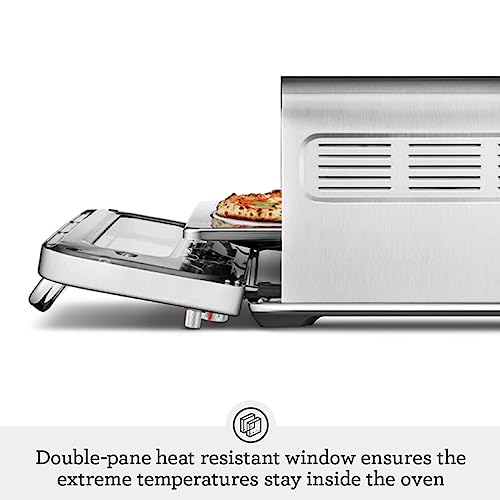
The Breville Pizzaiolo with its door dropped open and a pizza on the stone, captioned double-pane heat resistant window

The drop-down door and double-pane window. The opening is one of the size complaints.

Getting the pizza onto the stone is the learning curve. Owners say dough sticks to the metal peel unless it is well floured, and a pizza that misses the small stone lands among parts that are hard to clean.

One owner switched to an inexpensive wooden peel and says anything wider than 11 inches will not fit. Another says a couple of missed launches practically ruined the first oven, and a replacement was sent.

The insulation gets consistent praise. Owners say the outside stays relatively cool and the kitchen does not heat up, and one who uses it five or six days a week says counters and cabinets are unharmed. The exception is one owner whose quartz countertop cracked from the heat released when the door opened.

A little smoke from flour on the peel is normal; one apartment owner says it did not set off a sensitive smoke detector.

Design and Build

The Breville Pizzaiolo in the black Black Truffle finish, with the empty stone visible through the window

The same oven in Black Truffle, listed separately at the same $999.95.

It is a brushed stainless steel box with a drop-down door, a double-pane window and three dials. Breville also sells it in Black Truffle, a black finish, at the same price.

The listing gives the capacity as “12 cubic inches”, which one owner points out is meaningless for a round stone. Breville does not publish the stone’s diameter, so the real limit comes from owners.

Complaints about the build itself are few: no interior light, a door that can swing shut on you, and one owner wishes it were quieter.

What Owners Report

Amazon shows 81% five-star, 10% four, 6% three, 0% two and 3% one across 149 ratings. It is a small pool, so the themes below come from the written reviews rather than the average.

What recurs in the positive reviews

  • The crust. Leopard spotting and a charred, crisp base in about two minutes.
  • Control. Presets that work, a darkness dial, and a manual mode for top and bottom heat.
  • Insulation. A cool exterior and a kitchen that does not heat up.
  • Indoors, year-round. No waiting for weather, propane or wood.

What recurs in the critical reviews

  • Size. A small stone and door, and no room for standard 12-inch pans.
  • Cleaning. A tight chamber that is hard to reach, and smoke when it is dirty.
  • Learning curve. Dough sticking to the metal peel, and missed launches.
  • The stone. One owner’s cracked in two after three uses and another’s chipped; that owner says replacement stones are never in stock.
  • Price. Several owners call it expensive even while rating it highly.

The positive and critical reviews describe the same oven. The difference is whether an owner makes pizzas small enough, and cares enough about the crust, for the size and the cleaning not to matter.

Value

At $999.95 the Pizzaiolo costs four times as much as the Ooni Karu 12 and twice as much as the Ooni Koda 16, both of which reach 950℉ outdoors.

What the extra money buys is indoor cooking with separately controlled top and bottom elements. Cheaper electric countertop pizza ovens exist, and their listings claim similar or higher temperatures, so 750℉ on its own is not the reason to pay $1,000.

Owners report catching it at about $800 in sales, which makes the case easier. If you are not in a hurry, a price tracker is worth setting.

If a home oven is the alternative, my guide to why a pizza oven will not get hot enough explains what limits the crust.

Durability

Most owners report no problems. The stone is the weak point: one cracked in two after three uses, another chipped for an owner baking five or six days a week, and one owner reports discolouration of the metal and the stone.

One owner’s oven stopped heating and began shutting off, and they say Breville offered only a 35% discount on a replacement. The owner whose stone cracked also reports the unit catching fire twice, and says Breville described that as normal.

The listing gives a two-year warranty. Keep the stone clean, keep loose flour off it, and stay nearby while the oven runs.

On a stone or quartz countertop, a heat-proof mat under the front of the oven is cheap insurance, as the owner with the cracked countertop now recommends.

Alternatives to Consider

  • To cook outdoors for a quarter of the price, the Ooni Karu 12 is a multi-fuel oven that reaches 950℉.
  • For larger pizzas outdoors, the Ooni Koda 16 takes a 16-inch pizza for $498.
  • For a premium outdoor build, see my Gozney Roccbox review.
  • Every oven is compared in my pizza oven guide, and the rest of the cluster is in the pizza ovens hub.

Verdict

The Breville Pizzaiolo does what it promises: owners get pizzeria-style, leopard-spotted crust from a kitchen counter in about two minutes, with presets that work and a manual mode for anyone who wants more.

But it is small for a $1,000 appliance, hard to clean, and its stone is the part most likely to fail. Anyone making 12-inch pizzas or hoping to use existing pans should look elsewhere.

Seven out of ten: marked up for crust, control and insulation, marked down for size, cleaning and a price that only makes sense if you cannot cook outdoors.

Check Price on Amazon

How This Review Was Put Together

Plainly: this is research-based, not a hands-on test. I have not owned or used this oven, and nothing here should be read as a report from my own kitchen.

What it rests on: the published specification — the heating system, controls, dimensions and accessories Breville lists, the places its own figures disagree, and what owners report about crust, size, cleaning and the stone — read against the other ovens in my best pizza ovens guide; the shape of the rating distribution across 149 Amazon ratings rather than the 4.6 average it produces; and the text of the positive and critical reviews, read for themes that recur across independent owners.

Why owner reviews are treated as evidence here: one reviewer cooking on one unit for a fortnight cannot show whether a cordierite stone survives a year of 750℉ bakes. Owners writing over nearly six years can, even in a pool this small. A theme is only reported above where more than one unconnected owner raised it.

What I could not establish: how long the stone lasts for a typical owner, since most reviews are written in the first months. I also could not find the stone’s diameter in Breville’s listing, so the 11.75-inch limit comes from one owner’s measurement.

Price, stock and ratings were read from Amazon’s US marketplace on 14 September 2026 and will move.

Frequently Asked Questions

How big a pizza fits in the Breville Pizzaiolo?

Breville says 12 inches. One owner measured the largest pan that fits at 11.75 inches across, another says it suits 10-inch pizzas better, and one advises a wooden peel no wider than 11 inches.

How hot does the Breville Pizzaiolo get?

The listing gives a range of 350℉ to 750℉. Breville says about two minutes, and one owner bakes thin pizzas on the Wood Fired setting in two.

Is the Breville Pizzaiolo hard to clean?

Owners say so. The stone sits in a tight chamber that is hard to reach, and a dirty stone smokes. Cleaning is one of the two most common complaints, with size.

Does the Breville Pizzaiolo smoke?

A little, from flour on the peel, and more when the stone is dirty. One owner in an apartment says it did not set off a sensitive smoke detector; another warns that loose flour can catch fire.

What comes with the Breville Pizzaiolo?

A pizza peel and a pizza pan. One owner recommends adding a wooden peel no wider than 11 inches, because dough stuck to the metal one.

Can you use 12-inch pizza pans in it?

Owners say standard 12-inch pans do not fit. One measured the maximum at 11.75 inches, and a rounded heat shield at the back rules out square trays.

Is the Breville Pizzaiolo worth $1,000?

Only if you cannot cook outdoors and make pizza often. Outdoor ovens such as the Ooni Karu 12 reach 950℉ for about a quarter of the price, and owners report the Pizzaiolo dropping to about $800 in sales.

What is the warranty?

Two years from the date of purchase, according to the listing.
Filed Under: Product Reviews

All-Clad HA1 Fry Pan Set Review: Slick Pans, Awkward Handles

Last Updated September 14, 2026

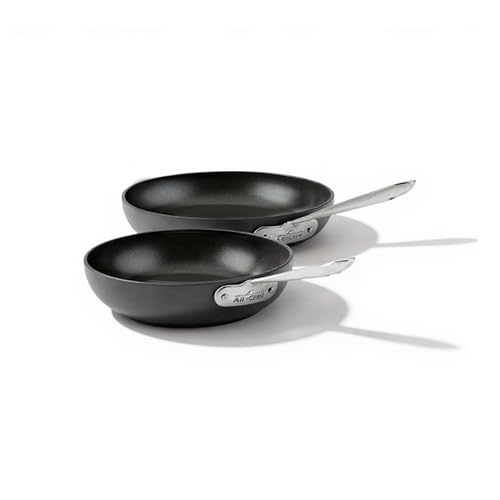
All-Clad HA1 hard-anodized nonstick 8-inch and 10-inch fry pans with stainless steel handles

I earn a commission if you buy through the Amazon links below, at no extra cost to you.

The All-Clad HA1 nonstick set is the premium pick in my omelette pan guide and in my guide to fry pans for gas stoves. For $99.99 you get two pans, an 8-inch and a 10-inch.

It has the largest body of owner feedback of any premium nonstick pan I checked: 4.6 stars across 10,808 ratings, with 4% one-star. It works on induction, goes in the oven to 500℉, and All-Clad is open about the coating being PTFE.

It also has two recurring complaints that a $100 set should not have. Enough owners report the pans warping, and enough dislike the handles, that both belong at the top of this review rather than the bottom.

Quick Verdict

Score Price Rating Buy
7/10 $99.99 4.6★ (10,808) Check Price on Amazon

What Comes in the Box

All-Clad dimension drawing for the HA1 8-inch and 10-inch fry pans showing total length, handle length and width

The 8-inch pan is 8.26 inches across and 15 inches long with its handle; the 10-inch is 10.27 inches across and 18.9 inches long.

Two fry pans: an 8-inch and a 10-inch. No lids — one of the listing bullets mentions tempered glass lids, and one product photo shows a lid, which this two-piece set does not include.

All-Clad’s drawing puts the 8-inch at 8.26 inches across with a 6.5-inch handle, and the 10-inch at 10.27 inches across with an 8.3-inch handle.

The 8-inch is the omelette pan. The 10-inch gives room for larger portions, which is what makes the set more useful than a single premium egg pan.

Specifications

Model All-Clad HA1 Nonstick 2-Piece Fry Pan Set
Pans 8″ and 10″ fry pans, no lids
Body Hard-anodized aluminium with a stainless steel base
Coating PTFE nonstick, PFOA-free, as the listing states
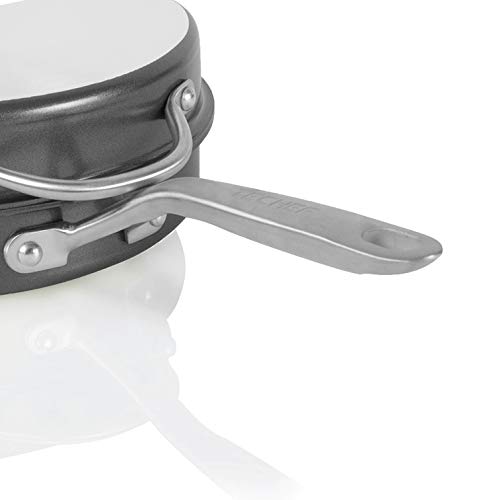
Handles Double-riveted stainless steel
Hobs All, including induction
Oven limit 500℉
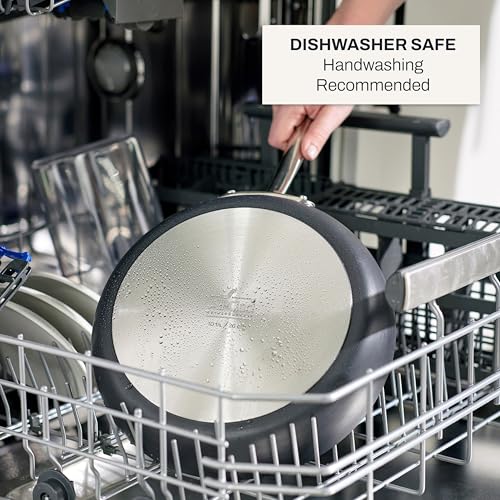
Care Bullets say dishwasher safe; the specification table says hand wash recommended
Utensils Nylon, silicone or wood
Warranty Limited lifetime
Made in China; designed in Canonsburg, Pennsylvania

The two complaints to weigh first

A fried egg on toast beside the All-Clad HA1 pan, with a towel wrapped around the handle and a caption recommending the chef’s trick of wrapping a towel around the handle

All-Clad’s own photo suggests wrapping a towel around the handle. Many owners say the handle needs the help.

Warping. At least six owners report these pans losing their flat base. One owner says both pans in the set warped with light to regular use on induction; another had two sets warp despite hand washing and never cooling them with water; others describe a pan warped within a year, a medium pan warped after a few uses, and a centre that began to bulge at six to eight months.

On gas a slight warp is a nuisance. On induction or a smooth electric top it matters more: a domed base rocks, and owners report exactly that. Plenty of induction owners report no problem at all, including one using theirs daily since November 2020, but the reports are frequent enough to take seriously.

Handles. This is the most repeated complaint on the listing. Owners call the handles uncomfortable, say the edges dig into the palm and that the pan wants to flip when lifted, and one returned the set on sight. Some say they get hot; one owner who otherwise loves the pans has burned themselves on them more in a year than on the rest of their cookware.

Neither complaint is universal, and the 4.6-star average shows most owners are happy. But these are the two things most likely to make you regret buying a $100 set, so check the pans for flatness and try the grip as soon as they arrive.

Who It’s For

  • Induction owners who want a nonstick set that will actually register on the hob, and are willing to check it for flatness on arrival.
  • Anyone who wants an 8-inch egg pan and a 10-inch everyday pan from one brand, for about $50 each.
  • Cooks who finish dishes in the oven. The 500℉ limit applies with the handles on, unlike the SENSARTE, which reaches 550℉ only with its handle removed.
  • People who are comfortable with a PTFE coating and want it stated honestly.
  • Anyone who does not mind putting a silicone sleeve or towel on a handle.

Who Should Look Elsewhere

  • Anyone with arthritis or a weak grip, unless you plan to add handle covers. One owner with arthritis bought silicone covers to make them usable.
  • Cooks who need a guaranteed-flat base on a smooth induction top. Warping reports are too frequent to ignore.
  • Anyone who only needs an omelette pan. The Tramontina Professional 8-inch costs $29 and has stronger durability reports, although it does not work on induction.
  • Anyone avoiding PTFE.
  • Anyone relying on the warranty to cover the coating: one owner says All-Clad refused to cover peeling at six months.

Performance

Release and cooking

A folded omelette in the All-Clad HA1 10-inch pan on a gas hob

The omelette the set is sold on, in the 10-inch pan on gas.

The nonstick performance is what the positive reviews are built on. Owners describe steak wiping out with a paper towel, eggs sliding free, and one owner using the pans ten to twelve times a week for four months with the surface still as slick as on day one.

Several owners compare the set favourably with more expensive pans; one who had paid far more for a hybrid pan says these are the truly nonstick ones. Many owners say the pans heat evenly, though one finds the edges run hotter than the middle.

The flared side walls make the 8-inch a reasonable omelette pan, and the flat base of the 10-inch gives more room than most egg pans.

Induction, and the base

The stainless steel base of the All-Clad HA1 pan held up in a kitchen

The stainless steel base is what makes the pans work on induction.

The stainless steel base under the hard-anodized body is why the set works on induction. Owners using induction hobs report the pans heating well, and one who switched from far pricier pans calls them the best they have used on induction.

Several of the warping reports also come from induction owners. A base that stays flat on gas can rock on a glass hob once it has moved even slightly, and one owner says the bottoms are not level and rock on their induction hob.

The practical advice is simple: put each pan on a flat surface when it arrives and check it does not spin or rock. If it does, return it while you can.

Oven and heat

The All-Clad HA1 pan in an oven with a gratin, captioned oven safe up to 500 degrees and compatible with any stovetop including induction

Oven-safe to 500℉ with the handles on.

At 500℉ with the handles on, the oven limit is among the highest in the omelette guide, so a frittata or a pan-roasted fillet can finish under a hot grill.

The stainless handles are part of why the limit is high, and part of why they are criticised. They carry heat, and owners report the handles getting hot while cooking. Treat them as oven handles and use a cloth.

Medium heat is also what keeps any PTFE coating in good condition.

Design and Build

The All-Clad HA1 pan in a dishwasher rack, captioned dishwasher safe with handwashing recommended

All-Clad’s own image says dishwasher safe and handwashing recommended in the same breath.

The handles are long, riveted stainless steel with a contoured shape. All-Clad describes them as engineered for control; owners mostly disagree, although at least one owner who expected to hate them after reading the reviews found they were fine.

Care instructions contradict each other. The bullets say dishwasher safe, but add that to preserve the nonstick you should wash by hand; the specification table says hand wash recommended; and the product image says both. Owners who have used the dishwasher report mixed results, so hand washing is the safer habit.

The pans are heavy for nonstick, which some owners like, and the exterior is scratch-resistant hard-anodized aluminium, per the listing.

What Owners Report

The distribution across the 10,808 ratings is 79% five-star, 11% four, 4% three, 2% two and 4% one.

What recurs in the positive reviews

  • Genuinely nonstick. The core of the positive reviews: food releases and cleanup is quick.
  • Even heating. Many owners say the pans heat evenly and brown food well.
  • Works on induction. Several induction owners are very happy, including one using the pans daily since 2020.
  • Holds up for some. Owners report the surface unchanged after months of heavy use and only a little wear at a year to eighteen months.
  • Solid construction. Heavy, well made and scratch resistant outside.

What recurs in the critical reviews

  • Handles. The most repeated complaint: uncomfortable, hard to grip, and hot.
  • Warping. At least six owners, several on induction.
  • Coating failures. Owners report sticking at seven months, peeling at six months, a surface that cracked and peeled within a year, and chips after a few uses; one says All-Clad would not cover the peeling under the warranty.

The positive and critical reviews rarely disagree about the cooking surface. They disagree about everything around it: whether the base stays flat, whether the handles are bearable, and whether the coating lasts past its first year.

Value

At $99.99 for two pans it works out at about $50 a pan, roughly what the Calphalon Easy System it replaced cost for one 8-inch pan.

Against the Tramontina Professional 8-inch at $29, you are paying for induction compatibility, a 500℉ oven limit, a second larger pan and the All-Clad name. If you cook on gas or electric and only want an egg pan, the Tramontina is the better buy.

On induction, the value case is stronger, because two of the six pans in the omelette guide, including the top pick, do not work on it at all. My guide to induction-compatible cookware explains why.

The limited lifetime warranty adds less than it sounds, at least for the coating, if one owner’s experience is typical.

Durability

Durability reports are mixed. Some owners describe months of heavy use with no change and only a little wear at a year to eighteen months; others report sticking or peeling within a year.

Warping is the concern that separates this set from most nonstick pans. Where owners give a timescale, it is usually within the first year, so keep an eye on the base through that period.

The usual PTFE rules apply: medium heat, no empty preheating, silicone, nylon or wood utensils, and hand washing. Two of the warping reports come from owners who say they already did.

Avoid thermal shock. Letting the pans cool before washing is sensible for any pan and more so for one with warping reports.

Alternatives to Consider

  • For an omelette pan on gas or electric, the Tramontina Professional 8-inch is the omelette guide’s overall pick, at $29.
  • For more options on gas, my fry pans for gas stoves guide compares this set with cast iron, the Tramontina 10-inch and others.
  • For the full omelette comparison, see the omelette pan guide.
  • Everything else in cookware is collected in the cookware hub.

Verdict

The All-Clad HA1 set cooks well: the nonstick surface is excellent when new, it heats evenly, it works on induction and it goes in a 500℉ oven. Two pans for $100 is fair value.

But warping and uncomfortable handles come up far too often for a premium set, and the coating does not always outlast its first year. Check both pans for flatness on arrival and decide about the handles before the return window closes.

Seven out of ten: marked up for induction and the oven limit, marked down for warping, handles and inconsistent coating life.

Check Price on Amazon

How This Review Was Put Together

Plainly: this is research-based, not a hands-on test. I have not owned or used this pan set, and nothing here should be read as a report from my own kitchen.

What it rests on: the published specification — the construction, coating, oven and hob details All-Clad publishes, the two places the listing contradicts itself, and what owners report about warping, handles and how long the coating lasts — read against the other pans in my best omelette pans guide; the shape of the rating distribution across 10,808 Amazon ratings rather than the 4.6 average it produces; and the text of the positive and critical reviews, read for themes that recur across independent owners.

Why owner reviews are treated as evidence here: one reviewer cooking on one unit for a fortnight cannot show whether a pan base stays flat on an induction hob after a year. Several thousand owners over years can. A theme is only reported above where more than one unconnected owner raised it.

What I could not establish: what share of owners experience warping, since most satisfied owners do not mention the base at all. I also could not establish how All-Clad handles coating claims under the limited lifetime warranty beyond the one owner who reports a refusal.

Price, stock and ratings were read from Amazon’s US marketplace on 14 September 2026 and will move.

Frequently Asked Questions

Does the All-Clad HA1 set work on induction?

Yes. The bodies are hard-anodized aluminium with a stainless steel base, and several induction owners are very happy with them. Several others report the pans warping and rocking on induction, so check both pans for flatness when they arrive.

Is the All-Clad HA1 coating PTFE?

Yes. All-Clad describes it as long-lasting PTFE nonstick, and it is PFOA-free.

Do All-Clad HA1 pans warp?

Some do. At least six owners report warping, often within a year and several on induction, including one owner who says they always hand washed and never cooled the pans with water. Many owners report no warping at all.

Why do people dislike the All-Clad HA1 handles?

Owners say the contoured stainless handles are uncomfortable, dig into the palm, get hot and make the pan want to flip when lifted. Some owners add silicone handle covers; All-Clad’s own photo suggests wrapping a towel around the handle.

Is it dishwasher safe?

The listing bullets say dishwasher safe, but also recommend hand washing to preserve the nonstick, and the specification table says hand wash recommended. Hand washing is the safer choice.

What is the oven-safe temperature?

500℉ for the pans. The set does not include lids.

Does the set come with lids?

No. The two-piece set is two fry pans only. A listing bullet and a product photo mention glass lids, but none come with this set.

Is it better than the Tramontina Professional for omelettes?

On induction, yes, because the Tramontina does not work there. On gas or electric, the Tramontina 8-inch costs $29 and has stronger durability reports, and the All-Clad set is mainly worth it for the second pan and the higher oven limit.

Filed Under: Product Reviews

TECHEF Frittata Pan Review: Folds Well, Leaks at the Hinge

Last Updated September 14, 2026

TECHEF frittata and omelette pan open, showing two hinged half-moon nonstick halves, a long stainless steel handle and a small helper handle

I earn a commission if you buy through the Amazon links below, at no extra cost to you.

The TECHEF Frittata and Omelette Pan is the no-flip pick in my omelette pan guide. It is a round pan split into two hinged halves: cook on one side, fold the other over, and the omelette turns without leaving the pan.

At $41.99 it holds 4.5 stars across 5,135 ratings. The folding idea works, owners say so repeatedly, and several describe years of use from the coating.

The catch is the hinge. The single most repeated complaint is liquid egg escaping through the seams when the pan is folded, and it is worth understanding before you buy.

Quick Verdict

Score Price Rating Buy
7/10 $41.99 4.5★ (5,135) Check Price on Amazon

What Comes in the Box

TECHEF frittata pan with an orange silicone cover fitted over the small helper handle

The silicone cover for the helper handle comes in the box. Owners find it more useful than an oven glove.

The pan, with a separate silicone cover for the small helper handle on the far side. That handle is bare metal and sits near the heat, so the cover earns its place.

Owners mention the cover more than once. One found it worked better than a bulky oven glove for grabbing the top half; another describes using it to lift and close the pan in one movement.

There is no lid, and none is needed: the second half of the pan is the lid.

Specifications

Model TECHEF Frittata and Omelette Pan, black
Shape Round, 9.5 inches across, divided into two hinged half-moon halves
Depth About 1.8 inches per half, per TECHEF’s drawing
Length 18.5 inches open, including the handle
Body Forged heavy-gauge aluminium (3004 alloy)
Coating Teflon Select nonstick, PFOA-free, per Amazon’s specification table
Handles Long double-riveted stainless steel handle; small helper handle with silicone cover
Oven limit 450℉
Hobs Gas, electric and ceramic — not induction
Weight 1.87 lb
Made in South Korea; also sold in purple on the same listing

How the fold works

TECHEF dimension drawing of the frittata pan: 9.5 inches across, 18.5 inches long with the handle, 1.8 inches deep open and 3.5 inches tall folded

Two half-moons, 1.8 inches deep, hinged along the middle. Folded, the pan stands 3.5 inches tall.

The idea is simple. Pour beaten egg into one half, or both, let it set, then lift the helper handle and fold that half over onto the other. The omelette flips inside a closed pan, and the uncooked top meets a hot surface.

For frittatas and filled omelettes that would break apart on a spatula, that is a real advantage. One owner who makes an omelette every other day is on their second pan; another describes adding cheese once the eggs had set, closing the pan and turning out a finished omelette.

The problem is the join. When the pan is folded, the two halves meet along a hinged seam, and there are gaps near the hinges themselves. Any egg that is still liquid can run out through them, and that is exactly what a steady number of owners report.

Two owners describe the same technique: fold the pan front to back, over the handles, rather than tipping it side to side. One says that doing so means no leaking at all; another warns that side-to-side flips send liquid out of the hinge corners.

Who It’s For

  • Anyone who makes frittatas or heavily filled omelettes that fall apart when turned.
  • Cooks who find flipping an omelette in a round pan awkward or unreliable.
  • People making two things at once — eggs in one half and wilted spinach in the other, as one owner describes.
  • Anyone on gas, electric or ceramic glass hobs who wants a pan that can also finish in the oven at up to 450℉.
  • Cooks happy with a Teflon coating and prepared to hand wash the rivets and hinges.

Who Should Look Elsewhere

  • Induction users. The listing is explicit that it is not induction-compatible.
  • Anyone who wants a simple omelette pan. The Tramontina Professional 8-inch is the omelette guide’s overall pick and costs less.
  • Cooks who will not adjust their technique. Folded side to side with runny egg, this pan leaks.
  • Anyone short of cupboard space. Open, it is 18.5 inches long; folded, it is 3.5 inches tall.
  • Anyone looking for a Japanese rolled omelette pan: the TECHEF tamagoyaki pan is the right shape for that.

Performance

The fold, and the leak

Beaten egg being poured into one half of the TECHEF frittata pan while the other half holds a cheese and ham omelette

Two halves, two dishes, or one omelette folded between them.

When it works, owners describe it as easy: the omelette turns cleanly and cooks evenly on both sides without the spatula stage that tears filled omelettes.

The complaints are specific and consistent. Owners report egg spilling when they fold the pan, leaking every time they tried it, uncooked egg running onto a glass hob, and noticeable gaps of about an inch near the hinges. One owner who liked the pan still expects to lose a little egg on every flip.

Two things reduce it. Let the egg set further before folding, so less of it is liquid; and fold front to back over the handles, as the owner who reports no leaks describes.

Release and sticking

A slice of vegetable frittata on a plate beside the TECHEF pan, with PFOA free, lead free and cadmium free badges

The badges say PFOA, lead and cadmium free. Amazon’s specification table names the coating as Teflon Select.

Most owners describe the surface as properly nonstick, with fluffy omelettes and quick cleanup. One owner brushes a little olive oil on before cooking and, three years in, says the surface is still very slippery.

A smaller group says the opposite. Owners report eggs sticking and failing to transfer to the other half, and one describes egg sticking and burning when turned. Two of the owners who report no sticking mention using a little oil or butter.

Food also catches on the rivets inside the pan, according to two owners. One soaks the pan for a few hours so egg and cheese come off the inside bolts easily.

Heat and hobs

A tomato and vegetable frittata filling one half of the TECHEF pan, with icons for gas, electric, ceramic, food safe and dishwasher

Gas, electric and ceramic. There is no induction icon, and the listing confirms it.

The body is forged aluminium, which heats quickly; one owner notes that the eggs cook fast enough to need watching closely.

It suits gas, electric and ceramic glass, and TECHEF states it is not for induction. One owner points out that the base spans about 10 inches when open, so it wants a large burner.

The long handle is stainless steel and described by TECHEF as stay-cool, but the small helper handle is bare metal over the heat. One owner reports burned fingers even with the silicone pad, so keep the cover on and use it.

Design and Build

Close-up of the TECHEF frittata pan folded shut, showing the hinge, the helper handle and the long stainless steel handle

The hinge is the design’s strength and its weak point.

The build draws a split verdict. Several owners describe sturdy metal, a good finish and hinges that hold up; others call the materials cheap for the price, and one returned it on sight as poorly constructed.

The hinges are the part to watch. One owner describes them as looking flimsy but holding, and another had to have one reattached, yet still swears by the pan.

Capacity is generous. One owner puts the depth at around one and a half to two inches and says it takes all the filling you can imagine; another needs about six eggs for a decent omelette, which is more than a single serving.

It is listed as dishwasher safe and oven-safe to 450℉. Given the rivets and hinges, hand washing is the practical choice.

What Owners Report

The 5,135 ratings cover the black and purple versions, which share this listing. The distribution is 73% five-star, 15% four, 7% three, 2% two and 3% one — a larger middle than most pans in the omelette guide, which fits a product that works well once you learn how to use it.

What recurs in the positive reviews

  • The fold works. Owners describe turning filled omelettes and frittatas without breaking them.
  • Cleanup. Repeatedly mentioned alongside the nonstick surface.
  • The silicone handle cover. Singled out by more than one owner as genuinely useful.
  • Longevity. One owner’s first pan lasted about five years of omelettes every other day; another says theirs still looks new and slippery three years after purchase.
  • Build. Several owners describe it as sturdy and well made.

What recurs in the critical reviews

  • Leaking at the hinges. The dominant complaint, from at least seven owners.
  • Sticking. A minority report eggs sticking or burning when turned.
  • Value. Several owners feel the materials do not match the price.
  • Rivets and hinges. Food catches on the inside rivets, and one owner needed a hinge reattached.
  • Coating life. One owner who washed it carefully and used it only for eggs and pancakes saw the coating peel at two years.

The positive and critical reviews are describing the same pan used two ways. Owners who learn to fold it front to back, with the egg mostly set, are happy; owners who expect it to work like a flip in a normal pan get egg on the hob.

Value

At $41.99 it is one of the more expensive pans in the omelette guide, costing about thirteen dollars more than the Tramontina Professional 8-inch overall pick.

Several owners think that is too much for the materials. The price is really for the folding design; if you do not need it, a conventional pan is the better buy.

For someone who makes frittatas or filled omelettes several times a week, the maths is kinder. Owners describe three and five years of use, which puts the yearly cost in the same range as a cheaper pan replaced more often.

For an occasional omelette, it is an expensive single-purpose pan that takes up a lot of cupboard.

Durability

The coating reports are mixed but include some long lives: about five years for one owner cooking an omelette every other day, three years and still slippery for another.

One owner saw peeling at two years despite careful hand washing and use only for eggs and pancakes, and compared that unfavourably with other nonstick pans they have kept for more than a decade.

The hinges are the other long-term concern. Few owners mention hinge trouble, but one needed a hinge reattached, and they are the part of the pan that takes the stress of every fold.

Hand washing, a little fat before cooking, medium heat and letting the pan cool before washing are the practical rules. Soaking loosens egg from around the rivets without scrubbing the coating.

Alternatives to Consider

  • For ordinary omelettes, the Tramontina Professional 8-inch is the omelette guide’s overall pick, with owners reporting years of use.
  • For Japanese rolled omelettes, TECHEF’s own tamagoyaki pan is the better shape.
  • For a PTFE-free label, the SENSARTE ceramic pan is the option, with a shorter reported coating life.
  • The full comparison is in my omelette pan guide, and the cookware hub collects everything else.

Verdict

The TECHEF Frittata pan does what it promises: it turns filled omelettes and frittatas without a spatula, it is well made enough for several owners to report years of use, and it can go in the oven.

But the hinge leaks unless you learn to use it. Let the egg set, fold front to back over the handles, and it works; tip it side to side with runny egg and you will clean the hob. It also does not work on induction and costs more than a conventional pan.

Seven out of ten: marked down for the leaking, the price, and the rivets and hinges that make cleaning more work.

Check Price on Amazon

How This Review Was Put Together

Plainly: this is research-based, not a hands-on test. I have not owned or used this pan, and nothing here should be read as a report from my own kitchen.

What it rests on: the published specification — the coating, construction, temperature and hob details on the listing, TECHEF’s dimension drawing, and what owners say about folding the pan without losing egg through the hinges — read against the other pans in my best omelette pans guide; the shape of the rating distribution across 5,135 Amazon ratings rather than the 4.5 average it produces; and the text of the positive and critical reviews, read for themes that recur across independent owners.

Why owner reviews are treated as evidence here: one reviewer cooking on one unit for a fortnight cannot show whether a hinged pan leaks egg on the hundredth fold as well as the first. Several thousand owners over years can. A theme is only reported above where more than one unconnected owner raised it.

What I could not establish: how many owners who report leaking were folding side to side rather than over the handles, since most do not say. I also could not establish how the rating splits between the black and purple versions, or how common hinge problems are over several years.

Price, stock and ratings were read from Amazon’s US marketplace on 14 September 2026 and will move.

Frequently Asked Questions

How do you stop the TECHEF frittata pan leaking?

Let the egg set more before folding, so less of it is liquid, and fold the pan front to back over the handles rather than side to side. The owner who describes folding it that way reports no leaking.

Does it work on induction?

No. TECHEF states it is suitable for gas, electric and ceramic hobs, excluding induction.

Is the coating Teflon?

Amazon’s specification table describes it as New Teflon Select nonstick coating, PFOA-free. The listing bullets call it a three-layer reinforced nonstick coating without cadmium or lead.

Is it oven safe?

Yes, to 450℉, according to both the listing and the specification table.

How big is it?

It is a round pan about 9.5 inches across, split into two half-moon halves about 1.8 inches deep. Open, it is 18.5 inches long with the handle; folded, it is 3.5 inches tall.

How many eggs does it need?

It holds a lot. One owner uses about six eggs for a decent omelette and another about three with plenty of filling, so it suits omelettes for two or a generous single serving.

Is it dishwasher safe?

The listing says so, but the rivets and hinges collect egg, and hand washing after a short soak is easier on the coating.

Does the small handle get hot?

Yes. The helper handle is bare metal over the heat, which is why TECHEF includes a silicone cover. One owner burned their fingers even with it, so keep the cover on.

Filed Under: Product Reviews

TECHEF Tamagoyaki Pan Review: The Right Shape for Rolled Eggs

Last Updated September 14, 2026

TECHEF medium rectangular tamagoyaki pan in black with a dark nonstick interior and a black handle on a steel neck

I earn a commission if you buy through the Amazon links below, at no extra cost to you.

The TECHEF Tamagoyaki pan is the specialist pick in my omelette pan guide: the one to buy for Japanese rolled omelettes. At $24.99 for the medium size, it holds 4.7 stars across 7,546 ratings, with only 2% one-star.

That is a stronger rating than any round pan in the guide, and it comes with some of the longest ownership reports I have seen on a nonstick listing. Two owners describe close to seven years of use.

Three things to know first. The coating is Teflon, which TECHEF says openly. The “induction-ready” claim does not hold on every induction hob. And TECHEF gives two different oven limits.

Quick Verdict

Score Price Rating Buy
8/10 $24.99 4.7★ (7,546) Check Price on Amazon

What Comes in the Box

TECHEF dimension drawing for the medium and large tamagoyaki pans: 7.5 by 5.5 inches at 1.2 lb, and 8.5 by 8.5 inches at 1.5 lb

Medium is a 7.5 by 5.5-inch rectangle; large is an 8.5-inch square. Both are made in South Korea.

The pan alone. There is no lid and no chopsticks or spatula, and a thin, wide spatula helps with rolling. One owner mentions buying one separately.

This review covers the medium pan, a 7.5 by 5.5-inch rectangle. TECHEF also sells an 8.5-inch square large version, and both sizes, in black and in purple, share this listing and its rating.

The medium is the traditional tamagoyaki shape, and one owner says to get it rather than the large. Two others found it smaller than they expected, so check the dimensions against your burner and your appetite.

Specifications

Model TECHEF Tamagoyaki Japanese Omelette Pan, medium, black
Cooking surface 7.5 × 5.5 inches, rectangular, per TECHEF’s drawing
Body Forged heavy-gauge aluminium (3004 alloy) with an embedded stainless steel induction plate
Coating Three-layer reinforced Teflon, PFOA-free; no cadmium or lead
Hobs Gas, electric, ceramic and induction, per the listing
Oven limit Conflicting: 350℉ in the bullets, 450℉ in the specification table
Dishwasher Listed as dishwasher safe
Weight About 1.2 lb
Made in South Korea
Also sold as Large 8.5-inch square; black or purple — same listing and rating

Teflon, and what the badges do not say

Two TECHEF tamagoyaki pans on a gas range under PFOA free, lead free and cadmium free badges

The badges say PFOA, lead and cadmium free. The listing adds the part the badges leave out: the coating is Teflon.

TECHEF is unusually direct about the coating. The listing calls it a three-layer reinforced Teflon nonstick coating, and Amazon’s specification table gives the coating as “Non-stick, Teflon, PFOA-free”. That is PTFE, stated plainly.

That candour is worth something. The product images lead with PFOA-free, lead-free and cadmium-free badges, which is true but is not the same as PTFE-free, and a quick glance could suggest otherwise. The listing text corrects it.

At least one owner took it badly. They rated the pan’s durability, cleaning and performance at five stars after using it daily since 2018, then gave it one star overall, citing the “New Teflon nonstick coating” in its advertising. If PTFE is a deal-breaker, this is not your pan — my Teflon-free guide covers the alternatives, although none of them are rectangular.

For everyone else, a Teflon coating is what you would expect on a pan like this, and it may help explain why the durability reports are so much better than for the ceramic pan reviewed alongside it.

Who It’s For

  • Anyone who makes tamagoyaki, dashimaki or Korean rolled omelettes regularly.
  • Cooks who want a small pan for single portions: owners use it for fried eggs and other small foods as well.
  • Anyone with a small burner. One owner notes the medium fits their small electric ring well.
  • People happy with a conventional Teflon coating in exchange for a long working life.
  • Anyone who wants a pan made in South Korea rather than a generic import.

Who Should Look Elsewhere

  • Anyone avoiding PTFE. The listing says Teflon.
  • Induction users whose hob is fussy about pan detection. Several owners report it not being recognised, or only working on smaller zones.
  • Anyone who only makes Western folded omelettes. A round pan with a sloped wall does that better; the Tramontina Professional 8-inch is the omelette guide’s overall pick.
  • Cooks who expect to fit much in it. The medium is 7.5 by 5.5 inches.
  • Anyone who wants to finish dishes in a hot oven, given the conflicting temperature limits.

Performance

Rolling an omelette

A rolled tamagoyaki omelette being turned in the TECHEF pan with a wide steel spatula

Straight sides and a sloped front edge: the shape that lets you roll and push layers of egg.

This is what the pan is for, and the reviews are close to unanimous on it. Owners describe layered omelettes rolling cleanly, egg releasing without oil, and a far better result than they got from cheaper rectangular pans.

TECHEF describes the design as a sloped front with straight side walls. The straight sides hold the thin layers square as you build the roll; the sloped front lets you turn the finished roll out.

One owner also bought a wide spatula to go with it, which makes the turn easier. None is included.

Heat and induction

Underside of the TECHEF tamagoyaki pan showing the embedded stainless steel plate marked induction ready

The embedded steel plate is what makes it induction-ready. On some hobs, that is not enough.

Owners describe it heating up quickly, and one notes the cooking surface is perfectly flat. Its forged aluminium body spreads heat faster than steel would.

Induction is the exception. The base carries an embedded steel plate, but owners report mixed results: one IKEA hob would not recognise it at all, a Breville unit kept flagging it, and another owner says it only works on their smaller zones. An owner of the large square pan found the centre cooked before the corners on induction.

That is a common problem with small pans on induction, where the plate may be too small for a zone to detect. Other owners report it working fine on induction. If yours is a large-zone hob, test it early, while the pan is still returnable.

Beyond tamagoyaki

A golden rolled tamagoyaki in the TECHEF pan on a gas hob, with a bowl of beaten egg alongside

Tamagoyaki is the reason to buy it. Fried eggs and small portions are the bonus.

Owners use it beyond rolled omelettes, mostly for fried eggs and other small foods, and TECHEF itself suggests sandwiches, pancakes and steak. One owner who bought it for tamagoyaki ended up using it daily for small foods.

Its limits are the shape and the size. One owner hoped to sauté small amounts of vegetables and found the rectangle awkward for it, and a 7.5 by 5.5-inch surface does not hold much.

Treat it as a specialist pan that also fries an egg well, rather than as a general small pan.

Design and Build

Beaten egg being poured into the TECHEF tamagoyaki pan on an induction hob, with icons for induction, gas, electric, ceramic, food safe and dishwasher

TECHEF’s icons include dishwasher safe. Hand washing is still the better habit for any Teflon coating.

The handle sits on a steel neck well away from the pan body, and owners describe the grip itself as well insulated and cool to the touch. One owner warns that the metal neck joining handle to pan is a different matter, and burned themselves on it.

Owners repeatedly describe the pan as solid without being heavy — about 1.2 lb for the medium — although one found it too light.

The oven limit is a genuine inconsistency. The listing bullets say oven-safe to 350℉; Amazon’s specification table says 450℉. A pan of this shape rarely needs the oven, but if you do use it, 350℉ is the safe figure.

Two owners had problems on arrival: one pan came dented after being shipped in a paper envelope with no box or padding, and a repeat buyer’s second pan arrived slightly warped and gave off a strong metallic smell when washed. Inspect it when it arrives.

What Owners Report

The 7,546 ratings are pooled across the medium and large sizes and the black and purple finishes, all of which share this listing. Reviews of each appear below where the size or colour matters. The distribution is 81% five-star, 12% four, 4% three, 1% two and 2% one.

What recurs in the positive reviews

  • It rolls a proper tamagoyaki. The consistent core of the positive reviews, often from owners who had struggled with cheaper rectangular pans.
  • Release and cleaning. Eggs slide out with little or no oil; cleanup is quick.
  • Build. Solid and substantial without being heavy, according to several owners.
  • Longevity. Two owners describe close to seven years of use, and another 28 months at four or five days a week who rates it five stars.
  • The handle grip. Well insulated and cool to hold, according to more than one owner.

What recurs in the critical reviews

  • Coating failures. Owners report bubbles appearing at three to four months and the coating then peeling, peeling starting around the rim, and early wear at the corners. One owner saw peeling begin after roughly two and a half years of heavy use.
  • Induction detection. Several owners report hobs not recognising it, or only recognising it on small zones.
  • Size. Two owners found the medium smaller than they expected.
  • Arrival condition. Two owners received pans that were dented or slightly warped.

The coating complaints are real, but they sit against unusually long ownership reports and a 2% one-star share. For a pan used for one job, gently, many of the owners who mention durability describe years of use.

Value

At $24.99 for the medium it costs about the same as the SENSARTE ceramic pan and slightly less than the Tramontina Professional 8-inch, the omelette guide’s overall pick.

It is a specialist pan, so value depends on how often you make rolled omelettes. For someone who makes tamagoyaki weekly, a pan that owners report lasting several years is very good value; for an occasional attempt, it is a pan that will spend most of its life in a cupboard.

Owners who had used cheaper rectangular pans before describe this one as a clear step up.

The large square is on the same listing. Buy the size that suits the omelette you make, not the one that seems like more pan for the money.

Durability

The longevity reports here are among the best in the omelette guide: two owners at close to seven years, one at 28 months of use four or five days a week, one who saw peeling begin at about two and a half years.

The failures are not rare, though. One owner used it at most once a day with only a soft spatula, saw bubbles in the coating at three to four months, and threw the pan away at six. Others report peeling around the rim or corners, including on the purple finish.

A Teflon coating lasts longest on medium or low heat, with no empty preheating, soft utensils and hand washing. That is also how tamagoyaki is cooked, which may be part of why owners who use it for its intended job report such long lives.

Check the pan when it arrives. Dents and slight warping have both been reported, and a warped rectangular pan will not roll an even omelette.

Alternatives to Consider

  • For Western omelettes, the Tramontina Professional 8-inch is the omelette guide’s overall pick, with similar durability reports.
  • For a PTFE-free label, the SENSARTE ceramic pan is round and induction-compatible, though its owners report a much shorter coating life.
  • TECHEF’s own large 8.5-inch square pan is on the same listing, for larger rolls or Korean-style egg rolls.
  • The full range of omelette pans is compared in my omelette pan guide, and the cookware hub collects everything else.

Verdict

The TECHEF Tamagoyaki pan is the one to buy if you make rolled omelettes. It has the right shape, releases cleanly, heats evenly on gas and electric, and has a 4.7-star rating backed by owners describing years of use.

Know the three caveats before you order. The coating is Teflon. Induction detection is unreliable on some hobs. And TECHEF lists two different oven limits, so use the lower one.

Eight out of ten: marked down for the induction inconsistency, the coating failures a minority report, and the contradictory temperature figures.

Check Price on Amazon

How This Review Was Put Together

Plainly: this is research-based, not a hands-on test. I have not owned or used this pan, and nothing here should be read as a report from my own kitchen.

What it rests on: the published specification — the coating, construction, size and temperature details TECHEF publishes, the two places those details contradict each other, and what owners say about induction hobs and about how long the coating lasts — read against the other pans in my best omelette pans guide; the shape of the rating distribution across 7,546 Amazon ratings rather than the 4.7 average it produces; and the text of the positive and critical reviews, read for themes that recur across independent owners.

Why owner reviews are treated as evidence here: one reviewer cooking on one unit for a fortnight cannot show whether a tamagoyaki pan still rolls a clean omelette after six years. Several thousand owners over years can. A theme is only reported above where more than one unconnected owner raised it.

What I could not establish: which oven limit is correct, since TECHEF’s bullets and Amazon’s specification table disagree. I also could not establish which induction hobs recognise the pan reliably, or how the rating splits between the medium and large sizes and the two finishes.

Price, stock and ratings were read from Amazon’s US marketplace on 14 September 2026 and will move.

Frequently Asked Questions

Is the TECHEF tamagoyaki pan Teflon?

Yes. The listing describes a three-layer reinforced Teflon nonstick coating, and Amazon’s specification table lists it as “Non-stick, Teflon, PFOA-free”. It is PFOA-free, but it is not PTFE-free.

Does it work on induction?

Often, but not always. It has an embedded steel plate and is sold as induction-ready, but several owners report hobs that do not recognise it or only detect it on smaller zones. Test it early if you cook on induction.

What is the oven-safe temperature?

TECHEF’s bullets say 350℉, while Amazon’s specification table says 450℉. Use 350℉ as the limit.

Should I get the medium or the large?

The medium, a 7.5 by 5.5-inch rectangle, is the traditional tamagoyaki shape, and at least one owner recommends it over the large. The large 8.5-inch square suits bigger rolls, but one owner who used it on induction found the centre cooked before the corners.

How long does the coating last?

It varies widely. Two owners describe close to seven years and another over two years of frequent use, while one owner saw the coating bubble at three to four months and peel by six. Low heat, soft utensils and hand washing give it the best chance.

Is it dishwasher safe?

The listing says so. As with any nonstick coating, hand washing will help it last longer.

Can I use it for things other than tamagoyaki?

Yes. Owners use it for fried eggs and other small foods, and TECHEF suggests sandwiches, pancakes and steak. The rectangle is less convenient for stirring vegetables, and the medium does not hold much.

Does the handle get hot?

Owners describe the grip itself as well insulated and cool. One owner burned themselves on the metal neck where the handle joins the pan, so hold the grip, not the neck.

Filed Under: Product Reviews

Tramontina Professional 8-Inch Pan Review: Years, Not Months

Last Updated September 14, 2026

Tramontina Professional 8-inch nonstick fry pan with a brushed aluminium body, dark nonstick interior and red silicone handle sleeve

I earn a commission if you buy through the Amazon links below, at no extra cost to you.

The Tramontina Professional 8-inch is the Best Overall pick in my omelette pan guide, at $28.99. It took that place from a ceramic pan with a cleaner label and a much shorter reported life, and the reason is simple: owners of this pan describe it lasting years, not months.

It holds 4.5 stars across 5,567 ratings, with just 4% one-star. It is an NSF-certified restaurant pan made in Brazil, and it looks like one: bare brushed aluminium, three rivets and a red silicone sleeve over the handle.

It is not a pan without faults. It will not work on induction, food catches on those rivets, and a steady number of owners say the 8-inch version tips towards its handle.

Quick Verdict

Score Price Rating Buy
8/10 $28.99 4.5★ (5,567) Check Price on Amazon

What Comes in the Box

Tramontina dimension drawing for the Professional 8-inch fry pan showing an 8.4-inch rim diameter and a 15.3-inch overall length including the handle

Tramontina’s own drawing: 8.4 inches across the rim and 15.3 inches from rim to the end of the handle.

The pan, with its removable silicone sleeve already on the handle. No lid is included.

Tramontina’s drawing puts the rim at 8.4 inches, a little over the nominal 8. One owner still describes it as small for an 8-inch pan, and another says the base is small and rounded, which matters more for how much fits than the rim figure does.

The handle is long — the pan is 15.3 inches from end to end — and that length is the root of the balance complaints covered below. At 1.89 lb it is not a heavy pan, but that weight sits well back from the cooking surface.

Specifications

Model Tramontina Professional 8-inch nonstick fry pan
Body Heavy-gauge aluminium, NSF-certified, made in Brazil
Coating Reinforced nonstick — not labelled PTFE-free
Rim diameter 8.4″, per Tramontina’s drawing
Handle Riveted with three rivets; removable silicone sleeve
Oven limit 400℉ in the listing text and specification table
Hobs Gas, electric and ceramic glass — not induction
Dishwasher Listed as dishwasher safe
Weight 1.89 lb
Warranty Lifetime, per the listing

Why this pan replaced a ceramic one

Tramontina diagram of the Professional nonstick fry pan labelling the heavy-gauge aluminium body, reinforced nonstick interior, three rivets and handle with removable silicone sleeve

Heavy-gauge aluminium, a reinforced nonstick interior and three rivets. The rivets come up again in the owner reviews.

Until September 2026 the top pick in the omelette guide was the SENSARTE 9.5-inch ceramic pan. Its label is excellent — SENSARTE states in writing that the coating is PTFE-free — but the critical reviews for that exact pan describe the release failing anywhere from the first week to about a year. My SENSARTE review sets that out in detail.

An omelette pan lives or dies on its release, so for a general recommendation the coating’s working life matters more than anything else. The Tramontina has one of the strongest owner records on that point of the omelette-sized pans I looked at.

Owners describe two pans bought together still in use after more than two years, previous Tramontinas that “lasted years”, a coating that wore out after three to four years of regular cooking, and an 8-inch and 10-inch pair that finally gave up at five years. One owner mentions using them in restaurants for years.

The trade is the label. Tramontina describes the coating as reinforced nonstick and does not claim it is PTFE-free. If that is your reason for choosing a pan, the SENSARTE is still the one to buy, and my Teflon-free guide covers the alternatives.

Who It’s For

  • Anyone who wants an egg pan that keeps working for years and will accept a conventional nonstick coating to get it.
  • Cooks on gas, electric or ceramic glass hobs.
  • Anyone who cooks eggs for one or two most mornings and wants a pan they will not replace annually.
  • People who like a handle that needs no oven glove on the hob; owners repeatedly mention the silicone sleeve.
  • Anyone who wants the option of finishing a dish in the oven, up to 400℉.

Who Should Look Elsewhere

  • Induction users. It is aluminium and will not work, and owners who missed that are some of the most disappointed reviewers on the listing.
  • Anyone who wants a PTFE-free label. The SENSARTE ceramic pan has one.
  • Cooks who are bothered by rivets inside the pan. Food catches on them and they take extra cleaning.
  • Anyone with a very smooth, flat hob who needs a pan that sits dead level. Several owners say the 8-inch tips towards the handle.
  • Anyone planning to run it through the dishwasher, despite the listing.

Performance

Egg release

An omelette folded with vegetables sliding out of the Tramontina Professional nonstick fry pan onto a white plate

The release is what owners buy it for, and what they report still getting years later.

The positive reviews are full of eggs. Owners describe using it every morning for a fried egg, eggs sliding straight out, and needing very little fat.

One owner notes that Tramontina’s instructions say not to use aerosol cooking spray, which can build up on nonstick coatings, and changed the habit. Another is trying to keep a family member from using spray on theirs. It is worth following.

One critical owner says it is not properly nonstick without some oil. That is a minority view on this listing, but it is a reminder that a little fat helps any coating, new or old.

Heat and hobs

Tramontina Professional fry pan cooking mushrooms and peppers over a gas burner

Heavy-gauge aluminium on gas, the hob this pan suits best.

Heavy-gauge aluminium spreads heat quickly and evenly, and that is how owners describe it: heats fast, cooks evenly, fine on medium. One owner who has used theirs probably more than two hundred times reports no warping.

It works on gas, electric and ceramic glass. It does not work on induction, and five owners raise that in their reviews — several of them otherwise pleased with the pan. The listing is clear about it, so read it before ordering.

Owners report the balance problem on both gas and smooth-top hobs, describing the pan tilting towards the handle when empty, one even with two eggs in it and the sleeve removed. One owner posted a photo of theirs sitting level, so it varies, but it is the most repeated complaint about this size.

Cleaning, rivets and the dishwasher

Three Tramontina Professional fry pans stacked with icons for gas, electric, ceramic glass, oven-safe and dishwasher-safe

Tramontina’s icons: gas, electric, ceramic glass, oven and dishwasher. Induction is not among them.

The interior wipes clean, with one exception that six owners raise: the three rivet heads inside the pan. Food catches on them, and they take a brush to get clean. One owner gives the pan four stars specifically because of the rivets.

The listing says dishwasher safe. Owners disagree about whether to believe it. Some run theirs through the dishwasher with no problem, but others report the exterior corroding or the coating peeling after dishwasher use, including one who lost three pans in under two months.

Given that the whole case for this pan is how long it lasts, hand washing is the obvious choice. It takes a minute and removes the cause several early-failure reports point to.

Design and Build

Tramontina Professional fry pan with vegetables and fish in an oven, captioned oven-safe up to 500 degrees F

This image says 500℉. The listing text and specification table say 400℉. Use the lower figure.

This is a restaurant pan in construction: bare aluminium outside, three through-rivets, and a long handle with a silicone sleeve that slides off. Owners like the sleeve because it means no potholder on the hob.

The oven figure needs care. Tramontina’s own product image says oven-safe up to 500℉, while the listing text and the specification table both say 400℉. One owner notes it is “even more oven safe” with the silicone removed. Until Tramontina reconciles the two, treat 400℉ as the limit.

The listing promises a lifetime warranty. One owner who tried to use it reports that it does not cover wear and tear, overheating, warping or scratches in the coating — which is to say, the ways a nonstick pan actually fails. Buy it for the durability owners report, not for the warranty.

What Owners Report

This listing is for the 8-inch pan only; the 10-inch and 12-inch sizes have their own listings and their own ratings, so the 5,567 ratings here are specific to this size. The distribution is 76% five-star, 13% four, 5% three, 2% two and 4% one.

What recurs in the positive reviews

  • It lasts. Owners describe two, three to four, and five years of use, and several are buying a replacement of the same pan.
  • Egg release. Eggs slide out with little fat, the point most positive reviews are built on.
  • Even heating. Fast and even on medium, raised repeatedly.
  • The silicone sleeve. No oven glove needed on the hob, according to several owners.
  • How it wears. One owner who has bought two says the coating does not chip or flake; it just gradually loses its slickness. Another owner reports no warping after probably more than two hundred uses.

What recurs in the critical reviews

  • Balance. The most repeated complaint: the pan tips towards its handle and does not sit flat, raised by at least seven owners.
  • Rivets. Food catches on the rivet heads inside the pan, and they are hard to clean, according to six owners.
  • No induction. Five owners are disappointed to find it will not work on induction.
  • The dishwasher. Several owners report the coating or the exterior degrading after dishwasher use, despite the listing.
  • Some early failures. A minority report peeling within months, and one owner saw the coating bubble at about three and a half years and peel at four — which they considered too soon.

Set side by side, the complaints are mostly about living with the pan — its balance, its rivets, its hob compatibility — rather than about the coating failing. That is the opposite of the pattern in the reviews for the SENSARTE and CAROTE pans in the same guide, and it is why this one leads it.

Value

At $28.99 it costs about three dollars more than the SENSARTE ceramic pan and thirteen more than the CAROTE 8-inch. Both of those have owners reporting the coating fading well within two years.

Cost per year is where it wins. If it lasts the two to five years owners describe, it costs somewhere between six and fifteen dollars a year. A $16 pan replaced every year and a half costs about eleven.

That arithmetic only holds if you look after it — hand washing, no aerosol spray, medium heat. Treated like a disposable pan, it will not outlast one by much.

The warranty does not change the sums. By one owner’s account it excludes coating wear, so budget on the pan’s life, not on a replacement.

Durability

This is the pan’s strongest point. Across the reviews, the ages owners give for a worn-out coating cluster around years rather than months: two years and still going, three to four years, five years for a pair. That is unusual on an Amazon nonstick listing.

It is not universal. A minority report peeling within months, and the dishwasher appears in several of those accounts. One owner saw the coating bubble at about three and a half years and peel at four, and still called that less durable than they expected.

The practical rules are the usual ones for any nonstick coating: medium heat or below, a little oil or butter rather than spray, wood or silicone utensils, and hand washing. According to one owner, Tramontina’s own instructions say no aerosol spray.

Structurally there is little to wear out. The body is heavy-gauge aluminium, and the handle is riveted rather than screwed on, which makes it less prone to loosening than a screw-fitted one.

Alternatives to Consider

  • The SENSARTE 9.5-inch ceramic pan is the pick for induction users and anyone who wants a PTFE-free label, with the understanding that owners report a much shorter coating life.
  • The CAROTE 8-inch granite pan is the cheapest option in the omelette guide, though its listing only claims PFOA-free.
  • Tramontina sells the Professional line in 10-inch and 12-inch sizes, on separate listings, if you want a main frying pan with the same construction.
  • For conventional nonstick frying pans more broadly, my nonstick pan guide covers the wider field, and the cookware hub collects everything else.

Verdict

The Tramontina Professional 8-inch is the omelette pan to buy if you want one that keeps working. Owners describe years of use from its coating, which is the single thing that matters most in a pan like this, and it releases eggs well, heats evenly and costs under $30.

Its faults are real but mostly practical. It does not work on induction, food catches on the rivets, and the 8-inch size can tip towards its long handle. The listing’s dishwasher-safe claim and its lifetime warranty are both weaker than they sound.

Eight out of ten: marked down for the balance, the rivets and the hob limitation, and for a coating Tramontina does not label PTFE-free.

Check Price on Amazon

How This Review Was Put Together

Plainly: this is research-based, not a hands-on test. I have not owned or used this frying pan, and nothing here should be read as a report from my own kitchen.

What it rests on: the published specification — the construction, temperature and hob entries on the listing, the one place the product images and the listing disagree, and the ages owners give when they say the coating finally wore out — read against the other pans in my best omelette pans guide; the shape of the rating distribution across 5,567 Amazon ratings rather than the 4.5 average it produces; and the text of the positive and critical reviews, read for themes that recur across independent owners.

Why owner reviews are treated as evidence here: one reviewer cooking on one unit for a fortnight cannot show whether a nonstick coating is still working in its third year. Several thousand owners over years can. A theme is only reported above where more than one unconnected owner raised it.

What I could not establish: what the reinforced nonstick coating is made of, since the listing does not say. I also could not reconcile the 400℉ oven limit in the listing with the 500℉ figure in the product image, or establish how common the balance problem is — several owners report it and at least one reports the opposite.

Price, stock and ratings were read from Amazon’s US marketplace on 14 September 2026 and will move.

Frequently Asked Questions

Does the Tramontina Professional work on induction?

No. It is aluminium, and the listing says it is for gas, electric and ceramic glass hobs, not induction. Several owners were disappointed to find it will not work on induction.

Is the Tramontina Professional PTFE-free?

The listing does not say so. Tramontina describes the coating as reinforced nonstick without claiming it is PTFE-free. If that matters to you, choose a pan whose listing states it, such as the SENSARTE ceramic pan.

How long does the coating last?

Owners describe it lasting years: reviewers describe two, three to four and five years of use before the coating wore out, although a minority report peeling within months, several after dishwasher use.

Is it oven safe?

Yes. The listing text and specification table say up to 400℉. One product image says 500℉, so treat the lower figure as the limit. The silicone handle sleeve can be removed.

Is it dishwasher safe?

The listing says so, but several owners report the coating or exterior degrading after dishwasher use. Given that its main advantage is how long it lasts, hand washing is the better choice.

Why does my Tramontina pan tip over?

The long handle carries a lot of the pan’s weight away from the cooking surface. Several owners say the 8-inch pan tilts towards the handle when empty or lightly loaded; at least one owner reports theirs sits level.

Does the lifetime warranty cover the nonstick coating?

By one owner’s account, no. They report it excludes wear and tear, overheating, warping and scratches in the coating. Treat the warranty as cover for manufacturing defects rather than coating wear.

Is it better than the SENSARTE ceramic pan for omelettes?

For most people, yes, because owners report its coating lasting years rather than months. The SENSARTE is the better choice on induction or for a PTFE-free label.

Filed Under: Product Reviews

  • « Go to Previous Page
  • Page 1
  • Interim pages omitted …
  • Page 3
  • Page 4
  • Page 5
  • Page 6
  • Page 7
  • Interim pages omitted …
  • Page 53
  • Go to Next Page »

Recent Articles

  • Bosch Universal Plus Stand Mixer Review: Built for Bread Bakers
  • Hamilton Beach 63326 Stand Mixer Review: Real Value, Real Limits
  • Ninja Foodi XL Pro Review (DT201): Biggest Capacity, Lowest Price
  • Cuisinart SM-50 Stand Mixer Review: Solid Value, Real Trade-Offs
  • Breville Smart Oven Pro Review (BOV845BSS): Fast, Even, One Real Flaw

Search


HOME          Contact          Affiliate Disclosure          Terms of Service          Privacy Policy


kitchenwarecompare.com is a participant in the Amazon Services LLC Associates Program, an affiliate advertising program designed to provide a means for sites to earn advertising fees by advertising and linking to Amazon.com, Endless.com, MYHABIT.com, SmallParts.com, or AmazonWireless.com. Amazon, the Amazon logo, AmazonSupply, and the AmazonSupply logo are trademarks of Amazon.com, Inc. or its affiliates. As an Amazon Associate I earn from qualifying purchases.


Copyright © 2026 kitchenwarecompare.com, ALL RIGHTS RESERVED.